This comprehensive guide compares LUNA and NEAR, two leading Layer-1 blockchain ecosystems with distinct market positions. LUNA, launched in 2018, experienced significant collapse in 2022 due to algorithmic stablecoin failure but now operates as Terra Classic with recovery mechanisms. NEAR, positioned since 2020 as a scalable infrastructure protocol using sharding technology, maintains stronger market fundamentals. Current pricing shows LUNA at $0.08451 versus NEAR at $1.6105, with NEAR demonstrating superior trading volume on Gate and other major exchanges. The article analyzes historical price trends, tokenomics differences, institutional adoption patterns, and technical development trajectories. Price forecasts through 2031 suggest NEAR's higher growth potential, though LUNA offers speculative opportunities. Investment recommendations vary by risk profile: conservative investors favor NEAR's infrastructure positioning, while aggressive investors may pursue LUNA's recovery narrative. Comprehensive risk anal
Introduction: Investment Comparison Between LUNA and NEAR
In the cryptocurrency market, the comparison between LUNA vs NEAR has consistently been a topic investors cannot avoid. The two not only exhibit significant differences in market cap ranking, application scenarios, and price performance, but also represent distinct positioning within the crypto asset landscape.
LUNA (LUNA): Launched in 2018, it gained market recognition through its algorithmic stablecoin mechanism and blockchain payment network positioning.
NEAR (NEAR): Since its launch in 2020, it has been positioned as a highly scalable infrastructure protocol, supporting decentralized application development through sharding technology.
This article will comprehensively analyze the investment value comparison of LUNA vs NEAR around historical price trends, supply mechanisms, institutional adoption, technical ecosystems, and future predictions, attempting to answer the question investors care about most:
"Which is the better buy right now?"
I. Historical Price Comparison and Current Market Status
Terra (LUNA) and NEAR Protocol (NEAR) Historical Price Trends
- 2022: Terra (LUNA) experienced significant volatility following ecosystem challenges, with price declining from an all-time high of $18.87 in May 2022 to substantially lower levels.
- 2022: NEAR Protocol reached its all-time high of $20.44 in January 2022, subsequently experiencing downward price movement amid broader market conditions.
- Comparative Analysis: During the 2022-2026 market cycle, LUNA declined from $18.87 to a historical low of $0.04580672, while NEAR Protocol decreased from $20.44 to $0.526762, demonstrating similar bearish patterns across both assets.
Current Market Status (2026-01-19)
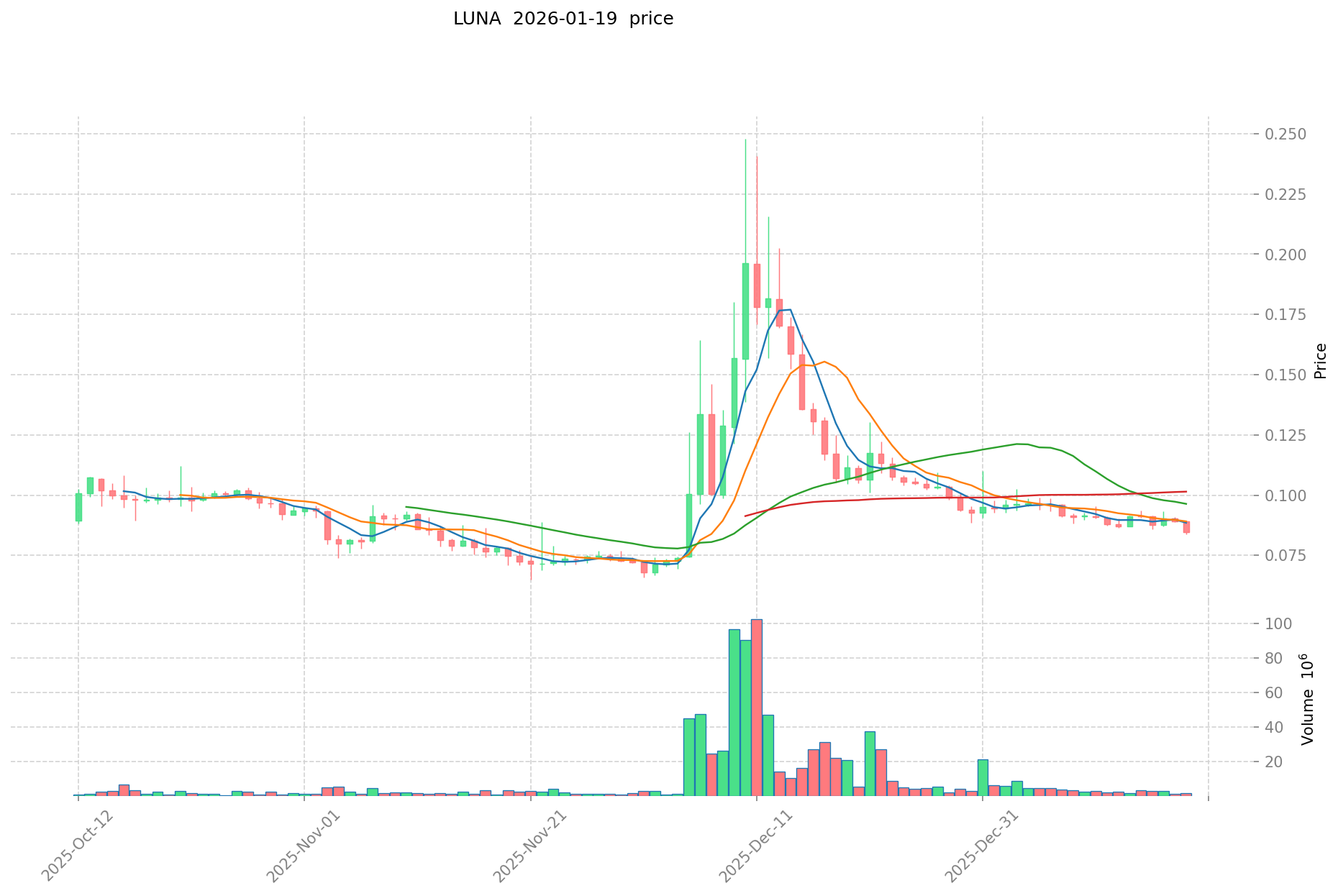
- LUNA Current Price: $0.08451
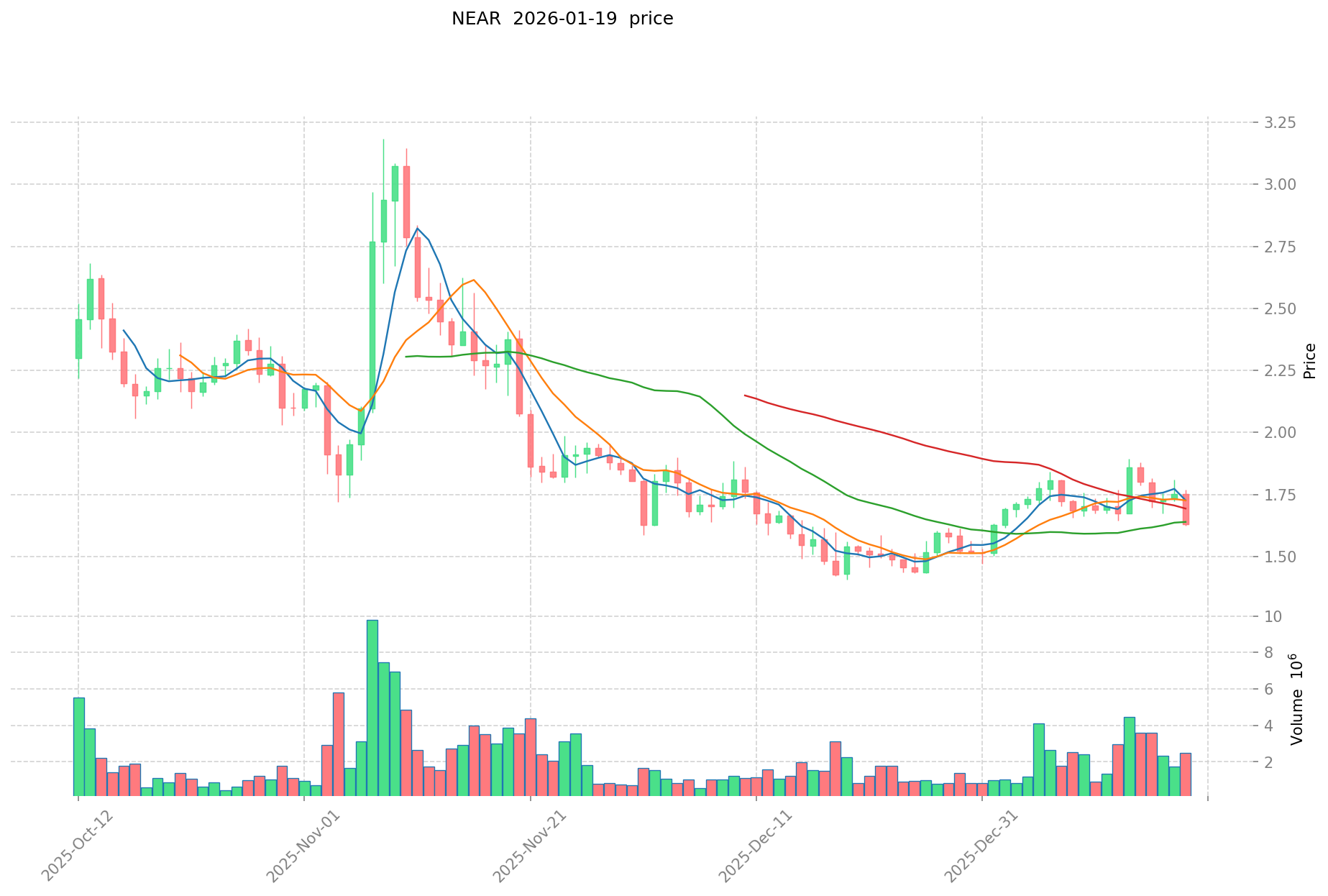
- NEAR Current Price: $1.6105
- 24-Hour Trading Volume: LUNA $194,568.99 vs NEAR $5,155,859.52
- Market Sentiment Index (Fear & Greed Index): 49 (Neutral)
View Real-Time Prices:
II. Core Factors Influencing LUNA vs NEAR Investment Value
Supply Mechanism Comparison (Tokenomics)
-
LUNA: Originally designed with an algorithmic supply model tied to the UST stablecoin, where supply expanded and contracted based on demand. Following the 2022 ecosystem collapse, Terra Classic (LUNC) implemented a token burn mechanism from transaction fees aimed at reducing total supply over time. The new Terra 2.0 blockchain introduced a separate LUNA token with distinct tokenomics.
-
NEAR: Information regarding NEAR's specific supply mechanism was not available in the reference materials.
-
📌 Historical Pattern: LUNA's supply mechanism demonstrated how algorithmic models can create volatility cycles. When UST demand increased, LUNA supply contracted and price rose; conversely, during the collapse, the inverse relationship triggered a death spiral as LUNA supply expanded dramatically while value plummeted.
Institutional Adoption and Market Application
-
Institutional Holdings: The reference materials indicate that LUNA experienced substantial institutional interest before its collapse. Post-collapse, major exchanges including Binance, KuCoin, and Gate.com continue to support LUNC trading, which remains important for maintaining liquidity and accessibility.
-
Enterprise Adoption: Following NEAR's announcement of launching an algorithmic stablecoin, there appears to be a trend where public chains seek to attract external capital and promote ecosystem development. However, specific enterprise adoption details for cross-border payments, settlements, or investment portfolios were not detailed in the materials.
-
National Policies: Regulatory attitudes toward both projects were not specifically addressed in the reference materials.
Technology Development and Ecosystem Construction
-
LUNA Technology Updates: After the 2022 collapse, the community voted to create Terra 2.0 as a new blockchain while maintaining the original chain as Terra Classic. The Terra Classic community has implemented various recovery mechanisms and continues development efforts aimed at restoring value.
-
NEAR Technology Development: NEAR announced plans to launch a new algorithmic stablecoin, suggesting an attempt to rebuild confidence following LUNA's collapse. The project appears to be combining elements of the LUNA-UST model to attract external funding and promote ecosystem growth.
-
Ecosystem Comparison: The materials note that maintaining Terra's business cycle faced challenges when the narrative construction process encountered issues, specifically as LUNA token price maintenance costs increased. The ecosystem's sustainability depends on whether income and capital can adequately support ongoing operations.
Macroeconomic and Market Cycles
-
Performance in Inflationary Environments: The materials suggest that investor confidence has shifted, with long-term value becoming central to new investment logic. Increasingly, technology and financial considerations are influencing asset evaluation.
-
Macroeconomic Monetary Policy: Specific impacts of interest rates and dollar index movements on both projects were not detailed in the reference materials.
-
Geopolitical Factors: The materials indicate that both projects face challenges related to regulatory environments. The collapse of Terra's algorithmic stablecoin UST and sister token LUNA in 2022 due to design flaws and market factors resulted in tens of billions of dollars in losses, shocking global markets and highlighting systemic risks in algorithmic stablecoin mechanisms.
III. 2026-2031 Price Forecast: LUNA vs NEAR
Short-term Forecast (2026)
- LUNA: Conservative $0.0564-$0.07944 | Optimistic $0.07944-$0.083412
- NEAR: Conservative $1.258-$1.5531 | Optimistic $1.5531-$1.817127
Mid-term Forecast (2028-2029)
- LUNA may enter a consolidation phase, with projected prices ranging from $0.0651 to $0.1058
- NEAR may enter an expansion phase, with projected prices ranging from $0.9782 to $2.8578
- Key drivers: institutional capital inflows, ETF developments, ecosystem growth
Long-term Forecast (2030-2031)
- LUNA: Baseline scenario $0.0865-$0.1206 | Optimistic scenario $0.1408-$0.1581
- NEAR: Baseline scenario $1.5869-$2.9755 | Optimistic scenario $3.4714-$4.1062
View detailed price predictions for LUNA and NEAR
Disclaimer
LUNA:
| Year |
Predicted High Price |
Predicted Average Price |
Predicted Low Price |
Price Change |
| 2026 |
0.083412 |
0.07944 |
0.0564024 |
-5 |
| 2027 |
0.09933972 |
0.081426 |
0.0692121 |
-3 |
| 2028 |
0.1003249746 |
0.09038286 |
0.0650756592 |
6 |
| 2029 |
0.105842848203 |
0.0953539173 |
0.084864986397 |
12 |
| 2030 |
0.1408377358521 |
0.1005983827515 |
0.08651460916629 |
19 |
| 2031 |
0.158140657685358 |
0.1207180593018 |
0.09657444744144 |
42 |
NEAR:
| Year |
Predicted High Price |
Predicted Average Price |
Predicted Low Price |
Price Change |
| 2026 |
1.817127 |
1.5531 |
1.258011 |
-3 |
| 2027 |
1.937880525 |
1.6851135 |
1.061621505 |
4 |
| 2028 |
2.3911760565 |
1.8114970125 |
0.97820838675 |
12 |
| 2029 |
2.85781768692 |
2.1013365345 |
1.59701576622 |
30 |
| 2030 |
3.471407954994 |
2.47957711071 |
1.5869293508544 |
53 |
| 2031 |
4.10617969533576 |
2.975492532852 |
2.29112925029604 |
84 |
IV. Investment Strategy Comparison: LUNA vs NEAR
Long-term vs Short-term Investment Strategies
-
LUNA: May appeal to speculative investors with high risk tolerance who focus on recovery narratives and community-driven rebuilding efforts. The token's historical volatility and post-collapse restructuring present opportunities for those comfortable with substantial uncertainty.
-
NEAR: May suit investors seeking exposure to infrastructure protocols with sharding technology and decentralized application development potential. The project's positioning as a scalable blockchain platform could attract those interested in ecosystem growth narratives.
Risk Management and Asset Allocation
- Conservative Investors: LUNA 10-15% vs NEAR 20-25% (within overall crypto portfolio allocation)
- Aggressive Investors: LUNA 25-30% vs NEAR 35-40% (within overall crypto portfolio allocation)
- Hedging Tools: Stablecoin allocations, options strategies, cross-asset portfolio diversification
V. Potential Risk Comparison
Market Risks
-
LUNA: Faces significant recovery challenges following the 2022 ecosystem collapse. Price movements remain highly sensitive to broader market sentiment and community confidence restoration efforts. The historical volatility pattern suggests susceptibility to sharp downward movements during market stress periods.
-
NEAR: Subject to infrastructure protocol competition risks and market cycles affecting layer-1 blockchain adoption. Price performance correlates with overall sentiment toward scalable blockchain solutions and decentralized application demand.
Technical Risks
-
LUNA: Post-collapse tokenomics restructuring introduces uncertainty regarding supply dynamics and economic model sustainability. The split between Terra Classic and Terra 2.0 creates complexity in evaluating technical development priorities.
-
NEAR: Sharding technology implementation complexity and network scalability challenges under high transaction volumes require ongoing technical development. Infrastructure protocol competition necessitates continuous innovation.
Regulatory Risks
- Global regulatory scrutiny has intensified following the Terra ecosystem collapse in 2022, particularly regarding algorithmic stablecoin mechanisms. Both projects operate in environments where regulatory frameworks continue evolving, with potential impacts on operational models and market access varying across jurisdictions.
VI. Conclusion: Which Is the Better Buy?
📌 Investment Value Summary:
-
LUNA Characteristics: Represents a high-risk recovery narrative with substantial historical price decline from $18.87 to current levels around $0.08451. Community-driven rebuilding efforts and token burn mechanisms present speculative opportunities alongside significant uncertainty.
-
NEAR Characteristics: Positioned as infrastructure protocol with sharding technology focus. Price decline from $20.44 all-time high to current $1.6105 reflects broader market conditions while maintaining higher absolute price level and trading volume compared to LUNA.
✅ Investment Considerations:
-
Novice Investors: Consider prioritizing education about fundamental differences between recovery-stage projects and established infrastructure protocols. Start with smaller position sizes and thorough research into tokenomics and ecosystem development.
-
Experienced Investors: Evaluate risk-reward profiles based on portfolio objectives. LUNA presents higher volatility with recovery potential; NEAR offers infrastructure protocol exposure with technical development considerations.
-
Institutional Investors: Assess regulatory environment impacts, liquidity profiles, and long-term ecosystem sustainability. Consider position sizing relative to overall crypto allocation and risk management frameworks.
⚠️ Risk Disclaimer: Cryptocurrency markets exhibit extreme volatility. This content does not constitute investment advice. Conduct thorough research and consult qualified financial advisors before making investment decisions.
VII. FAQ
Q1: What caused LUNA's collapse in 2022 and how does it affect current investment considerations?
LUNA collapsed due to the failure of its algorithmic stablecoin mechanism (UST), which triggered a death spiral where LUNA supply expanded dramatically while value plummeted. The collapse resulted from design flaws in the algorithmic model where UST's peg to the dollar depended on LUNA's value, creating systemic risk when market confidence deteriorated. For current investors, this history represents both substantial risk (given the uncertain recovery trajectory) and potential speculative opportunity (if community rebuilding efforts succeed). The project now exists as both Terra Classic (LUNC) with burn mechanisms and Terra 2.0 with distinct tokenomics, requiring careful evaluation of which ecosystem aligns with investment objectives.
Q2: How do LUNA and NEAR differ in their fundamental value propositions?
LUNA represents a recovery-stage project focused on rebuilding after ecosystem collapse, with value proposition centered on algorithmic stablecoin mechanisms and community-driven restoration efforts. NEAR positions itself as a scalable infrastructure protocol utilizing sharding technology to support decentralized application development. The fundamental difference lies in maturity and focus: LUNA offers high-risk exposure to recovery narratives with historical volatility, while NEAR provides infrastructure protocol exposure with emphasis on technical scalability and ecosystem growth potential. This distinction significantly impacts risk profiles, with LUNA suitable for speculative traders comfortable with extreme uncertainty and NEAR appealing to investors seeking layer-1 blockchain infrastructure exposure.
Q3: What are the key differences in supply mechanisms between LUNA and NEAR?
LUNA originally featured an algorithmic supply model tied to UST stablecoin demand, where supply contracted during high demand periods and expanded during low demand—a mechanism that ultimately contributed to its collapse. Post-2022, Terra Classic implemented transaction fee burn mechanisms to reduce total supply over time, while Terra 2.0 introduced separate tokenomics. NEAR's specific supply mechanism details were not available in reference materials, limiting direct comparison. The critical insight for investors is that LUNA's supply dynamics historically created extreme volatility cycles, and understanding these tokenomics differences remains essential for evaluating long-term value sustainability and price stability prospects between the two assets.
Q4: Based on 2026-2031 price forecasts, which asset offers better return potential?
NEAR demonstrates stronger projected returns across all timeframes according to forecast models. By 2031, NEAR's optimistic scenario projects $4.1062 (154% increase from current $1.6105), while LUNA's optimistic scenario forecasts $0.1581 (87% increase from current $0.08451). NEAR's baseline scenario suggests $2.9755 (85% increase), compared to LUNA's $0.1206 (43% increase). However, these projections assume continued ecosystem development and favorable market conditions. NEAR's higher absolute price level, stronger trading volume ($5.16M vs $194K daily), and infrastructure protocol positioning support more robust growth potential, though LUNA's recovery narrative presents asymmetric upside if rebuilding efforts succeed beyond expectations.
Q5: What portfolio allocation strategy should investors consider for LUNA vs NEAR?
Conservative investors should consider 10-15% LUNA and 20-25% NEAR within their overall crypto portfolio allocation, prioritizing NEAR's relatively lower risk profile and infrastructure positioning. Aggressive investors might allocate 25-30% LUNA and 35-40% NEAR, accepting higher volatility exposure for potential recovery gains. Regardless of strategy, neither asset should dominate total portfolio due to inherent cryptocurrency market volatility. Risk management requires combining these allocations with stablecoin holdings, options hedging strategies, and cross-asset diversification. The allocation difference reflects LUNA's higher speculative nature versus NEAR's infrastructure protocol characteristics, with position sizing adjusted based on individual risk tolerance and recovery timeline expectations.
Q6: How does regulatory environment impact LUNA and NEAR differently?
Both assets face regulatory scrutiny intensified by Terra's 2022 collapse, particularly regarding algorithmic stablecoin mechanisms. LUNA carries greater regulatory risk overhang due to its direct association with the failed UST stablecoin, which resulted in tens of billions in losses and highlighted systemic risks in algorithmic models. This history may subject LUNA to stricter regulatory oversight and potential restrictions in certain jurisdictions. NEAR, positioned as an infrastructure protocol without algorithmic stablecoin focus, faces standard layer-1 blockchain regulatory considerations around securities classification and decentralized application hosting. For investors, LUNA presents higher regulatory uncertainty that could limit market access or operational flexibility, while NEAR's regulatory profile aligns more closely with established blockchain infrastructure protocols.
Q7: What are the critical technical risks distinguishing LUNA from NEAR?
LUNA's primary technical risk involves post-collapse tokenomics restructuring and economic model sustainability uncertainty. The split between Terra Classic and Terra 2.0 creates development priority ambiguity and resource allocation challenges. NEAR's technical risks center on sharding technology implementation complexity and network scalability under high transaction volumes, requiring continuous innovation amid intense infrastructure protocol competition. For investors, LUNA's technical risks are existential—questioning whether the rebuilt economic model can avoid previous failure patterns—while NEAR's technical risks are developmental—focused on execution capability in delivering promised scalability. This distinction means LUNA technical failures could trigger complete value destruction, whereas NEAR technical challenges would more likely result in competitive positioning losses rather than total collapse.
Q8: Under what market conditions would LUNA outperform NEAR?
LUNA would likely outperform NEAR during speculative recovery bull markets where high-risk narratives attract disproportionate capital flows and investors prioritize asymmetric upside over fundamental stability. Specific conditions include: successful community rebuilding milestones, algorithmic stablecoin mechanism restoration without systemic flaws, broader market recovery lifting sentiment toward previously collapsed projects, and risk-on environments where speculative assets outperform infrastructure protocols. Conversely, NEAR would outperform during infrastructure buildout phases, institutional adoption cycles favoring scalable layer-1 solutions, and risk-off periods where investors prefer established protocols over recovery narratives. Current neutral market sentiment (Fear & Greed Index: 49) suggests neither scenario dominates, requiring investors to assess their market cycle positioning and risk appetite accordingly.
* The information is not intended to be and does not constitute financial advice or any other recommendation of any sort offered or endorsed by Gate.