This comprehensive guide compares Terra (LUNA) and Zilliqa (ZIL) as investment options across key dimensions including historical price performance, tokenomics, technological ecosystems, and market positioning. LUNA, an algorithmic stablecoin platform launched in 2018, currently trades at $0.08702 with higher volatility and recovery potential post-2022 collapse. ZIL, a high-throughput blockchain utilizing sharding technology, trades at $0.005738 with more stable performance and superior liquidity ($324,464 daily volume on Gate). The article provides detailed price forecasts through 2031, risk assessments, and tailored investment strategies for conservative, aggressive, and institutional investors. Discover which platform aligns with your investment objectives and risk tolerance through data-driven analysis of blockchain fundamentals, regulatory considerations, and long-term growth catalysts.
Introduction: Investment Comparison Between LUNA and ZIL
In the cryptocurrency market, the comparison between LUNA vs ZIL has consistently been a topic that investors cannot overlook. Both demonstrate notable differences in market cap ranking, application scenarios, and price performance, while representing distinct crypto asset positioning.
Terra (LUNA): Launched in January 2018, it has gained market recognition through its algorithmic stablecoin protocol and global payment system positioning.
Zilliqa (ZIL): Introduced in January 2018, it has been regarded as a high-throughput public blockchain platform, utilizing sharding technology to achieve thousands of transactions per second.
This article will comprehensively analyze the investment value comparison of LUNA vs ZIL around historical price trends, supply mechanisms, technical ecosystems, and future outlooks, attempting to address investors' most pressing question:
"Which presents a more compelling investment case based on current fundamentals?"
I. Historical Price Comparison and Current Market Status
Terra (LUNA) and Zilliqa (ZIL) Historical Price Trends
- 2022: Terra (LUNA) experienced significant volatility, with its price declining from a peak of $18.87 in May 2022 to substantially lower levels following ecosystem challenges.
- 2021: Zilliqa (ZIL) reached its all-time high of $0.255376 in May 2021, driven by increased adoption of its sharding technology and network expansion.
- 2020: Both assets faced downward pressure during the broader market correction. Terra (LUNA) recorded its historical low of $0.04580672 in October 2025, while Zilliqa (ZIL) reached its bottom at $0.00239616 in March 2020.
- Comparative Analysis: During the recent market cycle, Terra (LUNA) declined from $18.87 to its current levels, representing a substantial correction, while Zilliqa (ZIL) experienced a decline from $0.255376, showing relatively different recovery patterns.
Current Market Status (2026-01-19)
- Terra (LUNA) Current Price: $0.08702
- Zilliqa (ZIL) Current Price: $0.005738
- 24-Hour Trading Volume: LUNA recorded $124,856.15, while ZIL showed $324,464.30
- Market Sentiment Index (Fear & Greed Index): 49 (Neutral)
Check real-time prices:
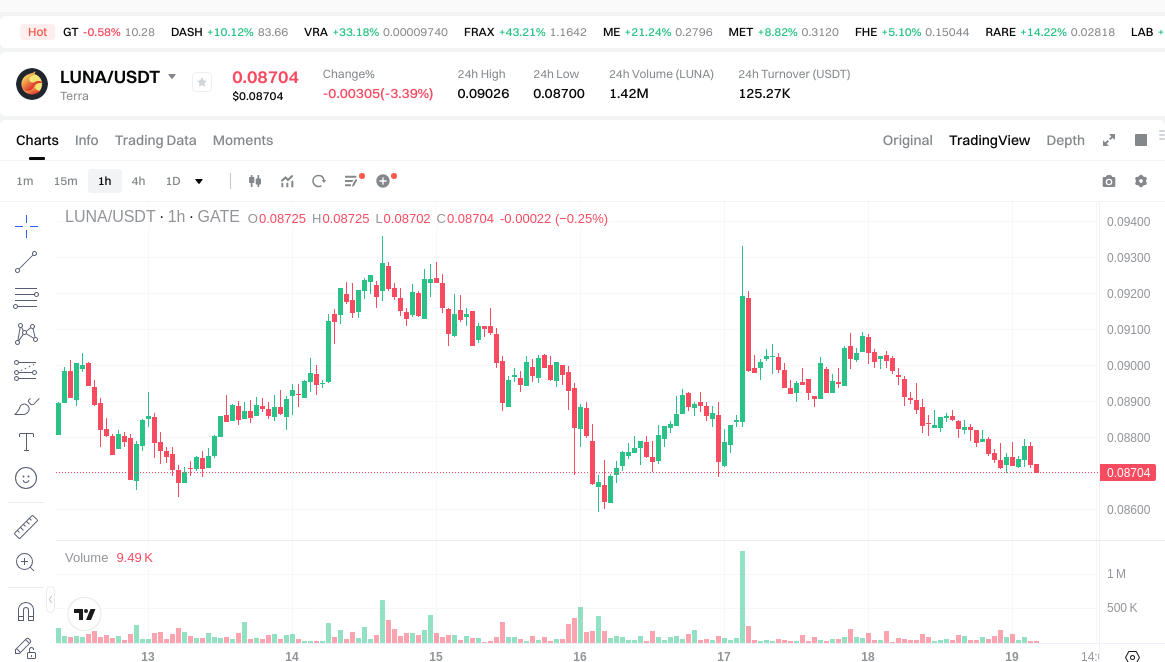
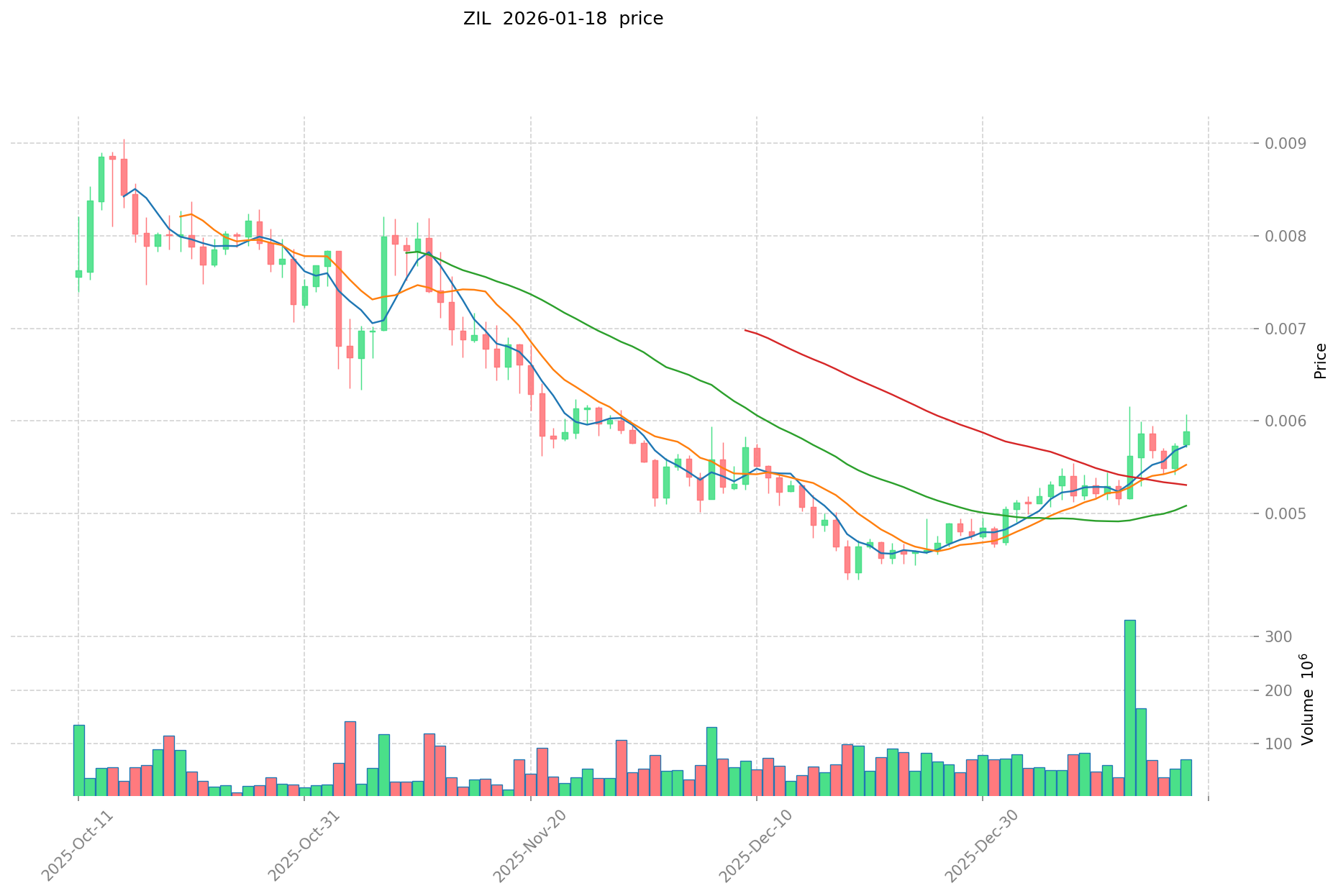
II. Core Factors Influencing LUNA vs ZIL Investment Value
Supply Mechanism Comparison (Tokenomics)
-
LUNA: The supply mechanism has undergone significant changes. Following the collapse in 2022, Terra network implemented a new tokenomics model with supply adjustments tied to stablecoin minting and burning mechanisms. The original design featured an algorithmic supply adjustment system linked to UST stablecoin demand.
-
ZIL: Information regarding ZIL's specific supply mechanism was not available in the reference materials.
-
📌 Historical Pattern: LUNA's price trajectory has been strongly influenced by changes in its supply mechanism and stablecoin stability. The collapse event demonstrated how supply mechanism vulnerabilities can create extreme price volatility.
Institutional Adoption and Market Application
-
Institutional Holdings: Reference materials suggest LUNA's institutional interest has been affected by historical market events and regulatory uncertainty. The 2022 collapse significantly impacted institutional confidence.
-
Enterprise Adoption: LUNA previously aimed to facilitate stablecoin-based payments and DeFi applications through its Terra ecosystem. However, enterprise adoption faced challenges following the UST de-pegging event.
-
National Policies: Regulatory attitudes toward both assets vary globally. Some jurisdictions have implemented stricter oversight of algorithmic stablecoins following the Terra incident, which may impact LUNA-related projects.
Technology Development and Ecosystem Building
-
LUNA Technology Upgrades: The Terra ecosystem has undergone restructuring efforts post-collapse, focusing on rebuilding developer and user confidence. Technical improvements aim to enhance network stability and governance mechanisms.
-
ZIL Technology Development: Specific information about ZIL's recent technology developments was not available in the reference materials.
-
Ecosystem Comparison: LUNA's ecosystem previously featured DeFi protocols and stablecoin applications. The network's current ecosystem rebuild focuses on reestablishing trust and utility. Comparative ecosystem metrics for ZIL were not provided in the materials.
Macroeconomic Environment and Market Cycles
-
Performance in Inflationary Environment: Stablecoins and crypto assets show varied responses to inflation. LUNA's historical performance demonstrated significant sensitivity to market confidence and systemic risk factors rather than purely inflationary pressures.
-
Macroeconomic Monetary Policy: Interest rates and dollar index movements can influence crypto market liquidity and investor risk appetite, affecting both assets. Higher interest rates may reduce speculative demand for volatile crypto assets.
-
Geopolitical Factors: Cross-border transaction demand and international regulatory developments can influence adoption. However, LUNA's adoption has been constrained by regulatory scrutiny following past market disruptions.
III. 2026-2031 Price Forecast: LUNA vs ZIL
Short-term Forecast (2026)
- LUNA: Conservative $0.0662-$0.0870 | Optimistic $0.0870-$0.1253
- ZIL: Conservative $0.0040-$0.0057 | Optimistic $0.0057-$0.0077
Mid-term Forecast (2028-2029)
- LUNA may enter a consolidation phase, with projected price range of $0.0708-$0.1358 in 2028 and $0.0787-$0.1437 in 2029
- ZIL may enter a growth phase, with projected price range of $0.0054-$0.0100 in 2028 and $0.0082-$0.0117 in 2029
- Key drivers: institutional capital inflows, ETF developments, ecosystem expansion
Long-term Forecast (2030-2031)
- LUNA: Baseline scenario $0.0685-$0.1344 (2030) | Optimistic scenario $0.0846-$0.2207 (2031)
- ZIL: Baseline scenario $0.0074-$0.0102 (2030) | Optimistic scenario $0.0085-$0.0130 (2031)
View detailed price predictions for LUNA and ZIL
Disclaimer: Price predictions are subject to market volatility and should not be considered as investment advice.
LUNA:
| Year |
Predicted High Price |
Predicted Average Price |
Predicted Low Price |
Price Change |
| 2026 |
0.1253376 |
0.08704 |
0.0661504 |
0 |
| 2027 |
0.12211712 |
0.1061888 |
0.056280064 |
22 |
| 2028 |
0.1358420224 |
0.11415296 |
0.0707748352 |
31 |
| 2029 |
0.14374711488 |
0.1249974912 |
0.078748419456 |
43 |
| 2030 |
0.1975272854688 |
0.13437230304 |
0.0685298745504 |
54 |
| 2031 |
0.220713226358352 |
0.1659497942544 |
0.084634395069744 |
90 |
ZIL:
| Year |
Predicted High Price |
Predicted Average Price |
Predicted Low Price |
Price Change |
| 2026 |
0.00770098 |
0.005747 |
0.00396543 |
0 |
| 2027 |
0.0082032678 |
0.00672399 |
0.0034292349 |
17 |
| 2028 |
0.010001262726 |
0.0074636289 |
0.005373812808 |
30 |
| 2029 |
0.01170147738942 |
0.008732445813 |
0.00820849906422 |
52 |
| 2030 |
0.013384219697585 |
0.01021696160121 |
0.007356212352871 |
78 |
| 2031 |
0.012980649714337 |
0.011800590649397 |
0.008496425267566 |
105 |
IV. Investment Strategy Comparison: LUNA vs ZIL
Long-term vs Short-term Investment Strategies
-
LUNA: May appeal to investors interested in ecosystem rebuilding narratives and algorithmic stablecoin protocol evolution. The asset's historical volatility suggests it carries higher risk-reward characteristics, potentially suitable for those with higher risk tolerance and interest in Terra's reconstruction efforts.
-
ZIL: May attract investors focused on sharding technology applications and high-throughput blockchain infrastructure. The asset's positioning in scalability solutions could appeal to those evaluating layer-1 platform investments with technical differentiation.
Risk Management and Asset Allocation
-
Conservative Investors: LUNA 20-30% vs ZIL 70-80% - Given LUNA's historical volatility and ecosystem challenges, conservative portfolios might favor lower exposure. ZIL's more stable historical trajectory may warrant relatively higher allocation within a diversified crypto portfolio.
-
Aggressive Investors: LUNA 40-50% vs ZIL 50-60% - Higher risk tolerance investors might increase LUNA allocation to capitalize on potential ecosystem recovery scenarios, while maintaining significant ZIL exposure for technology-driven appreciation potential.
-
Hedging Tools: Stablecoin allocation (USDT, USDC), options strategies for downside protection, cross-asset portfolio construction combining both assets to reduce concentration risk.
V. Potential Risk Comparison
Market Risk
-
LUNA: The asset faces elevated market risk stemming from historical ecosystem collapse and ongoing confidence rebuilding efforts. Price volatility remains substantial, with sensitivity to broader crypto market sentiment and risk appetite shifts. The 24-hour trading volume of $124,856.15 indicates relatively lower liquidity compared to major assets.
-
ZIL: Market risk includes competition from other layer-1 scaling solutions and evolving blockchain infrastructure landscape. The 24-hour trading volume of $324,464.30 suggests moderate market activity. Price performance remains correlated with overall crypto market cycles and investor interest in scalability narratives.
Technical Risk
-
LUNA: Faces technical challenges related to network stability following past disruptions, governance mechanism effectiveness, and developer ecosystem retention. The transition to new tokenomics models introduces implementation uncertainties.
-
ZIL: Technical considerations include scalability maintenance as network adoption grows, sharding technology optimization requirements, and potential security vulnerabilities inherent in complex consensus mechanisms.
Regulatory Risk
- Global regulatory environments present differentiated impacts on both assets. LUNA faces heightened scrutiny due to algorithmic stablecoin associations and past market disruptions, with certain jurisdictions implementing stricter oversight frameworks. ZIL's regulatory exposure relates primarily to general crypto asset classification and securities law interpretations. Both assets remain subject to evolving international regulatory standards affecting trading access, institutional participation, and compliance requirements.
VI. Conclusion: Which Is the Better Buy?
📌 Investment Value Summary:
-
LUNA Advantages: Potential ecosystem rebuilding upside, algorithmic stablecoin protocol experience, established brand recognition despite past challenges, projected price range suggesting recovery scenarios in optimistic forecasts ($0.0846-$0.2207 by 2031).
-
ZIL Advantages: Technical differentiation through sharding technology, relatively stable historical performance compared to LUNA, higher current trading volume indicating better liquidity, projected growth trajectory with price range $0.0085-$0.0130 by 2031 in optimistic scenarios.
✅ Investment Recommendations:
-
Beginner Investors: Consider starting with smaller allocations to both assets within a diversified portfolio. ZIL may present relatively lower complexity for those new to crypto investing, given its infrastructure focus. Prioritize understanding fundamental risks before committing significant capital.
-
Experienced Investors: May evaluate both assets based on risk-adjusted return profiles and portfolio diversification objectives. LUNA could serve as a higher-risk, higher-potential-reward component, while ZIL offers exposure to layer-1 scaling narratives. Consider implementing dollar-cost averaging strategies to mitigate timing risk.
-
Institutional Investors: Should conduct comprehensive due diligence on governance structures, regulatory compliance frameworks, and long-term ecosystem viability. Both assets require careful consideration of liquidity constraints, counterparty risks, and alignment with institutional investment mandates. Multi-year investment horizons may be necessary to realize projected value appreciation.
⚠️ Risk Warning: Cryptocurrency markets exhibit extreme volatility. This analysis does not constitute investment advice. Investors should conduct independent research and consider personal financial circumstances before making investment decisions.
VII. FAQ
Q1: What are the main differences between LUNA and ZIL's supply mechanisms?
LUNA features an algorithmic supply adjustment system that was originally linked to UST stablecoin demand, with significant tokenomics restructuring implemented after the 2022 collapse. The current model includes supply adjustments tied to stablecoin minting and burning mechanisms. In contrast, specific details about ZIL's supply mechanism were not available in the reference materials, though ZIL operates as a fixed-supply layer-1 blockchain token supporting its sharding-based network infrastructure.
Q2: Which asset presents lower risk for beginner investors?
ZIL may present relatively lower complexity and risk for beginners due to its more stable historical performance, higher trading liquidity ($324,464.30 versus LUNA's $124,856.15 in 24-hour volume), and infrastructure-focused positioning without the algorithmic stablecoin vulnerabilities that affected LUNA. However, both assets require thorough research and understanding of fundamental risks before committing capital, with conservative allocation strategies recommended for new investors.
Q3: How did the 2022 Terra collapse impact LUNA's investment outlook?
The 2022 collapse fundamentally reshaped LUNA's investment profile through several channels: price declined from $18.87 to historical lows, institutional confidence suffered significantly, regulatory scrutiny intensified globally, and the ecosystem required comprehensive rebuilding efforts. Current investment considerations must account for heightened volatility risk, governance uncertainties, and the ongoing process of developer and user confidence restoration, making LUNA a higher-risk proposition compared to its pre-collapse positioning.
Q4: What technological advantages does Zilliqa (ZIL) offer?
Zilliqa's primary technological differentiation comes from its sharding implementation, which enables the network to achieve thousands of transactions per second through parallel transaction processing. This scalability approach positions ZIL as a high-throughput blockchain platform addressing network congestion challenges faced by earlier generation blockchains, potentially supporting increased adoption in applications requiring rapid transaction finality and lower costs.
Q5: What are the projected price ranges for LUNA and ZIL by 2030?
By 2030, baseline forecasts project LUNA trading between $0.0685-$0.1344, representing potential growth from current levels of $0.08702, while ZIL's baseline scenario suggests $0.0074-$0.0102 range from current $0.005738. Optimistic scenarios for 2031 project LUNA reaching $0.0846-$0.2207 and ZIL achieving $0.0085-$0.0130. These projections depend on ecosystem development, institutional adoption, regulatory clarity, and broader market conditions, with actual outcomes subject to substantial uncertainty.
Q6: How should investors allocate between LUNA and ZIL in their portfolios?
Conservative investors might consider 20-30% LUNA versus 70-80% ZIL allocation within their crypto portfolio component, reflecting LUNA's higher risk profile and historical volatility. Aggressive investors with higher risk tolerance could increase LUNA exposure to 40-50% while maintaining 50-60% ZIL allocation to capture potential ecosystem recovery upside. Both strategies should implement appropriate hedging tools including stablecoin reserves, dollar-cost averaging approaches, and cross-asset diversification to manage concentration risk and market volatility exposure.
Q7: What regulatory risks affect LUNA and ZIL differently?
LUNA faces heightened regulatory scrutiny due to its algorithmic stablecoin associations and the 2022 market disruption, with certain jurisdictions implementing stricter oversight frameworks specifically targeting algorithmic stablecoin mechanisms. ZIL's regulatory exposure primarily relates to general crypto asset classification questions and securities law interpretations common to layer-1 platforms, without the specific algorithmic stablecoin-related compliance challenges. Both assets remain subject to evolving international regulatory standards affecting trading access and institutional participation.
Q8: What factors drive the trading volume difference between LUNA and ZIL?
Current 24-hour trading volumes show ZIL at $324,464.30 compared to LUNA's $124,856.15, reflecting several dynamics: ZIL maintains relatively stable market positioning without recent major disruptions, its sharding technology narrative attracts consistent investor interest, and the asset demonstrates more predictable price behavior. LUNA's lower volume may reflect lingering investor caution following ecosystem challenges, reduced institutional participation, and ongoing confidence rebuilding efforts that limit speculative trading activity.
* The information is not intended to be and does not constitute financial advice or any other recommendation of any sort offered or endorsed by Gate.