This comprehensive analysis compares LWA and FLOW, two leading blockchain payment solutions operating in distinct market segments. LWA, launched in 2024, focuses on Web3 IP transformation and blockchain gaming through the Sui ecosystem, while FLOW, established in 2020, serves as a mature NFT and application platform designed for mainstream adoption. The article examines critical investment dimensions including historical price trends, market positioning, tokenomics, institutional adoption, and ecosystem development. Current market data shows LWA trading at $0.004626 with $12,422.71 daily volume, compared to FLOW at $0.06356 with significantly higher $1,439,653.78 daily volume on Gate. The comparison addresses investment value, asset allocation strategies for different investor profiles, and risk management considerations. Conservative investors may favor FLOW's established market presence and superior liquidity, while aggressive investors might consider LWA exposure for emerging Web3 platform opportunities. T
Introduction: Investment Comparison Between LWA and FLOW
In the cryptocurrency market, the comparison between LumiWave (LWA) and Flow (FLOW) presents an intriguing case study for investors evaluating different segments of the digital asset ecosystem. These two tokens exhibit notable distinctions in market capitalization rankings, application scenarios, and price performance, representing divergent positioning strategies within the crypto space.
LumiWave (LWA): Launched in 2024, this Web3 IP platform powered by Sui focuses on transforming traditional intellectual property into NFTs and blockchain gaming content, creating new ecosystems for IP businesses.
Flow (FLOW): Introduced in 2020, Flow serves as a platform for next-generation games and applications, designed specifically for mainstream adoption with usability improvements integrated at the protocol layer.
This article will examine the investment value comparison between LWA and FLOW through multiple dimensions including historical price trends, supply mechanisms, technical ecosystems, and market positioning, addressing one of the most pressing questions for investors:
"Which cryptocurrency offers more compelling value based on current market conditions and fundamental characteristics?"
I. Historical Price Comparison and Current Market Status
Historical Price Trends of LWA (Coin A) and FLOW (Coin B)
- 2024: LWA experienced price fluctuations following its launch in May 2024, with an initial price of $0.065 declining over subsequent months.
- 2021: FLOW reached an all-time high of $42.4 in April 2021, driven by mainstream adoption in the NFT market and partnerships with major brands.
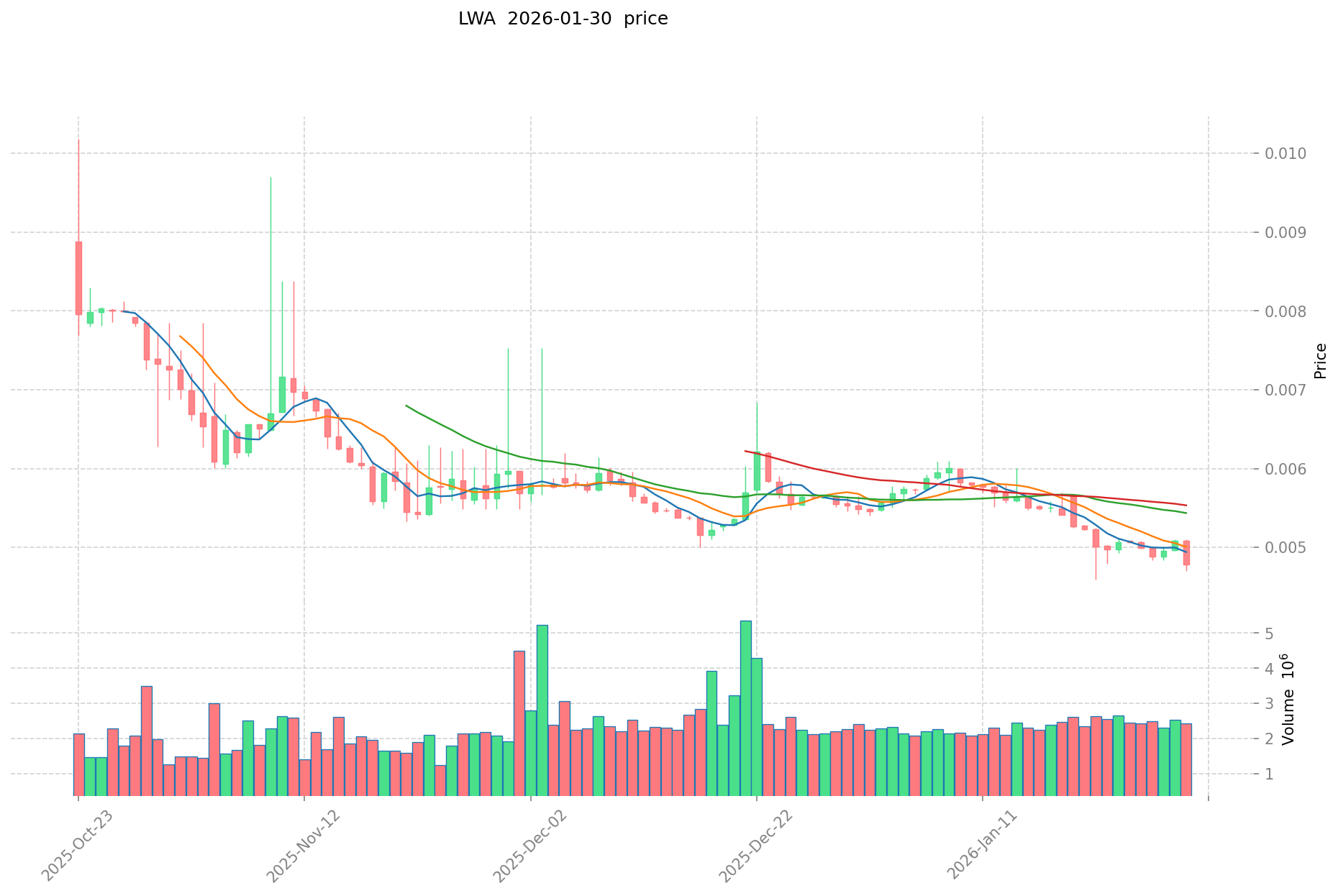
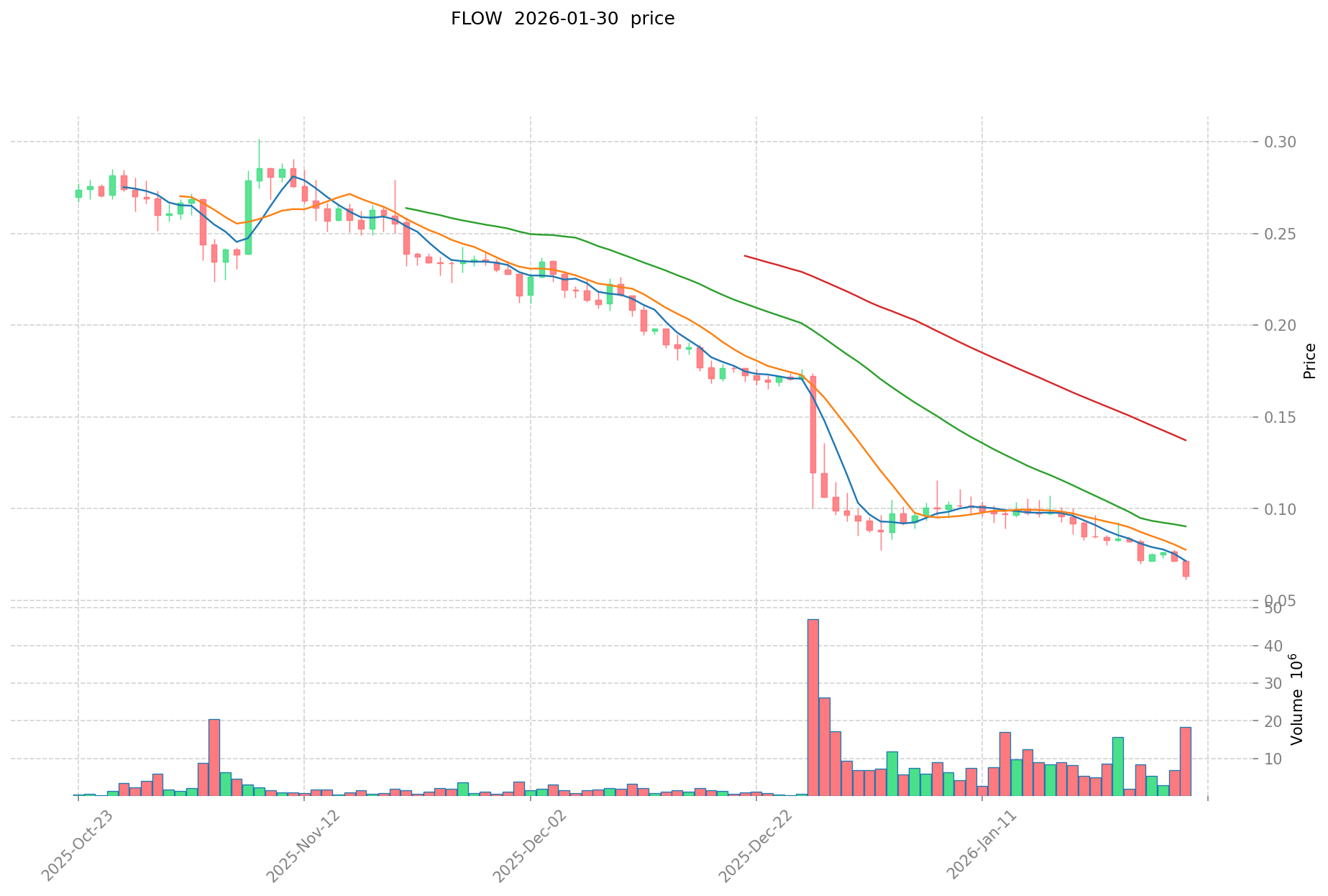
- 2026: LWA recorded an all-time low of $0.00459 on January 21, 2026, while FLOW hit its lowest point at $0.062847 on January 30, 2026.
- Comparative Analysis: During the recent market cycle, LWA declined from $1 to $0.00459, representing a decrease of over 99%, while FLOW dropped from $42.4 to $0.062847, marking a decline of approximately 99.85%.
Current Market Status (January 30, 2026)
- LWA current price: $0.004626
- FLOW current price: $0.06356
- 24-hour trading volume: LWA $12,422.71 vs FLOW $1,439,653.78
- Market Sentiment Index (Fear & Greed Index): 16 (Extreme Fear)
Click to view real-time prices:
II. Core Factors Influencing LWA vs FLOW Investment Value
Supply Mechanism Comparison (Tokenomics)
- LWA: Specific supply mechanism details are not available in the provided materials.
- FLOW: Specific supply mechanism details are not available in the provided materials.
- 📌 Historical Pattern: Supply mechanisms can influence price cycles through scarcity dynamics and emission schedules, though specific historical data for these assets is not available.
Institutional Adoption and Market Application
- Institutional Holdings: Reference materials indicate that institutional investors have shown increasing interest in tokenized assets, with approximately 50-60% of RWA market participants being institutional investors as of November 2025. However, specific institutional preference data for LWA or FLOW is not available.
- Enterprise Adoption: The materials discuss broader trends in blockchain-based financial applications, including cross-border payments and settlement systems, but do not provide specific application comparisons for LWA or FLOW.
- National Policies: Regulatory frameworks such as the EU's MiCA and approvals from the U.S. SEC have facilitated blockchain asset adoption, though jurisdiction-specific regulatory stances toward LWA or FLOW are not detailed in the materials.
Technology Development and Ecosystem Building
- LWA Technology Upgrades: Specific technological developments and their potential impacts are not available in the provided materials.
- FLOW Technology Development: Specific technological developments and their potential impacts are not available in the provided materials.
- Ecosystem Comparison: The reference materials discuss general trends in DeFi, tokenization, and blockchain applications, noting that RWA markets have expanded significantly with on-chain RWA totals reaching $35 billion as of November 2025. However, specific ecosystem deployment details for DeFi, NFT, payments, or smart contracts related to LWA or FLOW are not provided.
Macroeconomic Factors and Market Cycles
- Performance in Inflationary Environments: The materials reference that certain tokenized assets, particularly gold-backed tokens, have shown growth during periods of market uncertainty, suggesting potential inflation-hedging characteristics. Specific comparative performance data for LWA or FLOW in inflationary contexts is not available.
- Macroeconomic Monetary Policy: Interest rates and currency dynamics can influence digital asset valuations. The materials note that normalized interest rates in 2025 have supported certain tokenized treasury products, though specific impacts on LWA or FLOW are not detailed.
- Geopolitical Factors: Cross-border transaction demand and international developments can affect digital asset adoption. The materials reference increasing cross-border e-commerce and financial infrastructure development, but specific geopolitical impacts on LWA or FLOW are not documented.
III. 2026-2031 Price Prediction: LWA vs FLOW
Short-term Forecast (2026)
- LWA: Conservative $0.0037 - $0.0046 | Optimistic $0.0046 - $0.0055
- FLOW: Conservative $0.044 - $0.064 | Optimistic $0.064 - $0.080
Mid-term Forecast (2028-2029)
- LWA may enter a consolidation phase with projected price range of $0.0035 - $0.0095
- FLOW may enter an expansion phase with projected price range of $0.067 - $0.105
- Key drivers: institutional capital inflows, ETF adoption, ecosystem development
Long-term Forecast (2030-2031)
- LWA: Baseline scenario $0.0042 - $0.0081 | Optimistic scenario $0.0081 - $0.0093
- FLOW: Baseline scenario $0.053 - $0.094 | Optimistic scenario $0.094 - $0.125
View detailed price predictions for LWA and FLOW
Disclaimer
LWA:
| Year |
Predicted High Price |
Predicted Average Price |
Predicted Low Price |
Price Change |
| 2026 |
0.00550494 |
0.004626 |
0.0037008 |
0 |
| 2027 |
0.0071423127 |
0.00506547 |
0.004558923 |
9 |
| 2028 |
0.0072636307065 |
0.00610389135 |
0.003540256983 |
31 |
| 2029 |
0.009490940660115 |
0.00668376102825 |
0.004344444668362 |
44 |
| 2030 |
0.009138706453926 |
0.008087350844182 |
0.004205422438974 |
74 |
| 2031 |
0.009302070940978 |
0.008613028649054 |
0.008268507503092 |
86 |
FLOW:
| Year |
Predicted High Price |
Predicted Average Price |
Predicted Low Price |
Price Change |
| 2026 |
0.0795 |
0.0636 |
0.043884 |
0 |
| 2027 |
0.093015 |
0.07155 |
0.065826 |
12 |
| 2028 |
0.0855738 |
0.0822825 |
0.079814025 |
29 |
| 2029 |
0.1049101875 |
0.08392815 |
0.06714252 |
31 |
| 2030 |
0.11707976925 |
0.09441916875 |
0.0528747345 |
48 |
| 2031 |
0.12478437342 |
0.105749469 |
0.0634496814 |
65 |
IV. Investment Strategy Comparison: LWA vs FLOW
Long-term vs Short-term Investment Strategies
- LWA: May appeal to investors focused on emerging Web3 IP platforms and early-stage blockchain gaming ecosystems, though the asset exhibits heightened volatility characteristics
- FLOW: May suit investors interested in established NFT infrastructure and application platforms with historical market presence since 2020
Risk Management and Asset Allocation
- Conservative Investors: LWA 20-30% vs FLOW 70-80%
- Aggressive Investors: LWA 40-50% vs FLOW 50-60%
- Hedging Instruments: stablecoin allocation, options strategies, cross-asset portfolio diversification
V. Potential Risk Comparison
Market Risk
- LWA: Exhibits substantial price volatility with declines exceeding 99% from initial valuation levels, accompanied by relatively limited trading volume of $12,422.71 in 24-hour periods
- FLOW: Demonstrates significant historical price fluctuation with declines of approximately 99.85% from peak levels, though maintaining comparatively higher trading volume at $1,439,653.78 in 24-hour periods
Technical Risk
- LWA: scalability considerations and network stability factors
- FLOW: potential protocol-level vulnerabilities and network reliability considerations
Regulatory Risk
- Global regulatory frameworks such as the EU's MiCA and evolving oversight from authorities including the U.S. SEC may influence both assets differently based on their classification and operational jurisdictions
VI. Conclusion: Which Is the Better Buy?
📌 Investment Value Summary:
- LWA Advantages: represents exposure to Web3 IP transformation and blockchain gaming content development through the Sui ecosystem
- FLOW Advantages: established market presence with historical partnerships in the NFT sector and protocol-level design for mainstream application adoption
✅ Investment Recommendations:
- Novice Investors: consider starting with smaller position sizes and prioritize understanding fundamental project mechanics before capital allocation
- Experienced Investors: evaluate portfolio diversification opportunities by assessing risk-adjusted return profiles and correlation patterns with existing holdings
- Institutional Investors: conduct comprehensive due diligence on ecosystem development trajectories, liquidity conditions, and regulatory compliance frameworks
⚠️ Risk Disclosure: Cryptocurrency markets exhibit extreme volatility characteristics. This content does not constitute investment advice.
VII. FAQ
Q1: What are the key differences in market positioning between LWA and FLOW?
LWA focuses on Web3 IP transformation and blockchain gaming content through the Sui ecosystem (launched 2024), while FLOW serves as an established NFT and application platform designed for mainstream adoption (launched 2020). The primary distinction lies in their market maturity and operational focus: LWA represents an emerging platform in the intellectual property tokenization space, whereas FLOW has demonstrated historical partnerships with major brands and a longer track record in the NFT infrastructure sector. Additionally, FLOW maintains significantly higher trading volume ($1,439,653.78 vs $12,422.71 in 24-hour periods), indicating greater market liquidity and established trading infrastructure.
Q2: How do the historical price declines of LWA and FLOW compare?
Both assets have experienced substantial price corrections from their peak valuations. LWA declined from $1 to $0.00459 (representing over 99% decrease), while FLOW dropped from its all-time high of $42.4 in April 2021 to $0.062847 (approximately 99.85% decline). As of January 30, 2026, LWA trades at $0.004626 and FLOW at $0.06356. These significant drawdowns reflect broader cryptocurrency market dynamics and the extreme volatility characteristic of digital assets, particularly during periods of market uncertainty indicated by the current Fear & Greed Index reading of 16 (Extreme Fear).
Q3: What are the projected price ranges for LWA and FLOW in 2031?
According to long-term forecasts, LWA is projected to reach a baseline scenario range of $0.0042 - $0.0081, with an optimistic scenario of $0.0081 - $0.0093 by 2031, representing an 86% price change from current levels. FLOW is projected to achieve a baseline range of $0.053 - $0.094, with an optimistic scenario of $0.094 - $0.125 by 2031, representing a 65% price change. These projections factor in potential institutional capital inflows, ETF adoption developments, and ecosystem maturation. However, it is essential to note that cryptocurrency price predictions carry substantial uncertainty and should not be interpreted as guaranteed outcomes.
Q4: What asset allocation strategies are recommended for different investor profiles?
Conservative investors may consider a portfolio weighting of 20-30% LWA versus 70-80% FLOW, prioritizing the more established asset with higher liquidity. Aggressive investors might adopt a more balanced approach with 40-50% LWA versus 50-60% FLOW allocation, accepting higher risk in exchange for potential exposure to emerging Web3 IP platform growth. Both strategies should incorporate risk management techniques including stablecoin allocation for liquidity reserves, options strategies for downside protection, and cross-asset portfolio diversification to mitigate concentration risk. Position sizing should align with individual risk tolerance and investment timeframes.
Q5: What regulatory considerations affect LWA and FLOW investments?
Both assets operate within evolving regulatory frameworks that may influence their classification and operational parameters. The EU's Markets in Crypto-Assets (MiCA) regulation and oversight developments from the U.S. Securities and Exchange Commission (SEC) represent significant regulatory considerations. As of November 2025, regulatory approvals have facilitated broader blockchain asset adoption, with approximately 50-60% of real-world asset (RWA) market participants being institutional investors. However, jurisdiction-specific regulatory stances toward LWA and FLOW are not uniformly established, creating potential compliance risks that may affect market access, liquidity conditions, and institutional participation levels.
Q6: How do trading volumes reflect the liquidity differences between LWA and FLOW?
The 24-hour trading volume disparity between LWA ($12,422.71) and FLOW ($1,439,653.78) reveals substantial liquidity differences that significantly impact investment execution. FLOW's approximately 116x higher trading volume indicates greater market depth, tighter bid-ask spreads, and enhanced ability to execute larger transactions without substantial price impact. This liquidity advantage becomes particularly relevant during volatile market conditions, allowing FLOW investors greater flexibility for position adjustments. LWA's limited trading volume suggests higher transaction costs, increased price slippage for larger orders, and potential challenges in rapid position liquidation, factors that novice investors should carefully consider when determining appropriate position sizes.
* The information is not intended to be and does not constitute financial advice or any other recommendation of any sort offered or endorsed by Gate.