This comprehensive analysis compares LYX and XRP, two distinct digital assets in the cryptocurrency market. LYX, launched in 2023 on LUKSO blockchain, focuses on digital identity and creative economies with current price of $0.394 and market rank #1,116. XRP, an established payment infrastructure asset, trades at $1.895 with rank #5 and significantly higher liquidity. The article examines historical price movements, current market status, tokenomics, institutional adoption, and technical ecosystems. Current market conditions show extreme fear sentiment (Fear & Greed Index: 25), with LYX trading volume at $128K versus XRP's $30.4M daily volume. Price forecasts through 2031 suggest LYX ranging $0.20-$1.03 and XRP ranging $1.06-$3.88 depending on scenarios. Investment recommendations vary by investor profile: conservative investors should favor XRP's liquidity, while experienced investors may allocate strategically to both. Key risks include LYX's lower liquidity and market maturity versus XRP's regulatory consi
Introduction: LYX Investment Value, Price Prediction, and Risk Analysis
In the evolving landscape of blockchain technology, LYX represents a distinctive approach to digital identity and creative economies. Launched in May 2023, LUKSO positions itself as a next-generation EVM blockchain built on Casper Proof-of-Stake, aiming to revolutionize how brands, creators, and users interact with blockchain technology.
LYX (LUKSO): Since its launch in 2023, the project has introduced innovative blockchain standards through LUKSO Standards Proposals (LSPs) and Universal Profiles, focusing on identity, ownership, and asset representation in the digital world. With a current price of $0.394 and a market capitalization of approximately $12.03 million, LYX ranks #1116 in the cryptocurrency market.
This article provides a comprehensive analysis of LYX's investment characteristics, examining its price trends, supply mechanism, technical ecosystem, and market positioning. Through an objective assessment of available data, we aim to address key questions investors may have:
"What factors influence LYX's market performance, and what should investors consider when evaluating this asset?"
The analysis will cover historical price movements, tokenomics structure, adoption patterns, and technical developments, offering readers a framework for understanding LYX's position in the broader cryptocurrency ecosystem.
I. Historical Price Comparison and Current Market Status
Historical Price Trends of LYX (Coin A) and XRP (Coin B)
- 2024-01-17: LYX reached a notable price level of $11.6, marking a significant point in its trading history.
- 2025-07-18: XRP experienced a substantial price movement, reaching $3.65 during this period.
- 2025-12-31: LYX declined to $0.350308, representing a considerable price adjustment from previous levels.
- Comparative Analysis: During the recent market cycle, LYX demonstrated significant volatility with price movements from $11.6 to its lower levels, while XRP showed its own distinct price trajectory with movements between $3.65 and current levels.
Current Market Status (2026-01-25)
- LYX Current Price: $0.394
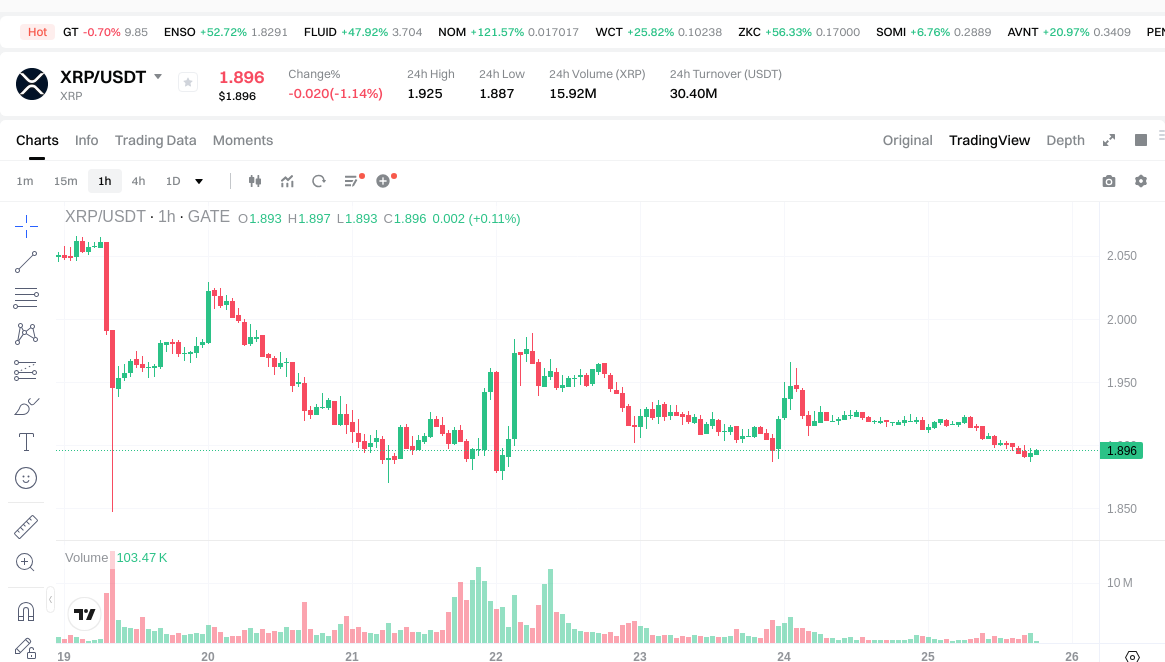
- XRP Current Price: $1.895
- 24-Hour Trading Volume: LYX recorded $128,382.17, while XRP demonstrated significantly higher liquidity with $30,414,218.60
- Market Capitalization: LYX stands at $12,031,147.20 with a market ranking of 1,116, while XRP maintains a substantially larger market cap of $115,316,877,171.72, ranking 5th in the overall market
- Market Sentiment Index (Fear & Greed Index): 25 (Extreme Fear)
- Recent Price Movement (24H): LYX showed a 1.62% increase, while XRP experienced a -1.19% change
View Real-time Prices:

II. Core Factors Affecting the Investment Value of LYX vs XRP
Supply Mechanism Comparison (Tokenomics)
Due to the absence of detailed supply mechanism information in the provided materials, a comprehensive comparison of tokenomics between LYX and XRP cannot be established at this time. Investors seeking to understand the supply dynamics of these assets should refer to their respective official documentation and blockchain explorers for current circulation data, emission schedules, and any deflationary or inflationary characteristics that may influence long-term value proposition.
Institutional Adoption and Market Application
Without specific data on institutional holdings, enterprise adoption patterns, or regulatory positioning across different jurisdictions, it is not feasible to draw comparisons regarding institutional preference between LYX and XRP. The assessment of cross-border payment integration, settlement infrastructure utilization, and portfolio allocation strategies requires concrete market data that is currently unavailable in the reference materials.
Technology Development and Ecosystem Building
The provided materials do not contain sufficient information regarding technical upgrades, development roadmaps, or ecosystem expansion initiatives for either LYX or XRP. A meaningful evaluation of their respective positions in DeFi, NFT markets, payment systems, and smart contract implementations cannot be conducted without access to current development metrics, network activity data, and ecosystem partnership announcements.
Macroeconomic Environment and Market Cycles
Analyzing the performance characteristics of LYX and XRP under various macroeconomic conditions, including inflationary pressures, monetary policy shifts, interest rate fluctuations, and USD index movements, requires historical performance data and correlation analysis that are not available in the current reference materials. Similarly, assessments of how geopolitical factors and cross-border transaction demand patterns affect these assets would necessitate empirical market data beyond the scope of the provided information.
III. 2026-2031 Price Forecast: LYX vs XRP
Short-term Forecast (2026)
- LYX: Conservative $0.20-$0.39 | Optimistic $0.39-$0.56
- XRP: Conservative $1.06-$1.90 | Optimistic $1.90-$2.20
Medium-term Forecast (2028-2029)
- LYX may enter a growth phase with estimated price range of $0.52-$0.67 in 2028, potentially reaching $0.32-$0.79 in 2029
- XRP may enter a consolidation phase with estimated price range of $2.43-$2.68 in 2028, and $2.00-$2.80 in 2029
- Key drivers: institutional capital inflows, ETF developments, ecosystem expansion
Long-term Forecast (2030-2031)
- LYX: Base scenario $0.36-$0.70 (2030) | Optimistic scenario $0.57-$1.03 (2031)
- XRP: Base scenario $1.65-$2.70 (2030) | Optimistic scenario $1.90-$3.88 (2031)
View detailed price predictions for LYX and XRP
Disclaimer
LYX:
| Year |
Predicted High Price |
Predicted Average Price |
Predicted Low Price |
Price Change |
| 2026 |
0.558344 |
0.3932 |
0.204464 |
0 |
| 2027 |
0.59947272 |
0.475772 |
0.4519834 |
20 |
| 2028 |
0.67202795 |
0.53762236 |
0.5214936892 |
36 |
| 2029 |
0.7862727015 |
0.604825155 |
0.32055733215 |
53 |
| 2030 |
0.8346587139 |
0.69554892825 |
0.36168544269 |
76 |
| 2031 |
1.03289015845125 |
0.765103821075 |
0.57382786580625 |
94 |
XRP:
| Year |
Predicted High Price |
Predicted Average Price |
Predicted Low Price |
Price Change |
| 2026 |
2.1982 |
1.895 |
1.0612 |
0 |
| 2027 |
2.96757 |
2.0466 |
1.412154 |
8 |
| 2028 |
2.68258095 |
2.507085 |
2.43187245 |
32 |
| 2029 |
2.802419613 |
2.594832975 |
1.99802139075 |
37 |
| 2030 |
2.9684889234 |
2.698626294 |
1.64616203934 |
42 |
| 2031 |
3.881973923919 |
2.8335576087 |
1.898483597829 |
49 |
IV. Investment Strategy Comparison: LYX vs XRP
Long-term vs Short-term Investment Strategies
- LYX: May appeal to investors focused on emerging blockchain identity solutions and creative economy ecosystems, particularly those willing to accept higher volatility in exchange for potential growth opportunities in the digital identity and creator-focused sectors
- XRP: May suit investors seeking exposure to established digital payment infrastructure with higher liquidity characteristics and institutional recognition in cross-border transaction frameworks
Risk Management and Asset Allocation
- Conservative Investors: LYX 10-15% vs XRP 20-30%
- Aggressive Investors: LYX 25-35% vs XRP 35-45%
- Hedging Tools: Stablecoin allocation for liquidity preservation, options strategies for downside protection, cross-asset portfolio diversification
V. Potential Risk Comparison
Market Risk
- LYX: Faces substantial market capitalization constraints with ranking at #1116, resulting in lower liquidity levels ($128,382.17 24-hour volume) and potential for significant price volatility during market stress periods
- XRP: Despite higher liquidity ($30,414,218.60 24-hour volume) and established market position (#5 ranking), remains subject to broader cryptocurrency market cycles and sentiment shifts, as reflected in current Extreme Fear market conditions (Fear & Greed Index: 25)
Technical Risk
- LYX: Network maturity considerations given its 2023 launch timeline, potential scalability challenges as adoption scales, and dependency on Universal Profile adoption rates
- XRP: Established network infrastructure with historical operational track record, though subject to considerations around network governance and consensus mechanism evolution
Regulatory Risk
- Global regulatory developments may impact both assets differently based on their functional classifications, with payment-oriented assets and identity-focused protocols potentially facing distinct regulatory frameworks across various jurisdictions
VI. Conclusion: Which Is the Better Buy?
📌 Investment Value Summary:
- LYX Advantages: Innovative approach to blockchain-based digital identity and creator economies through LUKSO Standards Proposals, positioning in emerging sectors of Web3 infrastructure, potential for growth as Universal Profile adoption expands
- XRP Advantages: Established market position with significant liquidity depth, higher trading volume facilitating easier entry and exit, institutional recognition in payment settlement infrastructure, lower relative volatility compared to smaller market cap assets
✅ Investment Recommendations:
- Novice Investors: Consider prioritizing assets with higher liquidity and established market presence; if including both assets, maintain smaller allocations (10-15% combined) with majority portfolio in more stable digital assets
- Experienced Investors: May implement tactical allocations based on risk tolerance, utilizing LYX for speculative exposure to identity infrastructure development (15-25%) and XRP for payment infrastructure positioning (25-35%), balanced with stablecoin reserves
- Institutional Investors: Evaluate allocation decisions based on comprehensive due diligence regarding regulatory positioning, liquidity requirements, and strategic alignment with digital asset infrastructure themes; consider gradual position building with defined risk parameters
⚠️ Risk Disclaimer: The cryptocurrency market exhibits extreme volatility characteristics. This analysis does not constitute investment advice. Investors should conduct independent research, assess personal risk tolerance, and consider consulting qualified financial advisors before making investment decisions.
VII. FAQ
Q1: What is the current market position of LYX compared to XRP?
LYX currently ranks #1,116 with a market capitalization of approximately $12.03 million and a price of $0.394, while XRP holds the #5 position with a market cap of $115.32 billion and a price of $1.895. The significant difference in trading volume—LYX at $128,382.17 versus XRP's $30,414,218.60 in 24-hour volume—demonstrates XRP's substantially higher liquidity and market establishment. This disparity reflects XRP's maturity as a payment-focused digital asset with broader institutional recognition, whereas LYX represents an emerging blockchain infrastructure project focused on digital identity and creative economies, launched only in 2023.
Q2: How do the price forecasts for LYX and XRP differ through 2031?
According to the projections, LYX shows a conservative short-term range of $0.20-$0.39 for 2026, potentially reaching $0.57-$1.03 by 2031 in optimistic scenarios. XRP's forecasts indicate a conservative range of $1.06-$1.90 for 2026, with optimistic projections reaching $1.90-$3.88 by 2031. The percentage growth potential appears more pronounced for LYX given its lower base price, though this comes with correspondingly higher volatility risk. XRP's projections suggest more moderate growth from an established price level, reflecting its mature market position and institutional integration in payment infrastructure.
Q3: What are the key technological differences between LYX and XRP?
LYX operates as an EVM-compatible blockchain built on Casper Proof-of-Stake, introducing innovative LUKSO Standards Proposals (LSPs) and Universal Profiles designed specifically for digital identity, brand interaction, and creative economy applications. XRP functions primarily as a payment-focused digital asset with established infrastructure for cross-border transactions and settlement systems. While both utilize blockchain technology, their core purposes diverge significantly—LYX targets Web3 identity infrastructure and creator economies, whereas XRP concentrates on financial institution payment rails and remittance solutions, reflecting fundamentally different use cases within the digital asset ecosystem.
Q4: Which asset presents higher risk for investors?
LYX presents higher risk characteristics due to its lower market capitalization (#1,116 ranking), limited liquidity ($128,382 daily volume), and relative newness since its 2023 launch, resulting in greater price volatility and potential exit challenges during market stress. XRP, despite regulatory considerations and market cycle exposure, offers lower relative risk through its established market position (#5 ranking), significantly higher liquidity ($30.4 million daily volume), and institutional recognition in payment infrastructure. The current Extreme Fear market sentiment (Fear & Greed Index: 25) affects both assets, though LYX's smaller market presence amplifies its sensitivity to broader market movements.
Q5: What allocation strategy should conservative investors consider?
Conservative investors should prioritize risk management and liquidity considerations when evaluating these assets. A suggested allocation framework includes limiting LYX exposure to 10-15% of cryptocurrency holdings, given its emerging status and lower liquidity profile, while potentially allocating 20-30% to XRP if seeking payment infrastructure exposure. The majority of a conservative portfolio should remain in more established digital assets or stablecoins for liquidity preservation. This approach acknowledges LYX's speculative growth potential in digital identity infrastructure while respecting XRP's more established market position, balanced against the high volatility inherent in cryptocurrency markets.
Q6: How does the current market sentiment affect both assets?
The current Fear & Greed Index of 25 (Extreme Fear) indicates widespread negative sentiment across cryptocurrency markets, creating challenging conditions for both assets. However, the impact differs based on market positioning: XRP's higher liquidity and institutional presence may provide relative stability during fear-driven selloffs, while LYX's smaller market cap and lower trading volume make it more susceptible to rapid price movements during sentiment shifts. Recent 24-hour performance shows LYX gaining 1.62% while XRP declined 1.19%, though short-term movements should not overshadow the broader market cycle considerations that affect both assets during extended periods of negative investor sentiment.
Q7: What factors should institutional investors prioritize when comparing these assets?
Institutional investors should conduct comprehensive due diligence focusing on several critical dimensions: liquidity depth (XRP's $30.4M daily volume versus LYX's $128K facilitates substantially different position sizing capabilities), regulatory positioning across relevant jurisdictions, strategic alignment with institutional objectives (payment infrastructure versus digital identity infrastructure), custody solutions availability, and counterparty risk considerations. XRP's established infrastructure and higher trading volumes support larger institutional allocations with more predictable execution, while LYX's emerging status requires specialized understanding of Universal Profile adoption trajectories and creative economy blockchain applications, typically warranting smaller exploratory positions with extended investment horizons and defined risk parameters.
* The information is not intended to be and does not constitute financial advice or any other recommendation of any sort offered or endorsed by Gate.