This comprehensive analysis compares MAGIC and GMX, two distinct tokens in the DeFi ecosystem. MAGIC serves as the native resource of the Treasure metaverse, functioning at the intersection of DeFi, NFT, and gaming, while GMX operates as a decentralized perpetual exchange with dual utility and governance functionality. As of January 2026, GMX maintains stronger market positioning with a $75.42 million market cap (ranked 405th) versus MAGIC's $29.79 million (ranked 716th). The article examines historical price trends, current market status, investment strategies across conservative to aggressive profiles, and technical risks including scalability and regulatory considerations. With both tokens experiencing significant annual declines in extreme fear market conditions, the analysis provides price forecasts through 2031, portfolio allocation recommendations, and detailed risk assessments to help investors evaluate which token aligns with their investment objectives and risk tolerance within the DeFi and gaming s
Introduction: MAGIC vs GMX Investment Comparison
In the cryptocurrency market, the comparison between MAGIC and GMX remains a topic of interest among investors. The two tokens exhibit notable differences in market cap ranking, application scenarios, and price performance, representing distinct positioning within the crypto asset landscape.
MAGIC: Launched in December 2021, MAGIC serves as the native resource of the Treasure metaverse, positioned at the intersection of DeFi, NFT, and gaming. It functions to activate NFTs and transform them into productive, yield-generating assets.
GMX: GMX operates as a decentralized perpetual exchange, with its token serving dual purposes as a utility and governance token while accruing a portion of platform-generated fees.
This article examines the investment comparison between MAGIC and GMX across multiple dimensions: historical price trends, supply mechanisms, technical ecosystems, and market positioning. The analysis aims to address a key question for investors:
"Which token presents more compelling investment characteristics based on available data?"
As of January 21, 2026, MAGIC ranks 716th with a market cap of approximately $29.79 million, while GMX holds the 405th position with a market cap of around $75.42 million. Both tokens have experienced significant price declines over the past year, with MAGIC down 74.7% and GMX down 67.7%, reflecting broader market dynamics in the decentralized finance and gaming sectors.
I. Historical Price Comparison and Current Market Status
Historical Price Trends of MAGIC (Coin A) and GMX (Coin B)
- 2022: MAGIC reached a notable price level in February, with trading activity reflecting broader market dynamics during that period.
- 2023: GMX experienced price movements in April, showing fluctuations associated with developments in the decentralized exchange sector.
- Comparative Analysis: During market cycles, MAGIC has demonstrated price variation from higher levels to lower ranges, while GMX has shown its own distinct pattern of movement, reflecting different project dynamics and market positioning.
Current Market Status (2026-01-21)
- MAGIC Current Price: $0.0938
- GMX Current Price: $7.268
- 24-Hour Trading Volume: MAGIC $263,748.76 vs GMX $21,180.75
- Market Sentiment Index (Fear & Greed Index): 24 (Extreme Fear)
View real-time prices:
- View MAGIC Current Price Market Price
- View GMX Current Price Market Price
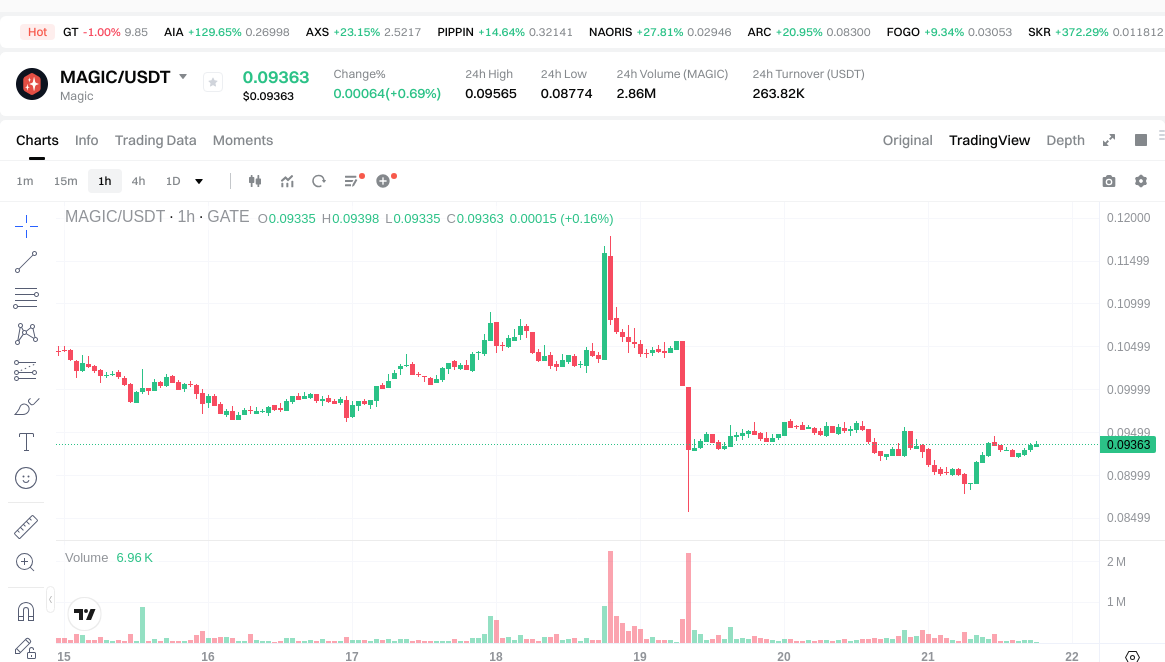
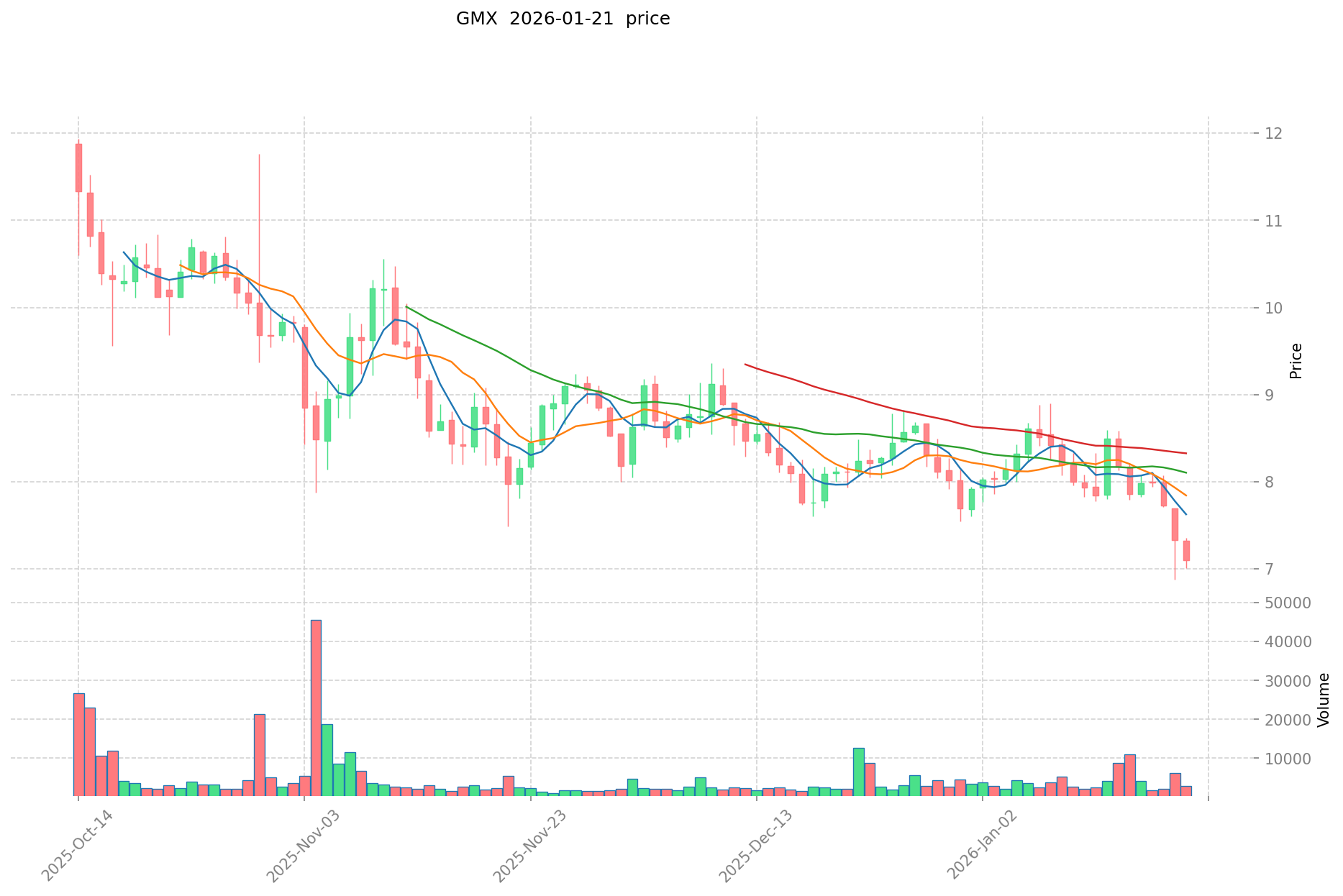
II. Core Factors Influencing MAGIC vs GMX Investment Value
Due to the absence of reference materials and insufficient information in the knowledge base regarding MAGIC and GMX's supply mechanisms, institutional adoption, technical developments, and macroeconomic performance, this section cannot be completed with reliable data. A comprehensive analysis requires specific tokenomics documentation, institutional holding reports, technical roadmaps, and market performance metrics that are not currently available.
III. 2026-2031 Price Forecast: MAGIC vs GMX
Short-term Forecast (2026)
- MAGIC: Conservative $0.0543-$0.0936 | Optimistic $0.0936-$0.1086
- GMX: Conservative $6.85-$7.28 | Optimistic $7.28-$7.57
Medium-term Forecast (2028-2029)
- MAGIC may enter a consolidation phase with projected prices ranging from $0.0657 to $0.1526, showing moderate volatility
- GMX may enter a growth phase with projected prices ranging from $5.48 to $11.87, demonstrating stronger upward momentum
- Key drivers: institutional capital flows, ETF developments, ecosystem expansion
Long-term Forecast (2030-2031)
- MAGIC: Baseline scenario $0.1038-$0.1674 | Optimistic scenario $0.1674-$0.2243
- GMX: Baseline scenario $10.36-$12.49 | Optimistic scenario $12.49-$18.36
View detailed price predictions for MAGIC and GMX
Disclaimer
MAGIC:
| Year |
Predicted High Price |
Predicted Average Price |
Predicted Low Price |
Price Change |
| 2026 |
0.1086224 |
0.09364 |
0.0543112 |
0 |
| 2027 |
0.109221696 |
0.1011312 |
0.079893648 |
7 |
| 2028 |
0.1525058496 |
0.105176448 |
0.09150350976 |
12 |
| 2029 |
0.145590498144 |
0.1288411488 |
0.065708985888 |
37 |
| 2030 |
0.19759078579968 |
0.137215823472 |
0.11937776642064 |
46 |
| 2031 |
0.224320428212025 |
0.16740330463584 |
0.10379004887422 |
78 |
GMX:
| Year |
Predicted High Price |
Predicted Average Price |
Predicted Low Price |
Price Change |
| 2026 |
7.57432 |
7.283 |
6.84602 |
0 |
| 2027 |
10.8458436 |
7.42866 |
6.5372208 |
2 |
| 2028 |
11.512937268 |
9.1372518 |
5.48235108 |
25 |
| 2029 |
11.8738587141 |
10.325094534 |
5.47230010302 |
42 |
| 2030 |
13.8743457800625 |
11.09947662405 |
8.9905760654805 |
52 |
| 2031 |
18.355759467022687 |
12.48691120205625 |
10.364136297706687 |
71 |
IV. Investment Strategy Comparison: MAGIC vs GMX
Long-term vs Short-term Investment Strategies
-
MAGIC: May appeal to investors interested in metaverse ecosystems, NFT utility integration, and gaming-DeFi convergence. The token's positioning at the intersection of multiple sectors suggests potential for investors with higher risk tolerance and interest in emerging narrative-driven projects.
-
GMX: May suit investors focused on decentralized exchange infrastructure and fee-generating mechanisms. The platform's perpetual trading functionality and dual-purpose token design could attract those seeking exposure to derivatives trading platforms.
Risk Management and Asset Allocation
-
Conservative Investors: MAGIC 20-30% vs GMX 70-80% - GMX's higher market capitalization and established exchange infrastructure may present relatively lower volatility characteristics
-
Aggressive Investors: MAGIC 50-60% vs GMX 40-50% - MAGIC's lower market cap and gaming-metaverse positioning may offer higher growth potential with correspondingly increased risk
-
Hedging Tools: Stablecoin allocation for liquidity management, options strategies for downside protection, cross-asset portfolio diversification
V. Potential Risk Comparison
Market Risks
-
MAGIC: Price volatility linked to metaverse adoption trends, NFT market cycles, and gaming sector sentiment. The 74.7% annual decline reflects significant downward pressure and sector-specific challenges.
-
GMX: Price movements correlated with derivatives trading volume, DeFi sector performance, and competitive dynamics among decentralized exchanges. The 67.7% annual decline indicates substantial market headwinds.
Technical Risks
-
MAGIC: Scalability considerations for supporting gaming transactions, network stability requirements for real-time metaverse interactions, smart contract security for NFT-DeFi integration
-
GMX: Platform capacity for handling high-volume perpetual trades, oracle reliability for accurate price feeds, smart contract security for derivatives settlement mechanisms
Regulatory Risks
Both tokens face evolving regulatory frameworks. GMX's derivatives trading functionality may encounter specific scrutiny regarding perpetual contracts and leverage offerings. MAGIC's multi-sector positioning across DeFi, NFT, and gaming may face varied regulatory approaches depending on jurisdictional interpretation of each component.
VI. Conclusion: Which Is the Better Buy?
📌 Investment Value Summary:
-
MAGIC Characteristics: Lower market capitalization positioning, integration across metaverse-gaming-DeFi sectors, NFT utility mechanisms. Current ranking at 716th with market cap around $29.79 million suggests early-stage project status with corresponding risk-reward profile.
-
GMX Characteristics: Established decentralized exchange infrastructure, fee-accrual mechanism for token holders, dual utility-governance functionality. Ranking at 405th with market cap approximately $75.42 million indicates relatively stronger market positioning.
✅ Investment Considerations:
-
Newer Investors: Consider starting with smaller position sizes given both tokens' significant annual declines. GMX's higher market cap and established exchange model may present a relatively more straightforward value proposition to understand.
-
Experienced Investors: May evaluate MAGIC for potential metaverse-gaming narrative exposure and GMX for decentralized derivatives infrastructure positioning. Portfolio allocation should account for correlation with broader DeFi and gaming sector trends.
-
Institutional Investors: May assess GMX's fee-generating model and trading volume metrics alongside MAGIC's ecosystem integration potential. Both require thorough due diligence on technical architecture, competitive landscape, and sector-specific tailwinds.
⚠️ Risk Disclosure: Cryptocurrency markets exhibit extreme volatility. This analysis does not constitute investment advice. Both MAGIC and GMX have experienced substantial price declines exceeding 67% annually. Current market sentiment indicates extreme fear conditions. Investors should conduct independent research and consider their risk tolerance before making investment decisions.
VII. FAQ
Q1: What are the fundamental differences between MAGIC and GMX tokens?
MAGIC serves as the native resource token of the Treasure metaverse ecosystem, functioning at the intersection of DeFi, NFT, and gaming to activate NFTs and transform them into yield-generating assets. GMX operates as a utility and governance token for a decentralized perpetual exchange, accruing platform-generated fees to token holders. The core distinction lies in their operational focus: MAGIC targets metaverse-gaming integration while GMX concentrates on derivatives trading infrastructure.
Q2: How do the market capitalizations of MAGIC and GMX compare currently?
As of January 21, 2026, GMX holds a significantly stronger market position with a market cap of approximately $75.42 million (ranked 405th), compared to MAGIC's market cap of around $29.79 million (ranked 716th). This approximately 2.5x difference in market capitalization reflects GMX's more established presence in the decentralized exchange sector versus MAGIC's emerging positioning in the metaverse-gaming space.
Q3: What are the key risks investors should consider for each token?
MAGIC's primary risks include exposure to metaverse adoption cycles, NFT market volatility, gaming sector sentiment, and technical challenges related to scalability and network stability for real-time interactions. GMX faces risks associated with derivatives trading volume fluctuations, DeFi sector performance, competitive pressure from other decentralized exchanges, oracle reliability issues, and potential regulatory scrutiny regarding perpetual contracts and leverage offerings. Both tokens have experienced substantial annual declines exceeding 67%, indicating significant market headwinds.
Q4: Which token offers better long-term growth potential based on price forecasts?
Based on 2030-2031 projections, GMX demonstrates stronger upward momentum with baseline scenario prices ranging from $10.36-$12.49 and optimistic scenarios reaching $12.49-$18.36, representing potential multi-fold increases from current levels. MAGIC shows more modest projections with baseline prices of $0.1038-$0.1674 and optimistic scenarios of $0.1674-$0.2243. However, MAGIC's lower market cap could theoretically provide higher percentage returns if metaverse-gaming narratives gain traction, though with correspondingly increased volatility.
Q5: What portfolio allocation strategy is recommended for different investor profiles?
Conservative investors may consider a 70-80% GMX and 20-30% MAGIC allocation, leveraging GMX's higher market capitalization and established exchange infrastructure for relatively lower volatility. Aggressive investors might adopt a 40-50% GMX and 50-60% MAGIC split, capitalizing on MAGIC's lower market cap and gaming-metaverse positioning for higher growth potential with increased risk. All allocations should incorporate hedging tools such as stablecoin reserves, options strategies, and cross-asset diversification given current extreme fear market conditions.
Q6: How do trading volumes compare between MAGIC and GMX?
As of the current analysis date, MAGIC demonstrates significantly higher 24-hour trading volume at $263,748.76 compared to GMX's $21,180.75. This approximately 12x difference in trading activity is particularly notable given GMX's larger market capitalization, suggesting potential differences in holder behavior, exchange listing patterns, or short-term trading interest. However, trading volume should be evaluated alongside price stability and market depth for comprehensive liquidity assessment.
Q7: What technical developments should investors monitor for each project?
For MAGIC, investors should track developments in scalability solutions supporting gaming transactions, network stability improvements for metaverse interactions, NFT-DeFi integration mechanisms, and partnerships within the gaming ecosystem. For GMX, key monitoring areas include platform capacity enhancements for high-volume perpetual trades, oracle system reliability improvements, smart contract security audits for derivatives settlement, competitive positioning against other decentralized exchanges, and fee generation metrics. Both projects require ongoing assessment of development activity and ecosystem growth indicators.
Q8: How does the current market sentiment affect investment decisions for these tokens?
The current Fear & Greed Index reading of 24 (Extreme Fear) indicates highly pessimistic market conditions, which historically can present accumulation opportunities for long-term investors but also suggests continued downward pressure risks. Both MAGIC and GMX have experienced substantial annual declines (74.7% and 67.7% respectively), reflecting sector-specific challenges and broader market dynamics. Investors should consider dollar-cost averaging strategies, position sizing appropriate to their risk tolerance, and maintaining sufficient liquidity reserves rather than attempting to time market bottoms in such extreme sentiment conditions.
* The information is not intended to be and does not constitute financial advice or any other recommendation of any sort offered or endorsed by Gate.