This comprehensive guide compares MANA and ARB, two prominent cryptocurrency tokens serving distinct blockchain sectors as of January 2026. MANA (currently $0.149) powers Decentraland's metaverse platform, enabling virtual real estate ownership and NFT transactions without intermediaries, while ARB ($0.2163) fuels Arbitrum's Layer-2 scaling solution with approximately 4,500 TPS supporting DeFi protocols. The article analyzes historical price trends, tokenomics structures, institutional adoption patterns, and technological developments influencing both tokens. ARB demonstrates superior liquidity ($2.56B daily volume) and stronger DeFi ecosystem integration, making it suitable for conservative investors, while MANA offers exposure to emerging metaverse opportunities for risk-tolerant portfolios. Price predictions through 2031 suggest divergent trajectories: MANA ranging $0.132-$0.302, ARB ranging $0.203-$0.514. The guide provides investment allocation recommendations, risk management strategies, and detailed co
Introduction: MANA Investment Value, Price Prediction, and Risk Analysis
In the rapidly evolving cryptocurrency market, Decentraland (MANA) has emerged as a notable player in the virtual world and metaverse sector. As of January 15, 2026, MANA is ranked 192nd by market capitalization, with a current price of $0.149 and a market cap of approximately $285.94 million.
MANA represents a blockchain-based virtual world platform designed to address the challenge of platform operators extracting intermediary profits in decentralized open-source projects. By leveraging blockchain technology, Decentraland enables content creators and gamers to engage in lower-cost payment models while permanently holding and managing virtual property rights. The absence of intermediary fees stands as Decentraland's most distinctive characteristic.
Since its launch in September 2017, MANA has experienced considerable price volatility. The token reached a high of $5.85 in November 2021 and a low of $0.00923681 in October 2017. Recent price trends show mixed signals: a 9.08% increase over the past 7 days and a 12.72% gain over 30 days, contrasted with a significant 70.17% decline over the past year.
This article provides a comprehensive analysis of MANA's investment potential, examining its price performance, supply mechanisms, ecosystem development, and market positioning. We will explore key factors influencing MANA's valuation, potential price trajectories, and associated investment risks to help investors make informed decisions in the dynamic metaverse and blockchain gaming landscape.
"What factors should investors consider when evaluating MANA's investment potential in 2026?"
I. Historical Price Comparison and Current Market Status
Historical Price Trends of MANA (Coin A) and ARB (Coin B)
- 2021: MANA experienced notable price appreciation, reaching a historical peak of $5.85 on November 25, 2021, driven by growing interest in metaverse concepts and virtual real estate.
- 2024: ARB recorded its historical high of $2.39 on January 12, 2024, supported by ecosystem expansion and increased adoption of Layer-2 scaling solutions.
- Comparative Analysis: During the recent market cycle, MANA declined from its peak of $5.85 to a current level of $0.149, representing a significant correction. Meanwhile, ARB decreased from its all-time high of $2.39 to $0.2163, showing a similar pattern of volatility within the broader crypto market adjustment period.
Current Market Status (January 15, 2026)
- MANA Current Price: $0.149
- ARB Current Price: $0.2163
- 24-Hour Trading Volume: MANA recorded $83.13 million while ARB showed higher liquidity with $2.56 billion in trading volume
- Market Sentiment Index (Fear & Greed Index): 61 (Greed)
Check real-time prices:
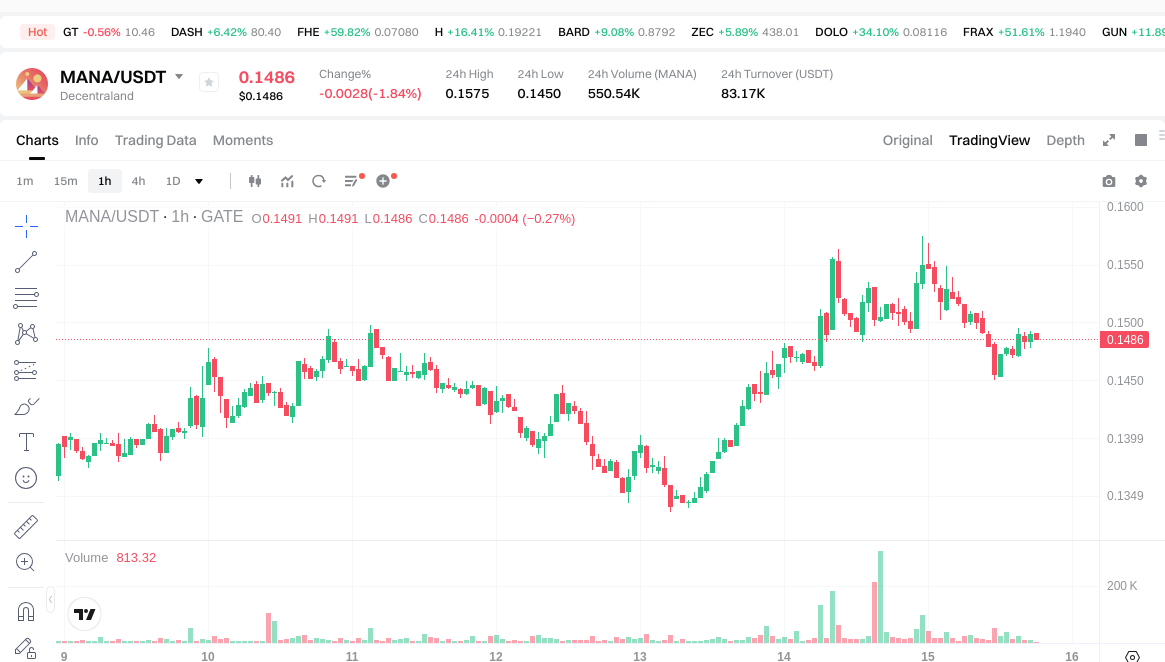
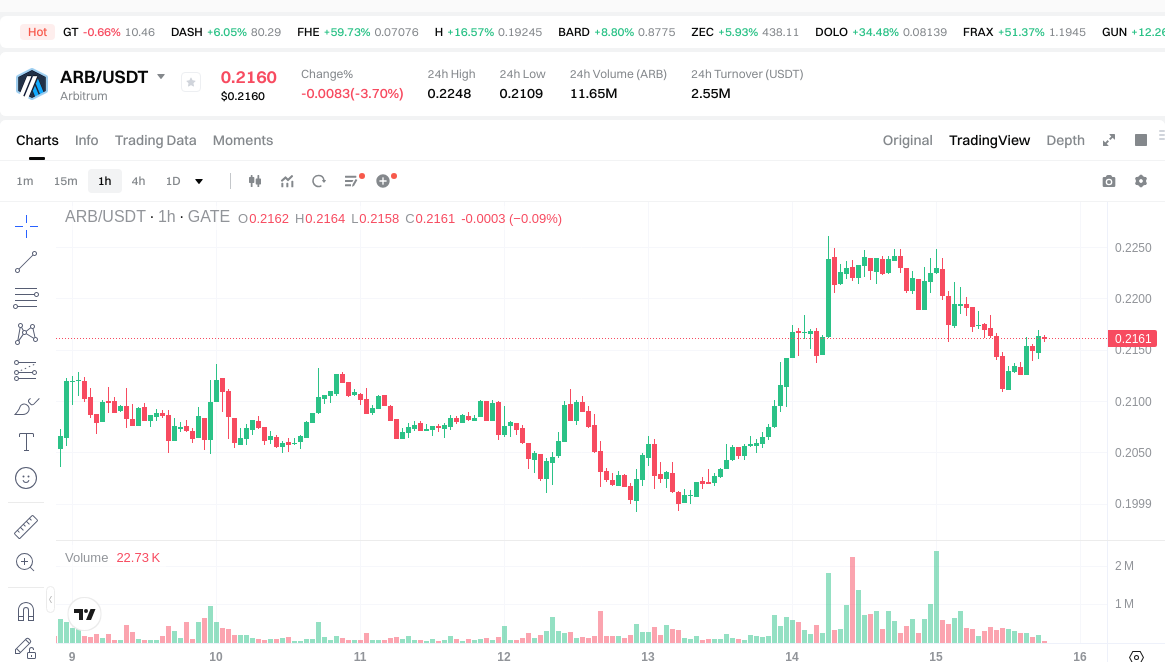
II. Core Factors Influencing MANA vs ARB Investment Value
Supply Mechanism Comparison (Tokenomics)
-
MANA: Decentraland's native token operates with a capped supply model. The token supports virtual land transactions and governance within the metaverse ecosystem, with distribution mechanisms tied to platform activity and staking rewards.
-
ARB: Arbitrum's token follows a gradual unlock schedule designed to incentivize long-term ecosystem participation. The supply structure incorporates allocation for community governance, developer grants, and network security incentives.
-
📌 Historical Pattern: Supply release schedules and token utility mechanisms have historically influenced price cycles, with deflationary pressure from platform usage potentially offsetting inflationary effects from unlock events.
Institutional Adoption and Market Applications
-
Institutional Holdings: ARB demonstrates broader institutional interest due to its role in Ethereum Layer 2 scaling infrastructure. According to available materials, ARB's integration with major DeFi protocols like GMX and RDNT creates sustained institutional demand. MANA attracts selective institutional attention focused on metaverse real estate investment, with entities like Hong Kong Disneyland reportedly acquiring virtual land assets.
-
Enterprise Adoption: ARB facilitates enterprise-scale transaction processing through Arbitrum's infrastructure, supporting high-throughput applications across DeFi and NFT marketplaces. MANA enables brand presence in virtual environments, with partnerships spanning entertainment and retail sectors for digital experience creation.
-
Regulatory Landscape: Both tokens operate within evolving regulatory frameworks, with jurisdiction-specific approaches to virtual asset classification and metaverse property rights continuing to develop.
Technology Development and Ecosystem Building
-
MANA Technical Evolution: Platform developments focus on enhancing virtual world interactivity, user experience optimization, and integration with broader metaverse standards. The ecosystem supports creator tools, virtual commerce infrastructure, and social interaction features.
-
ARB Technical Advancement: According to reference materials, Arbitrum's Nitro upgrade enhanced transaction throughput to approximately 4,500 TPS, representing substantial improvement over Ethereum mainnet capabilities. The Layer 2 solution continues optimizing gas fee efficiency and cross-chain interoperability.
-
Ecosystem Comparison: ARB demonstrates stronger DeFi integration with substantial total value locked (TVL) across decentralized exchanges and lending protocols. Materials indicate ARB maintains significant Layer 2 market share. MANA concentrates on NFT marketplaces, virtual land development, and social gaming applications within metaverse environments.
Macroeconomic Context and Market Cycles
-
Inflation Environment Performance: Both assets exhibit growth-oriented characteristics rather than traditional inflation hedges. Performance correlates more strongly with risk asset appetite and technology sector trends than direct inflation metrics.
-
Monetary Policy Impact: Interest rate environments and dollar strength influence both tokens through broader cryptocurrency market dynamics and investor risk tolerance adjustments. Liquidity conditions in digital asset markets remain significant determinants.
-
Geopolitical Considerations: Cross-border transaction demand for Layer 2 solutions like Arbitrum may increase during periods of traditional payment system stress. Metaverse platforms face varying adoption patterns across different regional markets and cultural contexts.
III. 2026-2031 Price Prediction: MANA vs ARB
Short-term Forecast (2026)
- MANA: Conservative $0.132254 - $0.1486 | Optimistic $0.1486 - $0.153058
- ARB: Conservative $0.203228 - $0.2162 | Optimistic $0.2162 - $0.24863
Mid-term Forecast (2028-2029)
- MANA may enter a consolidation phase, with projected price range of $0.0966 - $0.2262
- ARB may enter an expansion phase, with projected price range of $0.1889 - $0.4468
- Key drivers: institutional capital flows, ETF developments, ecosystem growth
Long-term Forecast (2030-2031)
- MANA: Base scenario $0.1576 - $0.2073 | Optimistic scenario $0.2073 - $0.3022
- ARB: Base scenario $0.2202 - $0.3796 | Optimistic scenario $0.3796 - $0.5142
View detailed price predictions for MANA and ARB
Disclaimer
MANA:
| Year |
Predicted High Price |
Predicted Average Price |
Predicted Low Price |
Price Change |
| 2026 |
0.153058 |
0.1486 |
0.132254 |
0 |
| 2027 |
0.1659119 |
0.150829 |
0.10708859 |
1 |
| 2028 |
0.218551221 |
0.15837045 |
0.0966059745 |
6 |
| 2029 |
0.2261530026 |
0.1884608355 |
0.13192258485 |
26 |
| 2030 |
0.261206718003 |
0.20730691905 |
0.157553258478 |
39 |
| 2031 |
0.302191295899185 |
0.2342568185265 |
0.16397977296855 |
57 |
ARB:
| Year |
Predicted High Price |
Predicted Average Price |
Predicted Low Price |
Price Change |
| 2026 |
0.24863 |
0.2162 |
0.203228 |
0 |
| 2027 |
0.32305685 |
0.232415 |
0.1812837 |
7 |
| 2028 |
0.34716990625 |
0.277735925 |
0.188860429 |
28 |
| 2029 |
0.44680766934375 |
0.312452915625 |
0.27183403659375 |
44 |
| 2030 |
0.417593321732812 |
0.379630292484375 |
0.220185569640937 |
75 |
| 2031 |
0.514209231170086 |
0.398611807108593 |
0.36273674446882 |
84 |
IV. Investment Strategy Comparison: MANA vs ARB
Long-term vs Short-term Investment Strategies
-
MANA: Suitable for investors focused on metaverse development, virtual real estate opportunities, and NFT ecosystem growth. The token appeals to those with interest in digital entertainment infrastructure and virtual world platforms. Short-term traders may capitalize on metaverse narrative cycles and platform partnership announcements, while long-term holders target ecosystem maturation and mainstream adoption of virtual experiences.
-
ARB: Suitable for investors seeking exposure to Ethereum Layer 2 scaling solutions and DeFi infrastructure development. The token attracts participants interested in transaction efficiency improvements and decentralized finance protocol growth. Short-term positioning may benefit from network upgrade releases and TVL fluctuations, while long-term accumulation strategies focus on Ethereum ecosystem expansion and institutional DeFi adoption trends.
Risk Management and Asset Allocation
-
Conservative Investors: MANA 20-30% vs ARB 70-80%. This allocation reflects ARB's stronger liquidity profile, broader institutional adoption, and integration with established DeFi protocols. Conservative portfolios prioritize assets with demonstrated utility and transaction volume.
-
Aggressive Investors: MANA 40-50% vs ARB 50-60%. More risk-tolerant allocations may increase MANA exposure for potential upside from metaverse sector growth, while maintaining ARB holdings for Layer 2 infrastructure positioning.
-
Hedging Tools: Stablecoin reserves (USDT, USDC) for volatility management, options strategies for downside protection, cross-token portfolio diversification across different blockchain sectors (DeFi, metaverse, infrastructure), and consideration of correlation patterns during market stress periods.
V. Potential Risk Comparison
Market Risk
-
MANA: Price performance demonstrates sensitivity to metaverse narrative cycles and broader NFT market sentiment. The 70.17% decline over the past year reflects challenges in sustaining user engagement and virtual real estate valuations during market downturns. Trading volume of $83.13 million indicates moderate liquidity, which may amplify volatility during periods of reduced market participation.
-
ARB: Token valuation correlates with Ethereum ecosystem health and Layer 2 adoption rates. Competition from alternative scaling solutions (Optimism, zkSync, Polygon) creates market share uncertainty. Despite higher trading volume of $2.56 billion suggesting robust liquidity, price movements remain subject to broader cryptocurrency market cycles and DeFi sector performance.
Technology Risk
-
MANA: Platform scalability requirements increase with user base expansion and content complexity. Virtual world performance optimization, server infrastructure reliability, and cross-platform interoperability present ongoing technical challenges. User experience quality and content creation tool sophistication influence platform retention rates.
-
ARB: Layer 2 architecture depends on Ethereum mainnet security and bridge mechanism integrity. Network congestion management, transaction sequencing reliability, and smart contract compatibility across protocol upgrades require continuous technical maintenance. Competition from emerging scaling technologies may impact long-term technical positioning.
Regulatory Risk
- Global regulatory frameworks for virtual assets continue evolving with jurisdiction-specific approaches. MANA faces regulatory considerations around virtual property rights, digital land ownership recognition, and metaverse content governance across different markets. ARB encounters regulatory scrutiny related to DeFi protocol compliance, securities classification questions, and cross-border transaction monitoring requirements. Both tokens operate within uncertain regulatory environments where policy developments may materially impact adoption trajectories and operational structures.
VI. Conclusion: Which Is the Better Buy?
📌 Investment Value Summary:
-
MANA Advantages: Established position in metaverse sector with virtual real estate infrastructure, NFT marketplace integration, and brand partnership ecosystem. Token utility within Decentraland platform supports governance participation and land transactions. Recent 30-day price increase of 12.72% suggests renewed interest in virtual world applications.
-
ARB Advantages: Strong DeFi ecosystem integration with substantial trading volume ($2.56 billion) indicating robust market liquidity. Technical infrastructure supporting approximately 4,500 TPS provides scalability for decentralized applications. Broader institutional adoption across Layer 2 solutions and established protocol partnerships create sustained demand drivers.
✅ Investment Recommendations:
-
Novice Investors: Consider ARB for initial cryptocurrency exposure due to stronger liquidity characteristics and integration with established DeFi protocols. Begin with conservative position sizing and utilize stablecoin reserves for portfolio stability during learning phases.
-
Experienced Investors: Diversified allocation across both tokens may capture different blockchain sector opportunities. ARB provides DeFi infrastructure exposure while MANA offers metaverse sector positioning. Monitor ecosystem development metrics, partnership announcements, and technical upgrade implementations for rebalancing decisions.
-
Institutional Investors: ARB presents more developed infrastructure for larger capital deployment given trading volume and protocol integration breadth. MANA may serve as selective allocation for metaverse sector exposure within broader digital asset portfolios. Conduct thorough due diligence on regulatory compliance frameworks and counterparty risks across both ecosystems.
⚠️ Risk Disclaimer: Cryptocurrency markets exhibit extreme volatility. This analysis does not constitute investment advice. Conduct independent research and consult qualified financial advisors before making investment decisions.
VII. FAQ
Q1: What is the primary difference between MANA and ARB in terms of use case and target market?
MANA focuses on metaverse and virtual real estate applications, while ARB serves as Ethereum Layer 2 infrastructure for DeFi and scalability solutions. MANA operates within Decentraland's virtual world platform, enabling users to purchase virtual land, participate in governance, and engage in NFT transactions without intermediary fees. The token targets creators, gamers, and brands seeking digital presence in immersive environments. Conversely, ARB facilitates high-throughput transactions on Arbitrum's Layer 2 network, supporting decentralized exchanges, lending protocols, and enterprise-scale applications. With approximately 4,500 TPS capability and integration across major DeFi protocols like GMX and RDNT, ARB addresses Ethereum's scalability challenges while maintaining security guarantees through its rollup architecture.
Q2: How do the liquidity profiles of MANA and ARB compare for trading purposes?
ARB demonstrates significantly higher liquidity with $2.56 billion in 24-hour trading volume compared to MANA's $83.13 million as of January 15, 2026. This 30x difference in trading volume indicates ARB provides superior market depth for executing larger transactions with reduced slippage impact. The higher liquidity stems from ARB's broader institutional adoption across DeFi protocols and its critical role in Ethereum's Layer 2 ecosystem. For traders requiring quick entry and exit positions, ARB's volume supports more efficient order execution. MANA's moderate liquidity may experience amplified volatility during periods of reduced market participation, particularly affecting larger position sizes or stop-loss order execution during rapid price movements.
Q3: What are the key risk factors investors should monitor for each token?
For MANA, monitor metaverse adoption rates, virtual land valuation trends, user engagement metrics within Decentraland, and competition from alternative virtual world platforms. The token's 70.17% decline over the past year highlights sensitivity to narrative cycles and NFT market sentiment. Technical risks include platform scalability challenges and user experience optimization requirements. For ARB, track Ethereum ecosystem health, Layer 2 market share versus competitors (Optimism, zkSync, Polygon), total value locked (TVL) trends across integrated protocols, and bridge security incidents. Both tokens face evolving regulatory frameworks around virtual asset classification, with MANA encountering virtual property rights questions and ARB navigating DeFi compliance requirements across jurisdictions.
Q4: Which token offers better potential for institutional investment portfolios?
ARB presents more developed infrastructure for institutional capital deployment based on current market characteristics. The token's $2.56 billion trading volume provides liquidity for larger position sizing without significant market impact, while integration with established DeFi protocols creates measurable utility metrics for valuation analysis. Institutional interest in Ethereum Layer 2 scaling solutions supports sustained demand drivers beyond speculative trading. MANA may serve as selective allocation for institutions seeking metaverse sector exposure, particularly those with interest in digital real estate asset classes. However, lower liquidity and concentrated exposure to virtual world adoption trends create higher portfolio volatility. Conservative institutional portfolios might allocate 70-80% ARB versus 20-30% MANA, reflecting liquidity profiles and ecosystem maturity differentials.
Q5: How do tokenomics and supply mechanisms differ between MANA and ARB?
MANA operates with a capped supply model tied to Decentraland platform activity, with distribution mechanisms supporting virtual land transactions, staking rewards, and governance participation. The fixed supply cap creates potential deflationary pressure as platform usage increases, offsetting inflation from token utility expansion. ARB follows a gradual unlock schedule designed to incentivize long-term ecosystem participation, with allocation structures supporting community governance, developer grants, and network security incentives. The scheduled unlock events may create periodic selling pressure as tokens vest to early participants and team members. Historical patterns show supply release schedules influence short-term price cycles, with both tokens experiencing volatility around major unlock milestones and ecosystem development announcements.
Q6: What price range should investors expect for MANA and ARB in 2026-2027?
For 2026, MANA conservative forecasts range from $0.132254 to $0.1486, with optimistic scenarios reaching $0.153058. ARB conservative estimates span $0.203228 to $0.2162, with upside potential to $0.24863. Moving into 2027, MANA projections extend to $0.1659119 high with average around $0.150829, while ARB may reach $0.32305685 with average pricing near $0.232415. These estimates reflect different growth trajectories: MANA faces consolidation following its 70.17% annual decline and requires renewed metaverse adoption momentum, whereas ARB benefits from expanding DeFi ecosystem integration and Ethereum Layer 2 infrastructure development. Price realizations depend heavily on institutional capital flows, ETF developments, broader cryptocurrency market cycles, and sector-specific catalysts including metaverse platform partnerships and Layer 2 protocol upgrades.
Q7: How should novice versus experienced investors approach allocation between these tokens?
Novice investors should prioritize ARB for initial cryptocurrency exposure due to superior liquidity characteristics, established DeFi protocol integration, and broader institutional adoption creating more predictable demand drivers. Begin with conservative position sizing (potentially 5-10% of total portfolio) and maintain substantial stablecoin reserves (USDT, USDC) for volatility management during learning phases. Experienced investors may implement diversified allocations capturing different blockchain sector opportunities: 50-60% ARB for DeFi infrastructure exposure and 40-50% MANA for metaverse sector positioning within risk-tolerant portfolios. Advanced strategies include monitoring ecosystem development metrics, partnership announcements, and technical upgrade implementations for tactical rebalancing decisions. Both investor categories should establish clear risk management protocols including stop-loss thresholds, position sizing rules based on portfolio volatility tolerance, and regular reassessment schedules aligned with market cycle dynamics.
Q8: What technological developments could significantly impact the price trajectory of each token?
For MANA, key technological catalysts include virtual world performance optimization enabling larger concurrent user capacity, enhanced creator tools improving content development efficiency, cross-platform interoperability allowing asset portability across metaverse environments, and mobile accessibility expansion broadening user base potential. Platform scalability improvements addressing server infrastructure reliability and transaction processing speed directly impact user experience quality and retention rates. For ARB, critical developments involve Ethereum mainnet upgrades affecting Layer 2 security assumptions, bridge mechanism enhancements improving cross-chain transaction efficiency, smart contract compatibility improvements reducing protocol integration friction, and competition responses to emerging scaling technologies like zkEVM solutions. The Nitro upgrade's achievement of approximately 4,500 TPS demonstrates infrastructure advancement, with future optimizations potentially reaching higher throughput thresholds supporting institutional-scale application deployment across DeFi and NFT marketplaces.
* The information is not intended to be and does not constitute financial advice or any other recommendation of any sort offered or endorsed by Gate.