This comprehensive analysis compares MANEKI and BCH, two distinct cryptocurrency assets representing different market segments and investment profiles. MANEKI, launched in 2024 as a Solana-based meme token, exhibits extreme volatility with a 98.5% decline from peak to recent lows, appealing to speculative investors with high risk tolerance. BCH, established since 2017 as a Bitcoin fork focused on payment utility and scalability, demonstrates greater price stability and institutional recognition with substantially higher trading volume. The article examines historical price trends, supply mechanisms, institutional adoption, technical ecosystems, and 2026-2031 price predictions to guide investment decisions. Conservative investors should favor BCH's established infrastructure, while aggressive traders may consider MANEKI's speculative potential. Both assets require careful risk assessment and position sizing aligned with individual investment objectives and market volatility tolerance.
Introduction: MANEKI vs BCH Investment Comparison
In the cryptocurrency market, the comparison between MANEKI vs BCH remains a topic investors cannot overlook. The two differ significantly in market cap rankings, application scenarios, and price performance, representing distinct crypto asset positioning.
MANEKI (MANEKI): Launched in 2024, it has gained market attention with its positioning as Solana's native cat coin, symbolizing good luck and prosperity.
BCH (BCH): Since its launch in 2017, it has been recognized as an on-chain scaling solution following Satoshi's vision, ranking among the cryptocurrencies with substantial global trading volume and market capitalization.
This article will analyze the investment value comparison of MANEKI vs BCH through historical price trends, supply mechanisms, institutional adoption, technical ecosystems, and future predictions, attempting to address investors' most pressing question:
"Which is the better buy right now?"
I. Historical Price Comparison and Current Market Status
MANEKI (Coin A) and BCH (Coin B) Historical Price Trends
- 2024: MANEKI reached its peak price of $0.028 on April 25, 2024, shortly after its launch in April 2024, reflecting initial market enthusiasm for this Solana-based meme token.
- 2017: BCH emerged from a Bitcoin hard fork in July 2017, with an initial price around $555.89, later reaching its all-time high of $3,785.82 in December 2017 during the broader cryptocurrency market rally.
- 2018: BCH experienced significant volatility, declining to its historical low of $76.93 in December 2018 amid broader market corrections.
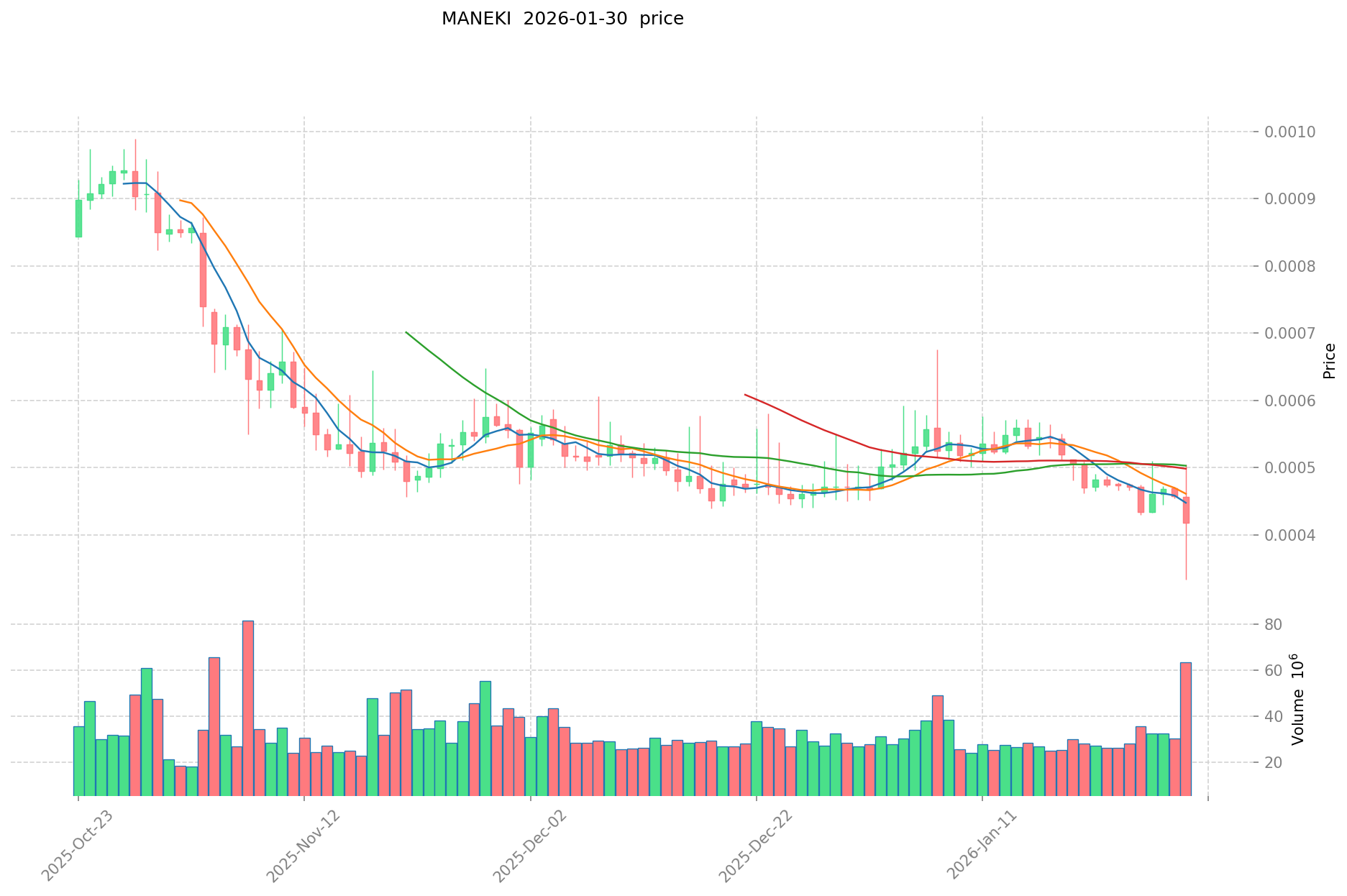
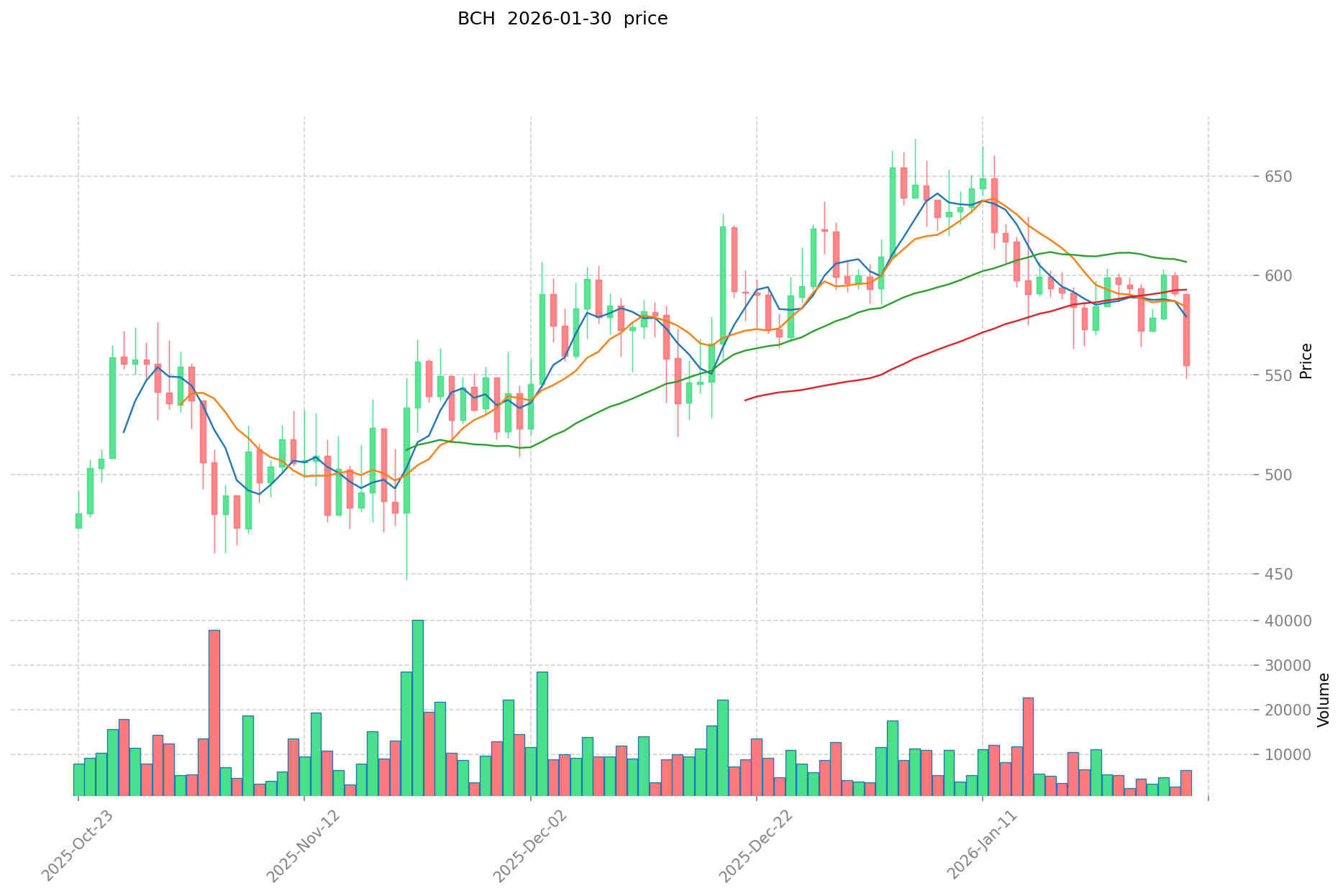
- Comparative Analysis: During recent market cycles, MANEKI declined from its peak of $0.028 to a low of $0.0003333 recorded on January 29, 2026, representing substantial volatility typical of newer meme tokens. In contrast, BCH has demonstrated greater price stability relative to its market history, though it remains well below its 2017 peak.
Current Market Status (January 30, 2026)
- MANEKI current price: $0.0004179
- BCH current price: $554.8
- 24-hour trading volume: MANEKI recorded $26,802.17 compared to BCH's significantly higher $3,716,599.29
- Market Sentiment Index (Fear & Greed Index): 26 (Fear)
View real-time prices:
II. Core Factors Influencing MANEKI vs BCH Investment Value
Supply Mechanism Comparison (Tokenomics)
- MANEKI: Specific supply mechanism details are not provided in available materials. Token distribution involved early wallet acquisitions, with seven wallets spending 3,388 SOL to purchase 399 million MANEKI tokens immediately after launch.
- BCH: Features a deflationary model through halving mechanisms, similar to Bitcoin's issuance schedule, which reduces block rewards periodically.
- 📌 Historical Pattern: Supply mechanisms influence price cycles through scarcity dynamics. Halving events in cryptocurrencies have historically preceded bullish market phases, though results vary based on broader market conditions.
Institutional Adoption and Market Application
- Institutional Holdings: Current data does not specify institutional preference between MANEKI and BCH. BCH has experienced community-driven development initiatives, including preparations for network upgrades.
- Enterprise Adoption: BCH has been explored for cross-border payment solutions and transaction settlement applications. MANEKI's enterprise adoption status remains unclear from available materials.
- Regulatory Landscape: Regulatory approaches vary across jurisdictions. Materials reference evolving blockchain regulations, including guidelines from U.S. financial authorities regarding digital asset frameworks.
Technological Development and Ecosystem Building
- MANEKI Technical Progress: Specific technical upgrades are not detailed in reference materials. Trading activity on Solana infrastructure suggests operational integration within that ecosystem.
- BCH Technical Development: Community organizations have prepared for network upgrades, with historical references to hard fork preparations. The platform continues development focused on transaction efficiency and scalability.
- Ecosystem Comparison: BCH maintains presence in payment applications and transaction networks. MANEKI's ecosystem positioning within DeFi, NFT, or smart contract applications is not documented in provided materials.
Macroeconomic Factors and Market Cycles
- Performance in Inflationary Environments: Materials do not provide comparative analysis of inflation resistance between MANEKI and BCH. Broader cryptocurrency market trends show correlation with macroeconomic indicators.
- Monetary Policy Impact: Interest rate adjustments and U.S. dollar index movements influence cryptocurrency valuations generally. Specific impacts on MANEKI versus BCH require additional market-specific analysis.
- Geopolitical Factors: Cross-border transaction demand and international regulatory developments affect cryptocurrency adoption patterns. Market sentiment reflects both regional policy changes and global economic conditions.
III. 2026-2031 Price Prediction: MANEKI vs BCH
Short-term Prediction (2026)
- MANEKI: Conservative $0.000347-$0.000418 | Optimistic $0.000418-$0.000451
- BCH: Conservative $532.94-$555.15 | Optimistic $555.15-$738.35
Mid-term Prediction (2028-2029)
- MANEKI may enter a consolidation phase, with estimated price range of $0.000463-$0.000805
- BCH may enter a growth phase, with estimated price range of $454.08-$1,069.79
- Key drivers: institutional capital inflows, ETF developments, ecosystem expansion
Long-term Prediction (2030-2031)
- MANEKI: Baseline scenario $0.000407-$0.000756 | Optimistic scenario $0.000678-$0.000834
- BCH: Baseline scenario $692.76-$1,018.76 | Optimistic scenario $974.89-$1,253.08
View detailed price predictions for MANEKI and BCH
Disclaimer: Price predictions are based on historical data analysis and market trends. Cryptocurrency markets are highly volatile and subject to various unpredictable factors. These projections should not be considered as investment advice. Users should conduct their own research and assess risk tolerance before making any investment decisions.
MANEKI:
| Year |
Predicted High Price |
Predicted Average Price |
Predicted Low Price |
Price Change |
| 2026 |
0.000451332 |
0.0004179 |
0.000346857 |
0 |
| 2027 |
0.00062584704 |
0.000434616 |
0.00024773112 |
4 |
| 2028 |
0.0005726500416 |
0.00053023152 |
0.0004825106832 |
26 |
| 2029 |
0.000805103539968 |
0.0005514407808 |
0.000463210255872 |
31 |
| 2030 |
0.000834274757272 |
0.000678272160384 |
0.00040696329623 |
62 |
| 2031 |
0.000816775335534 |
0.000756273458828 |
0.000733585255063 |
80 |
BCH:
| Year |
Predicted High Price |
Predicted Average Price |
Predicted Low Price |
Price Change |
| 2026 |
738.3495 |
555.15 |
532.944 |
0 |
| 2027 |
892.514655 |
646.74975 |
601.4772675 |
16 |
| 2028 |
1069.788761475 |
769.6322025 |
454.082999475 |
38 |
| 2029 |
1030.075739826 |
919.7104819875 |
882.922062708 |
65 |
| 2030 |
1062.6334908883575 |
974.89311090675 |
877.403799816075 |
75 |
| 2031 |
1253.078860103991112 |
1018.76330089755375 |
692.75904461033655 |
83 |
IV. Investment Strategy Comparison: MANEKI vs BCH
Long-term vs Short-term Investment Strategies
- MANEKI: May suit speculative investors with high risk tolerance seeking exposure to emerging meme token narratives within the Solana ecosystem, though extreme volatility patterns suggest careful position sizing
- BCH: May suit investors interested in established cryptocurrency infrastructure with payment utility focus and historical market presence, though price performance relative to peak levels warrants consideration
Risk Management and Asset Allocation
- Conservative Investors: MANEKI 5-10% vs BCH 15-25% (within broader cryptocurrency portfolio allocation)
- Aggressive Investors: MANEKI 15-25% vs BCH 25-40% (subject to individual risk assessment and market conditions)
- Hedging Tools: Stablecoin positions for liquidity management, diversified cryptocurrency exposure across different market segments, periodic rebalancing based on portfolio performance
V. Potential Risk Comparison
Market Risks
- MANEKI: Exhibits substantial price volatility characteristic of newer meme tokens, with 98.5% decline from peak to recent low; liquidity constraints reflected in lower 24-hour trading volume ($26,802.17); susceptibility to social sentiment shifts
- BCH: Experiences price fluctuations influenced by broader cryptocurrency market cycles and Bitcoin market dynamics; trading volume ($3,716,599.29) indicates established market presence though volatility persists relative to traditional assets
Technical Risks
- MANEKI: Dependency on Solana network infrastructure performance; limited information available regarding specific protocol development roadmap or technical upgrade schedules
- BCH: Network upgrade implementation processes require community coordination; ongoing development efforts focus on scalability and transaction efficiency enhancements
Regulatory Risks
- Evolving regulatory frameworks across jurisdictions may affect both assets differently based on their respective classifications and use cases; payment-focused cryptocurrencies like BCH may face specific compliance requirements in certain markets; meme tokens may encounter scrutiny regarding investor protection considerations
VI. Conclusion: Which Is the Better Buy?
📌 Investment Value Summary:
- MANEKI Characteristics: Represents emerging meme token category within Solana ecosystem; demonstrates substantial price volatility; limited historical performance data given 2024 launch; current market capitalization and ecosystem positioning remain in early development stages
- BCH Characteristics: Established presence since 2017 with focus on payment utility and transaction scalability; maintains position among recognized cryptocurrencies by market capitalization; historical price patterns reflect multiple market cycles; ongoing technical development initiatives
✅ Investment Considerations:
- Novice Investors: Consider starting with established cryptocurrencies offering greater liquidity and market information availability; allocate only capital prepared for potential loss given cryptocurrency market volatility; prioritize education regarding blockchain technology and market dynamics before position establishment
- Experienced Investors: Evaluate portfolio diversification objectives and risk-adjusted return expectations; consider technical analysis alongside fundamental assessment of ecosystem development; implement position sizing aligned with volatility characteristics of each asset
- Institutional Investors: Conduct comprehensive due diligence regarding regulatory compliance frameworks; assess liquidity depth for position management; evaluate custody solutions and operational infrastructure requirements; consider portfolio construction within broader digital asset allocation strategy
⚠️ Risk Disclaimer: Cryptocurrency markets exhibit extreme volatility influenced by numerous unpredictable factors including technological developments, regulatory changes, macroeconomic conditions, and market sentiment shifts. This analysis does not constitute investment advice, financial recommendations, or encouragement to engage in cryptocurrency trading. Individuals should conduct independent research, consult qualified financial advisors, and carefully assess personal risk tolerance and financial circumstances before making any investment decisions. Past performance does not indicate future results, and cryptocurrency investments carry substantial risk of capital loss.
VII. FAQ
Q1: Which cryptocurrency has better long-term growth potential, MANEKI or BCH?
BCH demonstrates stronger long-term growth potential based on established market presence, higher liquidity, and predictable development trajectory. While MANEKI represents a speculative opportunity within the emerging meme token category, BCH's historical performance since 2017, institutional recognition, and payment utility focus provide a more stable foundation for long-term investment. Price predictions suggest BCH could reach $1,018-$1,253 by 2031, supported by ongoing technical development and ecosystem expansion. However, both assets carry substantial risks, and investment decisions should align with individual risk tolerance and portfolio objectives.
Q2: What are the main risks associated with investing in MANEKI compared to BCH?
MANEKI carries significantly higher volatility risk, having declined 98.5% from its April 2024 peak to January 2026 low, compared to BCH's more moderate fluctuations within established market cycles. MANEKI's limited trading volume ($26,802 vs BCH's $3,716,599) indicates lower liquidity and potential difficulty executing large positions. Additionally, MANEKI's dependency on Solana infrastructure and limited information regarding technical roadmap creates greater uncertainty, while BCH benefits from eight years of operational history, community-driven development initiatives, and clearer regulatory positioning as a payment-focused cryptocurrency.
Q3: How do the supply mechanisms of MANEKI and BCH affect their investment value?
BCH employs a deflationary halving mechanism similar to Bitcoin, which reduces block rewards periodically and creates predictable supply constraints that historically precede bullish market phases. This established economic model provides transparency for long-term valuation analysis. In contrast, specific details regarding MANEKI's supply mechanism remain unclear from available materials, though early wallet concentration (seven wallets purchasing 399 million tokens) suggests potential supply distribution concerns. Investors should prioritize understanding tokenomics fundamentals, as supply mechanisms directly influence scarcity dynamics and long-term price sustainability.
Q4: What role do institutional adoption and real-world applications play in MANEKI vs BCH valuation?
BCH maintains demonstrated utility in cross-border payment solutions and transaction settlement applications, with ongoing community-driven development for network scalability improvements. This practical application foundation provides tangible value drivers beyond speculative trading. MANEKI's current positioning remains focused within the meme token narrative without documented enterprise adoption or specific DeFi/NFT ecosystem integration. For risk-conscious investors, cryptocurrencies with established real-world use cases typically demonstrate greater resilience during market downturns and benefit from network effects as adoption expands.
Q5: How should investors approach portfolio allocation between MANEKI and BCH?
Conservative investors should limit MANEKI exposure to 5-10% of cryptocurrency holdings while allocating 15-25% to BCH, reflecting the substantial risk differential between emerging meme tokens and established payment-focused cryptocurrencies. Aggressive investors may consider 15-25% MANEKI and 25-40% BCH allocations, though extreme volatility in MANEKI requires careful position sizing and stop-loss implementation. Regardless of strategy, maintain adequate stablecoin reserves for liquidity management, implement periodic rebalancing based on performance metrics, and ensure total cryptocurrency exposure aligns with overall investment portfolio risk parameters.
Q6: What market conditions would favor MANEKI performance over BCH?
MANEKI may outperform BCH during periods of heightened retail speculation, social media-driven narrative momentum, and risk-on market sentiment favoring high-volatility assets. The Solana ecosystem's growth and meme token sector enthusiasm could create temporary price surges significantly exceeding BCH's moderate appreciation potential. However, such conditions typically prove unsustainable, with meme tokens experiencing rapid corrections when sentiment shifts. Investors pursuing MANEKI opportunities should establish strict profit-taking protocols, avoid emotional decision-making during volatility spikes, and recognize that short-term gains often reverse quickly without fundamental value drivers supporting price levels.
Q7: How do regulatory developments differently impact MANEKI and BCH investment prospects?
BCH faces regulatory scrutiny focused on payment system compliance, anti-money laundering requirements, and potential securities classification debates, particularly as jurisdictions establish comprehensive digital asset frameworks. Its established presence and payment utility may attract specific regulatory attention regarding consumer protection and financial system integration. MANEKI's positioning as a meme token may encounter different regulatory considerations centered on investor protection, marketing practices, and potential restrictions on speculative digital assets in certain markets. Evolving regulatory clarity could benefit established cryptocurrencies like BCH through legitimacy enhancement, while potentially constraining meme token accessibility for retail investors.
Q8: What technical indicators should investors monitor when comparing MANEKI and BCH performance?
Beyond price movements, investors should track 24-hour trading volume trends (current MANEKI: $26,802 vs BCH: $3,716,599) as liquidity indicators affecting execution quality and market depth. Monitor market sentiment indices like the Fear & Greed Index (currently 26: Fear) for broader market context influencing both assets. For BCH, observe network upgrade implementations, transaction volume growth, and payment adoption metrics. For MANEKI, track Solana ecosystem developments, social media engagement patterns, and wallet concentration changes. Implement technical analysis including support/resistance levels, moving averages, and relative strength indicators while recognizing that fundamental analysis remains critical for long-term investment decisions.
* The information is not intended to be and does not constitute financial advice or any other recommendation of any sort offered or endorsed by Gate.