This article provides a comprehensive investment comparison between MANTA and LRC, two distinct Layer-2 cryptocurrency solutions. MANTA, launched in 2024, specializes in zero-knowledge applications with modular blockchain infrastructure, while LRC, established in 2017, focuses on decentralized exchange protocols. The analysis examines historical price trends, current market status, tokenomics, technical ecosystems, and risk factors to help investors determine which asset aligns with their portfolio objectives. With MANTA trading at $0.07517 and LRC at $0.0486 as of January 2026, the article offers tailored allocation strategies for conservative, aggressive, and institutional investors, along with detailed price forecasts through 2031 and essential risk disclosures to guide informed decision-making.
Introduction: Investment Comparison Between MANTA and LRC
In the cryptocurrency market, the comparison between MANTA vs LRC has consistently been a topic that investors cannot overlook. The two not only show notable differences in market cap ranking, application scenarios, and price performance, but also represent distinct crypto asset positioning.
MANTA (MANTA): Since its launch in 2024, it has gained market recognition through its positioning as a modular blockchain for zero-knowledge applications, offering low-cost ZK-as-a-Service solutions.
LRC (LRC): Since its emergence in 2017, it has been recognized as a decentralized exchange protocol, providing zero-risk token exchange mechanisms through off-chain matching and on-chain settlement.
This article will comprehensively analyze the investment value comparison of MANTA vs LRC around historical price trends, supply mechanisms, institutional adoption, technical ecosystems, and future predictions, attempting to answer the question that investors care about most:
"Which is the better buy right now?"
I. Historical Price Comparison and Current Market Status
Historical Price Trends of MANTA (Coin A) and LRC (Coin B)
- 2024: MANTA reached a peak price of $10.4405 on January 18, 2024, shortly after its launch on January 18, 2024, with an initial offering price of $0.36.
- 2025: MANTA experienced significant decline, falling to a historical low of $0.0405 on October 10, 2025.
- 2021: LRC achieved its all-time high of $3.75 on November 10, 2021, driven by market momentum during that period.
- 2019: LRC recorded its historical low of $0.01963893 on December 18, 2019.
- Comparative Analysis: During recent market cycles, MANTA declined from its peak of $10.4405 to $0.0405, representing a substantial downward movement, while LRC showed relative stability within its established range, declining from $3.75 to $0.01963893 over a longer timeframe.
Current Market Status (January 21, 2026)
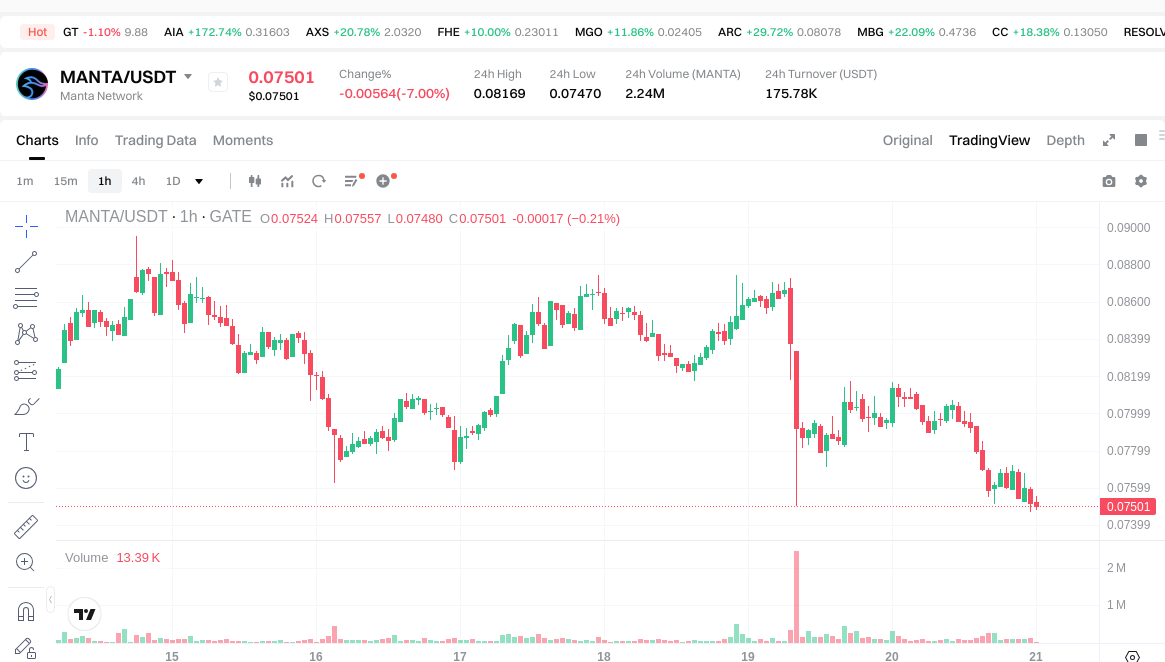
- MANTA current price: $0.07517
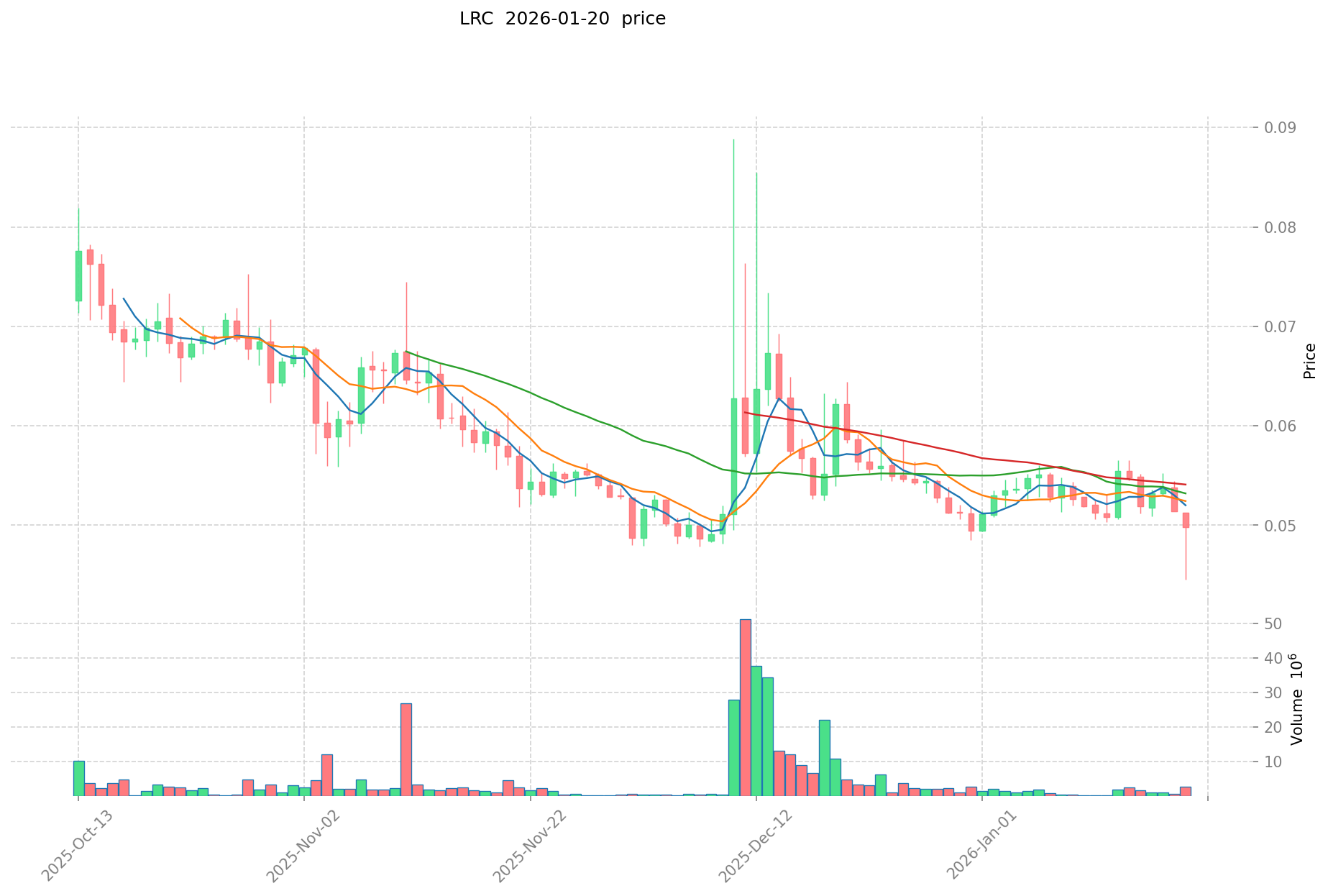
- LRC current price: $0.0486
- 24-hour trading volume: MANTA $181,790.44 vs LRC $322,489.65
- Market sentiment index (Fear & Greed Index): 32 (Fear)
View real-time prices:
II. Core Factors Affecting MANTA vs LRC Investment Value
Supply Mechanism Comparison (Tokenomics)
Due to insufficient reference materials, detailed supply mechanism information for MANTA and LRC cannot be provided at this time.
Institutional Adoption and Market Application
Institutional Holdings
Without available data on institutional holdings for either MANTA or LRC, a comparative analysis of institutional preference cannot be conducted.
Enterprise Adoption
Reference materials do not contain sufficient information regarding the application of MANTA or LRC in cross-border payments, settlements, or investment portfolios.
National Policies
Specific regulatory attitudes from different countries toward MANTA and LRC are not documented in the available materials.
Technological Development and Ecosystem Building
MANTA Technical Upgrades
The provided materials lack detailed information on MANTA's technical upgrade roadmap and potential market impact.
LRC Technical Development
Insufficient data exists in the reference materials to describe LRC's technical development trajectory and implications.
Ecosystem Comparison
A comprehensive comparison of DeFi, NFT, payment systems, and smart contract implementations for both projects cannot be established based on the available information.
Macroeconomic Environment and Market Cycles
Historical performance data under inflationary conditions is not available for either MANTA or LRC in the reference materials.
Macroeconomic Monetary Policy
The specific impacts of interest rates and US Dollar Index fluctuations on MANTA and LRC require additional data not present in current materials.
Geopolitical Factors
Analysis of cross-border transaction demand and international situation effects on both assets cannot be conducted without relevant reference data.
III. 2026-2031 Price Forecast: MANTA vs LRC
Short-term Forecast (2026)
- MANTA: Conservative $0.055-$0.075 | Optimistic $0.075-$0.082
- LRC: Conservative $0.029-$0.049 | Optimistic $0.049-$0.058
Mid-term Forecast (2028-2029)
- MANTA may enter a gradual growth phase, with projected price range of $0.042-$0.094
- LRC may enter a volatile expansion phase, with projected price range of $0.035-$0.078
- Key drivers: institutional capital flows, ETF developments, ecosystem expansion
Long-term Forecast (2030-2031)
- MANTA: Baseline scenario $0.054-$0.090 | Optimistic scenario $0.107-$0.131
- LRC: Baseline scenario $0.054-$0.072 | Optimistic scenario $0.079-$0.116
View detailed price predictions for MANTA and LRC
Disclaimer: Price forecasts are based on historical data analysis and market trends. Cryptocurrency markets involve significant risks and volatility. These projections should not be considered as investment advice. Users should conduct independent research and consult professional advisors before making any investment decisions.
MANTA:
| Year |
Predicted High Price |
Predicted Average Price |
Predicted Low Price |
Price Change |
| 2026 |
0.0815865 |
0.07485 |
0.055389 |
0 |
| 2027 |
0.082911345 |
0.07821825 |
0.0633567825 |
4 |
| 2028 |
0.091038221175 |
0.0805647975 |
0.0418936947 |
7 |
| 2029 |
0.093523645177875 |
0.0858015093375 |
0.052338920695875 |
14 |
| 2030 |
0.125527608160762 |
0.089662577257687 |
0.053797546354612 |
19 |
| 2031 |
0.131266013105254 |
0.107595092709225 |
0.057025399135889 |
43 |
LRC:
| Year |
Predicted High Price |
Predicted Average Price |
Predicted Low Price |
Price Change |
| 2026 |
0.057643 |
0.04885 |
0.0288215 |
0 |
| 2027 |
0.072947705 |
0.0532465 |
0.030350505 |
9 |
| 2028 |
0.0681448707 |
0.0630971025 |
0.05931127635 |
29 |
| 2029 |
0.078088974054 |
0.0656209866 |
0.034779122898 |
35 |
| 2030 |
0.08550742658913 |
0.071854980327 |
0.06538803209757 |
47 |
| 2031 |
0.116448181117936 |
0.078681203458065 |
0.053503218351484 |
61 |
IV. Investment Strategy Comparison: MANTA vs LRC
Long-term vs Short-term Investment Strategy
- MANTA: May suit investors interested in zero-knowledge application development and modular blockchain infrastructure, particularly those seeking exposure to emerging privacy-focused solutions
- LRC: May appeal to investors focused on decentralized exchange protocols and established DeFi infrastructure with longer market presence
Risk Management and Asset Allocation
- Conservative Investors: MANTA 30% vs LRC 70%
- Aggressive Investors: MANTA 60% vs LRC 40%
- Hedging Tools: Stablecoin allocation, options strategies, cross-currency portfolio combinations
V. Potential Risk Comparison
Market Risk
- MANTA: Relatively recent market entry (launched 2024) may present higher volatility patterns, with observed price movement from $10.4405 peak to $0.0405 low indicating substantial fluctuation potential
- LRC: Longer market history (since 2017) with established trading patterns, though historical range from $3.75 high to $0.01963893 low demonstrates significant volatility across extended timeframes
Technical Risk
- MANTA: Scalability considerations and network stability factors associated with modular blockchain architecture
- LRC: Protocol reliability and potential security considerations inherent to decentralized exchange mechanisms
Regulatory Risk
- Global regulatory developments may affect both assets differently based on their respective use cases: zero-knowledge applications for MANTA versus decentralized exchange protocols for LRC
VI. Conclusion: Which Is the Better Buy?
📌 Investment Value Summary:
- MANTA Characteristics: Focuses on zero-knowledge application infrastructure with modular blockchain approach, positioning in emerging privacy technology sector
- LRC Characteristics: Established presence in decentralized exchange protocol space with longer operational history and off-chain matching mechanism
✅ Investment Considerations:
- Beginner Investors: Consider gradual position building with diversification across both assets, prioritizing comprehensive market research and risk assessment
- Experienced Investors: May evaluate allocation based on individual portfolio objectives, technical understanding, and risk tolerance levels
- Institutional Investors: Should conduct thorough due diligence including liquidity analysis, regulatory compliance review, and alignment with investment mandates
⚠️ Risk Disclosure: Cryptocurrency markets involve substantial volatility and risk. This content does not constitute investment advice. Current market sentiment index indicates Fear level (32). Individual circumstances, financial objectives, and risk tolerance should guide investment decisions. Professional consultation is recommended before making any investment commitments.
VII. FAQ
Q1: What are the main technical differences between MANTA and LRC?
MANTA is a modular blockchain focused on zero-knowledge (ZK) applications, providing ZK-as-a-Service solutions for privacy-focused development. LRC, on the other hand, is a decentralized exchange protocol that utilizes off-chain matching combined with on-chain settlement to enable zero-risk token exchanges. The fundamental distinction lies in their core purposes: MANTA targets infrastructure for privacy applications, while LRC specializes in decentralized trading mechanisms.
Q2: Which cryptocurrency has demonstrated more price stability historically?
LRC has shown relatively more established price patterns due to its longer market presence since 2017, trading within a historical range from $0.01963893 to $3.75. MANTA, launched in 2024, experienced more dramatic volatility with movements from $10.4405 to $0.0405 within a shorter timeframe. However, both assets have demonstrated significant price fluctuations characteristic of cryptocurrency markets, and neither should be considered truly "stable" investments.
Q3: What is the current market sentiment for MANTA vs LRC investments?
As of January 21, 2026, the overall cryptocurrency market sentiment index stands at 32, indicating "Fear" conditions. MANTA trades at $0.07517 with 24-hour volume of $181,790.44, while LRC trades at $0.0486 with higher volume of $322,489.65. The current market environment suggests cautious investor behavior, with LRC demonstrating greater trading activity despite lower price levels.
Q4: How do the 2026-2031 price forecasts compare between MANTA and LRC?
For 2026, MANTA's conservative forecast ranges from $0.055-$0.075 with optimistic potential of $0.075-$0.082, while LRC projects conservatively at $0.029-$0.049 and optimistically at $0.049-$0.058. Long-term forecasts for 2031 suggest MANTA could reach $0.107-$0.131 under optimistic scenarios, compared to LRC's $0.079-$0.116 range. However, these projections carry significant uncertainty and should not be relied upon as guaranteed outcomes.
Q5: What allocation strategy should different investor types consider for MANTA vs LRC?
Conservative investors might consider a 30% MANTA / 70% LRC allocation, favoring the more established protocol with longer market history. Aggressive investors may opt for 60% MANTA / 40% LRC, accepting higher exposure to the newer zero-knowledge infrastructure project. All investors should implement risk management through stablecoin reserves, diversification, and position sizing appropriate to their individual risk tolerance and investment timeframe.
Q6: What are the primary risks associated with investing in MANTA versus LRC?
MANTA's risks include higher volatility due to recent market entry (2024), scalability challenges inherent to modular blockchain architecture, and uncertainty around zero-knowledge application adoption. LRC faces risks related to protocol security in decentralized exchange operations, competition from other DEX protocols, and its longer-term price decline from historical highs. Both assets face regulatory uncertainty as global frameworks for cryptocurrency continue evolving, with potential different impacts based on their distinct use cases.
Q7: Is there sufficient information available to make informed investment decisions about MANTA and LRC?
Current reference materials provide limited data on critical factors including tokenomics, supply mechanisms, institutional holdings, enterprise adoption rates, and specific regulatory developments. Investors should conduct independent comprehensive research beyond available materials, including examination of official project documentation, on-chain metrics, development activity, community engagement, and competitive landscape analysis before making investment decisions. Professional consultation is recommended given information gaps and market complexity.
* The information is not intended to be and does not constitute financial advice or any other recommendation of any sort offered or endorsed by Gate.