This comprehensive comparison analyzes MERL and DOT as two distinct blockchain infrastructure solutions for investors. MERL, launched in 2024, positions itself as a Bitcoin Layer 2 scaling solution empowering native Bitcoin assets, while DOT, operational since 2019, serves as a multi-chain interoperability protocol connecting diverse blockchain networks. The article examines historical price trends, tokenomics, institutional adoption, technological ecosystems, and risk profiles. Current market data shows MERL at $0.25371 with $1,361,753.20 trading volume versus DOT at $2.199 with $1,284,560.52 volume on Gate. Price forecasts through 2031 suggest different growth trajectories for both assets. Investment strategies vary by risk tolerance: conservative investors may favor DOT's established infrastructure, while aggressive investors might allocate toward MERL's emerging Layer 2 positioning. Both assets present distinct opportunities and challenges requiring thorough due diligence and risk management consideration
Introduction: MERL and DOT Investment Comparison
In the cryptocurrency market, the comparison between MERL vs DOT has consistently been a topic that investors cannot overlook. The two not only exhibit notable differences in market cap ranking, application scenarios, and price performance, but also represent distinct crypto asset positioning.
MERL (Merlin Chain): Launched in 2024, it has gained market recognition by positioning itself as a native Bitcoin Layer 2 solution, committed to empowering Bitcoin's native assets, protocols, and products through its Layer 2 network.
DOT (Polkadot): Since its launch in 2019, it has been recognized for its positioning in connecting private chains, alliance chains, public chains, open networks, and oracles, making it easier than ever to create and connect decentralized applications, services, and institutions.
This article will provide a comprehensive analysis of the MERL vs DOT investment value comparison, focusing on historical price trends, supply mechanisms, institutional adoption, technological ecosystems, and future forecasts, attempting to answer the question that investors care about most:
"Which is the better buy right now?"
I. Historical Price Comparison and Current Market Status
MERL and DOT Historical Price Trends
-
2024: MERL experienced notable price volatility following its mainnet launch in April, reaching an all-time high of $1.888 on April 19, 2024. The token attracted significant attention within the Bitcoin Layer 2 ecosystem during this period.
-
2021: DOT reached its historical peak of $54.98 on November 4, 2021, during the broader cryptocurrency bull market. The price reflected strong market confidence in Polkadot's multi-chain interoperability vision.
-
Comparative Analysis: During the market correction cycle from late 2021 through 2025, DOT declined from its peak of $54.98 to a low of $1.66 recorded on December 26, 2025, representing a substantial retracement. Meanwhile, MERL, which launched in 2024, established its historical low of $0.0623 on February 3, 2025, reflecting the challenging market conditions for newer Layer 2 projects.
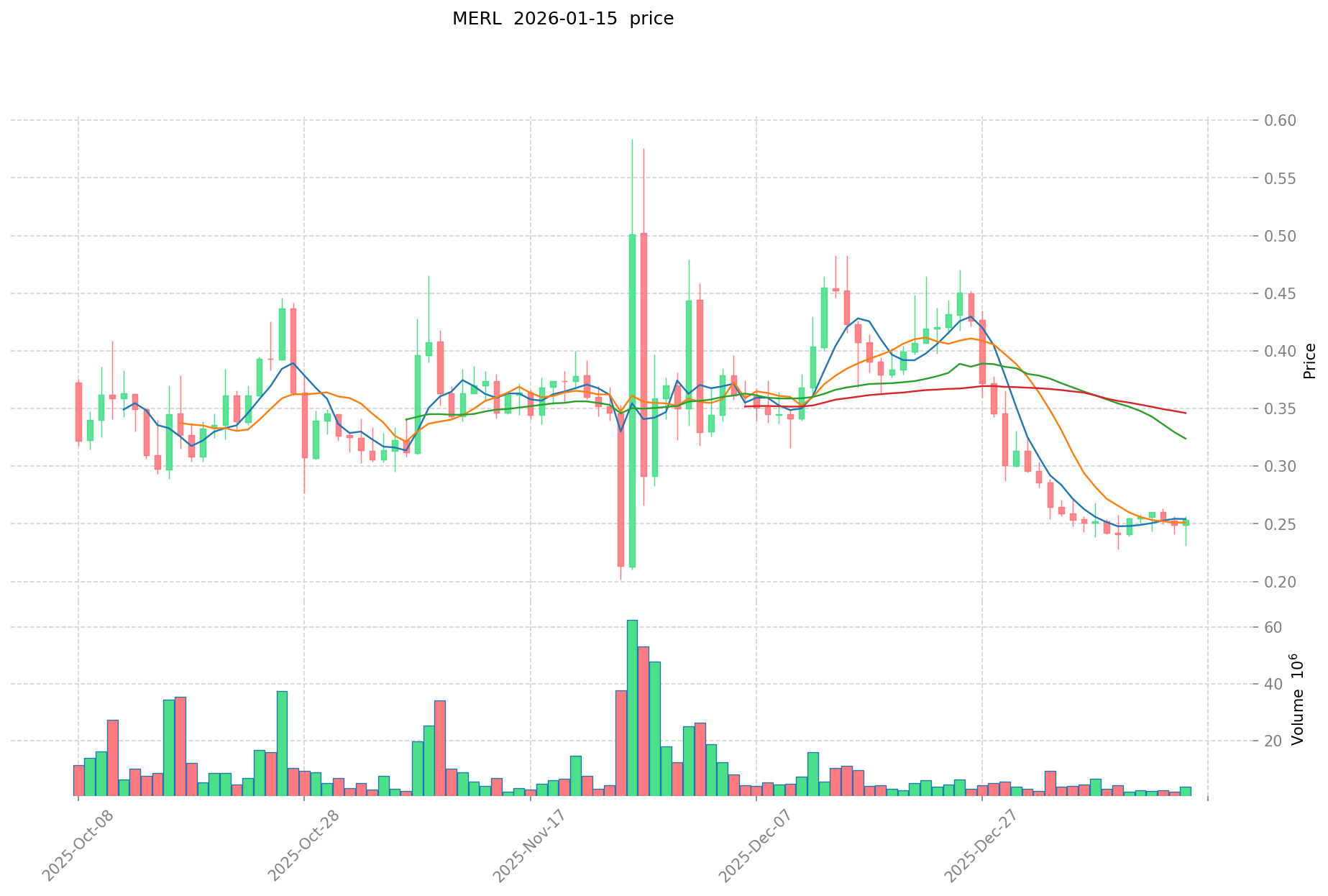
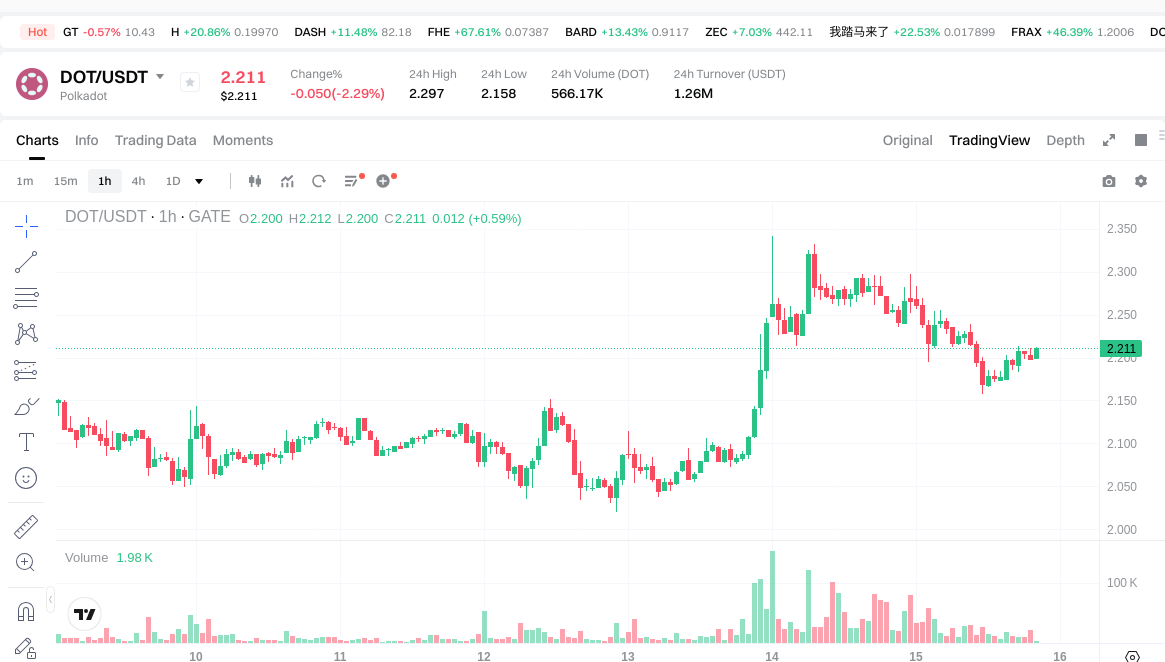
Current Market Status (2026-01-15)
- MERL Current Price: $0.25371
- DOT Current Price: $2.199
- 24-Hour Trading Volume: MERL recorded $1,361,753.20 compared to DOT's $1,284,560.52
- Market Sentiment Index (Fear & Greed Index): 61 (Greed)
View real-time prices:
II. Core Factors Influencing MERL vs DOT Investment Value
Supply Mechanism Comparison (Tokenomics)
-
DOT: Polkadot employs an inflationary token model with dynamic supply adjustments. As the native token of the Polkadot network, DOT serves governance and staking functions, with its issuance rate influenced by network participation and staking ratios.
-
MERL: Based on available materials, specific supply mechanism details for MERL remain limited. The token's economic model and distribution structure require further disclosure from the project team.
-
📌 Historical Pattern: Supply mechanisms play a significant role in driving price cycles. Tokens with clear deflationary or fixed-supply models may demonstrate different volatility characteristics compared to inflationary models during market fluctuations.
Institutional Adoption and Market Application
-
Institutional Holdings: DOT, as the native token of Polkadot, has gained recognition within the blockchain infrastructure sector. Its multi-chain interoperability architecture has attracted attention from some institutional participants. MERL's institutional adoption data remains insufficient for comprehensive assessment.
-
Enterprise Adoption: DOT's underlying technology supports cross-chain communication and parachain ecosystems, with potential applications in enterprise-level blockchain solutions. Current use cases for MERL in cross-border payments, settlements, or investment portfolios lack sufficient documentation.
-
Regulatory Environment: Different jurisdictions maintain varying regulatory approaches toward blockchain assets. DOT, being associated with an established network infrastructure, operates within evolving regulatory frameworks globally. Specific regulatory considerations for MERL depend on its jurisdictional deployment and compliance measures.
Technology Development and Ecosystem Building
-
DOT Technology Evolution: Polkadot continues development in multi-chain architecture, with its relay chain and parachain model designed to facilitate interoperability between different blockchain networks. The network's ongoing technical improvements aim to enhance scalability and security.
-
MERL Technology Development: Available materials provide limited information regarding MERL's specific technical roadmap or developmental milestones. Assessment of its technological competitiveness requires additional project disclosures.
-
Ecosystem Comparison: DOT operates within the Polkadot ecosystem, which encompasses various parachains and decentralized applications. The network supports diverse use cases including DeFi protocols and cross-chain asset transfers. MERL's ecosystem positioning and application scenarios remain less documented in available sources.
Macroeconomic Conditions and Market Cycles
-
Performance in Inflationary Environments: Digital assets may exhibit varying responses to macroeconomic conditions. DOT's value dynamics are influenced by network adoption, staking participation, and broader market sentiment. Comparative analysis with MERL requires more comprehensive market data.
-
Monetary Policy Impact: Interest rate adjustments and currency index fluctuations affect digital asset markets broadly. Both DOT and MERL may experience price movements correlated with traditional financial market conditions, though specific sensitivity levels differ based on project fundamentals.
-
Geopolitical Factors: Cross-border transaction demands and international developments can influence blockchain asset adoption. DOT's positioning in network infrastructure may provide certain utility in decentralized communication scenarios. MERL's role in such contexts requires further evaluation based on project development progress.
III. 2026-2031 Price Forecast: MERL vs DOT
Short-term Forecast (2026)
- MERL: Conservative $0.21-$0.26 | Optimistic $0.26-$0.30
- DOT: Conservative $1.41-$2.21 | Optimistic $2.21-$2.78
Mid-term Forecast (2028-2029)
- MERL may enter a phase of gradual expansion, with estimated prices ranging from $0.20 to $0.47
- DOT may enter a phase of moderate growth, with estimated prices ranging from $1.88 to $3.56
- Key drivers: institutional capital inflows, ETF developments, ecosystem expansion
Long-term Forecast (2030-2031)
- MERL: Baseline scenario $0.21-$0.42 | Optimistic scenario $0.53-$0.70
- DOT: Baseline scenario $2.84-$3.53 | Optimistic scenario $3.76-$5.26
View detailed price forecasts for MERL and DOT
Disclaimer
MERL:
| Year |
Predicted High Price |
Predicted Average Price |
Predicted Low Price |
Price Change |
| 2026 |
0.3010062 |
0.25509 |
0.2066229 |
0 |
| 2027 |
0.350340606 |
0.2780481 |
0.233560404 |
9 |
| 2028 |
0.43358820714 |
0.314194353 |
0.20108438592 |
23 |
| 2029 |
0.4673641000875 |
0.37389128007 |
0.2093791168392 |
47 |
| 2030 |
0.525784612598437 |
0.42062769007875 |
0.214520121940162 |
65 |
| 2031 |
0.700345103981118 |
0.473206151338593 |
0.326512244423629 |
86 |
DOT:
| Year |
Predicted High Price |
Predicted Average Price |
Predicted Low Price |
Price Change |
| 2026 |
2.78334 |
2.209 |
1.41376 |
0 |
| 2027 |
2.5960168 |
2.49617 |
1.6225105 |
13 |
| 2028 |
3.56453076 |
2.5460934 |
1.884109116 |
15 |
| 2029 |
3.5441620128 |
3.05531208 |
2.4748027848 |
38 |
| 2030 |
3.761700232896 |
3.2997370464 |
2.837773859904 |
50 |
| 2031 |
5.26077077307552 |
3.530718639648 |
3.1776467756832 |
60 |
IV. Investment Strategy Comparison: MERL vs DOT
Long-term vs Short-term Investment Strategies
-
MERL: May appeal to investors focused on Bitcoin Layer 2 infrastructure development and emerging blockchain ecosystems. The token's positioning within the Bitcoin scaling narrative could attract participants interested in nascent technological solutions, though adoption remains in early stages.
-
DOT: May suit investors seeking exposure to established multi-chain infrastructure with demonstrated network activity. Polkadot's operational history since 2019 and parachain ecosystem provides a longer track record for evaluation, potentially appealing to those prioritizing network maturity over speculative growth.
Risk Management and Asset Allocation
-
Conservative Investors: A portfolio allocation might consider DOT: 70-80% vs MERL: 20-30%, reflecting DOT's longer operational history and established network infrastructure. Conservative approaches typically emphasize assets with observable network activity and documented use cases.
-
Aggressive Investors: A higher-risk allocation could involve MERL: 40-50% vs DOT: 50-60%, acknowledging MERL's potential upside as an emerging Layer 2 solution while maintaining DOT exposure for diversification. This approach accepts higher volatility in pursuit of growth opportunities.
-
Hedging Instruments: Risk management strategies may include stablecoin allocations (20-30% of portfolio), options contracts for downside protection where available, and cross-asset diversification across different blockchain infrastructure categories to mitigate sector-specific risks.
V. Potential Risk Comparison
Market Risks
-
MERL: As a token launched in 2024, MERL faces liquidity considerations with 24-hour trading volume of $1,361,753.20. Price discovery mechanisms remain in development, and market depth may be insufficient to support larger transactions without significant slippage. The token's correlation with Bitcoin Layer 2 sector sentiment introduces additional volatility factors.
-
DOT: Despite longer market presence, DOT has experienced substantial price retracement from historical peaks, declining from $54.98 to current levels around $2.199. Market sentiment toward multi-chain infrastructure and parachain adoption rates directly influence valuation. Competition from alternative interoperability solutions presents ongoing market positioning challenges.
Technical Risks
-
MERL: Available documentation provides limited insight into network scalability parameters, security audit outcomes, or infrastructure redundancy measures. The project's technical maturity and ability to handle increased transaction volumes remains to be demonstrated through operational history.
-
DOT: Polkadot's relay chain and parachain architecture introduces complexity in network coordination and security sharing mechanisms. Technical dependencies between parachains and the relay chain create systemic considerations. Network upgrades and governance-driven protocol changes may introduce implementation risks affecting stability.
Regulatory Risks
- Regulatory frameworks for blockchain infrastructure tokens continue evolving across jurisdictions. DOT's classification and treatment vary by regulatory authority, with ongoing developments in securities law interpretations affecting operational compliance requirements. MERL's regulatory positioning depends on jurisdictional deployment strategies and token utility definitions, which remain subject to clarification as frameworks develop. Both assets face potential impacts from cross-border transaction monitoring requirements and evolving reporting standards for digital asset service providers.
VI. Conclusion: Which Is the Better Buy?
📌 Investment Value Summary:
-
MERL Considerations: The token operates within the Bitcoin Layer 2 narrative, positioning itself in an emerging sector focused on Bitcoin scalability solutions. Limited operational history and documentation require careful evaluation of project fundamentals before allocation decisions.
-
DOT Considerations: Polkadot maintains established network infrastructure with observable parachain activity and multi-chain interoperability capabilities. The network's longer operational track record provides more data points for fundamental analysis, though price performance has experienced significant retracement from historical levels.
✅ Investment Considerations:
-
Beginning Investors: Those new to digital asset markets may benefit from focusing on assets with established operational histories and comprehensive documentation. Understanding network fundamentals, tokenomics, and risk factors should precede allocation decisions. Starting with smaller position sizes allows learning through market observation.
-
Experienced Investors: Participants familiar with blockchain infrastructure may evaluate both assets through fundamental analysis frameworks, considering network adoption metrics, development activity, and ecosystem growth indicators. Portfolio allocation decisions should reflect individual risk tolerance and investment timeframes rather than market timing attempts.
-
Institutional Participants: Organizations evaluating blockchain infrastructure exposure require comprehensive due diligence processes examining technical architecture, governance frameworks, regulatory compliance measures, and liquidity considerations. Position sizing should align with institutional risk management protocols and fiduciary responsibilities.
⚠️ Risk Disclosure: Cryptocurrency markets demonstrate significant volatility characteristics. Price movements can result in substantial value fluctuations over short timeframes. This analysis presents informational content and does not constitute investment advice, financial recommendations, or solicitation to purchase digital assets. Participants should conduct independent research and consult qualified financial advisors before making allocation decisions.
VII. FAQ
Q1: What is the fundamental difference between MERL and DOT in terms of blockchain infrastructure?
MERL is a Bitcoin Layer 2 scaling solution launched in 2024, while DOT is a multi-chain interoperability protocol operational since 2019. MERL focuses specifically on enhancing Bitcoin's native assets and protocols through Layer 2 technology, targeting the Bitcoin ecosystem expansion. In contrast, DOT operates as a relay chain connecting various independent blockchains (parachains), enabling cross-chain communication and shared security across different networks. The architectural differences reflect distinct design philosophies: MERL extends Bitcoin's capabilities, whereas DOT creates infrastructure for blockchain interoperability.
Q2: How do the liquidity profiles of MERL and DOT compare for trading purposes?
Based on current data (2026-01-15), MERL shows 24-hour trading volume of $1,361,753.20, while DOT records $1,284,560.52. Despite similar volumes, DOT maintains broader exchange availability and deeper order books due to its longer market presence since 2019. MERL's liquidity, as a newer asset launched in 2024, remains in development phases with potential for wider price spreads and slippage on larger transactions. Traders executing substantial positions should consider these liquidity characteristics when planning entry and exit strategies, particularly for MERL where market depth may be insufficient for institutional-sized orders.
Q3: What are the primary risk factors distinguishing MERL from DOT investments?
MERL carries higher protocol maturity risk due to limited operational history, with documentation gaps regarding security audits, scalability testing, and infrastructure redundancy. DOT faces network complexity risks inherent in its relay chain and parachain coordination mechanisms, plus competitive pressures from alternative interoperability solutions. Regulatory positioning differs as well: DOT operates under evolving frameworks applicable to established network infrastructure, while MERL's regulatory classification remains subject to clarification as Bitcoin Layer 2 solutions face jurisdictional evaluation. Both assets share broader market volatility risks, though MERL exhibits amplified sensitivity to Bitcoin Layer 2 sector sentiment.
Q4: How should portfolio allocation differ between conservative and aggressive investors for MERL vs DOT?
Conservative investors might consider DOT-weighted allocations (70-80% DOT vs 20-30% MERL) prioritizing established network activity and documented use cases. This approach emphasizes DOT's longer operational track record and observable parachain ecosystem. Aggressive investors accepting higher volatility for potential growth opportunities could implement more balanced allocations (40-50% MERL vs 50-60% DOT), recognizing MERL's positioning in emerging Bitcoin Layer 2 infrastructure while maintaining DOT exposure for diversification. Both strategies should incorporate risk management through stablecoin reserves (20-30% of portfolio) and position sizing aligned with individual loss tolerance thresholds.
Q5: What technical development indicators should investors monitor for MERL and DOT?
For DOT, monitor parachain auction activity, network upgrade implementations, cross-chain message passing volumes, and developer engagement metrics within the Polkadot ecosystem. Track relay chain security parameters and validator participation rates as network health indicators. For MERL, given limited current documentation, investors should seek disclosure of transaction throughput capabilities, security audit reports, bridge mechanism performance with Bitcoin mainnet, and ecosystem application launches. Development activity on respective GitHub repositories, testnet performance metrics, and partnership announcements with Bitcoin infrastructure providers (for MERL) or blockchain projects (for DOT) serve as qualitative assessment inputs.
Q6: How do macroeconomic conditions differently impact MERL versus DOT valuations?
Both assets demonstrate correlation with broader cryptocurrency market cycles influenced by monetary policy and risk sentiment. DOT's valuation reflects institutional adoption of multi-chain infrastructure and DeFi protocol activity, showing sensitivity to enterprise blockchain investment trends. MERL's price dynamics tie closely to Bitcoin market performance and Layer 2 sector sentiment, with stronger correlation to BTC price movements given its Bitcoin-centric positioning. During inflationary environments or risk-off periods, DOT may benefit from institutional infrastructure investment themes, while MERL tracks Bitcoin's role as a digital asset narrative. Interest rate adjustments affect both through liquidity conditions in digital asset markets.
Q7: What are the key milestones that could significantly impact MERL and DOT prices in 2026-2027?
For DOT, watch for successful parachain integration expansions, enterprise partnership announcements, potential ETF developments related to multi-chain infrastructure, and governance decisions affecting tokenomics. Network upgrade implementations improving scalability or cross-chain functionality could drive adoption metrics. For MERL, critical milestones include mainnet stability demonstrations, transaction volume growth on Layer 2, security audit publications, major DApp launches utilizing MERL infrastructure, and listings on additional tier-1 exchanges improving liquidity. Both assets face influence from broader Bitcoin and Ethereum developments, regulatory clarity in major jurisdictions, and institutional capital allocation trends toward blockchain infrastructure sectors.
Q8: What due diligence steps are essential before investing in MERL compared to DOT?
For DOT, review Polkadot's technical documentation, analyze parachain auction results and slot utilization, examine validator distribution and staking economics, and assess ecosystem growth through DApp activity metrics. Evaluate governance proposal outcomes and development roadmap progress. For MERL, prioritize verification of security audit reports, assessment of team credentials and project transparency, evaluation of Bitcoin Layer 2 competitive positioning, and analysis of bridge mechanism security with Bitcoin mainnet. Both require examination of regulatory compliance measures, review of tokenomics and vesting schedules, assessment of exchange liquidity profiles, and understanding of network upgrade governance processes before allocation decisions.
* The information is not intended to be and does not constitute financial advice or any other recommendation of any sort offered or endorsed by Gate.