This comprehensive analysis compares MINA and STX, two distinct Layer-1 blockchain solutions competing for investor attention. MINA leverages zero-knowledge proof technology to compress the entire blockchain into 22KB, emphasizing technical innovation and privacy, while STX, launched in 2019, positions itself as decentralized application infrastructure enabling user data sovereignty. The article evaluates both assets across historical price performance, tokenomics, institutional adoption, and technological ecosystems to determine investment merit. With current prices at $0.0889 (MINA) and $0.3711 (STX), the comparison examines price forecasts through 2031, institutional trends, and regulatory considerations. Suitable allocation strategies range from conservative (30% MINA/70% STX) to aggressive (50/50), addressing different investor profiles and risk tolerances for optimal portfolio diversification in the cryptocurrency market.
Introduction: Investment Comparison Between MINA and STX
In the cryptocurrency market, the comparison between MINA vs STX remains an unavoidable topic for investors. The two differ notably in market cap ranking, application scenarios, and price performance, representing distinct positions within the crypto asset landscape.
MINA (MINA): Since its launch in 2021, it has gained market recognition through its positioning as the world's lightest blockchain, compressing the entire chain into a constant size of approximately 22KB through zero-knowledge proof technology.
STX (STX): Launched in 2019, it has been positioned as a decentralized application infrastructure that enables users to better control their data while making content censorship more difficult, becoming one of the prominent blockchain browser platforms.
This article will comprehensively analyze the investment value comparison of MINA vs STX around historical price trends, supply mechanisms, institutional adoption, technical ecosystems, and future predictions, attempting to answer investors' most pressing question:
"Which is the better buy right now?"
I. Historical Price Comparison and Market Overview
MINA and STX Historical Price Trends
- 2021: MINA reached a price peak at $9.09 in June 2021, coinciding with broader cryptocurrency market enthusiasm during that period.
- 2024: STX experienced notable price movement, reaching its historical high of $3.86 in April 2024.
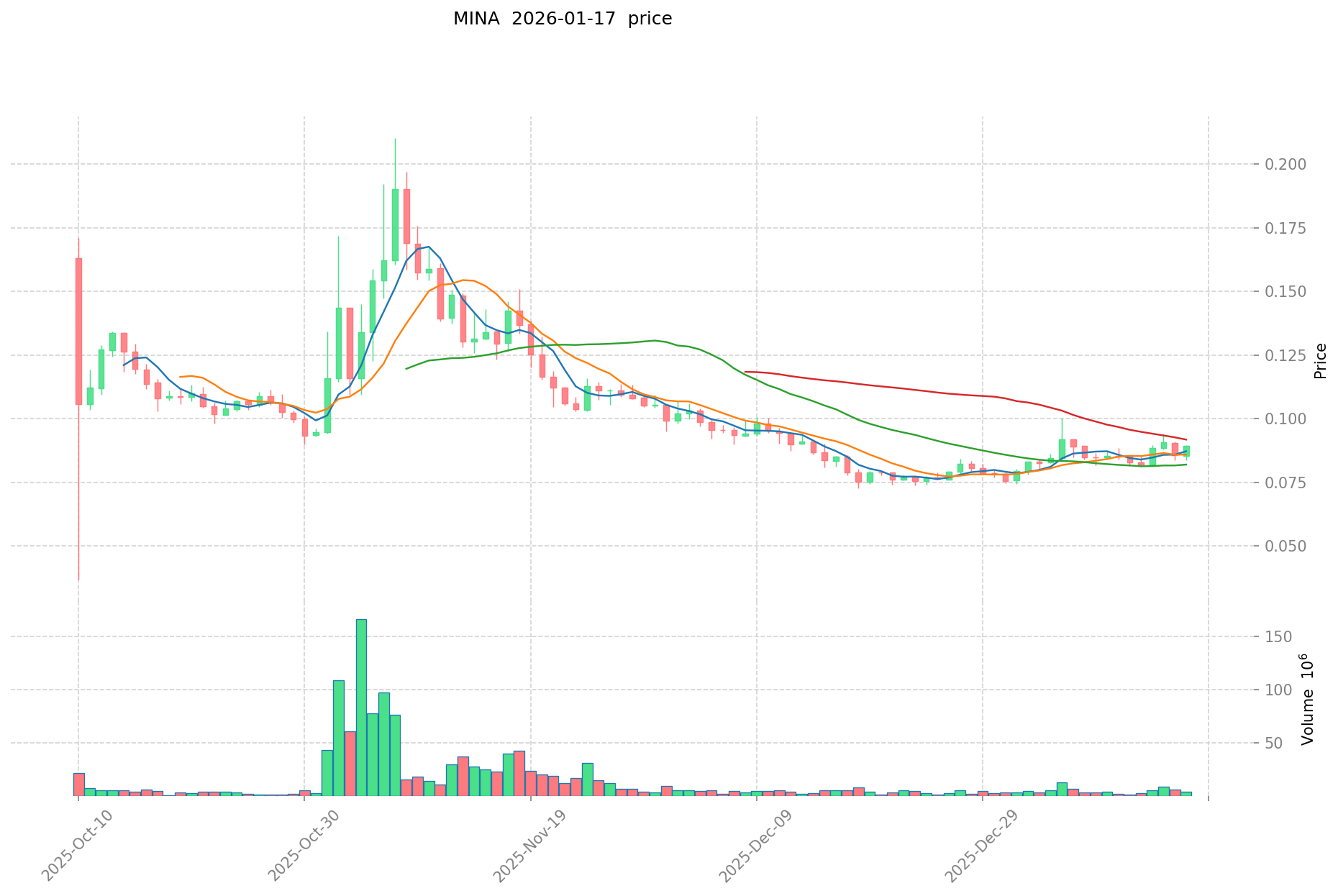
- Comparative Analysis: During the recent market cycle, MINA declined from its peak of $9.09 to a low of $0.063436 (recorded in October 2025), representing a substantial contraction. Meanwhile, STX fluctuated from its high of $3.86 to a low of $0.04559639 (recorded in March 2020), demonstrating different market dynamics across varying timeframes.
Current Market Status (2026-01-17)
- MINA current price: $0.0889
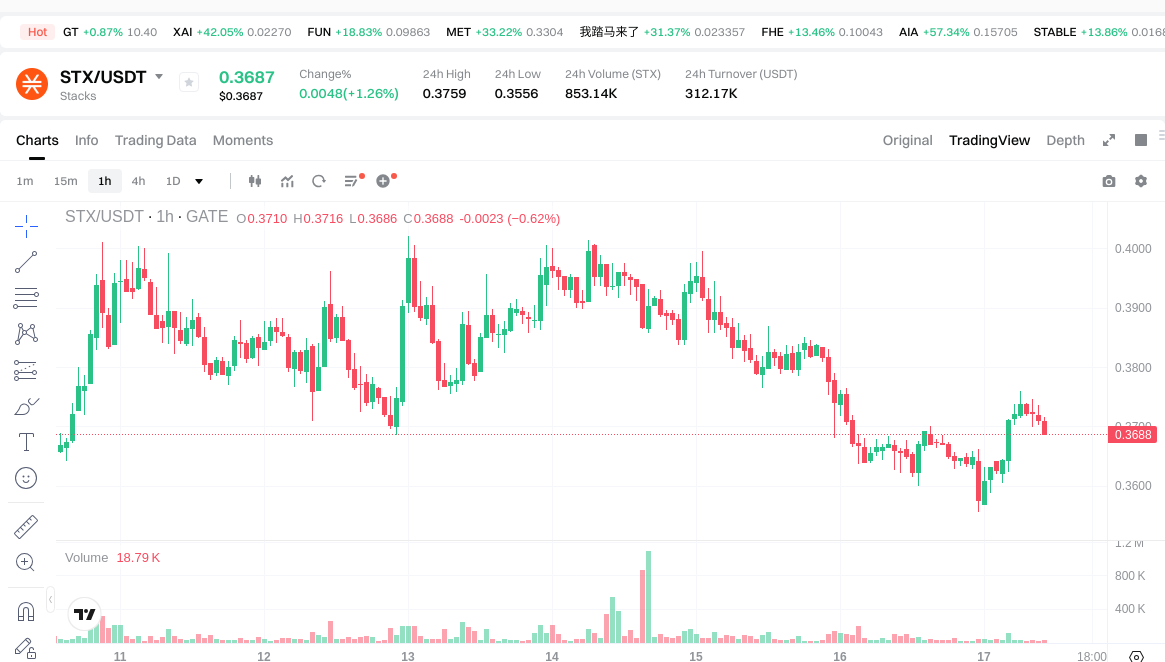
- STX current price: $0.3711
- 24-hour trading volume: MINA $330,518.69 vs STX $307,999.12
- Market sentiment index (Fear & Greed Index): 50 (Neutral)
View real-time prices:
II. Core Factors Affecting MINA vs STX Investment Value
Supply Mechanism Comparison (Tokenomics)
- MINA: Information about MINA's supply mechanism was not available in the provided materials.
- STX: Information about STX's supply mechanism was not available in the provided materials.
- 📌 Historical Pattern: Supply mechanisms play a role in driving price cycle changes, though specific patterns for these tokens require further analysis.
Institutional Adoption and Market Application
- Institutional Holdings: The reference materials indicate that STX was mentioned in discussions related to U.S. cryptocurrency policy developments, appearing in categories associated with projects mentioned by Trump. However, specific institutional holding data was not provided.
- Enterprise Adoption: Limited information was available regarding enterprise adoption for cross-border payments, settlements, or investment portfolios for either MINA or STX.
- National Policy: According to the materials, STX appeared in analyses of U.S. concept coins, suggesting potential policy relevance. MINA was noted as a U.S.-originated project ("Made in USA") in the orange region of policy discussions, which may indicate certain policy advantages. However, specific regulatory attitudes from different countries were not detailed.
Technology Development and Ecosystem Construction
- MINA Technology Upgrades: MINA was referenced as a lightweight blockchain project with technical innovation that may make it more attractive in policy-making contexts. Specific upgrade details were not provided.
- STX Technology Development: STX was mentioned in contexts related to DeFi and Layer 2 solutions, with references to its technical strength. The materials noted it as part of a diverse range of project types.
- Ecosystem Comparison: The materials provided limited specific information about DeFi, NFT, payment systems, or smart contract implementation for either MINA or STX.
Macroeconomic Environment and Market Cycles
- Performance in Inflationary Environments: The reference materials did not contain specific information comparing the anti-inflation properties of MINA versus STX.
- Macroeconomic Monetary Policy: The materials discussed broader market trends, including the 2024 approval of Bitcoin and Ethereum spot ETFs and their impact on institutional capital flows. However, specific impacts of interest rates or dollar index movements on MINA or STX were not detailed.
- Geopolitical Factors: The materials mentioned U.S.-China technology competition and suggested that U.S.-originated projects may have natural advantages in policy support, though specific impacts on cross-border transaction demand or international situations related to MINA or STX were not elaborated.
III. 2026-2031 Price Forecast: MINA vs STX
Short-term Forecast (2026)
- MINA: Conservative $0.0676-$0.0890 | Optimistic $0.0890-$0.0979
- STX: Conservative $0.2692-$0.3687 | Optimistic $0.3687-$0.4756
Mid-term Forecast (2028-2029)
- MINA may enter a gradual accumulation phase, with projected price range of $0.0697-$0.1425
- STX may enter a potential expansion phase, with projected price range of $0.2871-$0.6759
- Key drivers: institutional capital flows, ETF developments, ecosystem growth
Long-term Forecast (2030-2031)
- MINA: Base scenario $0.0690-$0.1429 | Optimistic scenario $0.1014-$0.1915
- STX: Base scenario $0.3861-$0.6534 | Optimistic scenario $0.4508-$0.9605
View detailed price predictions for MINA and STX
Disclaimer
MINA:
| Year |
Predicted High Price |
Predicted Average Price |
Predicted Low Price |
Price Change |
| 2026 |
0.097889 |
0.08899 |
0.0676324 |
0 |
| 2027 |
0.105586635 |
0.0934395 |
0.060735675 |
5 |
| 2028 |
0.108469243575 |
0.0995130675 |
0.06965914725 |
11 |
| 2029 |
0.142467883086375 |
0.1039911555375 |
0.084232835985375 |
16 |
| 2030 |
0.162662965491757 |
0.123229519311937 |
0.069008530814685 |
38 |
| 2031 |
0.191547964818475 |
0.142946242401847 |
0.101491832105311 |
60 |
STX:
| Year |
Predicted High Price |
Predicted Average Price |
Predicted Low Price |
Price Change |
| 2026 |
0.475623 |
0.3687 |
0.269151 |
0 |
| 2027 |
0.434826345 |
0.4221615 |
0.32928597 |
13 |
| 2028 |
0.595606552275 |
0.4284939225 |
0.287090928075 |
15 |
| 2029 |
0.6759063133515 |
0.5120502373875 |
0.445483706527125 |
37 |
| 2030 |
0.7127739304434 |
0.5939782753695 |
0.386085878990175 |
60 |
| 2031 |
0.960462871272481 |
0.65337610290645 |
0.45082951100545 |
76 |
IV. Investment Strategy Comparison: MINA vs STX
Long-term vs Short-term Investment Strategies
- MINA: May suit investors interested in technological innovation and lightweight blockchain applications. The project's zero-knowledge proof technology and compact blockchain size could appeal to those focusing on technical differentiation in the crypto space.
- STX: May suit investors seeking exposure to decentralized application infrastructure and browser-based blockchain platforms. The project's positioning in enabling user data control could attract those interested in decentralization-focused use cases.
Risk Management and Asset Allocation
- Conservative investors: Consider MINA 30% vs STX 70% allocation, given STX's relatively established market presence since 2019
- Aggressive investors: Consider MINA 50% vs STX 50% allocation, balancing innovation potential with market-tested infrastructure
- Hedging tools: Stablecoin allocation, options strategies, cross-currency portfolio diversification
V. Potential Risk Comparison
Market Risk
- MINA: The token experienced substantial price contraction from its peak of $9.09 to $0.063436, indicating significant volatility patterns. Current trading volume of $330,518.69 suggests moderate market activity levels.
- STX: Historical price movements from $3.86 to $0.04559639 demonstrate considerable price range fluctuation. Current trading volume of $307,999.12 indicates comparable market activity to MINA.
Technical Risk
- MINA: Scalability and network stability considerations apply to the lightweight blockchain architecture, though specific technical vulnerabilities were not detailed in available materials.
- STX: Network stability and potential security considerations exist for the decentralized application infrastructure, though specific technical risks were not elaborated in the reference materials.
Regulatory Risk
- Global regulatory policies may impact both projects differently. MINA was noted as a U.S.-originated project, potentially benefiting from certain policy considerations. STX appeared in discussions related to U.S. cryptocurrency policy developments. However, specific regulatory attitudes from different jurisdictions require ongoing monitoring.
VI. Conclusion: Which Is the Better Buy?
📌 Investment Value Summary:
- MINA Advantages: Innovative zero-knowledge proof technology creating a consistently lightweight blockchain (approximately 22KB), technical differentiation in the market, potential policy considerations as a U.S.-originated project.
- STX Advantages: Established market presence since 2019, positioning in decentralized application infrastructure, appearance in U.S. policy discussions, diversified project type categorization including DeFi and Layer 2 references.
✅ Investment Recommendations:
- Beginner Investors: Consider starting with smaller position sizes in either asset, prioritizing education about blockchain technology and market dynamics before significant capital allocation. Monitor market sentiment and volatility patterns.
- Experienced Investors: Evaluate portfolio diversification benefits of including both assets, considering their different technological approaches and market positions. Apply risk management strategies including stop-loss orders and position sizing based on volatility metrics.
- Institutional Investors: Assess alignment with broader cryptocurrency exposure strategies, considering institutional adoption trends, regulatory landscape developments, and ecosystem maturity. Evaluate liquidity requirements and trading infrastructure capabilities.
⚠️ Risk Disclaimer: The cryptocurrency market exhibits substantial volatility. This content does not constitute investment advice. Investors should conduct independent research and consult with financial advisors before making investment decisions.
VII. FAQ
Q1: What is the main technological difference between MINA and STX?
MINA utilizes zero-knowledge proof technology to maintain a constant blockchain size of approximately 22KB, making it the world's lightest blockchain. STX, on the other hand, focuses on decentralized application infrastructure that enables users to control their data and operates as a blockchain browser platform. MINA's approach emphasizes technical innovation in blockchain compression and scalability through cryptographic proofs, while STX prioritizes user data sovereignty and decentralized application deployment capabilities. These fundamental architectural differences result in distinct use cases and ecosystem development trajectories.
Q2: Which asset has shown better price stability historically?
Neither MINA nor STX has demonstrated strong price stability, both experiencing significant volatility. MINA declined from its peak of $9.09 (June 2021) to a low of $0.063436 (October 2025), representing over 99% contraction. STX fluctuated from $3.86 (April 2024) to $0.04559639 (March 2020), also showing substantial downside movement. As of January 2026, both assets continue to trade well below their historical peaks, reflecting the broader cryptocurrency market's volatile nature. Investors should not expect price stability from either asset and should implement appropriate risk management strategies.
Q3: How do institutional adoption levels compare between MINA and STX?
Available information suggests limited specific institutional holding data for both assets. STX has been mentioned in discussions related to U.S. cryptocurrency policy developments and appeared in analyses of projects potentially influenced by political developments. MINA was noted as a U.S.-originated project with potential policy advantages. However, concrete institutional adoption metrics, enterprise partnerships, or significant treasury holdings were not detailed in available materials. Both projects may benefit from broader institutional cryptocurrency adoption trends, but neither currently demonstrates clear institutional preference based on available evidence.
Q4: What are the projected price ranges for MINA and STX through 2031?
Based on available forecasts, MINA's projected price ranges from $0.0676-$0.0979 in 2026, potentially reaching $0.1014-$0.1915 by 2031 under optimistic scenarios. STX shows higher absolute price projections, ranging from $0.2692-$0.4756 in 2026 and potentially reaching $0.4508-$0.9605 by 2031. These forecasts suggest STX may maintain higher absolute valuations, though percentage gains could vary. However, cryptocurrency price predictions carry substantial uncertainty, influenced by market cycles, technological developments, regulatory changes, and macroeconomic conditions. Investors should treat these projections as speculative estimates rather than guaranteed outcomes.
Q5: Which asset is more suitable for portfolio diversification?
Both assets offer distinct diversification characteristics. MINA provides exposure to zero-knowledge proof technology and lightweight blockchain innovation, potentially benefiting from privacy-focused market trends. STX offers exposure to decentralized application infrastructure and browser-based blockchain platforms. For conservative portfolios, a 30% MINA / 70% STX allocation may balance innovation with established market presence. Aggressive investors might consider 50/50 allocation to maximize exposure to both technological approaches. Optimal diversification depends on individual risk tolerance, investment horizon, and existing portfolio composition. Neither asset should constitute a majority portfolio holding given their volatility profiles.
Q6: What are the primary risk factors investors should monitor?
Key risk factors include market volatility (both assets have experienced 90%+ drawdowns from peaks), regulatory uncertainty (particularly regarding U.S. cryptocurrency policies affecting both projects), technical risks (network stability, security vulnerabilities, scalability challenges), competitive pressure (from other blockchain platforms and technological alternatives), and macroeconomic conditions (interest rates, inflation, institutional capital flows). Additionally, investors should monitor trading volume trends, ecosystem development progress, and any significant protocol upgrades or governance changes. The cryptocurrency market's inherent unpredictability requires continuous risk assessment and position management.
Q7: How do current trading volumes compare between MINA and STX?
As of January 17, 2026, MINA recorded 24-hour trading volume of $330,518.69, while STX showed $307,999.12, representing relatively similar liquidity levels. Both volumes suggest moderate market activity without dominant liquidity advantages for either asset. These comparable trading volumes indicate similar market interest and accessibility for both assets. However, trading volume can fluctuate significantly based on market conditions, news events, and broader cryptocurrency market trends. Investors should monitor volume trends over time rather than focusing on single-day metrics, as sustained volume growth may indicate increasing market adoption and liquidity depth.
Q8: What role might regulatory developments play in future performance?
Regulatory developments could significantly impact both assets, particularly given their U.S. origins. MINA's designation as a "Made in USA" project and STX's appearance in U.S. policy discussions suggest potential sensitivity to American cryptocurrency regulations. Positive regulatory clarity could benefit both projects through increased institutional adoption and mainstream acceptance. Conversely, restrictive policies could limit growth potential or create compliance challenges. Global regulatory coordination, securities classification decisions, and tax treatment determinations may affect both assets differently based on their specific use cases and technological characteristics. Investors should monitor regulatory developments across major jurisdictions and assess potential impacts on project viability and market accessibility.
* The information is not intended to be and does not constitute financial advice or any other recommendation of any sort offered or endorsed by Gate.