This comprehensive article compares MIRA and AAVE, two distinct cryptocurrency projects within the blockchain ecosystem. MIRA represents an emerging decentralized verification network for autonomous AI launched in September 2025, currently trading at $0.1215 with significant volatility. AAVE stands as an established DeFi lending protocol with a price of $160.37 and substantially higher trading volume. The article examines historical price trends, current market status as of January 22, 2026, and provides price projections through 2031 for both tokens. It analyzes key investment factors including tokenomics, institutional adoption, technological development, and macroeconomic influences. The guide offers tailored investment strategies for conservative, aggressive, and institutional participants, while comprehensively addressing market risks, technical risks, and regulatory considerations. Concluding with a detailed FAQ section, this resource equips investors with critical information for informed decision-maki
Introduction: MIRA Investment Value, Price Prediction, and Risk Analysis
In the rapidly evolving cryptocurrency market, MIRA has emerged as a noteworthy project attracting investor attention. Positioned as a decentralized verification network for autonomous AI, MIRA represents a unique approach to addressing reliability challenges in artificial intelligence systems.
MIRA (MIRA): Launched in September 2025, this project aims to enable truly autonomous AI through consensus-based verification mechanisms. By routing outputs through multiple independent AI models and requiring agreement between them, MIRA creates mathematically verifiable results without human intervention, targeting high-stakes domains like healthcare, finance, and legal services.
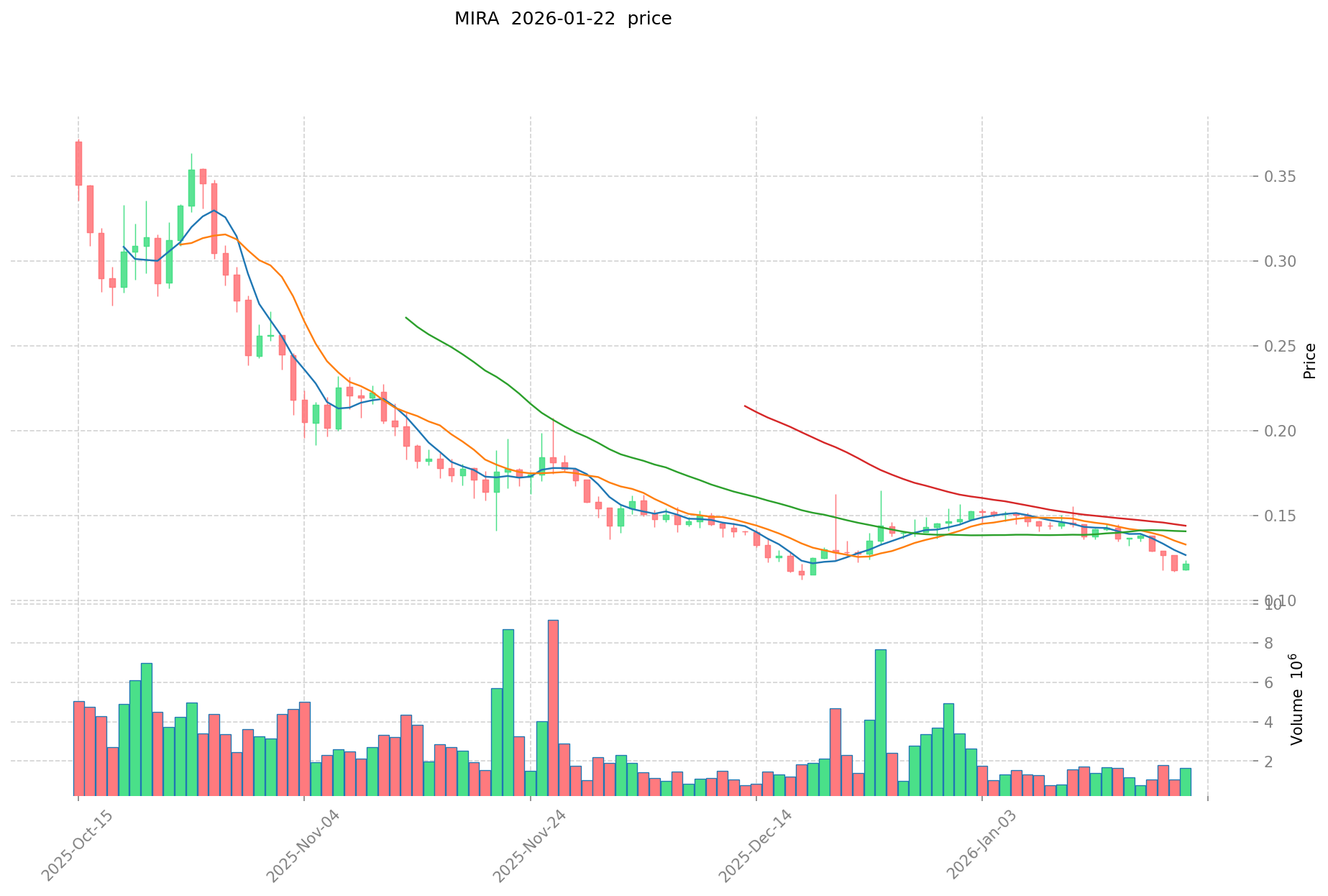
As of January 22, 2026, MIRA is ranked 817th by market capitalization, with a current price of approximately $0.1215 and a circulating supply of 191,200,000 tokens out of a maximum supply of 1,000,000,000. The token has experienced notable volatility, with prices ranging from a low of $0.1122 to a peak of $2.6662 since its launch.
This article will provide a comprehensive analysis covering historical price trends, tokenomics and supply mechanisms, technical ecosystem development, and future price projections. We aim to address key questions that investors commonly consider:
"What factors influence MIRA's value proposition, and what are the associated investment considerations?"
I. Historical Price Comparison and Current Market Status
Historical Price Trends of MIRA (Coin A) and AAVE (Coin B)
- 2025: MIRA reached a price peak of 2.6662 on September 26, 2025, followed by a significant decline. The token experienced substantial volatility during its initial months after launch.
- 2020-2021: AAVE saw notable growth during the DeFi summer period, reaching a peak of 661.69 on May 19, 2021. The platform's decentralized lending protocol gained significant traction during this bull market cycle.
- Comparative Analysis: During recent market cycles, MIRA declined from its peak of 2.6662 to a low of 0.1122 on December 18, 2025, representing considerable downward pressure. Meanwhile, AAVE has experienced a longer-term correction from its 2021 peak, currently trading substantially below historical levels.
Current Market Status (January 22, 2026)
- MIRA current price: 0.1215
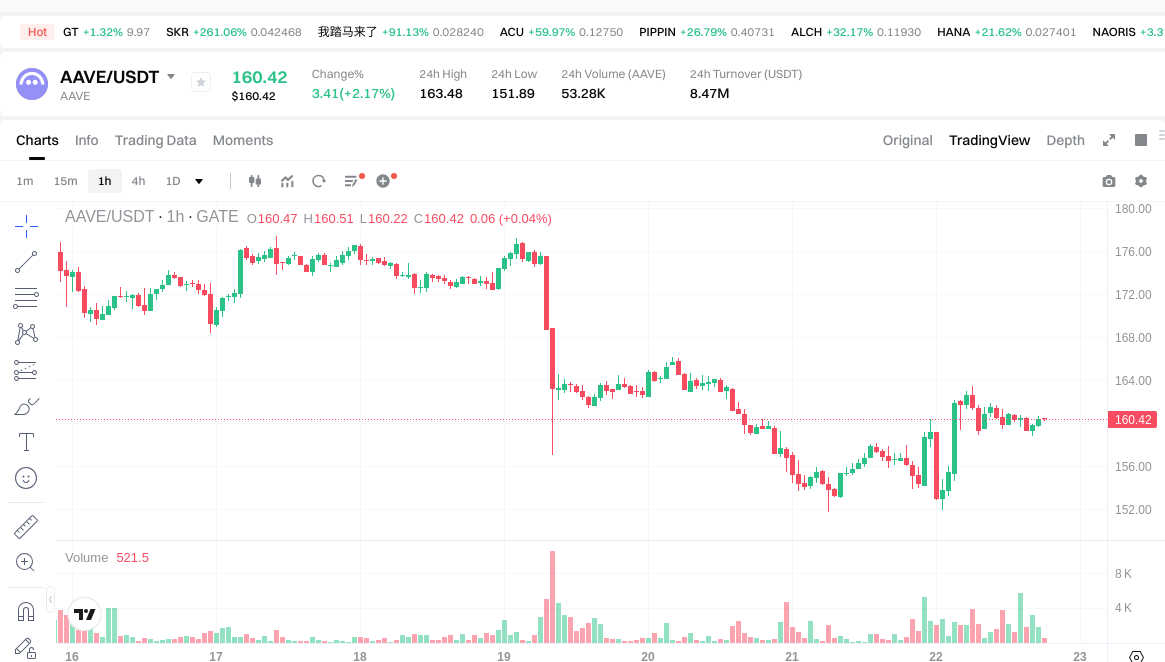
- AAVE current price: 160.37
- 24-hour trading volume: MIRA at 164,842.75 vs AAVE at 8,435,018.29
- Market Sentiment Index (Fear & Greed Index): 20 (Extreme Fear)
Check real-time prices:
II. Core Factors Affecting MIRA vs AAVE Investment Value
Supply Mechanism Comparison (Tokenomics)
Due to the absence of specific supply mechanism data in the provided materials, a detailed tokenomics comparison cannot be presented at this time.
Institutional Adoption and Market Application
Without concrete data regarding institutional holdings, enterprise adoption patterns, or regulatory frameworks from different jurisdictions, a comparative analysis of institutional preferences and real-world applications cannot be conducted.
Technology Development and Ecosystem Construction
The provided materials do not contain information about technical upgrades, development roadmaps, or ecosystem implementations for either MIRA or AAVE. Therefore, a technical and ecosystem comparison cannot be performed.
Macroeconomic Factors and Market Cycles
In the absence of historical performance data under various macroeconomic conditions, including inflationary environments, monetary policy shifts, or geopolitical events, an analysis of how these factors influence MIRA versus AAVE cannot be provided.
III. 2026-2031 Price Forecast: MIRA vs AAVE
Short-term Forecast (2026)
- MIRA: Conservative $0.0826 - $0.1214 | Optimistic $0.1214 - $0.1287
- AAVE: Conservative $129.87 - $160.33 | Optimistic $160.33 - $174.76
Mid-term Forecast (2028-2029)
- MIRA may enter a gradual expansion phase, with estimated price range of $0.1192 - $0.2001
- AAVE may enter a moderate growth phase, with estimated price range of $133.70 - $318.02
- Key drivers: institutional capital inflows, ETF developments, ecosystem expansion
Long-term Forecast (2030-2031)
- MIRA: Baseline scenario $0.1514 - $0.2383 | Optimistic scenario $0.2050 - $0.2383
- AAVE: Baseline scenario $138.55 - $472.46 | Optimistic scenario $221.36 - $472.46
View detailed price predictions for MIRA and AAVE
Disclaimer
MIRA:
| Year |
Predicted High Price |
Predicted Average Price |
Predicted Low Price |
Price Change |
| 2026 |
0.128684 |
0.1214 |
0.082552 |
0 |
| 2027 |
0.1312941 |
0.125042 |
0.07377478 |
2 |
| 2028 |
0.1576467015 |
0.12816805 |
0.1191962865 |
5 |
| 2029 |
0.20007032605 |
0.14290737575 |
0.1329038594475 |
17 |
| 2030 |
0.238369502751 |
0.1714888509 |
0.166344185373 |
41 |
| 2031 |
0.227471386276305 |
0.2049291768255 |
0.15164759085087 |
68 |
AAVE:
| Year |
Predicted High Price |
Predicted Average Price |
Predicted Low Price |
Price Change |
| 2026 |
174.7597 |
160.33 |
129.8673 |
0 |
| 2027 |
214.457408 |
167.54485 |
127.334086 |
4 |
| 2028 |
238.75141125 |
191.001129 |
133.7007903 |
19 |
| 2029 |
318.016879785 |
214.876270125 |
206.28121932 |
33 |
| 2030 |
394.3409309334 |
266.446574955 |
138.5522189766 |
66 |
| 2031 |
472.463066710206 |
330.3937529442 |
221.363814472614 |
105 |
IV. Investment Strategy Comparison: MIRA vs AAVE
Long-term vs Short-term Investment Strategies
- MIRA: May appeal to investors interested in emerging AI verification infrastructure with tolerance for early-stage volatility. The project's focus on autonomous AI consensus mechanisms positions it within specialized decentralized verification applications.
- AAVE: May suit investors seeking exposure to established DeFi lending protocols with demonstrated market presence. The platform's track record in decentralized finance and liquidity provision represents a different risk-return profile.
Risk Management and Asset Allocation
- Conservative Investors: MIRA 15-20% vs AAVE 25-30% (within crypto portfolio allocation)
- Aggressive Investors: MIRA 30-40% vs AAVE 40-50% (within crypto portfolio allocation)
- Hedging Tools: Stablecoin positions, options strategies, cross-asset diversification across different blockchain sectors
V. Potential Risk Comparison
Market Risk
- MIRA: The token has demonstrated considerable price volatility since launch, declining from 2.6662 to 0.1122 within approximately three months. Lower trading volume of 164,842.75 compared to more established projects may contribute to liquidity concerns.
- AAVE: While experiencing substantial correction from 2021 peaks, the project maintains higher trading volume at 8,435,018.29. Market sentiment currently reflects extreme fear conditions (Fear & Greed Index: 20), affecting broader market participants.
Technical Risk
- MIRA: As an emerging verification network for autonomous AI launched in September 2025, the project faces developmental uncertainties common to newer blockchain infrastructures.
- AAVE: Established DeFi protocols face ongoing considerations regarding smart contract security, platform scalability, and competitive pressures within decentralized lending markets.
Regulatory Risk
- Evolving regulatory frameworks across different jurisdictions may impact both projects differently. AI-focused blockchain applications and DeFi lending protocols each face distinct regulatory considerations regarding compliance requirements, operational parameters, and cross-border implementations.
VI. Conclusion: Which Is the Better Buy?
📌 Investment Value Summary:
- MIRA Characteristics: Represents exposure to specialized AI verification infrastructure with consensus-based mechanisms. Current market position at rank 817 with circulating supply of 191,200,000 tokens out of 1,000,000,000 maximum supply indicates early development stage.
- AAVE Characteristics: Established presence in decentralized lending protocols with demonstrated market cycles. Higher trading volume and longer operational history provide different risk considerations compared to newer projects.
✅ Investment Considerations:
- Newer Market Participants: Consider starting with smaller position sizes across diversified blockchain sectors. Understanding fundamental differences between AI verification networks and DeFi lending protocols helps inform allocation decisions.
- Experienced Market Participants: May evaluate portfolio weighting based on risk tolerance, sector exposure preferences, and long-term conviction in specific use cases. Consider correlation between different blockchain verticals when constructing positions.
- Institutional Participants: May conduct comprehensive due diligence regarding liquidity profiles, custody solutions, regulatory compliance frameworks, and alignment with investment mandates before establishing positions.
⚠️ Risk Disclosure: Cryptocurrency markets exhibit substantial volatility. This analysis does not constitute investment advice. Participants should conduct independent research and consider consulting qualified financial professionals before making investment decisions.
VII. FAQ
Q1: What is MIRA and how does it differ from traditional cryptocurrency projects?
MIRA is a decentralized verification network for autonomous AI that launched in September 2025. Unlike traditional cryptocurrencies, MIRA focuses on creating mathematically verifiable AI results through consensus-based mechanisms. The platform routes AI outputs through multiple independent models and requires agreement between them before producing results, eliminating the need for human intervention. This positions MIRA specifically for high-stakes domains like healthcare, finance, and legal services, where AI reliability and verification are critical. As of January 22, 2026, MIRA ranks 817th by market capitalization with a circulating supply of 191,200,000 tokens out of a maximum supply of 1,000,000,000.
Q2: How has MIRA's price performance compared since its launch?
MIRA has experienced significant volatility since its September 2025 launch. The token reached its peak price of $2.6662 on September 26, 2025, followed by a substantial decline to a low of $0.1122 on December 18, 2025—representing a correction of approximately 95.8% from its all-time high. As of January 22, 2026, MIRA trades at approximately $0.1215 with a 24-hour trading volume of $164,842.75. This volatility pattern is characteristic of early-stage cryptocurrency projects, particularly those introducing novel technological concepts like AI verification infrastructure.
Q3: What are the price predictions for MIRA between 2026 and 2031?
Price projections for MIRA suggest varied scenarios depending on market conditions. For 2026, conservative estimates range from $0.0826 to $0.1214, while optimistic scenarios project $0.1214 to $0.1287. Mid-term forecasts for 2028-2029 estimate a price range of $0.1192 to $0.2001 during a potential gradual expansion phase. Long-term projections for 2030-2031 present a baseline scenario of $0.1514 to $0.2383, with optimistic scenarios reaching $0.2050 to $0.2383. However, these projections remain speculative and subject to numerous variables including market adoption, technological development, regulatory changes, and broader cryptocurrency market cycles.
Q4: What are the primary risks associated with investing in MIRA?
MIRA presents several notable risk categories. Market risk includes substantial price volatility, as evidenced by the 95.8% decline from peak to trough, and relatively low trading volume of $164,842.75 compared to established projects, which may create liquidity challenges. Technical risk stems from MIRA being an emerging verification network launched only in September 2025, facing developmental uncertainties common to new blockchain infrastructures. Regulatory risk involves evolving frameworks across jurisdictions that may impact AI-focused blockchain applications differently than traditional cryptocurrencies. Additionally, the current market sentiment index shows extreme fear conditions (20 out of 100), reflecting broader negative market psychology.
Q5: How should different investor types approach MIRA allocation in their portfolios?
Investment approach varies significantly by investor profile. Newer market participants should consider starting with smaller position sizes and focus on understanding the fundamental differences between AI verification networks and other blockchain sectors before allocating capital. Conservative investors might consider MIRA allocation of 15-20% within their cryptocurrency portfolio, balanced with exposure to more established projects. Aggressive investors with higher risk tolerance may allocate 30-40% to MIRA, though this should still represent only a portion of overall portfolio holdings. Institutional participants should conduct comprehensive due diligence regarding liquidity profiles, custody solutions, regulatory compliance frameworks, and alignment with investment mandates before establishing positions.
Q6: What factors could drive MIRA's value in the future?
Several potential catalysts could influence MIRA's future valuation. Successful implementation and adoption of its AI verification mechanisms in high-stakes domains like healthcare, finance, and legal services could drive fundamental value. Institutional capital inflows into the AI and blockchain intersection sector may provide upward momentum. Ecosystem expansion, including developer adoption and integration with existing AI platforms, represents another growth vector. Broader cryptocurrency market cycles, including potential bull markets driven by macroeconomic factors or regulatory clarity, could lift MIRA alongside other digital assets. However, the project's early stage means execution risk remains substantial, and these potential catalysts are not guaranteed to materialize.
Q7: How does MIRA's current market position compare to established projects like AAVE?
MIRA and AAVE represent fundamentally different sectors within cryptocurrency markets. As of January 22, 2026, MIRA ranks 817th by market capitalization with a price of $0.1215 and 24-hour trading volume of $164,842.75, reflecting its early-stage status in the AI verification sector. In contrast, AAVE trades at $160.37 with significantly higher trading volume of $8,435,018.29, representing an established presence in decentralized lending protocols with demonstrated market cycles. AAVE reached a peak of $661.69 during the 2021 DeFi bull market, while MIRA's peak of $2.6662 occurred shortly after its September 2025 launch. This comparison highlights the different maturity levels, liquidity profiles, and sector exposures between emerging AI-focused projects and established DeFi platforms.
Q8: What should investors consider before allocating capital to MIRA?
Before investing in MIRA, several critical considerations warrant attention. First, assess risk tolerance and investment timeframe, as MIRA represents an early-stage project with substantial volatility and developmental uncertainty. Second, evaluate portfolio diversification—MIRA should represent only a portion of cryptocurrency holdings, which themselves should be part of a broader diversified investment strategy. Third, conduct independent research on the AI verification use case and competitive landscape to understand MIRA's value proposition. Fourth, consider liquidity needs, as lower trading volumes may impact ability to enter or exit positions efficiently. Finally, stay informed about regulatory developments affecting both AI applications and cryptocurrency markets, as these could materially impact project viability. This analysis does not constitute investment advice, and consultation with qualified financial professionals is recommended before making investment decisions.
* The information is not intended to be and does not constitute financial advice or any other recommendation of any sort offered or endorsed by Gate.