This comprehensive analysis compares Mintlayer (ML) and Hedera (HBAR), two distinct cryptocurrency projects shaping the distributed ledger space. ML, launched in 2023, operates as a Layer 2 protocol enabling Bitcoin DeFi through atomic swaps and NFT evaluation via machine learning. HBAR, established in 2020, functions as an enterprise-grade distributed ledger utilizing hashgraph consensus. The article examines critical investment dimensions: current market positioning shows HBAR trading at $0.09891 with superior $3.8M daily volume versus ML at $0.016376 with $37K volume on Gate. Key factors analyzed include tokenomics mechanisms, institutional adoption patterns, ISO 20022 compliance advantages for HBAR, and technical ecosystem development. Price scenarios through 2031 project HBAR at $0.12-$0.27 range while ML targets $0.017-$0.038. The analysis provides tailored investment strategies for conservative and aggressive investors, comprehensive risk assessment, and actionable recommendations for determining optim
Introduction: Investment Comparison Between ML and HBAR
In the cryptocurrency market, the comparison between ML vs HBAR remains a topic that investors cannot avoid. The two differ significantly in market cap ranking, application scenarios, and price performance, representing distinct crypto asset positioning.
Mintlayer (ML): Launched in 2023, it has gained market recognition by positioning itself as a Layer 2 protocol enabling decentralized finance ecosystem using native Bitcoin through atomic swaps.
Hedera (HBAR): Since its launch in 2020, it has been recognized as a fast, secure, and fair public ledger network utilizing hashgraph consensus, establishing itself as one of the widely-adopted enterprise-grade distributed ledger technologies.
This article will comprehensively analyze the investment value comparison between ML vs HBAR, focusing on historical price trends, supply mechanisms, institutional adoption, technical ecosystems, and future forecasts, attempting to answer the question investors care about most:
"Which is the better buy right now?"
I. Historical Price Comparison and Current Market Status
ML (Mintlayer) and HBAR (Hedera) Historical Price Trends
- 2024: ML experienced a notable decline from its historical high of $0.988308 recorded in January 2024, reflecting broader market corrections and evolving investor sentiment toward layer-2 Bitcoin protocols.
- 2021: HBAR reached its peak price of $0.569229 in September 2021, driven by increased adoption of enterprise-grade blockchain solutions and partnerships within the Hedera ecosystem.
- Comparative Analysis: During the 2024-2025 market cycle, ML dropped from $0.988308 to a low of $0.00908935 in December 2025, representing a substantial correction. Meanwhile, HBAR declined from its 2021 high of $0.569229 to $0.00986111 in January 2020, demonstrating resilience through different market phases with relatively lower percentage losses compared to ML's recent trajectory.
Current Market Status (2026-01-30)
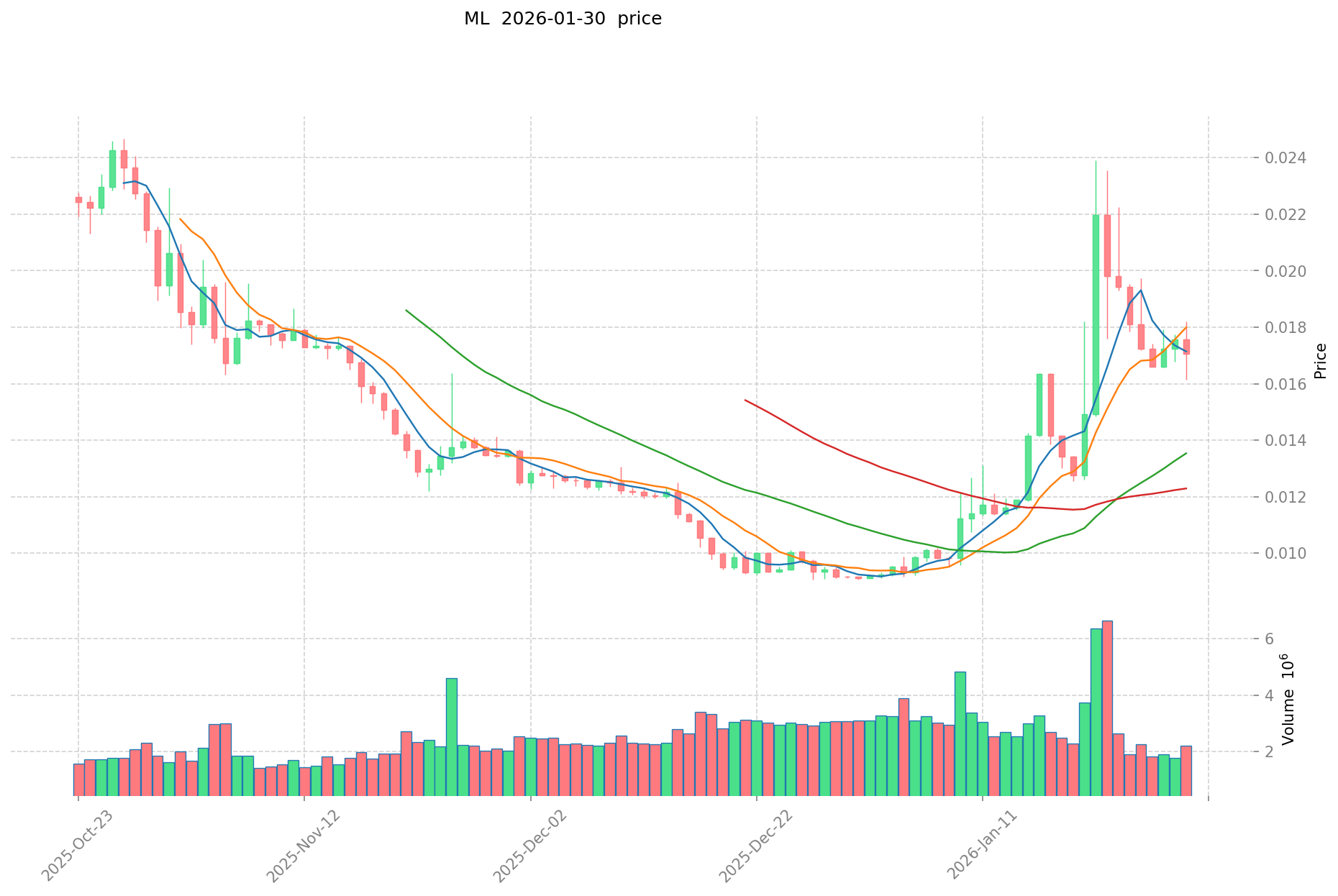
- ML Current Price: $0.016376
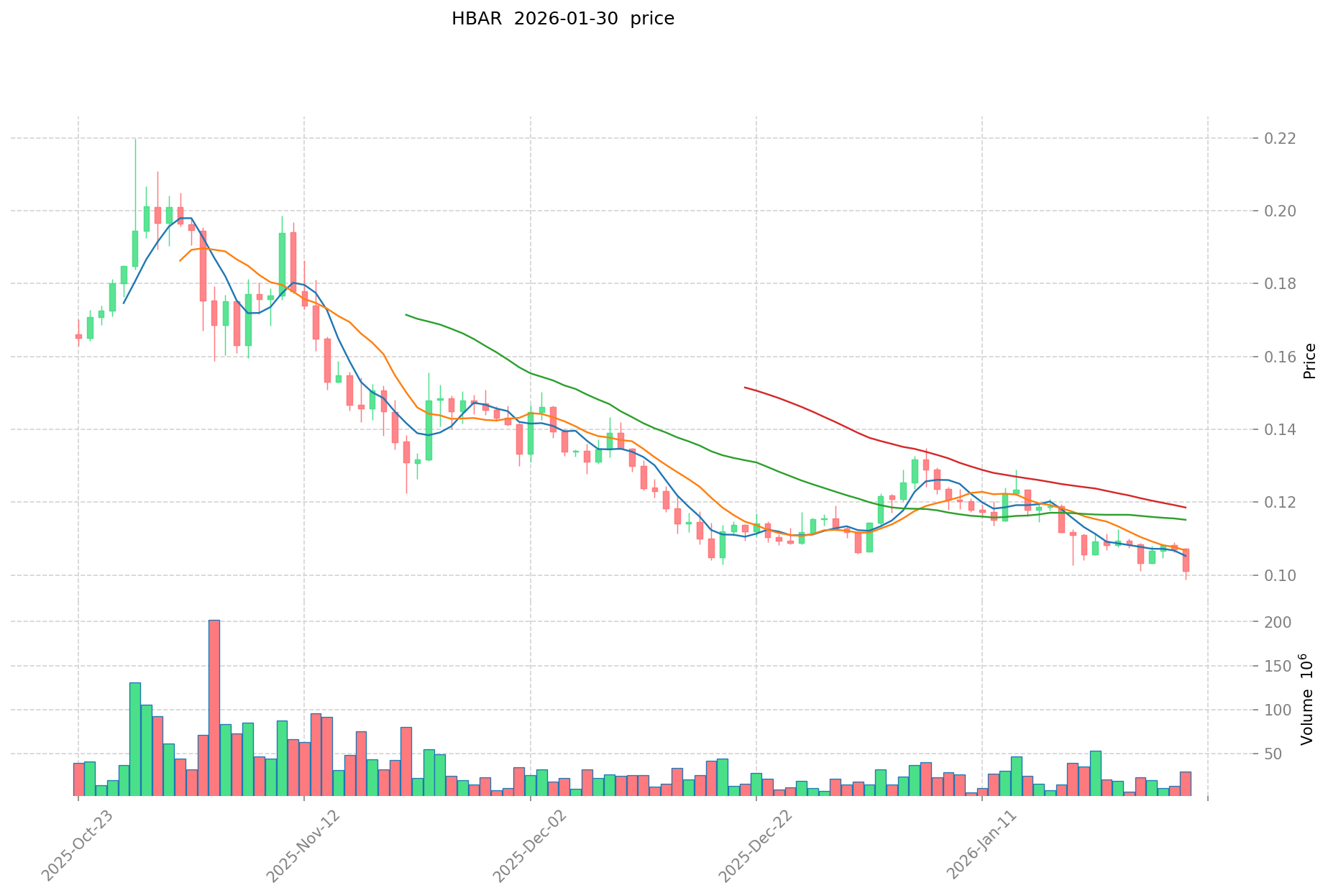
- HBAR Current Price: $0.09891
- 24-Hour Trading Volume: ML recorded $37,885.86, while HBAR demonstrated significantly higher liquidity with $3,852,340.96
- Market Sentiment Index (Fear & Greed Index): 16 (Extreme Fear)
View real-time prices:
II. Core Factors Affecting ML vs HBAR Investment Value
Supply Mechanism Comparison (Tokenomics)
- HBAR: Hedera employs a fixed supply model with governance structure designed for enterprise adoption. The network's consensus mechanism supports high throughput operations while maintaining supply stability.
- ML: TrustNFT's machine learning platform utilizes algorithms that continuously learn and improve through blockchain-sourced data and market trend identification, though specific tokenomics details were not extensively covered in available materials.
- 📌 Historical Pattern: Supply mechanisms influence price cycles through scarcity dynamics and demand-driven appreciation.
Institutional Adoption and Market Applications
- Institutional Holdings: HBAR has demonstrated appeal to institutional networks, particularly in the context of ISO 20022 compliance and tokenized asset support.
- Enterprise Adoption: HBAR shows positioning in enterprise governance and high-throughput applications with fast finality characteristics. ML focuses on NFT evaluation and market trend analysis through machine learning algorithms.
- National Policies: The ISO 20022 standard has influenced institutional interest in HBAR, as financial institutions prioritize compliant assets for international payment systems.
Technological Development and Ecosystem Building
- HBAR Technical Features: Hedera provides high throughput capabilities, fast finality, and enterprise governance functions. Its tokenized asset support enhances attractiveness for institutional networks.
- ML Technical Development: TrustNFT's NFT evaluation machine development began in early 2021, with machine learning algorithms continuously learning and improving through blockchain data sources and market trend identification.
- Ecosystem Comparison: HBAR demonstrates infrastructure suitable for enterprise applications and payment systems, while ML focuses on NFT market evaluation and trend analysis capabilities.
Macroeconomic Environment and Market Cycles
- Inflationary Environment Performance: Both assets operate within broader cryptocurrency market dynamics influenced by institutional adoption trends and regulatory developments.
- Macroeconomic Monetary Policy: Interest rates and dollar index movements impact cryptocurrency markets broadly, with compliant assets like HBAR potentially benefiting from institutional capital flows during favorable monetary conditions.
- Geopolitical Factors: Cross-border transaction demand and international regulatory frameworks influence adoption patterns, particularly for ISO 20022-compliant assets in international payment systems.
III. 2026-2031 Price Prediction: ML vs HBAR
Short-term Prediction (2026)
- ML: Conservative $0.0136-$0.0164 | Optimistic $0.0164-$0.0219
- HBAR: Conservative $0.0861-$0.0990 | Optimistic $0.0990-$0.1257
Medium-term Prediction (2028-2029)
- ML may enter a gradual growth phase, with estimated price range of $0.0137-$0.0287 in 2028 and $0.0189-$0.0307 in 2029
- HBAR may enter an expansion phase, with estimated price range of $0.1261-$0.2028 in 2028 and $0.0935-$0.1903 in 2029
- Key drivers: institutional capital inflows, ETF developments, ecosystem expansion
Long-term Prediction (2030-2031)
- ML: Base scenario $0.0170-$0.0304 | Optimistic scenario $0.0277-$0.0384
- HBAR: Base scenario $0.1243-$0.2207 | Optimistic scenario $0.1801-$0.2714
View detailed price predictions for ML and HBAR
Disclaimer
ML:
| Year |
Predicted High Price |
Predicted Average Price |
Predicted Low Price |
Price Change |
| 2026 |
0.0219425 |
0.016375 |
0.01359125 |
0 |
| 2027 |
0.021840975 |
0.01915875 |
0.015327 |
16 |
| 2028 |
0.0286998075 |
0.0204998625 |
0.013734907875 |
25 |
| 2029 |
0.03074979375 |
0.024599835 |
0.01894187295 |
50 |
| 2030 |
0.03320977725 |
0.027674814375 |
0.02684456994375 |
68 |
| 2031 |
0.03835729272375 |
0.0304422958125 |
0.017047685655 |
85 |
HBAR:
| Year |
Predicted High Price |
Predicted Average Price |
Predicted Low Price |
Price Change |
| 2026 |
0.1257046 |
0.09898 |
0.0861126 |
0 |
| 2027 |
0.161772912 |
0.1123423 |
0.071899072 |
13 |
| 2028 |
0.20284525688 |
0.137057606 |
0.12609299752 |
38 |
| 2029 |
0.1903456032128 |
0.16995143144 |
0.093473287292 |
71 |
| 2030 |
0.26121535012328 |
0.1801485173264 |
0.124302476955216 |
82 |
| 2031 |
0.271438778481553 |
0.22068193372484 |
0.207441017701349 |
123 |
IV. Investment Strategy Comparison: ML vs HBAR
Long-term vs Short-term Investment Strategies
- ML: Suitable for investors focused on emerging NFT evaluation technologies and algorithmic trend analysis capabilities, with higher risk tolerance for early-stage layer-2 protocols
- HBAR: Suitable for investors seeking enterprise-grade infrastructure exposure and institutional adoption potential in compliant payment systems
Risk Management and Asset Allocation
- Conservative Investors: ML 20-30% vs HBAR 70-80%
- Aggressive Investors: ML 40-50% vs HBAR 50-60%
- Hedging Tools: stablecoin allocation, options strategies, cross-asset portfolio diversification
V. Potential Risk Comparison
Market Risks
- ML: Higher volatility exposure due to lower trading volume ($37,885.86 daily) and early-stage market positioning, with substantial correction history from $0.988308 to current levels
- HBAR: Moderate volatility with higher liquidity ($3,852,340.96 daily trading volume), subject to broader enterprise blockchain adoption cycles and institutional sentiment shifts
Technical Risks
- ML: Scalability challenges in NFT evaluation algorithms, dependency on blockchain data quality for machine learning model accuracy
- HBAR: Network governance complexity, potential centralization concerns in enterprise-focused consensus mechanisms
Regulatory Risks
- Global regulatory frameworks may impact both assets differently, with HBAR potentially benefiting from ISO 20022 compliance positioning in regulated payment systems, while ML faces evolving NFT and DeFi regulatory landscapes
VI. Conclusion: Which Is the Better Buy?
📌 Investment Value Summary:
- ML Advantages: Early positioning in NFT evaluation technology with machine learning integration, potential for growth in emerging market trend analysis applications
- HBAR Advantages: Established enterprise infrastructure with high throughput capabilities, ISO 20022 compliance positioning, stronger liquidity profile, and institutional network appeal
✅ Investment Recommendations:
- New Investors: Consider HBAR for more established market presence, higher liquidity, and clearer enterprise adoption trajectory
- Experienced Investors: Evaluate portfolio diversification with weighted allocation favoring HBAR (60-70%) for stability while maintaining ML exposure (30-40%) for emerging technology potential
- Institutional Investors: HBAR presents clearer value proposition through enterprise governance functions, compliant infrastructure positioning, and tokenized asset support capabilities
⚠️ Risk Warning: Cryptocurrency markets exhibit extreme volatility. This content does not constitute investment advice.
VII. FAQ
Q1: What are the main differences between ML and HBAR in terms of market positioning?
ML (Mintlayer) focuses on Layer 2 Bitcoin DeFi solutions and NFT evaluation through machine learning algorithms, while HBAR (Hedera) targets enterprise-grade distributed ledger applications with hashgraph consensus technology. ML positions itself as an emerging protocol for decentralized finance using native Bitcoin through atomic swaps, launched in 2023. HBAR, launched in 2020, emphasizes fast, secure, and fair public ledger services for institutional networks, particularly those requiring ISO 20022 compliance for international payment systems and tokenized asset support.
Q2: Which asset demonstrates better liquidity and trading volume?
HBAR shows significantly superior liquidity with 24-hour trading volume of $3,852,340.96 compared to ML's $37,885.86 as of January 30, 2026. This substantial difference reflects HBAR's more established market presence and broader institutional adoption. Higher liquidity generally translates to better price discovery, reduced slippage during trades, and lower volatility risk for investors. The trading volume disparity indicates HBAR's stronger market depth and more active participation from both retail and institutional market participants.
Q3: How do the historical price performances of ML and HBAR compare?
ML experienced substantial volatility, declining from its historical high of $0.988308 in January 2024 to $0.00908935 in December 2025 before recovering to current levels around $0.016376. HBAR reached its peak of $0.569229 in September 2021 and declined to $0.00986111 in January 2020, currently trading at approximately $0.09891. HBAR demonstrates relatively better price stability and smaller percentage corrections compared to ML's recent trajectory. The historical patterns suggest HBAR has weathered multiple market cycles with greater resilience, while ML's sharper corrections reflect its earlier stage and higher risk profile.
Q4: What role does ISO 20022 compliance play in HBAR's investment value?
ISO 20022 compliance positions HBAR favorably within regulated financial infrastructure and international payment systems. This standard enhances HBAR's attractiveness to institutional investors and financial institutions prioritizing compliant assets for cross-border transactions. The compliance framework provides HBAR with potential advantages in enterprise adoption, particularly as traditional financial institutions integrate blockchain technology into payment processing systems. This regulatory positioning may contribute to more stable institutional capital flows and reduced regulatory uncertainty compared to assets without similar compliance frameworks.
Q5: What are the key risk factors investors should consider when comparing ML vs HBAR?
ML presents higher volatility risk due to lower trading volume, early-stage market positioning, and substantial historical price corrections. Technical risks include scalability challenges in NFT evaluation algorithms and dependency on blockchain data quality. HBAR faces moderate volatility with network governance complexity and potential centralization concerns in enterprise-focused consensus mechanisms. Both assets are subject to broader cryptocurrency market dynamics, regulatory developments, and macroeconomic conditions. ML carries higher execution risk for new technology adoption, while HBAR's institutional focus may limit retail market enthusiasm during speculative market phases.
Q6: Which asset is more suitable for long-term institutional investors?
HBAR presents a clearer value proposition for institutional investors through enterprise governance functions, ISO 20022 compliance positioning, high throughput capabilities with fast finality, and tokenized asset support infrastructure. The established network architecture, higher liquidity profile, and existing institutional partnerships provide more predictable growth trajectories aligned with enterprise adoption cycles. ML's emerging technology focus and lower market maturity create higher uncertainty for institutional capital allocation strategies that prioritize risk-adjusted returns and regulatory clarity.
Q7: How should conservative investors approach portfolio allocation between ML and HBAR?
Conservative investors should favor HBAR with 70-80% allocation due to its established market presence, higher liquidity, enterprise-grade infrastructure, and clearer regulatory positioning. ML allocation of 20-30% provides exposure to emerging NFT evaluation technology and Layer 2 Bitcoin protocol potential while limiting downside risk exposure. This allocation strategy balances portfolio stability through HBAR's institutional adoption trajectory with growth potential from ML's early-stage technology development. Risk management should incorporate stablecoin reserves, diversification across multiple blockchain infrastructure assets, and periodic rebalancing based on evolving market conditions.
Q8: What are the projected price trajectories for ML and HBAR through 2031?
Short-term 2026 projections suggest ML trading between $0.0136-$0.0219 (optimistic scenario) while HBAR ranges from $0.0990-$0.1257. Medium-term 2028-2029 estimates indicate ML reaching $0.0189-$0.0307 and HBAR achieving $0.0935-$0.2028, driven by institutional capital inflows and ecosystem expansion. Long-term 2030-2031 forecasts project ML at $0.0170-$0.0384 and HBAR at $0.1243-$0.2714 under base and optimistic scenarios respectively. These projections assume continued enterprise blockchain adoption, favorable regulatory developments, and sustained market cycle progression, though actual outcomes depend on numerous unpredictable factors including technological breakthroughs, competitive dynamics, and macroeconomic conditions.
* The information is not intended to be and does not constitute financial advice or any other recommendation of any sort offered or endorsed by Gate.