This comprehensive article compares MNDE and SNX, two leading blockchain protocols with distinct market positions and investment value propositions. MNDE is a non-custodial liquid staking protocol on Solana, while SNX is an established synthetic asset platform launched in 2018. The analysis covers historical price trends, current market status as of January 2026, tokenomics, institutional adoption, technology development, and macroeconomic factors affecting both assets. MNDE trades at $0.04562 with $24.95 million market cap, while SNX commands $149.72 million market cap at $0.4359, offering significantly better liquidity. Price forecasts through 2031 project potential growth of 105% for MNDE and 75% for SNX under base scenarios. The article provides tailored investment strategies for conservative and aggressive investors, detailed risk assessments, and clear recommendations: SNX suits beginners due to higher liquidity and established presence, while MNDE appeals to experienced investors seeking Solana ecosyst
Introduction: MNDE vs SNX Investment Comparison
In the cryptocurrency market, the comparison between MNDE and SNX remains a topic of ongoing interest among investors. Both assets differ significantly in market capitalization ranking, application scenarios, and price performance, representing distinct positioning within the crypto asset landscape.
Marinade (MNDE): A non-custodial liquid staking protocol built on the Solana blockchain, MNDE has established its presence in the decentralized finance ecosystem since its launch.
Synthetix (SNX): Launched in 2018, SNX is designed as a decentralized synthetic asset protocol that enables the creation of various synthetic assets, including fiat currencies pegged to the US dollar, precious metals, indices, and other cryptocurrencies.
This article provides a comprehensive analysis of MNDE vs SNX investment value comparison, examining historical price trends, supply mechanisms, institutional adoption, technical ecosystems, and future projections. We aim to address the question that concerns investors most:
"Which is the better buy right now?"
I. Historical Price Comparison and Current Market Status
MNDE (Coin A) and SNX (Coin B) Historical Price Trends
- 2021: MNDE reached its all-time high of $1.64 on October 9, 2021, during the broader cryptocurrency market rally period.
- 2022: MNDE experienced significant price decline, hitting its all-time low of $0.0282187 on August 29, 2022, amid the crypto market downturn.
- 2021: SNX achieved its all-time high of $28.53 on February 14, 2021, driven by the DeFi summer momentum and increased adoption of synthetic assets.
- 2019: SNX recorded its all-time low of $0.0347864 on January 6, 2019, during the early development phase of the protocol.
- Comparative Analysis: During the 2021-2022 market cycle, MNDE declined from its peak of $1.64 to $0.0282187, representing a decrease of approximately 98.3%, while SNX dropped from $28.53 to lower levels, demonstrating similar volatility patterns common across DeFi protocols during market corrections.
Current Market Status (2026-01-22)
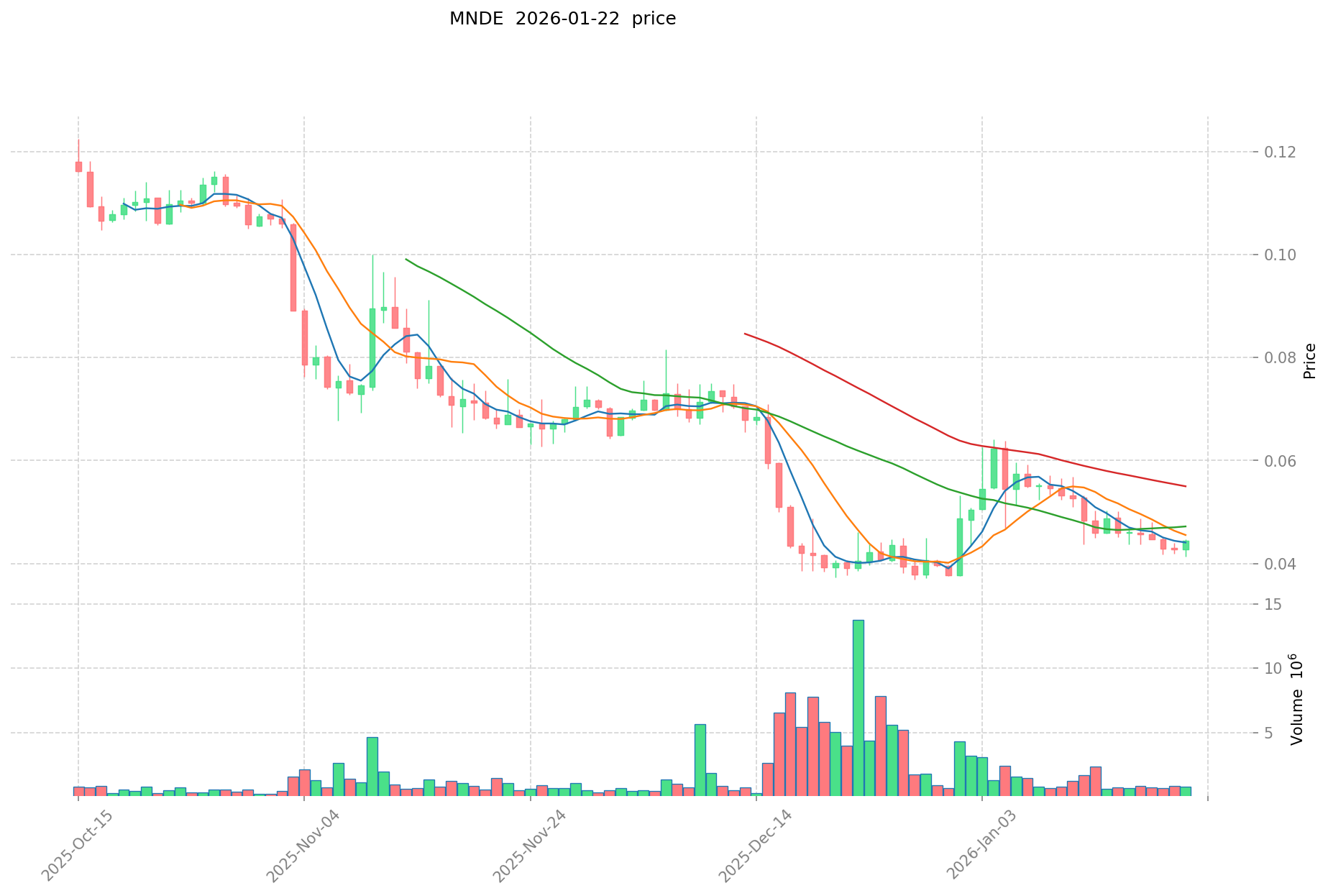
- MNDE current price: $0.04562
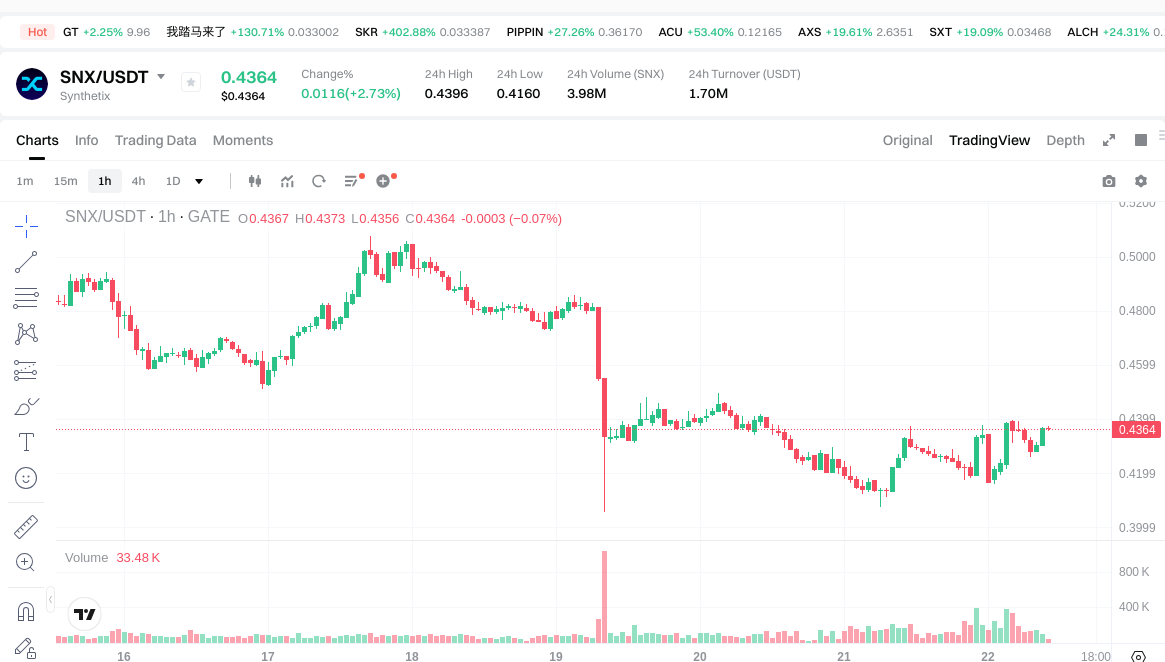
- SNX current price: $0.4359
- 24-hour trading volume: MNDE $36,168.13 vs SNX $1,707,744.55
- Market Sentiment Index (Fear & Greed Index): 20 (Extreme Fear)
- MNDE 24-hour price change: +6.71%, with intraday high at $0.04632 and low at $0.04134
- SNX 24-hour price change: +2.39%, with intraday high at $0.4396 and low at $0.416
- MNDE market capitalization: $24.95 million (ranking #781)
- SNX market capitalization: $149.72 million (ranking #277)
Click to view real-time prices:
II. Core Factors Affecting MNDE vs SNX Investment Value
Supply Mechanism Comparison (Tokenomics)
Due to limited reference materials, specific supply mechanism details for MNDE and SNX cannot be provided at this time. Supply mechanisms typically include aspects such as total supply caps, emission schedules, and deflationary features that may influence long-term token economics.
Institutional Adoption and Market Application
Institutional Holdings: Current data on institutional preference between MNDE and SNX is not available in the provided materials.
Enterprise Adoption: Information regarding the application of MNDE or SNX in cross-border payments, settlements, or investment portfolios is not included in the reference materials.
National Policies: Specific regulatory attitudes of different countries toward MNDE and SNX are not documented in the available sources.
Technology Development and Ecosystem Building
MNDE Technical Upgrades: Details about technical developments and their potential impacts are not available in the reference materials.
SNX Technical Development: Information regarding technical advancements and potential implications is not provided in the source documents.
Ecosystem Comparison: Data comparing DeFi integration, NFT applications, payment solutions, and smart contract implementations for both projects is not available in the provided materials.
Macroeconomic Factors and Market Cycles
Performance in Inflationary Environments: Comparative analysis of inflation-hedging properties between MNDE and SNX cannot be determined from the available materials.
Macroeconomic Monetary Policy: The impact of interest rates and dollar index movements on both assets is not documented in the reference sources.
Geopolitical Factors: Information regarding cross-border transaction demand and international situation impacts on MNDE and SNX is not included in the provided materials.
III. 2026-2031 Price Forecast: MNDE vs SNX
Short-term Forecast (2026)
- MNDE: Conservative $0.044-$0.046 | Optimistic $0.056-$0.064
- SNX: Conservative $0.30-$0.44 | Optimistic $0.44-$0.54
Mid-term Forecast (2028-2029)
- MNDE may enter a gradual growth phase, with estimated price range of $0.034-$0.090
- SNX may enter a moderate expansion phase, with estimated price range of $0.36-$0.75
- Key drivers: institutional capital inflows, ETF developments, ecosystem expansion
Long-term Forecast (2030-2031)
- MNDE: Base scenario $0.058-$0.094 | Optimistic scenario $0.087-$0.124
- SNX: Base scenario $0.43-$0.77 | Optimistic scenario $0.58-$1.00
View detailed price predictions for MNDE and SNX
Disclaimer
MNDE:
| Year |
Predicted High Price |
Predicted Average Price |
Predicted Low Price |
Price Change |
| 2026 |
0.063854 |
0.04561 |
0.0442417 |
0 |
| 2027 |
0.06184716 |
0.054732 |
0.04706952 |
19 |
| 2028 |
0.0664501212 |
0.05828958 |
0.0343908522 |
27 |
| 2029 |
0.09043628337 |
0.0623698506 |
0.036798211854 |
36 |
| 2030 |
0.1115484777981 |
0.076403066985 |
0.0580663309086 |
67 |
| 2031 |
0.124048019556846 |
0.09397577239155 |
0.087397468324141 |
105 |
SNX:
| Year |
Predicted High Price |
Predicted Average Price |
Predicted Low Price |
Price Change |
| 2026 |
0.542004 |
0.4371 |
0.301599 |
0 |
| 2027 |
0.61194 |
0.489552 |
0.4161192 |
12 |
| 2028 |
0.61132806 |
0.550746 |
0.3579849 |
26 |
| 2029 |
0.7495377687 |
0.58103703 |
0.5171229567 |
33 |
| 2030 |
0.864873619155 |
0.66528739935 |
0.425783935584 |
52 |
| 2031 |
1.002255467120775 |
0.7650805092525 |
0.5814611870319 |
75 |
IV. Investment Strategy Comparison: MNDE vs SNX
Long-term vs Short-term Investment Strategies
- MNDE: May suit investors interested in Solana ecosystem participation and liquid staking protocols, with focus on DeFi infrastructure development
- SNX: May appeal to investors seeking exposure to synthetic asset protocols and decentralized derivatives markets
Risk Management and Asset Allocation
- Conservative investors: MNDE 20-30% vs SNX 70-80%
- Aggressive investors: MNDE 40-50% vs SNX 50-60%
- Hedging tools: stablecoin allocation, options strategies, cross-asset portfolio diversification
V. Potential Risk Comparison
Market Risk
- MNDE: Lower market capitalization ($24.95 million) indicates higher volatility potential and liquidity constraints; trading volume of $36,168.13 suggests limited market depth
- SNX: Mid-range market capitalization ($149.72 million) with relatively higher trading volume ($1,707,744.55) indicates improved liquidity but remains subject to broader DeFi market movements
Technical Risk
- MNDE: Network dependency on Solana blockchain infrastructure; protocol scalability considerations
- SNX: Smart contract complexity in synthetic asset creation; oracle dependency and potential security considerations
Regulatory Risk
- Global regulatory frameworks may impact both protocols differently, with synthetic asset platforms potentially facing increased scrutiny regarding securities classification and derivatives regulations
VI. Conclusion: Which Is the Better Buy?
📌 Investment Value Summary:
- MNDE advantages: Participation in Solana liquid staking ecosystem; non-custodial protocol structure; potential growth aligned with Solana network expansion
- SNX advantages: Established protocol since 2018; higher market capitalization and trading volume; exposure to synthetic asset and derivatives market segment
✅ Investment Recommendations:
- Novice investors: Consider starting with SNX due to higher liquidity and established market presence; limit exposure to 5-10% of crypto portfolio
- Experienced investors: Evaluate both assets based on risk tolerance and ecosystem preferences; consider diversified allocation with regular rebalancing
- Institutional investors: Conduct thorough due diligence on protocol fundamentals, liquidity profiles, and regulatory considerations before allocation decisions
⚠️ Risk Disclaimer: Cryptocurrency markets exhibit high volatility. This content does not constitute investment advice. Investors should conduct independent research and consult qualified financial advisors before making investment decisions.
VII. FAQ
Q1: What are the main differences between MNDE and SNX protocols?
MNDE is a non-custodial liquid staking protocol on Solana, while SNX is a synthetic asset protocol launched in 2018. MNDE focuses on liquid staking infrastructure within the Solana ecosystem, allowing users to stake SOL while maintaining liquidity. SNX enables the creation of synthetic assets including fiat currencies, precious metals, indices, and cryptocurrencies through a decentralized derivatives platform. The fundamental difference lies in their core use cases: MNDE addresses staking liquidity needs, while SNX provides exposure to synthetic asset trading and derivatives markets.
Q2: Which asset has better liquidity for trading?
SNX demonstrates significantly better liquidity with a 24-hour trading volume of $1,707,744.55 compared to MNDE's $36,168.13. SNX also maintains a higher market capitalization of $149.72 million (ranking #277) versus MNDE's $24.95 million (ranking #781). This substantial difference in trading volume and market cap indicates that SNX offers better market depth, tighter spreads, and easier entry/exit opportunities for both retail and institutional investors. Lower liquidity in MNDE may result in higher slippage and price impact during larger transactions.
Q3: How have both assets performed during market downturns?
Both assets experienced significant corrections during the 2021-2022 crypto market downturn. MNDE declined approximately 98.3% from its all-time high of $1.64 (October 2021) to its all-time low of $0.0282187 (August 2022). SNX similarly dropped from its peak of $28.53 (February 2021) to lower levels during the same period. These parallel movements demonstrate high correlation with broader DeFi market cycles and suggest both assets carry substantial volatility risk during bear markets. Current market conditions show Extreme Fear sentiment (index: 20), indicating continued cautious market environment.
Q4: What is the price outlook for 2026-2031?
Conservative forecasts for 2026 suggest MNDE may range between $0.044-$0.046, while SNX may trade between $0.30-$0.44. By 2031, base scenarios project MNDE at $0.058-$0.094 and SNX at $0.43-$0.77, with optimistic scenarios reaching $0.087-$0.124 for MNDE and $0.58-$1.00 for SNX. These projections indicate potential growth of 105% for MNDE and 75% for SNX from current levels by 2031. However, these forecasts depend heavily on broader market conditions, protocol adoption, institutional capital inflows, regulatory developments, and ecosystem expansion. Investors should treat these estimates as speculative rather than guaranteed outcomes.
Q5: Which asset is more suitable for beginners?
SNX is generally more suitable for novice investors due to several factors: higher liquidity ($1.7 million daily volume vs $36,168), established market presence since 2018, better price discovery mechanisms, and lower volatility compared to smaller-cap assets. The higher market capitalization and trading volume reduce the risk of manipulation and provide easier exit opportunities. Beginners are advised to limit initial exposure to 5-10% of their crypto portfolio regardless of choice. MNDE's lower liquidity and smaller market cap make it more appropriate for experienced investors who understand the risks associated with lower-cap DeFi protocols and can tolerate higher volatility.
Q6: What are the main risk factors for each investment?
MNDE faces risks including: dependency on Solana network performance, limited liquidity ($36,168 daily volume) leading to higher slippage, smaller market cap vulnerability ($24.95 million), and protocol scalability considerations. SNX risks include: smart contract complexity in synthetic asset creation, oracle dependency for price feeds, potential regulatory scrutiny as synthetic assets may be classified as securities in some jurisdictions, and exposure to broader DeFi derivatives market volatility. Both assets face general cryptocurrency market risks including regulatory uncertainty, technological vulnerabilities, and macroeconomic factors. Investors should assess their risk tolerance and diversify across multiple assets rather than concentrating positions.
Q7: How should investors allocate between MNDE and SNX?
Conservative investors may consider a 20-30% MNDE and 70-80% SNX allocation if choosing between these two assets, favoring SNX's higher liquidity and established market presence. Aggressive investors with higher risk tolerance might adopt a 40-50% MNDE and 50-60% SNX split, accepting greater exposure to MNDE's higher volatility potential. However, both assets should represent only a portion of a broader cryptocurrency portfolio that includes established assets like Bitcoin and Ethereum, as well as stablecoin reserves for risk management. Regular portfolio rebalancing, hedging strategies using options or stablecoins, and maintaining diversification across different blockchain ecosystems can help manage concentration risk.
Q8: What factors could drive future price appreciation?
Key growth drivers for MNDE include: Solana network expansion and increased adoption, growth in liquid staking demand, protocol upgrades enhancing functionality, and integration with major DeFi applications. For SNX, potential catalysts include: expansion of synthetic asset offerings, institutional adoption of decentralized derivatives, regulatory clarity on synthetic assets, partnerships with traditional finance entities, and technological improvements reducing oracle dependency. Common factors affecting both include: broader cryptocurrency market trends, Bitcoin halving cycles, institutional capital inflows through ETFs, macroeconomic conditions (interest rates, inflation), and overall DeFi sector growth. Investors should monitor these developments while maintaining realistic expectations about cryptocurrency market volatility.
* The information is not intended to be and does not constitute financial advice or any other recommendation of any sort offered or endorsed by Gate.