This comprehensive comparison analyzes MORPHO and MANA tokens across multiple investment dimensions to help readers determine which asset better suits their portfolio. MORPHO, a DeFi lending protocol launched in 2024 with institutional backing from a16z, optimizes capital efficiency through modular architecture and peer-to-peer matching mechanisms across 320+ liquidity pools. MANA, Decentraland's native token since 2017, enables virtual property transactions within metaverse ecosystems. The article examines historical price trends, tokenomics, market adoption, technical architecture, and risk profiles, revealing MORPHO's stronger institutional adoption and DeFi positioning versus MANA's established market presence and metaverse exposure. Investment recommendations vary by experience level, from dollar-cost averaging for novices to sector-based allocation strategies for experienced and institutional investors. Both assets present distinct risk-reward profiles within their respective DeFi infrastructure and vir
Introduction: Investment Comparison Between MORPHO and MANA
In the cryptocurrency market, the comparison between MORPHO vs MANA has consistently been a topic investors cannot overlook. The two assets exhibit notable differences in market cap ranking, application scenarios, and price performance, while representing distinct positioning within the crypto asset landscape.
MORPHO (MORPHO): Launched in 2024, this lending protocol has gained market recognition through its innovative approach to optimizing liquidity pools on Ethereum. By integrating peer-to-peer matching mechanisms with traditional lending pools, it aims to enhance capital efficiency for both lenders and borrowers.
MANA (MANA): Since its inception in 2017, MANA has been positioned as the native token of Decentraland, a blockchain-based virtual world platform. It enables users to acquire, transfer, and monetize virtual property rights without intermediary fees.
This article provides a comprehensive analysis of MORPHO vs MANA investment value comparison, examining historical price trends, supply mechanisms, institutional adoption, technical ecosystems, and future projections. We aim to address the question most pressing to investors:
"Which is the better buy right now?"
With MORPHO currently ranked 103rd with a market cap of approximately $760 million and a circulating supply of 54.33%, compared to MANA's 192nd ranking with a market cap of around $288 million and 87.5% circulating supply, the two assets present distinctly different risk-reward profiles. MORPHO's recent price of $1.40 reflects a 7.74% increase over 24 hours, while MANA trades at $0.15 with a 7.68% gain in the same period. Understanding these dynamics requires examining multiple dimensions beyond simple price movements.
I. Historical Price Comparison and Current Market Situation
Historical Price Trends of MORPHO (Coin A) and MANA (Coin B)
- 2025: MORPHO experienced notable price movements following its market debut in November 2024, with prices fluctuating between its initial offering and subsequent trading activity.
- 2021: MANA was influenced by the metaverse boom, with its price reaching peaks driven by increased interest in virtual reality platforms and NFT trading.
- Comparative Analysis: During recent market cycles, MORPHO moved from its all-time high of $4.19 to a low of $0.53, while MANA declined from its historical peak of $5.85 to $0.009, demonstrating MANA's longer market presence and more extensive price volatility.
Current Market Status (2026-01-14)
- MORPHO current price: $1.40
- MANA current price: $0.15
- 24-hour trading volume: MORPHO $1.45M vs MANA $137.58K
- Market sentiment index (Fear & Greed Index): 48 (Neutral)
Click to view real-time prices:
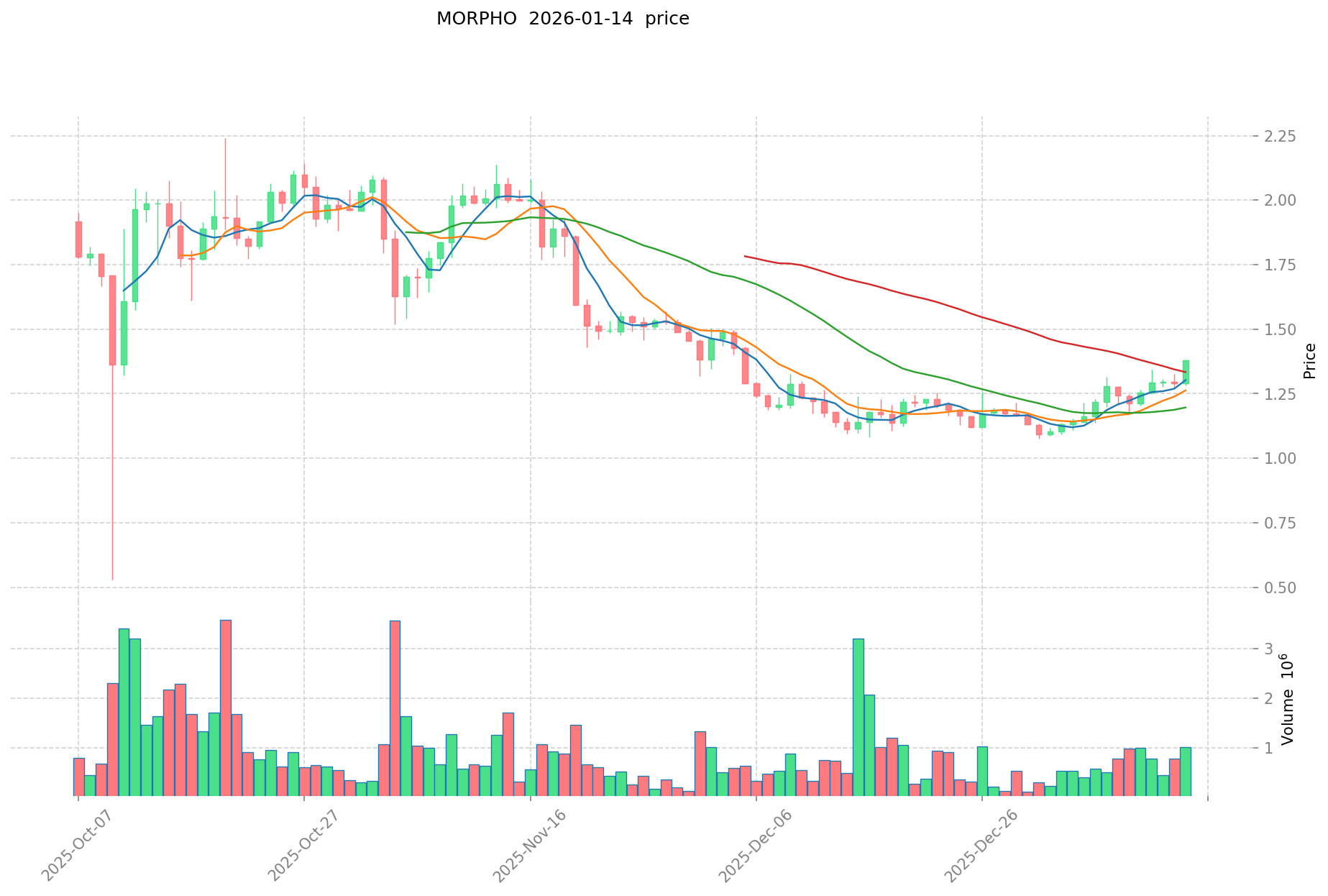
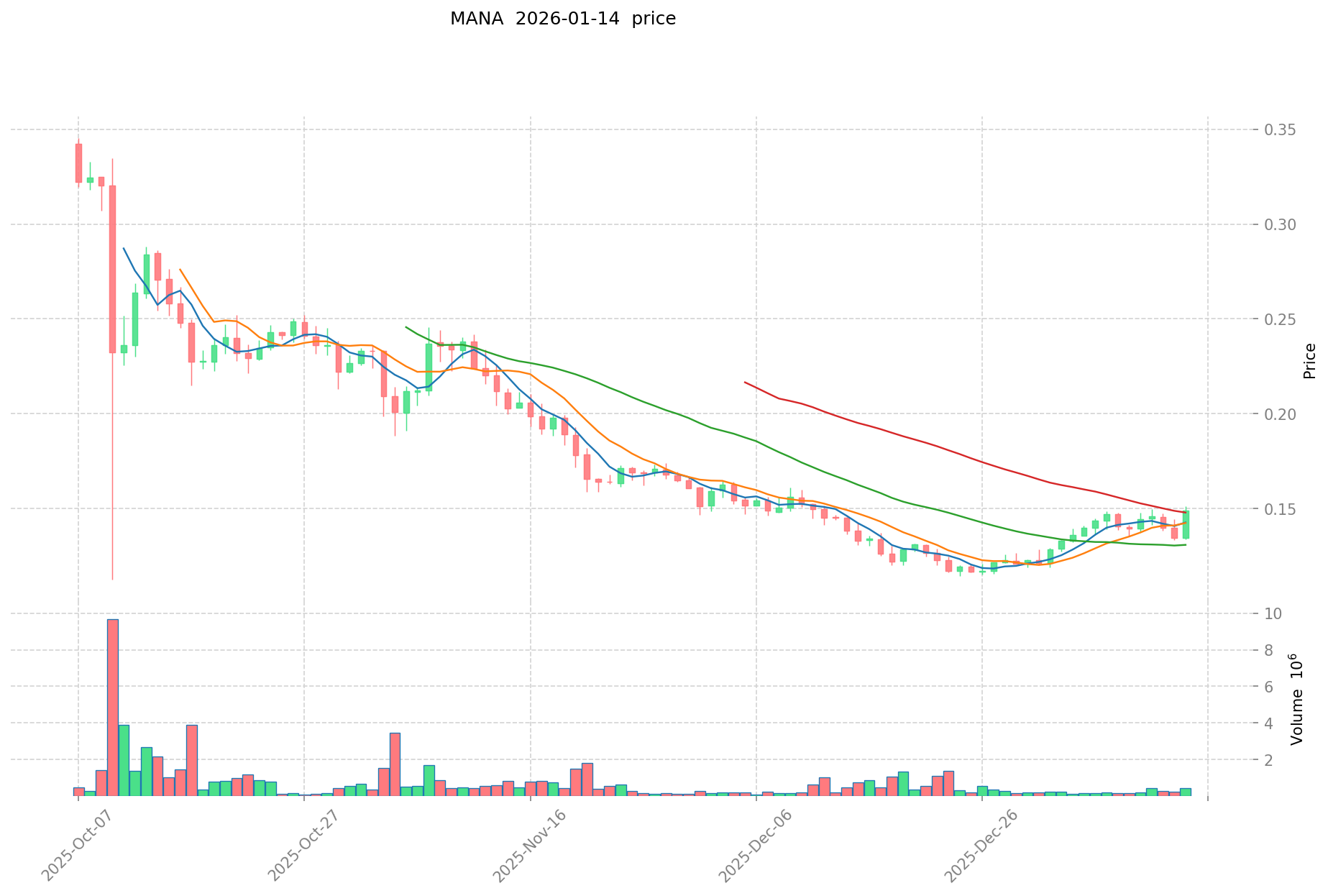
II. Core Factors Influencing MORPHO vs MANA Investment Value
Tokenomics Comparison
-
MORPHO: The project features a modular infrastructure design that enables efficient liquidity management across multiple vaults. According to available data, Morpho operates over 320 liquidity pools, with the majority maintaining normal operational status. The protocol's composability allows for flexible capital deployment across different DeFi strategies.
-
MANA: Information regarding MANA's specific supply mechanism was not detailed in the reference materials. However, the emphasis on high capital efficiency suggests a token model designed to optimize resource utilization within decentralized finance applications.
-
📌 Historical Pattern: Supply mechanisms in DeFi protocols tend to influence price cycles through their impact on liquidity availability and yield generation capabilities. Protocols with efficient capital rotation models may demonstrate different price dynamics compared to those with fixed supply schedules.
Institutional Adoption and Market Application
-
Institutional Holdings: MORPHO has gained recognition from notable institutional investors, with a16z specifically highlighting the project in investment reports. This institutional attention stems from the protocol's ability to provide mathematical certainty and enhanced capital efficiency in DeFi operations.
-
Enterprise Application: Both projects position themselves within the decentralized finance infrastructure layer, focusing on lending, liquidity mining, and other foundational DeFi strategies. MORPHO's modular approach allows integration across various financial primitives including swap mechanisms and yield optimization protocols.
-
Regulatory Landscape: The reference materials did not provide specific information regarding jurisdictional regulatory attitudes toward either project. The evolving regulatory environment for DeFi protocols continues to shape institutional participation patterns.
Technical Development and Ecosystem Building
-
MORPHO Technical Architecture: The protocol's core value proposition centers on its modular and composable infrastructure, which enables seamless integration with existing DeFi protocols. This design philosophy allows for flexible liquidity management and risk-adjusted yield optimization across multiple strategies.
-
MANA Technical Evolution: While specific technical upgrade details were limited in the reference materials, the emphasis on capital efficiency suggests ongoing development focused on optimizing fund utilization and reducing friction in DeFi operations.
-
Ecosystem Comparison: Both projects operate within the broader DeFi ecosystem, with applications spanning lending protocols, liquidity provision, and yield generation strategies. The integration capabilities with established DeFi primitives remain a key differentiator in ecosystem positioning.
Macroeconomic and Market Cycles
-
Inflation Environment Performance: The reference materials indicate a broader market shift from retail-driven cycles toward institutional capital flows. According to industry analysis, this transition suggests that price movements may increasingly reflect structured capital allocation rather than sentiment-driven volatility.
-
Monetary Policy Impact: Global macroeconomic conditions, including interest rate policies and currency valuations, continue to influence capital flows into digital assets. The materials noted that institutional participation patterns may demonstrate different sensitivity to these factors compared to retail-driven market phases.
-
Geopolitical Considerations: Cross-border transaction demand and evolving international regulatory frameworks represent ongoing factors in DeFi protocol adoption. However, specific geopolitical impacts on MORPHO or MANA were not detailed in the available reference materials.
III. 2026-2031 Price Prediction: MORPHO vs MANA
Short-term Forecast (2026)
- MORPHO: Conservative $0.85-$1.41 | Optimistic $1.41-$1.79
- MANA: Conservative $0.11-$0.15 | Optimistic $0.15-$0.18
Mid-term Forecast (2028-2029)
- MORPHO may enter a growth phase, with estimated price range of $1.37-$2.24 in 2028 and $1.22-$2.58 in 2029
- MANA may enter a consolidation phase, with estimated price range of $0.13-$0.23 in 2028 and $0.12-$0.29 in 2029
- Key drivers: institutional capital inflows, ETF developments, ecosystem expansion
Long-term Forecast (2030-2031)
- MORPHO: Baseline scenario $1.29-$2.70 (2030), $1.59-$2.66 (2031) | Optimistic scenario $2.27-$2.70 (2030), $2.49-$2.66 (2031)
- MANA: Baseline scenario $0.14-$0.32 (2030), $0.23-$0.37 (2031) | Optimistic scenario $0.25-$0.32 (2030), $0.29-$0.37 (2031)
View detailed price predictions for MORPHO and MANA
Disclaimer
MORPHO:
| Year |
Predicted High Price |
Predicted Average Price |
Predicted Low Price |
Price Change |
| 2026 |
1.789938 |
1.4094 |
0.84564 |
0 |
| 2027 |
1.79162928 |
1.599669 |
0.89581464 |
14 |
| 2028 |
2.2382568648 |
1.69564914 |
1.3734758034 |
21 |
| 2029 |
2.576708433144 |
1.9669530024 |
1.219510861488 |
40 |
| 2030 |
2.70347855414868 |
2.271830717772 |
1.29494350913004 |
62 |
| 2031 |
2.661790460477563 |
2.48765463596034 |
1.592098967014617 |
77 |
MANA:
| Year |
Predicted High Price |
Predicted Average Price |
Predicted Low Price |
Price Change |
| 2026 |
0.175044 |
0.1509 |
0.10563 |
0 |
| 2027 |
0.23142024 |
0.162972 |
0.1140804 |
8 |
| 2028 |
0.2346633828 |
0.19719612 |
0.1340933616 |
31 |
| 2029 |
0.29150516439 |
0.2159297514 |
0.116602065756 |
43 |
| 2030 |
0.31714682236875 |
0.253717457895 |
0.1420817764212 |
69 |
| 2031 |
0.3653531393688 |
0.285432140131875 |
0.234054354908137 |
90 |
IV. Investment Strategy Comparison: MORPHO vs MANA
Long-term vs Short-term Investment Strategies
-
MORPHO: Suitable for investors focused on DeFi infrastructure growth, institutional adoption trends, and protocol innovation. The modular architecture and capital efficiency mechanisms position this asset for potential appreciation tied to DeFi ecosystem expansion. Short-term traders may capitalize on volatility driven by institutional announcements and protocol integrations, while long-term holders might benefit from sustained adoption of optimized lending solutions.
-
MANA: Suitable for investors interested in metaverse development, virtual property ecosystems, and long-established blockchain projects. With its longer market history since 2017, MANA appeals to those seeking exposure to virtual world platforms and NFT-related applications. Short-term positioning may respond to metaverse sector sentiment shifts, while extended holding periods could align with broader virtual reality adoption cycles.
Risk Management and Asset Allocation
-
Conservative Investors: MORPHO 30% vs MANA 70%. This allocation acknowledges MANA's longer operational track record and higher circulating supply percentage (87.5%), while maintaining measured exposure to MORPHO's institutional-backed protocol innovations.
-
Aggressive Investors: MORPHO 60% vs MANA 40%. Higher MORPHO allocation reflects potential for protocol expansion and institutional capital inflows, balanced with MANA's established market position to manage concentration risk.
-
Hedging Instruments: Stablecoin reserves for opportunistic rebalancing, options strategies to manage downside exposure, cross-asset portfolio construction including established DeFi protocols and metaverse tokens to reduce correlation risk.
V. Potential Risk Comparison
Market Risk
-
MORPHO: Price sensitivity to DeFi sector performance, liquidity concentration in specific vault strategies, and market cap volatility given the 54.33% circulating supply. The protocol's relatively recent market entry in November 2024 introduces uncertainty regarding price stability during broader market corrections. Daily trading volume of approximately $1.45 million suggests developing market depth compared to more established protocols.
-
MANA: Exposure to metaverse sector sentiment cycles, dependency on Decentraland platform user growth, and price correlation with broader NFT market trends. Historical price movement from peaks of $5.85 to lows of $0.009 demonstrates significant volatility potential. Current 24-hour trading volume of $137.58K indicates lower liquidity compared to peak periods, potentially amplifying price movements during market stress.
Technical Risk
-
MORPHO: Scalability challenges associated with managing over 320 liquidity pools, protocol composability dependencies on external DeFi primitives, and smart contract security considerations inherent to modular architecture. Integration complexity across multiple DeFi protocols introduces potential vulnerabilities in interconnected systems.
-
MANA: Platform development execution risk, technical dependencies on blockchain infrastructure for virtual world operations, and potential security considerations in virtual property rights management. Network congestion during high-activity periods could impact user experience and platform utility.
Regulatory Risk
- Global regulatory frameworks for DeFi protocols remain in development, with varying jurisdictional approaches to lending protocols and decentralized financial services. MORPHO's institutional backing may attract regulatory scrutiny regarding compliance frameworks and user protection mechanisms. MANA faces evolving regulations concerning virtual property rights, digital asset taxation in metaverse environments, and cross-border transaction compliance. Both assets operate in regulatory landscapes characterized by ongoing policy development rather than established frameworks.
VI. Conclusion: Which Is the Better Buy?
📌 Investment Value Summary:
-
MORPHO Advantages: Institutional recognition from entities including a16z, modular protocol architecture enabling flexible DeFi integration, capital efficiency optimization through peer-to-peer matching mechanisms, operational management of over 320 liquidity pools, and positioning within the growing DeFi infrastructure sector. The protocol's composability allows for strategic positioning across multiple financial primitives.
-
MANA Advantages: Established market presence since 2017 providing longer operational history, higher circulating supply percentage (87.5%) suggesting reduced supply-side pressure, positioning as native token within Decentraland's virtual world platform, and exposure to metaverse and virtual property markets. The asset benefits from brand recognition within blockchain-based virtual reality applications.
✅ Investment Recommendations:
-
Novice Investors: Consider beginning with smaller position sizes in both assets to gain exposure while managing learning curve risk. MANA's longer track record may provide more historical data for analysis, while MORPHO requires understanding of DeFi protocol mechanics. Dollar-cost averaging strategies could help navigate volatility in both assets. Prioritize understanding fundamental differences between DeFi infrastructure tokens and metaverse platform tokens before capital allocation.
-
Experienced Investors: Evaluate portfolio positioning based on existing DeFi and metaverse sector exposure. MORPHO may complement holdings in established lending protocols, while MANA could diversify virtual reality and NFT-related investments. Consider technical analysis of both assets' price action relative to sector performance benchmarks. Monitor institutional activity patterns in DeFi protocols and metaverse platform development metrics as allocation indicators.
-
Institutional Investors: Assess MORPHO's protocol architecture for institutional DeFi strategy integration, considering capital efficiency metrics and liquidity management capabilities. Evaluate MANA's market position within broader virtual world platform investments and digital asset real estate exposure. Both assets require due diligence regarding regulatory compliance frameworks, custody solutions, and risk management protocols appropriate for institutional capital deployment.
⚠️ Risk Warning: Cryptocurrency markets exhibit extreme volatility. This analysis does not constitute investment advice.
VII. FAQ
Q1: What are the main differences between MORPHO and MANA's use cases?
MORPHO is a DeFi lending protocol focused on optimizing capital efficiency through peer-to-peer matching and liquidity pool management, while MANA is a metaverse platform token enabling virtual property transactions in Decentraland. MORPHO operates within decentralized finance infrastructure, managing over 320 liquidity pools with modular architecture that integrates across various DeFi primitives including lending, yield optimization, and swap mechanisms. MANA serves as the native currency for a blockchain-based virtual world where users can acquire, transfer, and monetize digital real estate and assets without intermediary fees, positioning it within the virtual reality and NFT sectors rather than pure financial infrastructure.
Q2: Which asset has stronger institutional backing?
MORPHO currently demonstrates stronger institutional recognition, particularly with backing from a16z and other institutional investors who have specifically highlighted the protocol in investment reports. This institutional attention stems from MORPHO's mathematical certainty in operations and enhanced capital efficiency mechanisms. While the reference materials do not detail specific institutional holdings for MANA, MORPHO's positioning within DeFi infrastructure and its institutional-grade protocol architecture have attracted structured capital allocation from established venture funds. However, MANA's longer market presence since 2017 has enabled broader retail adoption and platform development partnerships within the metaverse sector.
Q3: How do the circulating supply percentages affect investment risk?
MANA has a higher circulating supply at 87.5% compared to MORPHO's 54.33%, which has direct implications for supply-side price pressure. MANA's higher circulation percentage suggests reduced future dilution risk from token unlocks, potentially providing more predictable supply dynamics for price analysis. MORPHO's lower circulating supply indicates that approximately 45.67% of tokens remain locked or unvested, which could create selling pressure as these tokens enter circulation over time. For conservative investors, MANA's supply structure may present lower unlock-related volatility risk, while MORPHO's controlled release could support price appreciation if demand growth outpaces supply expansion during unlock schedules.
Q4: What are the key technical risks for each protocol?
MORPHO faces technical risks related to its modular architecture complexity, including dependencies on external DeFi protocols for composability, smart contract security considerations across 320+ liquidity pools, and scalability challenges in managing multiple vault strategies simultaneously. Integration vulnerabilities in interconnected DeFi systems represent ongoing technical considerations. MANA encounters platform-specific technical risks including blockchain infrastructure dependencies for virtual world operations, network congestion during high user activity periods affecting platform utility, execution challenges in ongoing platform development, and security considerations in managing virtual property rights and digital asset transactions within the Decentraland ecosystem.
Q5: How should investors approach portfolio allocation between these assets?
Portfolio allocation depends on risk tolerance and investment objectives. Conservative investors might consider a 30% MORPHO / 70% MANA allocation, acknowledging MANA's longer operational track record and higher circulating supply stability while maintaining measured exposure to MORPHO's institutional-backed innovation. Aggressive investors could shift toward 60% MORPHO / 40% MANA to capture potential protocol expansion and institutional capital inflows while using MANA's established position to manage concentration risk. Both strategies benefit from diversification across DeFi infrastructure and metaverse sectors, with stablecoin reserves for rebalancing opportunities and cross-asset portfolio construction to reduce correlation risk during sector-specific volatility.
Q6: What market conditions favor each asset's performance?
MORPHO may outperform during periods of DeFi sector expansion, institutional capital inflows into decentralized finance, yield optimization demand, and protocol innovation cycles. The asset benefits from increasing adoption of capital-efficient lending solutions and growth in modular DeFi infrastructure usage. MANA typically shows strength during metaverse sector sentiment improvements, NFT market expansion, virtual reality adoption acceleration, and increased activity within Decentraland platform ecosystems. Historical patterns suggest MANA responds to broader virtual world platform developments, while MORPHO correlates with DeFi-specific metrics including total value locked growth, institutional DeFi adoption rates, and lending protocol market share dynamics.
Q7: What are the regulatory considerations for each project?
Both assets operate within evolving regulatory frameworks rather than established compliance structures. MORPHO's institutional backing may attract regulatory scrutiny regarding DeFi protocol compliance, user protection mechanisms, and lending service regulations across different jurisdictions. The protocol's capital efficiency mechanisms and peer-to-peer matching features require consideration of securities law interpretations and financial service regulations. MANA faces regulatory considerations concerning virtual property rights recognition, digital asset taxation within metaverse environments, cross-border transaction compliance, and platform governance structures. Global regulatory approaches to DeFi protocols and virtual world platforms remain in development, introducing policy uncertainty that affects both assets' operational frameworks and adoption trajectories.
Q8: How do trading volumes reflect market sentiment differences?
Current 24-hour trading volumes show MORPHO at approximately $1.45 million versus MANA at $137.58K, reflecting significantly higher liquidity and market activity for MORPHO despite its more recent market entry in November 2024. This volume disparity suggests stronger current market interest in MORPHO, possibly driven by institutional participation patterns and DeFi sector momentum. MANA's lower trading volume may indicate reduced short-term speculation or a more stable holder base accumulated since 2017. Volume analysis should consider that MORPHO's higher activity occurs with a smaller circulating supply (54.33%), potentially indicating more concentrated trading, while MANA's lower volumes with 87.5% circulation suggest reduced turnover velocity among existing holders.
* The information is not intended to be and does not constitute financial advice or any other recommendation of any sort offered or endorsed by Gate.