This comprehensive investment guide compares Metal (MTL) and Immutable (IMX), two distinct cryptocurrency assets serving different market segments. MTL, launched in 2017, functions as a payment wallet with reward mechanisms targeting small businesses, while IMX, since 2021, operates as Ethereum's Layer 2 NFT scaling solution offering zero gas fees. As of January 2026, IMX leads with $198.5M market cap (ranked 224th) versus MTL's $32.1M (ranked 678th), though MTL shows higher volatility potential. The article analyzes historical price performance, current market status, tokenomics, institutional adoption, technical ecosystems, and macroeconomic factors. Price forecasts through 2031 suggest MTL reaching $0.45-$0.96 and IMX reaching $0.33-$0.50. Conservative investors favor IMX's established infrastructure, while aggressive investors may pursue MTL's higher-risk opportunities. Both assets carry liquidity and regulatory risks requiring careful portfolio positioning and independent research before investment decis
Introduction: MTL and IMX Investment Comparison
In the cryptocurrency market, the comparison between MTL vs IMX has consistently been a topic of interest for investors. The two differ notably in market cap ranking, application scenarios, and price performance, representing distinct positioning within the crypto asset landscape.
Metal (MTL): Launched in 2017, Metal has positioned itself as a digital asset storage payment wallet that rewards users through its Proof of Processed Payment (PoPP) mechanism, aiming to provide financial services for small and medium-sized businesses.
Immutable (IMX): Since its inception in 2021, Immutable has established itself as a Layer 2 scaling solution for NFTs on Ethereum, offering instant transactions and zero gas fees for minting and trading without compromising security.
This article will provide a comprehensive analysis of MTL vs IMX investment value comparison, focusing on historical price trends, supply mechanisms, institutional adoption, technical ecosystems, and future projections, attempting to address the question most investors care about:
"Which is the better buy right now?"
As of January 21, 2026, MTL ranks 678th with a market cap of approximately $32.1 million and a circulating supply of 89.2 million tokens, while IMX ranks 224th with a market cap of approximately $198.5 million and a circulating supply of 826.3 million tokens. Both assets have experienced notable volatility, with MTL showing a 7-day decline of 11.52% and IMX experiencing a 16.25% decrease over the same period. Understanding these distinct characteristics and performance metrics is essential for making informed investment decisions in the current market environment.
I. Historical Price Comparison and Current Market Status
- 2018: MTL recorded a high of $17.03 on June 21, during a period of heightened interest in payment-focused crypto wallets and reward mechanisms.
- 2021: IMX experienced a notable price level of $9.52 on November 26, driven by momentum in NFT scaling solutions and Layer 2 development on Ethereum.
- Comparative Analysis: MTL has declined from its 2018 high of $17.03 to a recorded low of $0.117252 on March 13, 2020, while IMX saw its low of $0.215226 on December 19, 2025, reflecting differing market cycles and sector dynamics.
Current Market Status (January 21, 2026)
- MTL Current Price: $0.36
- IMX Current Price: $0.2402
- 24-Hour Trading Volume: MTL $18,588.40 vs IMX $385,272.21
- Market Sentiment Index (Fear & Greed Index): 32 (Fear)
View real-time prices:
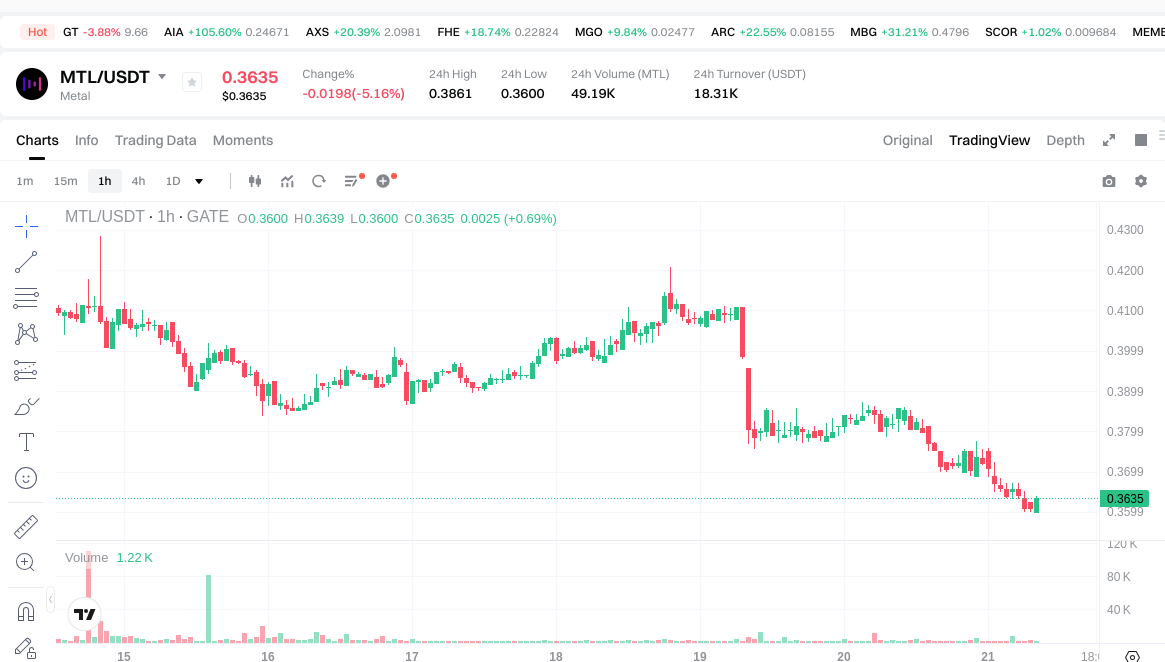
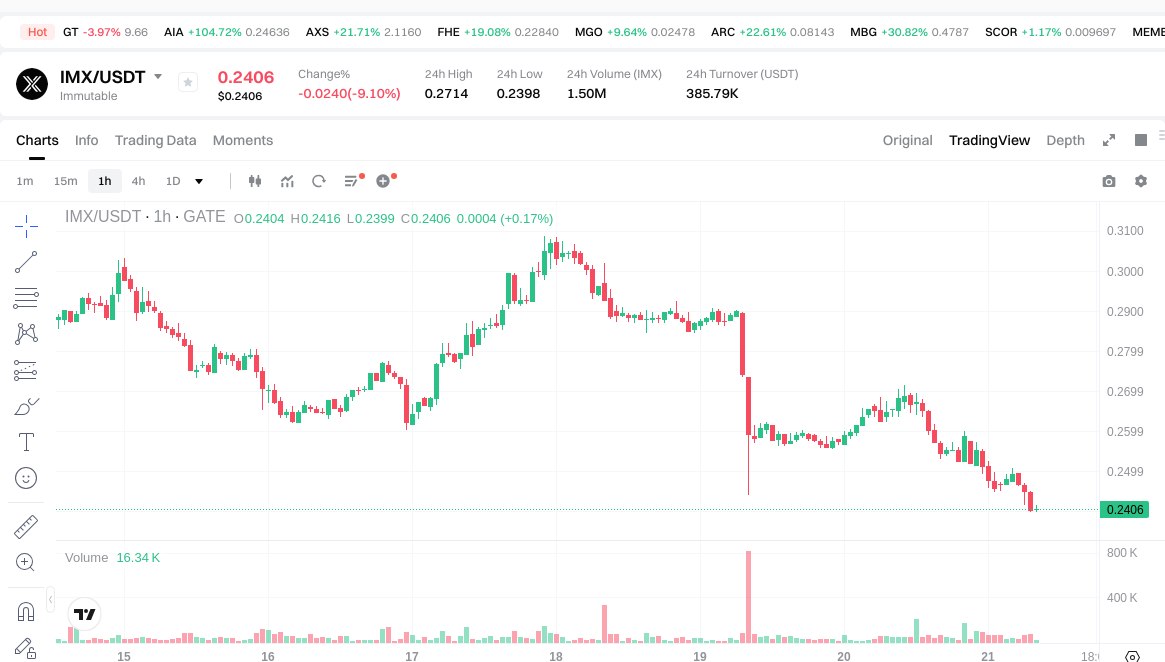
II. Core Factors Affecting MTL vs IMX Investment Value
Supply Mechanism Comparison (Tokenomics)
Due to insufficient reference materials regarding the specific supply mechanisms of MTL and IMX, a detailed comparative analysis cannot be provided at this time.
Institutional Adoption and Market Application
Institutional Holdings
Based on available information, a comprehensive comparison of institutional preference between MTL and IMX cannot be established due to limited data on institutional holdings patterns.
Enterprise Adoption
Specific applications of MTL and IMX in cross-border payments, settlements, and investment portfolios require further data collection for accurate assessment.
National Policies
Regulatory attitudes toward MTL and IMX vary across jurisdictions, though specific policy frameworks and their comparative impacts remain under-documented in current materials.
Technical Development and Ecosystem Building
MTL Technical Upgrades
Detailed information about recent technical upgrades for MTL and their potential market implications is currently limited in available resources.
IMX Technical Development
Comprehensive analysis of IMX's technical development trajectory requires additional reference materials for accurate reporting.
Ecosystem Comparison
Comparative data on DeFi integration, NFT marketplace presence, payment infrastructure, and smart contract implementation between MTL and IMX ecosystems is insufficient for detailed analysis.
Macroeconomic Environment and Market Cycles
Historical performance data comparing MTL and IMX under various inflationary conditions is limited in current reference materials.
Macroeconomic Monetary Policy
The specific impacts of interest rate fluctuations and US Dollar Index movements on MTL versus IMX require more comprehensive datasets for meaningful comparison.
Geopolitical Factors
While cross-border transaction demand and international developments may influence both assets, specific comparative impacts on MTL and IMX remain unclear based on available information.
III. 2026-2031 Price Forecast: MTL vs IMX
Short-term Forecast (2026)
- MTL: Conservative $0.2138-$0.3624 | Optimistic $0.3624-$0.4349
- IMX: Conservative $0.2145-$0.2410 | Optimistic $0.2410-$0.3229
Mid-term Forecast (2028-2029)
- MTL may enter a growth phase, with expected price range of $0.4135-$0.6471
- IMX may enter a consolidation phase, with expected price range of $0.2888-$0.4859
- Key drivers: institutional capital inflows, ETF developments, ecosystem expansion
Long-term Forecast (2030-2031)
- MTL: Base scenario $0.4484-$0.7540 | Optimistic scenario $0.6692-$0.9637
- IMX: Base scenario $0.3335-$0.5255 | Optimistic scenario $0.4264-$0.4954
View detailed price predictions for MTL and IMX
Disclaimer
MTL:
| Year |
Predicted High Price |
Predicted Average Price |
Predicted Low Price |
Price Change |
| 2026 |
0.43488 |
0.3624 |
0.213816 |
0 |
| 2027 |
0.5860008 |
0.39864 |
0.3069528 |
10 |
| 2028 |
0.551398848 |
0.4923204 |
0.413549136 |
36 |
| 2029 |
0.64710593376 |
0.521859624 |
0.44879927664 |
44 |
| 2030 |
0.7539827847552 |
0.58448277888 |
0.5201896732032 |
61 |
| 2031 |
0.963695205817344 |
0.6692327818176 |
0.448385963817792 |
85 |
IMX:
| Year |
Predicted High Price |
Predicted Average Price |
Predicted Low Price |
Price Change |
| 2026 |
0.32294 |
0.241 |
0.21449 |
0 |
| 2027 |
0.3975777 |
0.28197 |
0.1494441 |
17 |
| 2028 |
0.4858766055 |
0.33977385 |
0.2888077725 |
41 |
| 2029 |
0.4417229936925 |
0.41282522775 |
0.29723416398 |
71 |
| 2030 |
0.525547156187137 |
0.42727411072125 |
0.397364922970762 |
77 |
| 2031 |
0.495467058792361 |
0.476410633454193 |
0.333487443417935 |
98 |
IV. Investment Strategy Comparison: MTL vs IMX
Long-term vs Short-term Investment Strategies
-
MTL: May suit investors interested in payment-focused digital assets and reward mechanism innovations. The PoPP (Proof of Processed Payment) model represents a distinctive approach in the payment wallet sector, though market adoption requires ongoing observation.
-
IMX: May appeal to investors focused on NFT infrastructure and Layer 2 scaling solutions. The platform's emphasis on zero gas fees and instant transactions positions it within the growing NFT ecosystem, though performance depends on sustained sector development.
Risk Management and Asset Allocation
-
Conservative Investors: MTL 30% vs IMX 70% - This allocation reflects IMX's positioning in the expanding NFT infrastructure sector and relatively higher market capitalization ranking (224th vs 678th).
-
Aggressive Investors: MTL 45% vs IMX 55% - A more balanced approach considering MTL's potential for higher volatility alongside IMX's established market presence.
-
Hedging Tools: Stablecoin allocation for liquidity management, options strategies for downside protection, and cross-asset portfolio diversification to mitigate concentration risk.
V. Potential Risk Comparison
Market Risk
-
MTL: Trading volume of $18,588.40 indicates limited liquidity, which may result in increased price volatility and potential execution challenges during market stress. The 11.52% seven-day decline reflects susceptibility to broader market sentiment shifts.
-
IMX: Despite higher trading volume of $385,272.21, the 16.25% seven-day decline demonstrates correlation with NFT market cycles and broader crypto market trends. Market sentiment (Fear & Greed Index: 32) suggests cautious investor positioning.
Technical Risk
-
MTL: Network stability and scalability considerations remain relevant for payment-focused platforms, though specific technical development updates require ongoing monitoring.
-
IMX: As a Layer 2 solution, security dependencies on Ethereum's base layer and potential bridge vulnerabilities represent areas requiring attention. Protocol upgrade risks and smart contract security remain considerations.
Regulatory Risk
Both assets face evolving regulatory frameworks across jurisdictions. Payment-focused tokens like MTL may encounter specific regulations around financial services, while NFT infrastructure platforms like IMX could be affected by emerging digital asset and securities regulations. Cross-border transaction capabilities may face varying compliance requirements.
VI. Conclusion: Which Is the Better Buy?
📌 Investment Value Summary:
-
MTL Advantages: Established presence since 2017 in the payment wallet sector with a distinctive reward mechanism. Lower market cap positioning may present higher potential return opportunities, though accompanied by increased risk. Current price of $0.36 represents a substantial decline from historical highs, potentially offering entry points for risk-tolerant investors.
-
IMX Advantages: Strong positioning within the NFT infrastructure space with Layer 2 scaling capabilities. Higher market cap ranking (224th) and trading volume ($385,272.21) suggest relatively better liquidity. The platform's focus on zero gas fees addresses a key pain point in NFT transactions, aligning with sector growth trends.
✅ Investment Recommendations:
-
New Investors: Consider starting with smaller allocations due to current market conditions (Fear & Greed Index: 32). IMX may offer a more accessible entry point given its established infrastructure role, though thorough research and risk assessment remain essential before any investment decision.
-
Experienced Investors: May evaluate both assets within a diversified portfolio context, considering MTL's payment sector positioning against IMX's NFT infrastructure focus. Risk management through position sizing and stop-loss strategies should be prioritized given recent price declines.
-
Institutional Investors: Comprehensive due diligence on technical infrastructure, regulatory compliance frameworks, and ecosystem development trajectories is recommended. Consideration of liquidity requirements and portfolio correlation effects should inform allocation decisions.
⚠️ Risk Warning: The cryptocurrency market exhibits high volatility. This analysis does not constitute investment advice. All investment decisions should be based on individual risk tolerance, financial circumstances, and independent research.
VII. FAQ
Q1: What are the main differences between MTL and IMX in terms of their core use cases?
MTL focuses on payment wallet services with a reward mechanism through Proof of Processed Payment (PoPP), targeting financial services for small and medium-sized businesses since 2017. IMX, launched in 2021, operates as a Layer 2 scaling solution specifically designed for NFT transactions on Ethereum, offering instant transactions and zero gas fees. The fundamental distinction lies in their sectors: MTL addresses payment infrastructure while IMX serves NFT marketplace infrastructure.
Q2: Which asset shows better liquidity for trading purposes?
IMX demonstrates significantly better liquidity with a 24-hour trading volume of $385,272.21 compared to MTL's $18,588.40 as of January 21, 2026. This approximately 20x difference in trading volume suggests IMX offers easier entry and exit opportunities with potentially lower slippage risk. However, both assets have experienced notable recent declines (MTL: -11.52%, IMX: -16.25% over 7 days), indicating both face current market headwinds.
Q3: How do the market capitalizations and rankings compare between MTL and IMX?
IMX ranks 224th globally with a market cap of approximately $198.5 million and 826.3 million tokens in circulation, while MTL ranks 678th with a market cap of around $32.1 million and 89.2 million circulating tokens. IMX's market cap is roughly 6x larger than MTL's, indicating stronger market presence and investor confidence, though this also suggests potentially lower percentage gains compared to smaller-cap assets like MTL during bullish cycles.
Q4: What are the price forecasts for MTL and IMX through 2031?
For 2026, MTL is projected between $0.2138-$0.4349 (conservative to optimistic), while IMX ranges from $0.2145-$0.3229. By 2031, MTL's forecast spans $0.4484-$0.9637 and IMX ranges from $0.3335-$0.4954. MTL shows higher potential percentage gains from current levels, with projected increases of 85-98% by 2031, compared to IMX's more moderate growth trajectory, reflecting MTL's lower base and higher risk-reward profile.
Q5: What allocation strategy should different investor types consider for MTL vs IMX?
Conservative investors might consider 30% MTL and 70% IMX, favoring IMX's stronger market position and established NFT infrastructure role. Aggressive investors could adopt a more balanced 45% MTL and 55% IMX allocation to capture MTL's higher potential volatility upside while maintaining exposure to IMX's sector positioning. Both strategies should incorporate stablecoin reserves for liquidity management and implement risk mitigation through position sizing appropriate to individual circumstances.
Q6: What are the primary risks associated with investing in MTL versus IMX?
MTL faces liquidity risk due to low trading volume ($18,588.40), which can result in significant price slippage and execution challenges. Its payment wallet sector positioning may also encounter specific financial services regulations. IMX, while more liquid, carries technical dependencies as a Layer 2 solution, including potential bridge vulnerabilities and smart contract risks. Both assets are subject to broader cryptocurrency market volatility, currently reflected in the Fear & Greed Index of 32, and face evolving regulatory frameworks across jurisdictions.
Q7: How have MTL and IMX performed historically compared to their all-time highs?
MTL reached its all-time high of $17.03 in June 2018, representing a decline of approximately 97.9% to its current price of $0.36. IMX achieved a notable price of $9.52 in November 2021, declining approximately 97.5% to its current level of $0.2402. Both assets have experienced substantial corrections from peak levels, though IMX's shorter market history (launched 2021) versus MTL's longer track record (launched 2017) provides different contexts for evaluating recovery potential and market cycle positioning.
Q8: Which asset is more suitable for investors interested in the NFT ecosystem?
IMX is specifically designed for the NFT ecosystem, offering Layer 2 scaling solutions with zero gas fees and instant transactions for NFT minting and trading. This positioning makes IMX the clear choice for investors seeking direct exposure to NFT infrastructure growth. MTL, focused on payment wallets and financial services for SMEs, does not directly address NFT-specific use cases. However, diversified investors might hold both assets as complementary exposures to different segments of the broader digital asset ecosystem.
* The information is not intended to be and does not constitute financial advice or any other recommendation of any sort offered or endorsed by Gate.