This comprehensive analysis compares MULTI and VET, two distinct cryptocurrency tokens in the blockchain ecosystem. MULTI, a cross-chain infrastructure solution launched as Anyswap in 2020, facilitates Web3 interoperability, while VET, established in 2015, specializes in enterprise-grade supply chain management. The article examines historical price trends, tokenomics, institutional adoption, technical ecosystems, and macroeconomic factors influencing both tokens. With current prices at $0.2822 (MULTI) and $0.009396 (VET), the analysis provides price forecasts through 2031 and tailored investment strategies for conservative, aggressive, and novice investors. Key findings reveal VET's superior trading liquidity and enterprise partnerships, while MULTI presents higher growth potential amid greater volatility. The comparison addresses critical investment questions through detailed risk assessments and actionable recommendations for different investor profiles.
Introduction: Investment Comparison Between MULTI and VET
In the cryptocurrency market, the comparison between MULTI vs VET remains a topic of ongoing interest among investors. The two tokens differ significantly in market capitalization ranking, application scenarios, and price performance, representing distinct positioning within the crypto asset landscape.
Multichain (MULTI): Launched in 2020 as Anyswap, it has gained recognition for its role as a cross-chain infrastructure facilitating arbitrary cross-chain interactions across Web3.
VeChain (VET): Since its 2015 inception, it has been positioned as an enterprise-grade Layer-1 blockchain solution, focusing on supply chain transparency and real-world business applications through partnerships with global organizations.
This article will provide a comprehensive analysis of MULTI vs VET investment value comparison, examining historical price trends, supply mechanisms, institutional adoption, technical ecosystems, and future outlooks. The analysis aims to address the key question on investors' minds:
"Which is the better buy right now?"
I. Historical Price Comparison and Current Market Status
MULTI (Coin A) and VET (Coin B) Historical Price Trends
- 2022: MULTI experienced significant price movement, reaching a historical high of $33.64 on January 14, 2022, driven by market momentum during the broader cryptocurrency rally.
- 2024: MULTI faced substantial downward pressure, recording its historical low of $0.093819 on September 2, 2024, amid market-wide corrections.
- 2021: VET achieved its historical peak of $0.280991 on April 19, 2021, during a period of increased adoption and partnership announcements.
- 2020: VET established its historical low of $0.00191713 on March 13, 2020, coinciding with broader market volatility.
- Comparative Analysis: During the 2021-2024 market cycle, MULTI declined from its peak of $33.64 to its low of $0.093819, representing a significant contraction, while VET experienced a decline from $0.280991 to $0.00191713 during a similar timeframe.
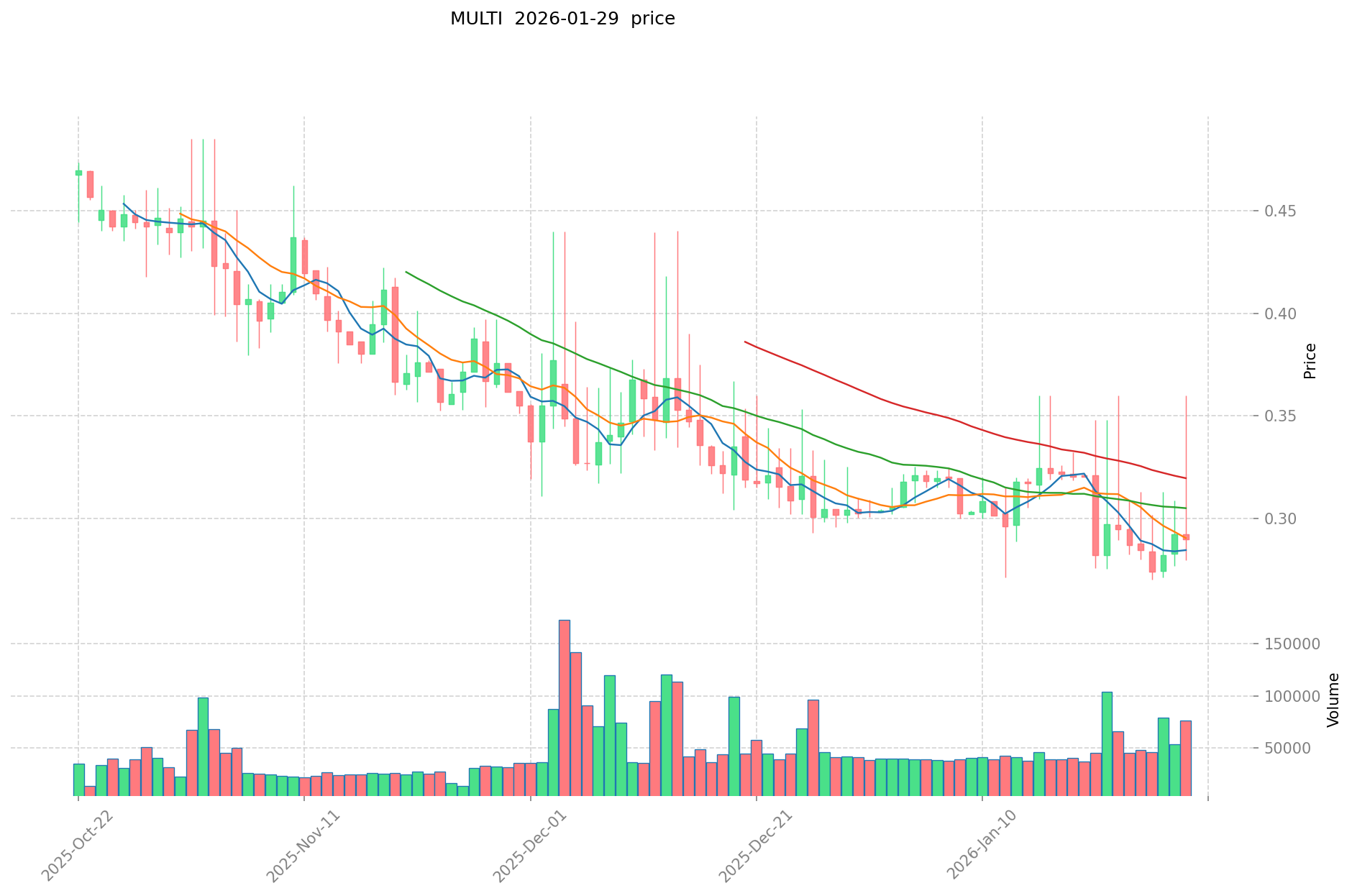
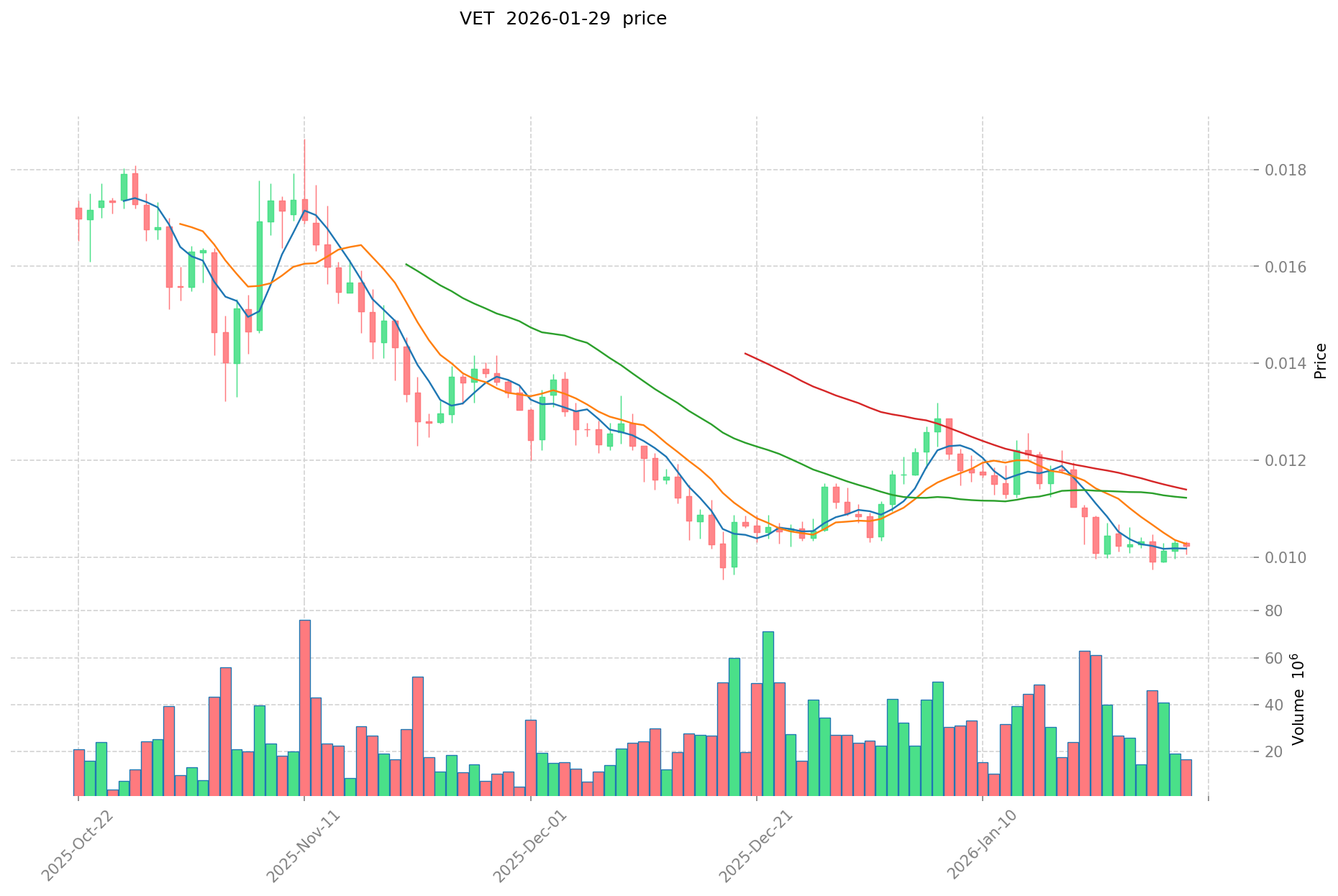
Current Market Status (January 30, 2026)
- MULTI Current Price: $0.2822
- VET Current Price: $0.009396
- 24-Hour Trading Volume: MULTI recorded $17,015.21 versus VET's $387,453.04
- Market Sentiment Index (Fear & Greed Index): 26 (Fear)
View real-time prices:
II. Core Factors Influencing MULTI vs VET Investment Value
Tokenomics Comparison
- VET: The token serves as the native asset of the VeChain blockchain, primarily applied in supply chain management. Its core features include controlled transaction cycles, Multi-Party Payment (MPP) mechanism, Multi-Task Transaction (MTT), and transaction dependencies, providing foundational support for enterprise-level blockchain applications.
- MULTI: Information regarding MULTI's supply mechanism and tokenomics structure is currently limited in available materials.
- 📌 Historical Pattern: Supply mechanisms play a significant role in driving price cycle variations across crypto assets, though specific historical data for these tokens requires further observation.
Institutional Adoption and Market Application
- Institutional Holdings: Available materials do not provide comparative data on institutional preference between MULTI and VET.
- Enterprise Adoption: VET demonstrates application potential in supply chain management and traceability systems. Its environmental benefits and utility within the VeChain ecosystem represent key factors for enterprise consideration. Specific enterprise adoption data for MULTI is not available in the provided materials.
- National Policies: Regulatory attitudes toward both assets vary across jurisdictions, though specific policy frameworks are not detailed in the reference materials.
Technological Development and Ecosystem Building
- VET Technical Upgrades: VeChain's blockchain technology focuses on enterprise-grade applications with features designed for supply chain transparency and verification.
- MULTI Technical Development: Technical development details and roadmap information are not available in the provided materials.
- Ecosystem Comparison: VET's ecosystem centers on supply chain management applications. Comparative data regarding DeFi, NFT, payment systems, and smart contract implementation for both tokens is limited in available resources.
Macroeconomic Factors and Market Cycles
- Performance in Inflationary Environments: Comparative analysis of anti-inflation properties between MULTI and VET requires additional market data beyond the scope of provided materials.
- Macroeconomic Monetary Policy: Interest rates, dollar index movements, and broader monetary policy shifts influence crypto asset valuations, though specific correlations for these tokens are not documented in available resources.
- Geopolitical Factors: Cross-border transaction demand and international dynamics may affect adoption trajectories, particularly for blockchain solutions targeting global supply chain management.
III. 2026-2031 Price Forecast: MULTI vs VET
Short-term Forecast (2026)
- MULTI: Conservative $0.200362 - $0.2822 | Optimistic $0.2822 - $0.400724
- VET: Conservative $0.0051513 - $0.009366 | Optimistic $0.009366 - $0.01152018
Mid-term Forecast (2028-2029)
- MULTI may enter a moderate growth phase, with projected price range of $0.3107987124 - $0.566997651 in 2028, potentially reaching $0.281293834635 - $0.715572035475 by 2029
- VET may enter a gradual expansion phase, with projected price range of $0.007385353248 - $0.016386252519 in 2028, potentially reaching $0.00753998408163 - $0.01452145082388 by 2029
- Key drivers: institutional capital inflows, ETF developments, ecosystem expansion
Long-term Forecast (2030-2031)
- MULTI: Baseline scenario $0.406610237964892 - $0.68916989485575 | Optimistic scenario $0.68916989485575 - $0.773804794224
- VET: Baseline scenario $0.008643586418377 - $0.016948208663486 | Optimistic scenario $0.016948208663486 - $0.019654225172782
View detailed price forecasts for MULTI and VET
Disclaimer
MULTI:
| Year |
Predicted High Price |
Predicted Average Price |
Predicted Low Price |
Price Change |
| 2026 |
0.400724 |
0.2822 |
0.200362 |
0 |
| 2027 |
0.49853452 |
0.341462 |
0.22536492 |
21 |
| 2028 |
0.566997651 |
0.41999826 |
0.3107987124 |
48 |
| 2029 |
0.715572035475 |
0.4934979555 |
0.281293834635 |
74 |
| 2030 |
0.773804794224 |
0.6045349954875 |
0.380857047157125 |
114 |
| 2031 |
0.737411787495652 |
0.68916989485575 |
0.406610237964892 |
144 |
VET:
| Year |
Predicted High Price |
Predicted Average Price |
Predicted Low Price |
Price Change |
| 2026 |
0.01152018 |
0.009366 |
0.0051513 |
0 |
| 2027 |
0.0126361389 |
0.01044309 |
0.0082500411 |
11 |
| 2028 |
0.016386252519 |
0.01153961445 |
0.007385353248 |
22 |
| 2029 |
0.01452145082388 |
0.0139629334845 |
0.00753998408163 |
48 |
| 2030 |
0.019654225172782 |
0.01424219215419 |
0.009399846821765 |
51 |
| 2031 |
0.019151475789739 |
0.016948208663486 |
0.008643586418377 |
80 |
IV. Investment Strategy Comparison: MULTI vs VET
Long-term vs Short-term Investment Strategies
- MULTI: May appeal to investors interested in cross-chain infrastructure development and Web3 interoperability solutions, though limited ecosystem data suggests careful evaluation of long-term viability
- VET: May suit investors focusing on enterprise blockchain adoption, particularly those interested in supply chain management applications and real-world business integration scenarios
Risk Management and Asset Allocation
- Conservative Investors: MULTI 20-30% vs VET 70-80% - considering VET's established enterprise partnerships and longer operational history
- Aggressive Investors: MULTI 50-60% vs VET 40-50% - reflecting higher volatility potential in cross-chain infrastructure segment
- Hedging Instruments: stablecoin allocation for portfolio balance, options strategies for downside protection, cross-asset diversification to mitigate single-token concentration risk
V. Potential Risk Comparison
Market Risks
- MULTI: Significant historical price volatility evidenced by the decline from $33.64 (January 2022) to $0.093819 (September 2024), lower trading volume ($17,015.21 as of January 30, 2026) may indicate liquidity constraints
- VET: Price fluctuations from $0.280991 (April 2021) to lower levels, though higher 24-hour trading volume ($387,453.04) suggests relatively better liquidity conditions
Technical Risks
- MULTI: Limited available information regarding network scalability, security audits, and operational stability creates uncertainty in technical assessment
- VET: Enterprise-grade blockchain infrastructure requires continuous maintenance and upgrade capabilities, network performance under high transaction volumes remains a consideration for enterprise adoption
Regulatory Risks
- Cross-chain infrastructure solutions like MULTI may face evolving regulatory frameworks regarding interoperability protocols and multi-chain asset transfers across different jurisdictions
- Enterprise blockchain platforms like VET operating in supply chain management may encounter varying compliance requirements across different national regulatory environments, particularly in data privacy and cross-border transaction monitoring
VI. Conclusion: Which Is the Better Buy?
📌 Investment Value Summary:
- MULTI Strengths: Positioned in the cross-chain infrastructure sector with potential for Web3 ecosystem growth, though current market data indicates significant volatility and limited available ecosystem information
- VET Strengths: Established presence in enterprise blockchain applications, focus on supply chain transparency with documented use cases, higher trading volume suggests relatively better market liquidity
✅ Investment Recommendations:
- Novice Investors: Consider starting with smaller allocations in both assets, prioritize understanding blockchain fundamentals and market cycles before committing substantial capital, maintain diversified portfolio approach
- Experienced Investors: Evaluate technical development trajectories, monitor ecosystem growth metrics, consider strategic allocation based on risk tolerance and market cycle positioning, implement proper risk management protocols
- Institutional Investors: Conduct comprehensive due diligence on enterprise adoption rates, assess regulatory compliance frameworks, evaluate long-term infrastructure viability and partnership developments, consider portfolio allocation within broader digital asset strategy
⚠️ Risk Disclaimer: The cryptocurrency market exhibits extreme volatility. This analysis does not constitute investment advice. Investors should conduct independent research and consult qualified financial advisors before making investment decisions.
VII. FAQ
Q1: What are the key differences between MULTI and VET in terms of use cases?
MULTI focuses on cross-chain infrastructure for Web3 interoperability, while VET specializes in enterprise-grade supply chain management solutions. MULTI, originally launched as Anyswap in 2020, facilitates arbitrary cross-chain interactions across different blockchain networks, positioning itself within the decentralized finance and cross-chain bridge sector. VET, established in 2015, provides blockchain-based transparency and traceability systems for real-world business applications, particularly in supply chain verification and enterprise adoption scenarios. The fundamental distinction lies in MULTI's technical infrastructure orientation versus VET's business application focus.
Q2: How do the historical price volatilities of MULTI and VET compare?
MULTI has exhibited more extreme price volatility compared to VET. MULTI experienced a dramatic decline from its historical high of $33.64 (January 14, 2022) to a low of $0.093819 (September 2, 2024), representing a contraction of over 99%. VET's historical range spans from $0.280991 (April 19, 2021) to $0.00191713 (March 13, 2020), demonstrating significant but relatively less extreme fluctuations. As of January 30, 2026, MULTI's 24-hour trading volume stands at $17,015.21 compared to VET's $387,453.04, suggesting VET maintains better market liquidity and potentially more stable trading conditions.
Q3: Which token has stronger institutional and enterprise adoption?
VET demonstrates clearer enterprise adoption pathways through its focus on supply chain management applications. VeChain has established partnerships with global organizations and positions itself as an enterprise-grade Layer-1 blockchain solution with features designed for business integration, including Multi-Party Payment mechanisms and transaction dependencies. MULTI's institutional adoption metrics are less documented in available materials, with limited information regarding enterprise partnerships or corporate implementation cases. For investors prioritizing established business relationships and real-world utility, VET presents more transparent adoption indicators.
Q4: What are the projected price trajectories for MULTI and VET through 2031?
For 2026, MULTI's conservative forecast ranges from $0.200362 to $0.2822, with optimistic projections reaching $0.400724, while VET's conservative estimate spans $0.0051513 to $0.009366, with optimistic scenarios extending to $0.01152018. By 2031, MULTI's baseline projection ranges from $0.406610237964892 to $0.68916989485575, potentially reaching $0.773804794224 in optimistic scenarios. VET's 2031 baseline forecast ranges from $0.008643586418377 to $0.016948208663486, with optimistic projections up to $0.019654225172782. These forecasts suggest potential moderate growth for both assets, though actual performance depends on ecosystem development, market conditions, and regulatory environments.
Q5: What are the main risk factors investors should consider when comparing MULTI and VET?
Three primary risk categories warrant consideration: market risks, technical risks, and regulatory risks. Market risks include MULTI's historical extreme volatility and lower trading volume, which may indicate liquidity constraints, compared to VET's relatively higher trading activity. Technical risks encompass limited available information regarding MULTI's network scalability and security audits, while VET faces ongoing requirements for enterprise-grade infrastructure maintenance. Regulatory risks affect both tokens differently—MULTI's cross-chain operations may encounter evolving interoperability protocol regulations, while VET's enterprise applications must navigate varying compliance requirements across jurisdictions, particularly in data privacy and cross-border transaction monitoring. Investors should implement proper risk management protocols and maintain diversified portfolios regardless of allocation choices.
Q6: How should different investor profiles approach MULTI vs VET allocation?
Investment allocation should align with risk tolerance and experience levels. Conservative investors might consider a 20-30% MULTI allocation versus 70-80% VET, reflecting VET's established enterprise partnerships and longer operational history. Aggressive investors with higher risk tolerance could pursue a 50-60% MULTI allocation versus 40-50% VET, capitalizing on potential volatility in the cross-chain infrastructure segment. Novice investors should begin with smaller allocations in both assets, prioritizing education on blockchain fundamentals and market cycles before substantial commitments. Experienced investors should evaluate technical development trajectories and monitor ecosystem growth metrics, while institutional investors require comprehensive due diligence on enterprise adoption rates, regulatory compliance frameworks, and long-term infrastructure viability before strategic positioning.
* The information is not intended to be and does not constitute financial advice or any other recommendation of any sort offered or endorsed by Gate.