This comprehensive investment analysis compares MYRIA and SAND, two distinct gaming tokens with different market positions and risk profiles. MYRIA, launched in April 2023, serves as an Ethereum Layer2 scaling solution for blockchain gaming and NFT development, currently trading at $0.00006715 with limited liquidity. SAND, established since August 2020, operates as a recognized virtual game world platform at $0.1022 with significantly higher trading volume. The article examines historical price trends, tokenomics, technical ecosystems, and institutional adoption to evaluate investment potential through 2031. MYRIA offers higher growth potential for risk-tolerant investors seeking emerging infrastructure exposure, while SAND suits conservative investors prioritizing established platforms with broader adoption. Real-time pricing data and detailed predictions are available on Gate, helping investors make informed decisions based on their risk tolerance and investment horizons.
Introduction: MYRIA vs SAND Investment Comparison
In the cryptocurrency market, the comparison between MYRIA and SAND has become a topic of interest for investors. Both assets show distinct differences in market cap ranking, application scenarios, and price performance, representing different positioning within the crypto asset landscape.
Myria (MYRIA): Launched in April 2023, this project has gained recognition for its positioning as an Ethereum Layer2 scaling solution specifically developed for gaming, supporting blockchain game deployment and NFT development.
The Sandbox (SAND): Since its launch in August 2020, it has been recognized as a virtual game world platform, ranking among the established projects in the gaming and metaverse sector with broader market adoption.
This article will analyze the investment value comparison between MYRIA and SAND through historical price trends, supply mechanisms, technical ecosystem, and future outlook, attempting to address investors' key question:
"Which is the better buy right now?"
I. Price History Comparison and Current Market Status
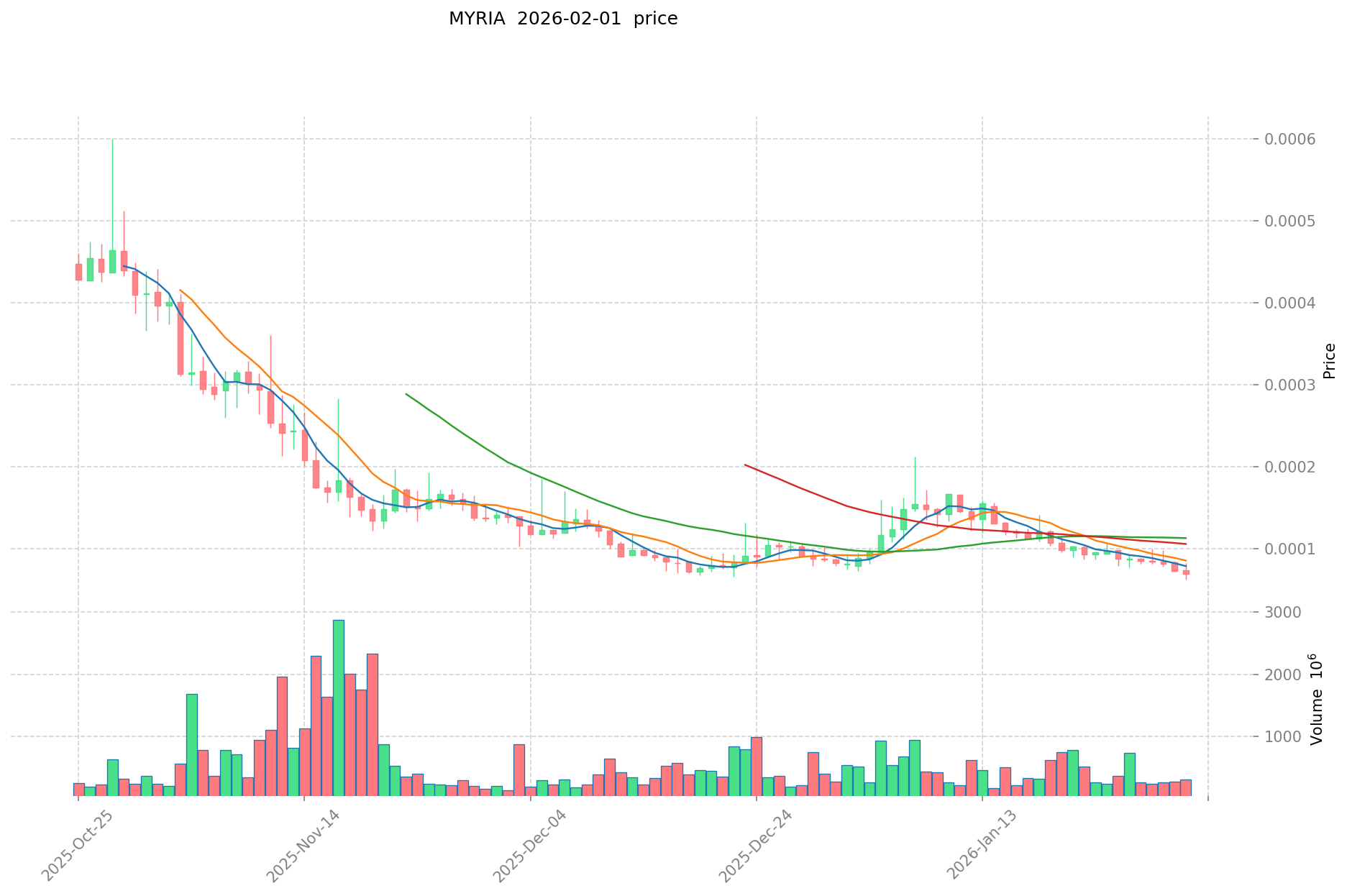
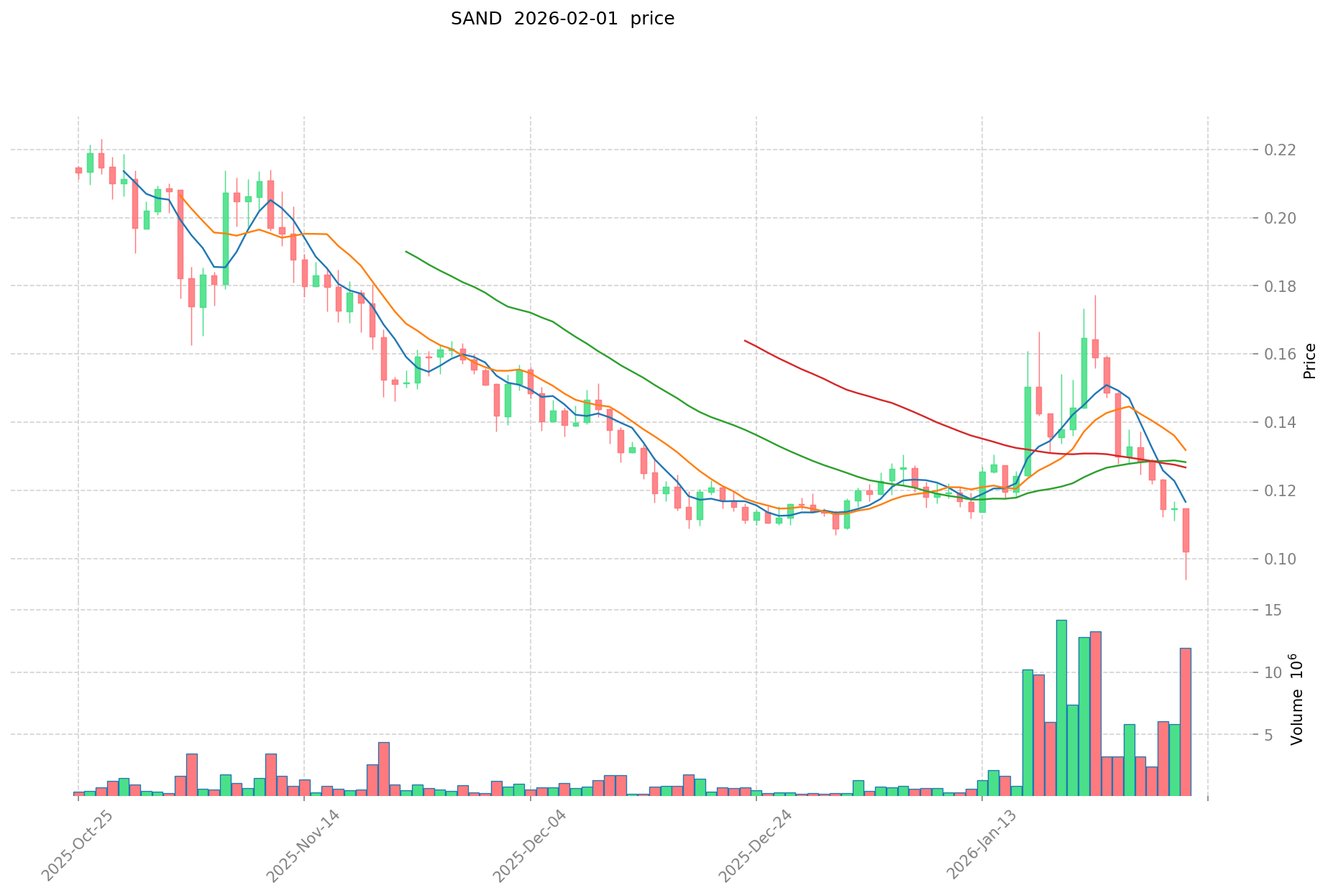
MYRIA (Coin A) and SAND (Coin B) Historical Price Trends
- December 2023: MYRIA reached a notable price level of $0.01667821, representing a significant valuation point during this period.
- November 2021: SAND experienced substantial growth, reaching $8.4, driven by heightened interest in metaverse and gaming-related digital assets.
- Comparative Analysis: During the market cycle from late 2021 to early 2026, MYRIA declined from $0.01667821 to $0.00006715, while SAND decreased from $8.4 to $0.1022, reflecting broader market corrections in the gaming and metaverse sectors.
Current Market Status (February 1, 2026)
- MYRIA current price: $0.00006715
- SAND current price: $0.1022
- 24-hour trading volume: MYRIA $21,097.18 vs SAND $1,268,701.53
- Market Sentiment Index (Fear & Greed Index): 14 (Extreme Fear)
View real-time prices:
II. Core Factors Influencing MYRIA vs SAND Investment Value
Supply Mechanism Comparison (Tokenomics)
- MYRIA: Specific supply mechanism details are not available in the reference materials. Token economics may include distribution models that influence long-term value dynamics.
- SAND: Supply mechanism information is not detailed in the provided materials. Token distribution and emission schedules may affect market performance.
- 📌 Historical Pattern: Supply mechanisms can influence price cycles through scarcity effects, emission rates, and distribution schedules, though specific historical data for these tokens requires further analysis.
Institutional Adoption and Market Application
- Institutional Holdings: Reference materials indicate MYRIA had a market capitalization of approximately $753.25 million with token positions of $1.29 million (representing a minimal percentage of market cap) as of October 9, 2023. Comparative institutional preference data requires additional research.
- Enterprise Adoption: Specific applications in cross-border payments, settlements, or investment portfolios are not documented in the available materials for either token.
- Regulatory Environment: National policy stances toward these specific tokens are not covered in the reference materials.
Technical Development and Ecosystem Building
- MYRIA Technical Progress: Detailed technical upgrade information is not available in the provided materials.
- SAND Technical Development: Specific technical advancement data is not included in the reference materials.
- Ecosystem Comparison: Implementation details regarding DeFi, NFT, payment systems, and smart contract applications for both tokens are not documented in the available materials.
Macroeconomic and Market Cycle
- Performance in Inflationary Environments: Comparative anti-inflation characteristics of these tokens are not addressed in the reference materials.
- Macroeconomic Monetary Policy: The specific impact of interest rates and dollar index movements on MYRIA and SAND requires further analysis beyond the provided materials.
- Geopolitical Factors: Cross-border transaction demand and international situation influences are not detailed in the available reference materials.
III. 2026-2031 Price Prediction: MYRIA vs SAND
Short-term Prediction (2026)
- MYRIA: Conservative $0.00004029 - $0.00006715 | Optimistic $0.00006715 - $0.00008058
- SAND: Conservative $0.084577 - $0.1019 | Optimistic $0.1019 - $0.149793
Mid-term Prediction (2028-2029)
- MYRIA may enter a gradual growth phase, with expected price range of $0.000054748738 - $0.0001022513195 in 2028, potentially reaching $0.000088640622207 - $0.000126107276955 by 2029
- SAND may enter an expansion phase, with expected price range of $0.089099322 - $0.178198644 in 2028, potentially reaching $0.15473078868 - $0.20246688306 by 2029
- Key drivers: institutional capital inflows, ETF developments, ecosystem growth
Long-term Prediction (2030-2031)
- MYRIA: Baseline scenario $0.000071771489362 - $0.000108744680852 (2030) | Optimistic scenario $0.00010154578298 - $0.00015231867447 (2031)
- SAND: Baseline scenario $0.1211344546698 - $0.18353705253 (2030) | Optimistic scenario $0.118216215534573 - $0.296577523183227 (2031)
View detailed price predictions for MYRIA and SAND
Disclaimer
MYRIA:
| Year |
Predicted High Price |
Predicted Average Price |
Predicted Low Price |
Price Change |
| 2026 |
0.00008058 |
0.00006715 |
0.00004029 |
0 |
| 2027 |
0.0000871607 |
0.000073865 |
0.00005539875 |
10 |
| 2028 |
0.0001022513195 |
0.00008051285 |
0.000054748738 |
19 |
| 2029 |
0.000126107276955 |
0.00009138208475 |
0.000088640622207 |
36 |
| 2030 |
0.000112007021278 |
0.000108744680852 |
0.000071771489362 |
61 |
| 2031 |
0.00015231867447 |
0.000110375851065 |
0.00010154578298 |
64 |
SAND:
| Year |
Predicted High Price |
Predicted Average Price |
Predicted Low Price |
Price Change |
| 2026 |
0.149793 |
0.1019 |
0.084577 |
0 |
| 2027 |
0.1761851 |
0.1258465 |
0.07299097 |
23 |
| 2028 |
0.178198644 |
0.1510158 |
0.089099322 |
47 |
| 2029 |
0.20246688306 |
0.164607222 |
0.15473078868 |
61 |
| 2030 |
0.2312566861878 |
0.18353705253 |
0.1211344546698 |
79 |
| 2031 |
0.296577523183227 |
0.2073968693589 |
0.118216215534573 |
102 |
IV. Investment Strategy Comparison: MYRIA vs SAND
Long-term vs Short-term Investment Strategies
- MYRIA: May appeal to investors focused on emerging Layer2 gaming infrastructure and early-stage blockchain gaming ecosystem development, with higher risk tolerance for nascent projects
- SAND: May suit investors seeking exposure to established metaverse platforms with demonstrated market presence and broader community adoption in virtual world applications
Risk Management and Asset Allocation
- Conservative Investors: MYRIA 20-30% vs SAND 70-80% - allocation weighted toward the more established project with broader market recognition
- Aggressive Investors: MYRIA 50-60% vs SAND 40-50% - balanced exposure allowing participation in both emerging gaming infrastructure and established metaverse platforms
- Hedging Tools: stablecoin allocations for liquidity management, diversified portfolio approach across gaming and metaverse sectors, position sizing based on risk tolerance
V. Potential Risk Comparison
Market Risks
- MYRIA: Higher volatility risk associated with lower market capitalization and trading volume ($21,097.18 daily), increased sensitivity to gaming sector sentiment shifts, liquidity constraints during market stress periods
- SAND: Exposure to metaverse sector cycles and gaming platform adoption trends, trading volume of $1,268,701.53 indicates better liquidity but still subject to sector-wide corrections, correlation with broader gaming and NFT market movements
Technical Risks
- MYRIA: Scalability considerations related to Layer2 implementation, network stability dependent on underlying Ethereum infrastructure, early-stage technical development uncertainties
- SAND: Platform technical evolution requirements, ecosystem maintenance challenges, dependency on continued platform development and user engagement
Regulatory Risks
- Both assets face evolving regulatory frameworks for gaming tokens and virtual asset platforms, potential classification uncertainties across different jurisdictions, compliance requirements for gaming and metaverse applications may differ regionally
VI. Conclusion: Which Is the Better Buy?
📌 Investment Value Summary:
- MYRIA Advantages: Positioning in Layer2 gaming infrastructure space, potential for growth in blockchain gaming adoption, early-stage entry opportunity for risk-tolerant investors
- SAND Advantages: Established market presence since 2020, broader community recognition in metaverse sector, higher trading liquidity and market stability relative to emerging competitors
✅ Investment Recommendations:
- Novice Investors: Consider starting with SAND for exposure to established metaverse platforms with demonstrated market presence, allocate smaller positions until developing understanding of gaming token dynamics
- Experienced Investors: Evaluate portfolio diversification across both assets based on risk tolerance, with weighted allocation favoring established projects while maintaining exposure to emerging gaming infrastructure
- Institutional Investors: Conduct thorough due diligence on technical architecture, tokenomics, and ecosystem development roadmaps, consider position sizing aligned with gaming and metaverse sector allocation strategies
⚠️ Risk Disclaimer: The cryptocurrency market exhibits substantial volatility. This content does not constitute investment advice. Investors should conduct independent research and consider their financial situation before making investment decisions.
VII. FAQ
Q1: What are the main differences between MYRIA and SAND in terms of market positioning?
MYRIA is an Ethereum Layer2 scaling solution specifically designed for gaming launched in April 2023, while SAND is an established virtual game world platform operating since August 2020. MYRIA focuses on blockchain game deployment and NFT development infrastructure, representing an emerging technology layer for gaming applications. SAND, conversely, operates as a metaverse platform with a broader user base and market recognition. The fundamental distinction lies in MYRIA's role as gaming infrastructure versus SAND's position as an end-user gaming platform, resulting in different risk-reward profiles and investment characteristics.
Q2: Which token shows better liquidity for trading purposes?
SAND demonstrates significantly superior liquidity with a 24-hour trading volume of $1,268,701.53 compared to MYRIA's $21,097.18 as of February 1, 2026. This 60x volume difference indicates SAND offers substantially easier entry and exit opportunities with reduced slippage risk during normal market conditions. The higher liquidity reduces execution risk for larger positions and provides better price discovery mechanisms. For investors prioritizing trade execution quality and position flexibility, SAND's liquidity profile presents clear advantages, particularly during volatile market periods when liquidity constraints can amplify losses.
Q3: How do the price predictions compare for both tokens through 2031?
MYRIA's conservative price projection ranges from $0.00004029 in 2026 to $0.00010154578298 by 2031, representing approximately 152% growth potential. SAND's conservative forecast spans $0.084577 in 2026 to $0.118216215534573 by 2031, indicating roughly 40% appreciation potential. In percentage terms, MYRIA exhibits higher growth projections from a lower base, characteristic of early-stage assets with greater risk-reward asymmetry. However, SAND's predictions suggest more stable appreciation with lower volatility expectations. The divergent trajectories reflect MYRIA's speculative growth potential versus SAND's established market position with moderate expansion expectations.
Q4: What allocation strategy is recommended for conservative versus aggressive investors?
Conservative investors should consider a 20-30% MYRIA and 70-80% SAND allocation, weighted toward the established project with demonstrated market presence and higher liquidity. This approach prioritizes capital preservation while maintaining modest exposure to emerging gaming infrastructure. Aggressive investors may adopt a 50-60% MYRIA and 40-50% SAND split, allowing balanced participation across both emerging technology layers and established platforms. The allocation differential reflects risk tolerance differences—conservative strategies emphasize proven platforms with lower volatility, while aggressive approaches accept higher risk for potentially superior returns from early-stage infrastructure projects.
Q5: What are the primary risks specific to each token?
MYRIA faces elevated risks from its lower market capitalization, minimal daily trading volume creating liquidity constraints, and early-stage technical development uncertainties inherent to Layer2 implementations. Network stability depends on underlying Ethereum infrastructure, and adoption risk remains significant for nascent gaming infrastructure. SAND confronts different challenges including exposure to metaverse sector cycles, platform evolution requirements, and dependency on sustained user engagement and ecosystem development. Both tokens face evolving regulatory frameworks for gaming assets, though MYRIA's infrastructure positioning versus SAND's platform model may result in different compliance trajectories across jurisdictions.
Q6: How does current market sentiment affect investment decisions for these tokens?
The Fear & Greed Index reading of 14 (Extreme Fear) as of February 1, 2026, indicates widespread market pessimism that typically creates opportunities for contrarian investors with long-term perspectives. During extreme fear periods, quality assets may trade below fundamental value, potentially offering attractive entry points. For MYRIA, extreme fear amplifies liquidity risks and volatility due to its lower trading volume, making position sizing and execution timing critical. SAND's higher liquidity provides better conditions for accumulation during fearful markets. Historically, accumulation during extreme fear phases has preceded recovery periods, though timing market bottoms remains challenging and requires disciplined risk management.
Q7: Which token is more suitable for first-time cryptocurrency investors?
SAND represents a more appropriate entry point for novice investors due to its established market presence since 2020, higher trading liquidity, and broader community recognition within the metaverse sector. The $1,268,701.53 daily trading volume provides easier execution and reduced slippage compared to MYRIA's limited liquidity. New investors benefit from SAND's longer operational history, which provides more price data for analysis and reduced uncertainty regarding project viability. MYRIA's early-stage positioning, minimal liquidity, and higher technical complexity create additional challenges for inexperienced investors lacking sophisticated risk management capabilities. Starting with established projects allows skill development before venturing into higher-risk emerging assets.
Q8: What role does Layer2 technology play in MYRIA's investment thesis?
MYRIA's positioning as an Ethereum Layer2 gaming solution represents both its primary value proposition and key risk factor. Layer2 scaling addresses Ethereum's throughput limitations, enabling faster transactions and lower fees essential for gaming applications requiring frequent interactions. Success depends on achieving widespread adoption among game developers seeking blockchain integration, which remains uncertain given competitive alternatives. The technical architecture must demonstrate scalability, security, and seamless Ethereum integration to attract meaningful ecosystem development. Investment value correlates directly with Layer2 adoption trends in gaming, developer tool quality, and MYRIA's ability to capture market share in the emerging blockchain gaming infrastructure sector against competing solutions.
* The information is not intended to be and does not constitute financial advice or any other recommendation of any sort offered or endorsed by Gate.