This comprehensive guide compares MYX Finance and Loopring (LRC), two distinct blockchain tokens with different market positions and investment profiles. MYX, launched in 2025, operates as a non-custodial derivatives exchange enabling perpetual contract trading with deflationary tokenomics, currently trading at $6.051 with $884,033.68 daily volume. LRC, established in 2017, functions as a Layer 2 protocol for decentralized exchange, currently at $0.055 with lower trading activity. The article analyzes historical price trends, supply mechanisms, technological ecosystems, and risk factors to help investors make informed decisions. MYX shows higher volatility and trading volume, while LRC demonstrates longer operational history and stability. Price predictions through 2031 suggest potential growth for both assets, though with different risk-reward profiles suitable for varying investor strategies ranging from conservative to aggressive allocations.
Introduction: Investment Comparison Between MYX and LRC
In the cryptocurrency market, the comparison between MYX vs LRC has become a topic of interest for investors. The two projects differ significantly in market capitalization ranking, application scenarios, and price performance, representing distinct positioning within the crypto asset landscape.
MYX (MYX): Launched in 2025, this non-custodial derivatives exchange has gained market recognition by enabling on-chain perpetual contract trading for virtually any token with an existing AMM market, aiming to lower capital costs for liquidity providers.
LRC (LRC): Introduced in 2017, Loopring has established itself as an open protocol based on ERC20 and smart contracts for multi-token trading, enabling decentralized exchange applications without asset custody requirements.
This article will provide a comprehensive analysis of MYX vs LRC investment value comparison, covering historical price trends, supply mechanisms, institutional adoption, technological ecosystems, and future projections, addressing the question that concerns investors most:
"Which is the better buy right now?"
I. Historical Price Comparison and Current Market Status
MYX Finance (MYX) and Loopring (LRC) Historical Price Trends
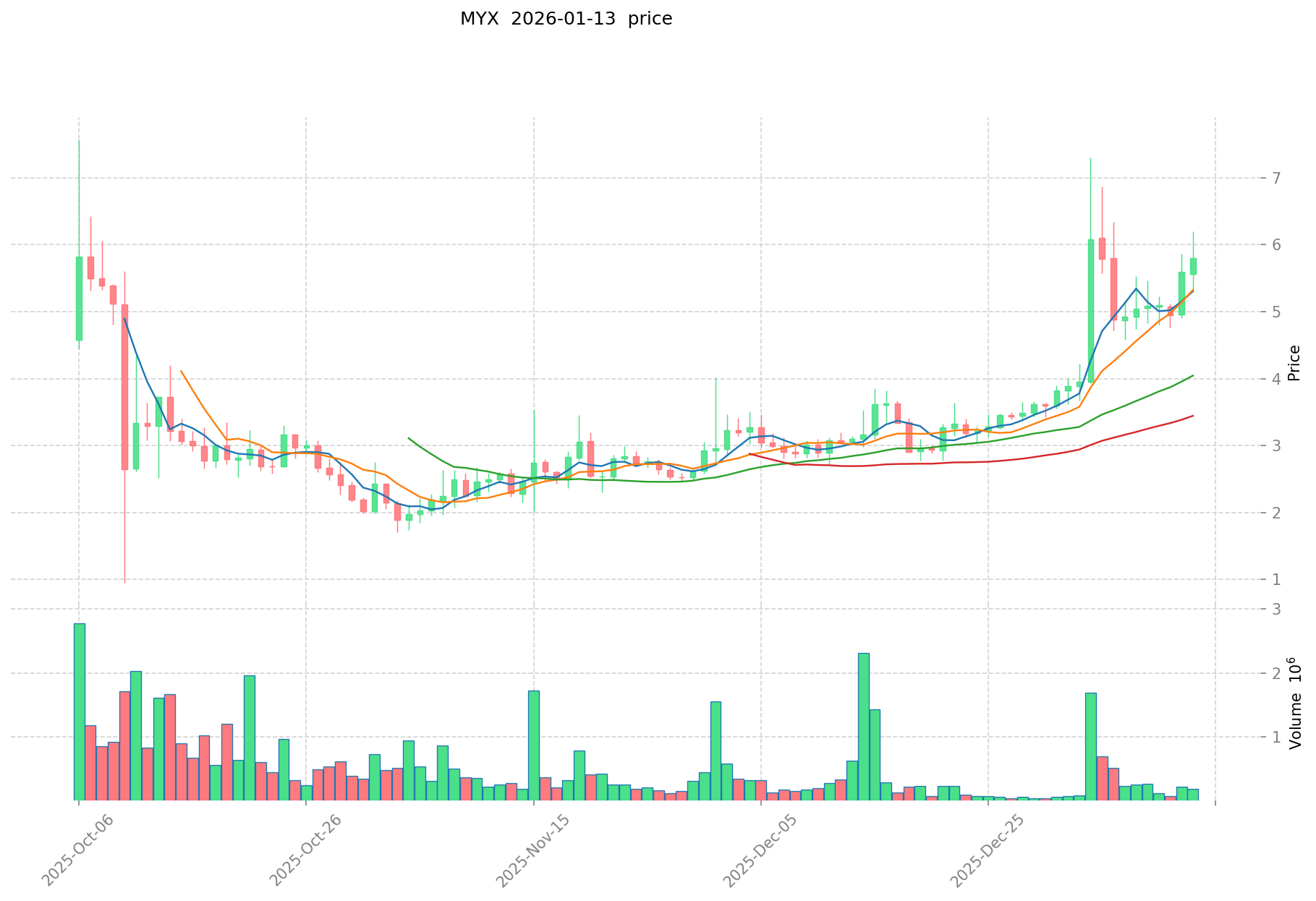
- 2025: MYX Finance experienced significant price volatility, with its all-time high recorded at $19.898 on September 9, 2025, followed by a decline to an all-time low of $0.946 on October 10, 2025.
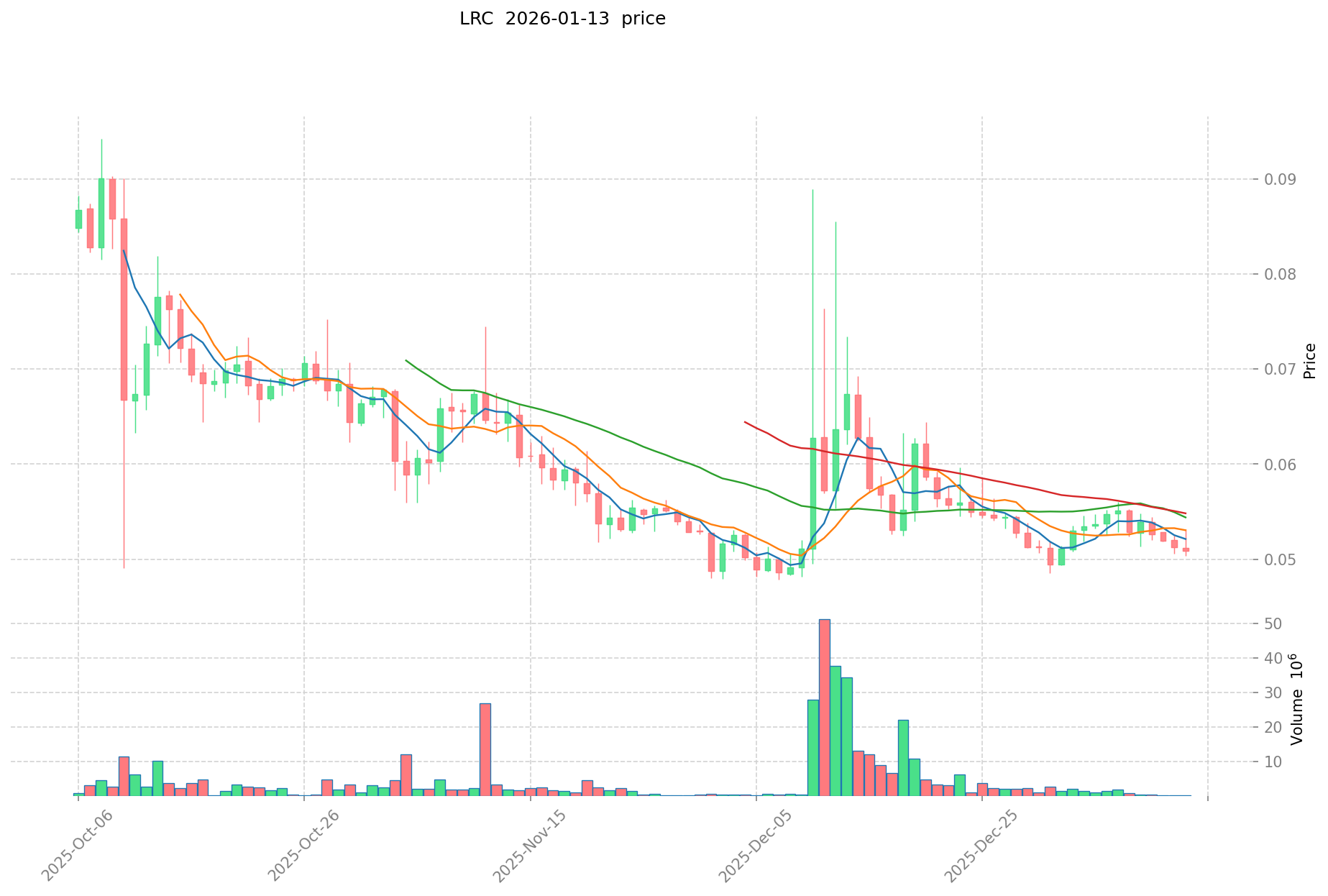
- 2021: Loopring (LRC) reached its all-time high of $3.75 on November 10, 2021, driven by market enthusiasm around Layer 2 scaling solutions and DeFi growth.
- 2019: LRC recorded its all-time low of $0.01963893 on December 18, 2019, during a broader market downturn.
- Comparative Analysis: During recent market cycles, MYX has shown substantial fluctuations, moving from its peak of $19.898 to $0.946 within a short period, reflecting high volatility. In contrast, LRC has demonstrated a more gradual decline from its 2021 peak, stabilizing at lower price levels over time.
Current Market Status (January 14, 2026)
- MYX Current Price: $6.051
- LRC Current Price: $0.05505
- 24-Hour Trading Volume: MYX recorded $884,033.68, while LRC registered $59,367.86
- Market Sentiment Index (Fear & Greed Index): 26 (Fear)
View real-time prices:
- Check MYX current price Market Price
- Check LRC current price Market Price
II. Core Factors Influencing MYX vs LRC Investment Value
Supply Mechanism Comparison (Tokenomics)
- MYX: Features a deflationary economic model with a token burn mechanism designed to reduce circulating supply over time, contrasting with tokens that have unlimited issuance.
- LRC: Supply mechanism details are not extensively covered in the available materials.
- 📌 Historical Pattern: Supply mechanisms can influence price cycles by creating scarcity dynamics that may affect token valuation over different market periods.
Institutional Adoption and Market Applications
- Institutional Holdings: The available materials do not provide comparative data on institutional preference between MYX and LRC.
- Enterprise Adoption: Real-world asset tokenization represents a potential value creation avenue for investors, expanding investment options in the broader market context.
- National Policies: Regulatory attitudes toward these assets vary across jurisdictions and may impact their adoption trajectories.
Technology Development and Ecosystem Building
- MYX Technology: The token incorporates a carefully designed deflationary economic structure aimed at reducing supply through burn mechanisms.
- LRC Technology: Information on specific technical developments is limited in the provided materials.
- Ecosystem Comparison: Real-world asset tokenization may create value for both asset holders and investors by expanding investment choices, though specific ecosystem details for DeFi, NFT, payment systems, and smart contract implementations are not comprehensively documented.
Macroeconomic Environment and Market Cycles
- Performance Under Inflation: The materials do not provide specific comparative analysis of inflation-hedging properties between MYX and LRC.
- Macroeconomic Monetary Policy: Various factors including global policy environments and investor confidence can significantly influence digital asset valuations. Interest rates and dollar index movements may affect both assets, though specific impacts are not detailed.
- Geopolitical Factors: Market participants are advised to follow capital flow directions as a core strategy, suggesting that geopolitical developments and cross-border transaction demands play important roles in valuation.
⚠️ Risk Consideration: Blockchain project-related digital assets exhibit high price volatility and may be influenced by various factors. Participation in project investments may face substantial or total investment losses. Additionally, underlying technology issues or security incidents could pose risks to asset holders.
III. 2026-2031 Price Prediction: MYX vs LRC
Short-term Forecast (2026)
- MYX: Conservative $3.52-$6.08 | Optimistic $6.08-$7.53
- LRC: Conservative $0.049-$0.056 | Optimistic $0.056-$0.060
Mid-term Forecast (2028-2029)
- MYX may enter a growth phase, with estimated prices ranging from $5.92 to $11.83
- LRC may enter a gradual appreciation phase, with estimated prices ranging from $0.046 to $0.108
- Key drivers: institutional capital inflows, ETF developments, ecosystem expansion
Long-term Forecast (2030-2031)
- MYX: Baseline scenario $5.92-$10.39 | Optimistic scenario $10.39-$16.99
- LRC: Baseline scenario $0.073-$0.094 | Optimistic scenario $0.094-$0.141
View detailed price predictions for MYX and LRC
Disclaimer
MYX:
| Year |
Predicted High Price |
Predicted Average Price |
Predicted Low Price |
Price Change |
| 2026 |
7.533 |
6.075 |
3.5235 |
0 |
| 2027 |
9.8658 |
6.804 |
3.67416 |
12 |
| 2028 |
9.585135 |
8.3349 |
5.917779 |
37 |
| 2029 |
11.8272231 |
8.9600175 |
5.91361155 |
48 |
| 2030 |
14.966813232 |
10.3936203 |
5.924363571 |
71 |
| 2031 |
16.99149046644 |
12.680216766 |
6.9741192213 |
109 |
LRC:
| Year |
Predicted High Price |
Predicted Average Price |
Predicted Low Price |
Price Change |
| 2026 |
0.0596525 |
0.05575 |
0.0485025 |
1 |
| 2027 |
0.07616565 |
0.05770125 |
0.051931125 |
4 |
| 2028 |
0.092368161 |
0.06693345 |
0.0461840805 |
21 |
| 2029 |
0.10832509548 |
0.0796508055 |
0.058145088015 |
44 |
| 2030 |
0.1250039741517 |
0.09398795049 |
0.0827093964312 |
70 |
| 2031 |
0.141249791393896 |
0.10949596232085 |
0.073362294754969 |
98 |
IV. Investment Strategy Comparison: MYX vs LRC
Long-term vs Short-term Investment Strategies
- MYX: May suit investors interested in emerging derivatives platforms with deflationary tokenomics, though price volatility patterns suggest careful position sizing considerations
- LRC: May appeal to investors evaluating established Layer 2 protocols with longer operational track records in decentralized exchange infrastructure
Risk Management and Asset Allocation
- Conservative Investors: MYX 30% vs LRC 70% - allocation favoring established projects with longer market histories
- Aggressive Investors: MYX 60% vs LRC 40% - allocation considering higher volatility tolerance for newer market entrants
- Hedging Tools: Stablecoin positions, options strategies, cross-asset portfolio diversification approaches
V. Potential Risk Comparison
Market Risks
- MYX: Demonstrated substantial price fluctuations ranging from $19.898 to $0.946 within recent periods, reflecting elevated volatility characteristics common to newer market entrants
- LRC: Experienced gradual decline from 2021 peaks, with current trading volumes of $59,367.86 indicating reduced market activity levels compared to historical periods
Technology Risks
- MYX: As a non-custodial derivatives platform launched in 2025, operational history remains limited for comprehensive assessment of network stability and scalability performance
- LRC: Technology development details are not extensively documented in available materials, limiting comprehensive technical risk evaluation
Regulatory Risks
- Regulatory frameworks for decentralized derivatives platforms and Layer 2 protocols continue evolving across jurisdictions, potentially affecting both assets differently based on their respective operational models and geographic exposure
VI. Conclusion: Which Is the Better Buy?
📌 Investment Value Summary:
- MYX Characteristics: Features deflationary tokenomics with burn mechanisms; operates in derivatives trading sector; shows significant price volatility with trading volume of $884,033.68
- LRC Characteristics: Established presence since 2017 in Layer 2 scaling solutions; longer operational track record; currently experiencing reduced trading activity levels
✅ Investment Considerations:
- Newer Market Participants: May consider starting with smaller position sizes in established protocols while monitoring market developments, given current Fear sentiment index of 26
- Experienced Market Participants: Could evaluate diversified approaches considering volatility tolerance, time horizons, and risk management frameworks across both assets
- Institutional Participants: May benefit from comprehensive due diligence on operational histories, liquidity profiles, and regulatory landscapes affecting both projects
⚠️ Risk Notice: Cryptocurrency markets exhibit substantial volatility. This content does not constitute investment advice.
VII. FAQ
Q1: What are the main differences between MYX and LRC in terms of their core functionality?
MYX is a non-custodial derivatives exchange enabling perpetual contract trading for tokens with existing AMM markets, while LRC is a Layer 2 protocol for decentralized token exchange. MYX focuses specifically on derivatives trading infrastructure launched in 2025, aiming to reduce capital costs for liquidity providers in perpetual contracts. In contrast, Loopring (LRC), established in 2017, provides an open protocol built on ERC20 and smart contracts that enables decentralized exchange applications without requiring asset custody, primarily addressing scalability challenges for spot trading on Ethereum.
Q2: Which asset has shown greater price volatility historically?
MYX has demonstrated substantially higher price volatility compared to LRC. MYX experienced extreme fluctuations between September and October 2025, ranging from an all-time high of $19.898 to an all-time low of $0.946 within approximately one month—representing a decline of over 95%. Meanwhile, LRC's price movements have been more gradual, with its all-time high of $3.75 in November 2021 followed by a steady decline to current levels around $0.055, reflecting more moderate volatility patterns typical of established protocols with longer operational histories.
Q3: How do the trading volumes compare between MYX and LRC?
As of January 14, 2026, MYX recorded a 24-hour trading volume of $884,033.68, significantly higher than LRC's $59,367.86. This approximately 15x difference in trading volume suggests greater market activity and liquidity for MYX despite its more recent market entry. However, LRC's reduced trading volume compared to its historical peaks indicates diminished market interest relative to earlier periods, particularly during the 2021 DeFi and Layer 2 scaling solution enthusiasm that drove LRC to its all-time high.
Q4: What are the key tokenomics differences between these two assets?
MYX features a deflationary economic model incorporating token burn mechanisms designed to reduce circulating supply over time, creating potential scarcity dynamics that may influence long-term valuation. This contrasts with unlimited issuance models and aims to create upward price pressure through supply reduction. The available materials do not provide detailed information about LRC's specific supply mechanism or tokenomics structure, limiting direct comparison on emission schedules, maximum supply caps, or other supply-side characteristics that could affect their respective value propositions.
Q5: What are the projected price ranges for both assets through 2031?
For 2026, MYX predictions range from $3.52-$7.53 (conservative to optimistic), while LRC ranges from $0.049-$0.060. By 2031, MYX projections extend from $5.92-$16.99 (baseline to optimistic scenario), representing potential growth of 109% from current levels, whereas LRC projections range from $0.073-$0.141, indicating potential growth of 98%. These forecasts suggest both assets may experience appreciation over the five-year period, though MYX projections indicate higher absolute price targets with correspondingly greater uncertainty ranges reflecting its newer market presence and elevated volatility profile.
Q6: What risk factors should investors consider when comparing these two assets?
Market risk differs significantly between the two assets: MYX exhibits extreme volatility evidenced by its 95% decline within one month, requiring careful position sizing, while LRC demonstrates more gradual price movements but reduced trading activity levels. Technology risk considerations include MYX's limited operational history since its 2025 launch, providing insufficient data for comprehensive assessment of network stability, whereas LRC's longer track record since 2017 offers more historical performance data, though specific technical development details remain limited in available documentation. Both assets face evolving regulatory frameworks affecting decentralized derivatives platforms and Layer 2 protocols across different jurisdictions.
Q7: Which investment strategy might be appropriate for different investor profiles?
Conservative investors might consider a 30% MYX and 70% LRC allocation, favoring the established project with longer operational history and more moderate volatility patterns. Aggressive investors with higher volatility tolerance could evaluate a 60% MYX and 40% LRC allocation, accepting greater exposure to the newer derivatives platform's price fluctuations in exchange for potential higher returns. Both strategies should incorporate risk management tools including stablecoin positions for portfolio stability, options strategies for downside protection, and cross-asset diversification. Current market sentiment at Fear index level 26 suggests cautious positioning regardless of risk profile, with systematic entry approaches potentially preferable to concentrated positions.
Q8: How do institutional adoption levels compare between MYX and LRC?
The available materials do not provide comparative data on institutional holdings or preference between MYX and LRC, limiting definitive analysis of institutional adoption levels. However, LRC's longer operational history since 2017 and established presence in Layer 2 scaling solutions may provide greater institutional familiarity and due diligence resources compared to MYX's recent 2025 launch. Both assets operate within the broader context of real-world asset tokenization trends that may create value for institutional participants by expanding investment options, though specific enterprise adoption metrics, national policy frameworks, and institutional capital flow data would be necessary for comprehensive evaluation of relative institutional interest between these two protocols.
* The information is not intended to be and does not constitute financial advice or any other recommendation of any sort offered or endorsed by Gate.