This comprehensive analysis compares NATIX and ARB, two distinct blockchain governance tokens with different market positioning. NATIX, launched in 2024, represents an emerging decentralized physical infrastructure network utilizing AI for geospatial intelligence with over 120,000 registered drivers. ARB, established in 2023, functions as an Ethereum Layer 2 scaling solution using Optimistic Rollup technology. The article examines historical price trends, tokenomics, institutional adoption, technical ecosystems, and long-term forecasts through 2031. Current market data shows ARB maintains significantly higher liquidity at $710,081.42 versus NATIX's $21,097.90 in 24-hour trading volume. Investment recommendations vary by investor profile: conservative investors favor ARB allocation at 70-80%, while aggressive investors may pursue balanced 40-50% NATIX positions. The analysis incorporates current market sentiment of extreme fear and provides risk assessments specific to each asset's developmental stage and infr
Introduction: Investment Comparison Between NATIX and ARB
In the cryptocurrency market, the comparison between NATIX vs ARB has become a topic that investors cannot overlook. The two not only show significant differences in market cap ranking, application scenarios, and price performance, but also represent different positioning within the crypto asset landscape.
NATIX Network (NATIX): Launched in 2024, it has gained market recognition through its positioning as a decentralized physical infrastructure network (DePIN) utilizing AI and smartphone cameras for geospatial intelligence. With over 120,000 registered drivers and 45 million kilometers covered within 12 months, NATIX represents one of the rapidly growing DePIN projects globally.
Arbitrum (ARB): Since its launch in 2023, it has been recognized as an Ethereum Layer 2 scaling solution, offering faster and cheaper transactions while inheriting Ethereum-level security through its Optimistic Rollup protocol.
This article will comprehensively analyze the investment value comparison between NATIX vs ARB, focusing on historical price trends, supply mechanisms, institutional adoption, technological ecosystems, and future predictions, attempting to answer the question that concerns investors most:
"Which is the better buy right now?"
I. Historical Price Comparison and Current Market Status
NATIX (Coin A) and ARB (Coin B) Historical Price Trends
- 2024: NATIX reached a notable price level of $0.0021 on July 2, 2024, representing an earlier phase of market activity.
- 2024: ARB experienced price movement with a recorded level of $2.39 on January 12, 2024, reflecting a different market dynamic.
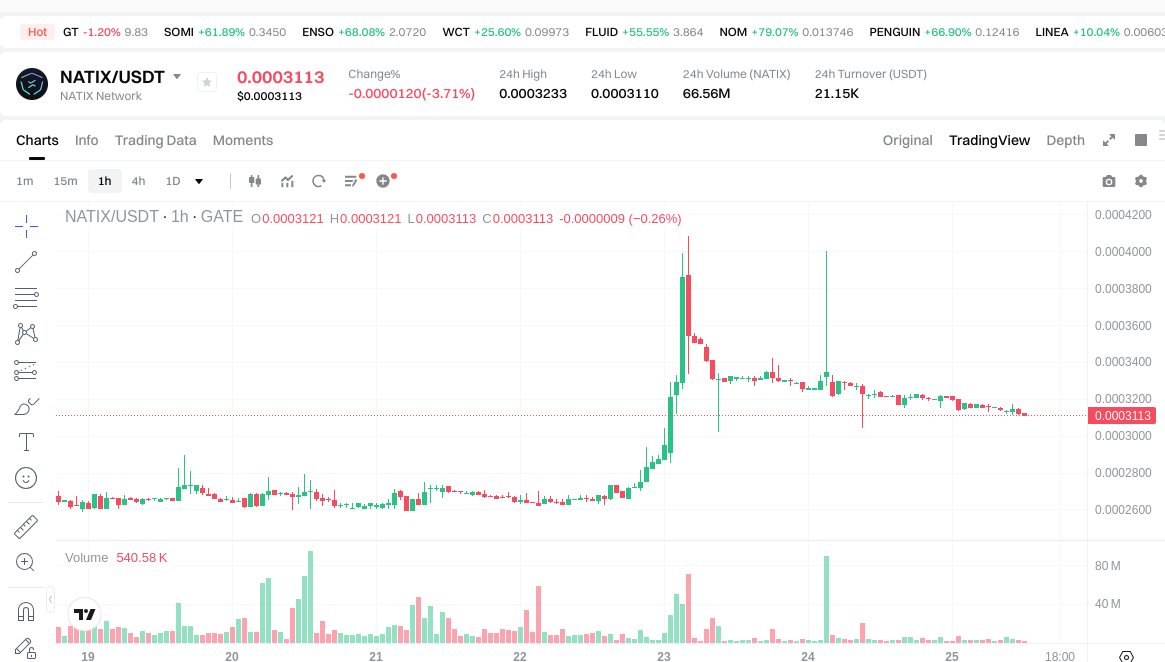
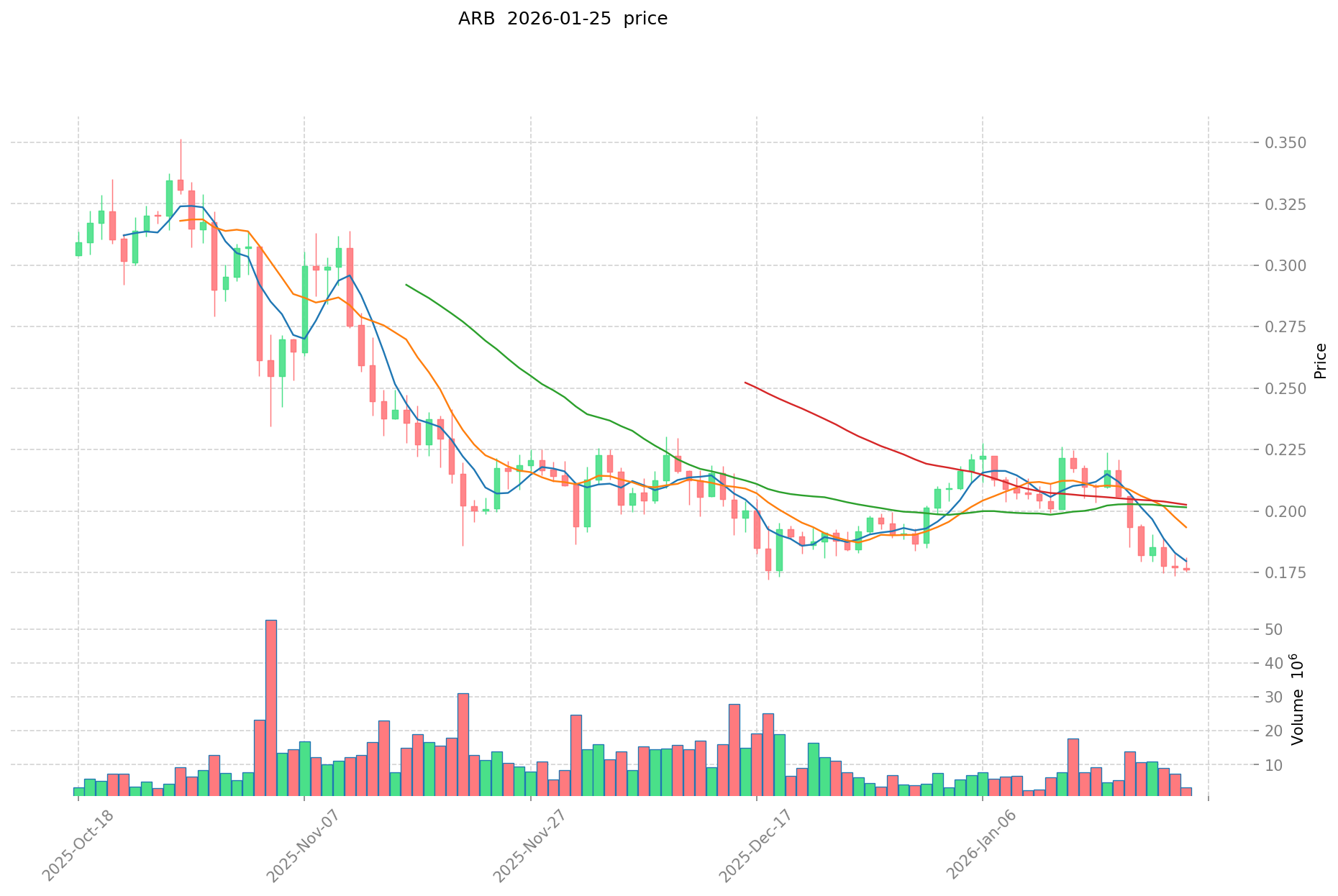
- Comparative Analysis: During recent market cycles, NATIX has moved from $0.0021 to a lower level of $0.0002586, while ARB has adjusted from $2.39 to $0.172637, showing distinct price trajectories for both assets.
Current Market Status (2026-01-25)
- NATIX Current Price: $0.0003121
- ARB Current Price: $0.1746
- 24-Hour Trading Volume: NATIX $21,097.90 vs ARB $710,081.42
- Market Sentiment Index (Fear & Greed Index): 25 (Extreme Fear)
View real-time prices:
II. Core Factors Affecting NATIX vs ARB Investment Value
Supply Mechanism Comparison (Tokenomics)
Due to insufficient reference materials and knowledge base limitations regarding the specific supply mechanisms of NATIX and ARB, this section cannot provide detailed comparative analysis at this time.
Institutional Adoption and Market Application
Institutional Holdings
Specific data on institutional holdings for NATIX and ARB is not available in the provided materials.
Enterprise Adoption
The provided materials do not contain sufficient information regarding the adoption of NATIX or ARB in cross-border payments, settlements, or investment portfolios.
National Policies
Regulatory attitudes toward NATIX and ARB across different jurisdictions are not covered in the available reference materials.
Technical Development and Ecosystem Building
NATIX Technical Upgrades
The reference materials do not provide information on NATIX's technical upgrade roadmap or their potential impact.
ARB Technical Development
Information regarding ARB's technical development plans is not available in the provided materials.
Ecosystem Comparison
Comparative data on DeFi, NFT, payment systems, and smart contract implementation for NATIX and ARB is not included in the reference materials.
Macroeconomic Conditions and Market Cycles
The provided materials do not contain analytical data on the inflation-hedging properties of either NATIX or ARB.
Macroeconomic Monetary Policy
The influence of interest rates and the US Dollar Index on NATIX and ARB cannot be analyzed based on the available reference materials.
Geopolitical Factors
Information regarding cross-border transaction demand and international developments affecting these assets is not present in the provided materials.
III. 2026-2031 Price Forecast: NATIX vs ARB
Short-term Forecast (2026)
- NATIX: Conservative $0.000174 - $0.000311 | Optimistic $0.000311 - $0.000451
- ARB: Conservative $0.150 - $0.175 | Optimistic $0.175 - $0.212
Mid-term Forecast (2028-2029)
- NATIX may enter a gradual growth phase, with estimated price range of $0.000372 - $0.000586
- ARB may enter a consolidation and expansion phase, with estimated price range of $0.186 - $0.374
- Key drivers: institutional capital inflows, ETF developments, ecosystem expansion
Long-term Forecast (2030-2031)
- NATIX: Base scenario $0.000415 - $0.000744 | Optimistic scenario $0.000571 - $0.000802
- ARB: Base scenario $0.186 - $0.414 | Optimistic scenario $0.265 - $0.452
View detailed price predictions for NATIX and ARB
Disclaimer
NATIX:
| Year |
Predicted High Price |
Predicted Average Price |
Predicted Low Price |
Price Change |
| 2026 |
0.000451385 |
0.0003113 |
0.000174328 |
0 |
| 2027 |
0.000446170725 |
0.0003813425 |
0.000217365225 |
22 |
| 2028 |
0.00057098412525 |
0.0004137566125 |
0.00037238095125 |
32 |
| 2029 |
0.000585920738961 |
0.000492370368875 |
0.000359430369278 |
57 |
| 2030 |
0.000744020864406 |
0.000539145553918 |
0.000415142076516 |
72 |
| 2031 |
0.000801979011453 |
0.000641583209162 |
0.000571009056154 |
105 |
ARB:
| Year |
Predicted High Price |
Predicted Average Price |
Predicted Low Price |
Price Change |
| 2026 |
0.211629 |
0.1749 |
0.150414 |
0 |
| 2027 |
0.284098815 |
0.1932645 |
0.148813665 |
10 |
| 2028 |
0.2768707227 |
0.2386816575 |
0.18617169285 |
36 |
| 2029 |
0.373775475645 |
0.2577761901 |
0.250042904397 |
47 |
| 2030 |
0.413666341062975 |
0.3157758328725 |
0.2652516996129 |
80 |
| 2031 |
0.452254147839994 |
0.364721086967737 |
0.186007754353546 |
108 |
IV. Investment Strategy Comparison: NATIX vs ARB
Long-term vs Short-term Investment Strategies
- NATIX: May be suitable for investors focused on emerging DePIN infrastructure projects and early-stage growth potential, given its positioning in decentralized physical infrastructure networks utilizing AI and geospatial intelligence
- ARB: May be suitable for investors seeking exposure to established Layer 2 scaling solutions with demonstrated technical infrastructure and broader market recognition
Risk Management and Asset Allocation
- Conservative Investors: NATIX 20-30% vs ARB 70-80%
- Aggressive Investors: NATIX 40-50% vs ARB 50-60%
- Hedging Tools: Stablecoin allocation, options strategies, cross-asset portfolio diversification
V. Potential Risk Comparison
Market Risk
- NATIX: Trading volume of $21,097.90 indicates relatively lower liquidity compared to more established assets, which may result in increased price volatility during market fluctuations
- ARB: Trading volume of $710,081.42 suggests relatively higher market participation, though still subject to broader cryptocurrency market sentiment, currently reflected in the Fear & Greed Index of 25 (Extreme Fear)
Technical Risk
- NATIX: Scalability considerations and network stability related to its DePIN infrastructure model
- ARB: Network capacity management and potential security considerations inherent to Layer 2 solutions
Regulatory Risk
- Global regulatory frameworks may affect both assets differently, with DePIN-focused projects like NATIX potentially facing distinct regulatory considerations compared to Layer 2 infrastructure solutions like ARB
VI. Conclusion: Which Is the Better Buy?
📌 Investment Value Summary:
- NATIX Strengths: Represents emerging DePIN sector with specific use case in geospatial intelligence; has demonstrated user adoption with over 120,000 registered drivers and 45 million kilometers covered
- ARB Strengths: Established Layer 2 solution with demonstrated technical infrastructure; benefits from Ethereum ecosystem integration and broader market recognition
✅ Investment Recommendations:
- Beginner Investors: Consider starting with ARB due to relatively higher trading volume and established market presence, while maintaining exposure to diversified portfolio including stablecoins
- Experienced Investors: May explore balanced allocation between both assets based on risk tolerance, considering NATIX's early-stage growth potential and ARB's infrastructure positioning
- Institutional Investors: Evaluate both assets within broader portfolio context, considering liquidity requirements, risk management frameworks, and strategic alignment with investment objectives
⚠️ Risk Disclaimer: The cryptocurrency market exhibits significant volatility. This article does not constitute investment advice.
VII. FAQ
Q1: What is the main difference between NATIX and ARB in terms of their fundamental use cases?
NATIX is a decentralized physical infrastructure network (DePIN) focused on geospatial intelligence using AI and smartphone cameras, while ARB is an Ethereum Layer 2 scaling solution designed to improve transaction speed and reduce costs. NATIX operates in the emerging DePIN sector with real-world data collection applications, having registered over 120,000 drivers covering 45 million kilometers since its 2024 launch. In contrast, ARB serves as infrastructure for the Ethereum ecosystem, utilizing Optimistic Rollup technology to enhance blockchain scalability while maintaining Ethereum-level security. These fundamentally different value propositions position them in distinct segments of the cryptocurrency market.
Q2: How do the current trading volumes of NATIX and ARB reflect their market liquidity?
ARB demonstrates significantly higher liquidity with a 24-hour trading volume of $710,081.42 compared to NATIX's $21,097.90 as of January 25, 2026. This substantial difference indicates that ARB offers approximately 33 times more trading activity, which translates to easier entry and exit positions with potentially lower slippage for investors. The higher trading volume of ARB reflects its broader market recognition and more established presence since its 2023 launch, while NATIX's lower volume is consistent with its earlier stage as a 2024 project still building market awareness and adoption within the DePIN sector.
Q3: What are the price forecast ranges for NATIX and ARB by 2031?
According to the provided predictions, NATIX is projected to reach $0.000571 - $0.000802 by 2031 under an optimistic scenario, representing a 105% cumulative price change from 2026 levels. ARB's 2031 forecast ranges from $0.186 - $0.452 in the optimistic scenario, with a projected 108% cumulative price change. It's important to note that NATIX operates at a significantly lower absolute price point, starting from $0.0003121 currently, while ARB trades at $0.1746. These forecasts assume various factors including institutional adoption, ecosystem expansion, and favorable market conditions. However, cryptocurrency price predictions carry substantial uncertainty and should be evaluated within comprehensive risk management frameworks.
Q4: Which asset is more suitable for conservative versus aggressive investors?
Conservative investors may consider a portfolio allocation favoring ARB at 70-80% versus NATIX at 20-30%, given ARB's higher trading volume, established infrastructure position, and broader market recognition. Aggressive investors might explore a more balanced allocation of 40-50% NATIX and 50-60% ARB to capture NATIX's early-stage growth potential while maintaining exposure to ARB's infrastructure positioning. This recommendation reflects the risk-return profiles of both assets, with NATIX representing higher risk due to lower liquidity and earlier development stage, while ARB offers relatively more stability through its established Layer 2 solution status. Both allocation strategies should incorporate hedging tools such as stablecoin reserves and portfolio diversification across multiple assets.
Q5: How does the current market sentiment affect NATIX and ARB investment decisions?
The current Fear & Greed Index stands at 25, indicating "Extreme Fear" in the cryptocurrency market as of January 25, 2026. This sentiment typically reflects risk-averse behavior among investors and can present both challenges and opportunities. During extreme fear periods, both NATIX and ARB may experience downward price pressure regardless of their fundamental value propositions. However, such conditions historically have offered potential entry points for long-term investors with appropriate risk tolerance. For NATIX, the combination of extreme fear sentiment and lower trading volume may result in heightened volatility, while ARB's higher liquidity might provide relatively more stable pricing during market stress periods. Investors should factor current sentiment into their decision-making while focusing on long-term fundamental analysis rather than short-term emotional market movements.
Q6: What are the primary risk factors to consider when investing in NATIX versus ARB?
NATIX's primary risks include lower market liquidity with only $21,097.90 in 24-hour trading volume, scalability considerations for its DePIN infrastructure model, and regulatory uncertainties specific to decentralized physical infrastructure networks. ARB faces risks related to network capacity management, potential security considerations inherent to Layer 2 solutions, and dependency on Ethereum's broader ecosystem performance. Both assets are subject to overall cryptocurrency market volatility and regulatory developments. Additionally, NATIX's earlier stage (launched in 2024) carries execution risk associated with newer projects, while ARB's more established presence (launched in 2023) may face competitive pressure from other Layer 2 solutions. Investors should implement appropriate risk management strategies including position sizing, portfolio diversification, and regular monitoring of both projects' technical and market developments.
* The information is not intended to be and does not constitute financial advice or any other recommendation of any sort offered or endorsed by Gate.