This comprehensive analysis examines NC versus SOL as cryptocurrency investment opportunities, comparing an emerging AI-focused platform launched in 2025 with an established Layer-1 blockchain protocol. NC currently trades at $0.001251 with limited liquidity, having declined 99.6% from its peak, while SOL trades at $81.27 with substantial trading volume, down 72.3% from recent highs. The article evaluates critical investment factors including tokenomics, institutional adoption, technological ecosystems, and macroeconomic influences. Price forecasts through 2031 project NC at $0.0016-$0.0031 and SOL at $74.66-$190.32 depending on market scenarios. Investment strategies vary by risk profile: conservative investors favor SOL's established infrastructure (15-25% allocation), while aggressive investors may allocate 15-25% to NC. Key risk considerations include NC's extreme volatility and liquidity constraints versus SOL's regulatory exposure. The analysis provides entry-level, experienced, and institutional invest
Introduction: NC vs SOL Investment Comparison
In the cryptocurrency market, the comparison between NC vs SOL remains a focal point for investors. These two assets exhibit notable differences in market capitalization ranking, application scenarios, and price performance, representing distinct positioning within the crypto asset landscape.
Nodecoin (NC): Launched in 2025, this token operates as part of a real-time predictive intelligence platform that aggregates user signal inputs, social activity, and on-chain data to deliver structured market sentiment views and actionable insights.
Solana (SOL): Established in 2018 by former engineers from Qualcomm, Intel, and Dropbox, Solana is a high-performance blockchain protocol designed to provide scalability without compromising decentralization or security, achieving recognition as one of the prominent layer-1 blockchain solutions.
This article will examine historical price trajectories, supply mechanisms, institutional adoption patterns, technical ecosystems, and future projections to provide a comprehensive analysis of NC vs SOL investment value comparison, addressing the key question that investors frequently consider:
"Which asset presents a more suitable investment opportunity at the current market juncture?"
Note: This analysis is for informational purposes and does not constitute investment advice. Cryptocurrency investments carry inherent risks and require thorough individual research.
I. Price History Comparison and Market Status
NC (Coin A) and SOL (Coin B) Historical Price Trends
-
2025: NC experienced a notable price surge following its listing on exchanges in January 2025, reaching an all-time high of $0.335 on January 17, 2025. This initial momentum reflected early market interest in the Nodepay platform's decentralized bandwidth-sharing network and AI-powered predictive intelligence capabilities.
-
2020-2021: SOL demonstrated significant price appreciation during the broader crypto market rally. The token initially traded between $0.50 and $1.50 in early 2020, then surged over 2,500% in Q1 2021, ultimately reaching approximately $253 in November 2021. This growth was driven by increasing adoption of the Solana blockchain's high-speed transaction capabilities and expanding DeFi ecosystem.
-
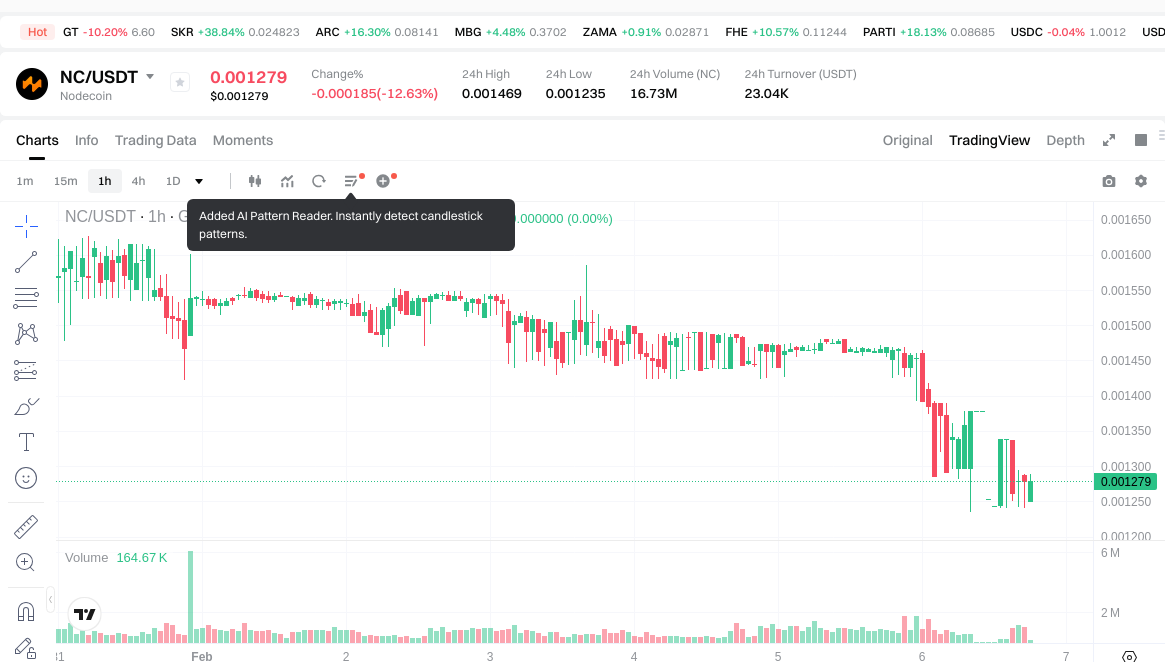
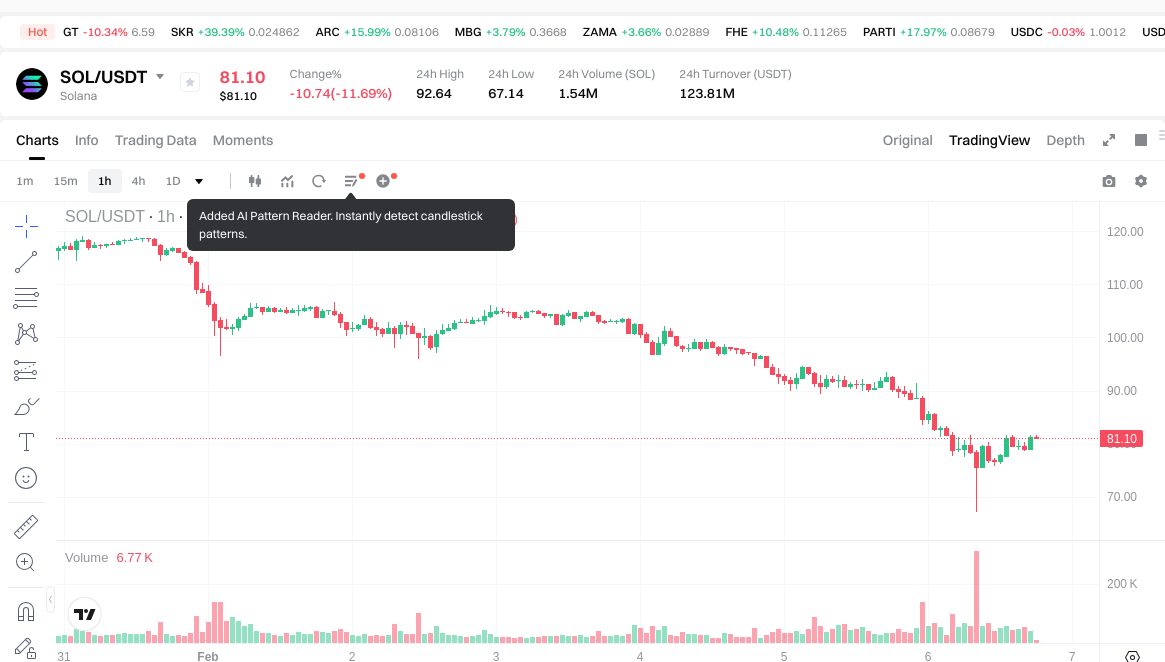
Comparative Analysis: During the recent market downturn period, NC declined from its peak of $0.335 to $0.001251 (as of February 6, 2026), representing a decline of approximately 99.6%. Meanwhile, SOL experienced a decrease from its historical high of $293.31 (January 19, 2025) to $81.27, reflecting a decline of approximately 72.3% from its recent peak.
Current Market Conditions (2026-02-06)
- NC Current Price: $0.001251
- SOL Current Price: $81.27
- 24-Hour Trading Volume: NC recorded $23,056.96 versus SOL's $123,695,107.95
- Market Sentiment Index (Fear & Greed Index): 9 (Extreme Fear)
View real-time prices:
II. Core Factors Influencing NC vs SOL Investment Value
Comparison of Supply Mechanisms (Tokenomics)
- NC: The reference materials do not provide specific details regarding NC's supply mechanism or tokenomics model.
- SOL: SOL serves as the native token of the Solana blockchain, playing a critical role in transaction fees, security, and governance. The materials note that the Solana Foundation was established with an initial treasury of 167 million SOL tokens, but specific supply mechanism details such as fixed supply or deflationary models are not explicitly documented in the provided materials.
- 📌 Historical Pattern: The relationship between supply mechanisms and price cycle dynamics requires detailed tokenomics data for accurate assessment.
Institutional Adoption and Market Application
- Institutional Holdings: For NC, the materials indicate that the Nodepay decentralized AI platform has attracted considerable positive attention and secured support from credible investors, suggesting potential institutional interest. For SOL, the materials highlight its prominent position in the crypto market due to its fast transaction speed, low fees, and expanding ecosystem, though specific institutional holdings data is not provided.
- Enterprise Adoption: SOL functions as the core of the Solana ecosystem, supporting various decentralized applications (dApp) and service platforms. The materials emphasize SOL's significant role in DeFi applications and its competitive position in the decentralized application domain. NC is positioned as a cryptocurrency focused on AI development, with materials referencing its platform's positive reception, though specific enterprise use cases are not detailed.
- National Policies: The materials note that SOL price volatility may stem from multiple factors including policy changes, market sentiment, and technological developments. Investors need to maintain sensitivity to market dynamics. Specific regulatory attitudes toward NC and SOL across different jurisdictions are not elaborated in the provided materials.
Technological Development and Ecosystem Construction
- NC Technological Development: NC is described as focused on AI domain development within the cryptocurrency space. The Nodepay platform's approach to decentralized AI has garnered attention, though specific technical upgrades and their potential impacts are not detailed in the materials.
- SOL Technological Development: Solana is recognized for its high speed and scalability, making it a strong competitor in the dApp field. The materials reference client diversity initiatives, including the gradual rollout and integration of new clients such as Frankendancer and Firedancer, with expectations that this landscape will undergo significant changes in the coming 12 months. The Solana Foundation, established as a non-profit organization in Switzerland in June 2019, oversees grant funding, delegation programs, and developer tools.
- Ecosystem Comparison: SOL's ecosystem demonstrates substantial development in DeFi and dApp platforms. The materials indicate that all core Solana client software is hosted on GitHub under open-source licenses, encouraging community contributions. The Agave client codebase shows 357 contributors and 26,408 commits. For NC, the materials mention its positioning in the AI platform space but do not provide comparable ecosystem development metrics.
Macroeconomic Environment and Market Cycles
- Performance in Inflationary Environments: The materials identify macroeconomic conditions as one of NC's core investment value factors but do not provide comparative analysis of inflation resistance properties between NC and SOL.
- Macroeconomic Monetary Policy: For SOL, the materials note that price volatility may be influenced by various factors including policy changes, though specific impacts of interest rates or dollar index movements are not quantified. For NC, macroeconomic environment is mentioned as a core factor affecting investment value, but detailed policy impact analysis is not available in the materials.
- Geopolitical Factors: The materials do not provide specific information regarding how cross-border transaction demand or international circumstances affect NC or SOL investment value.
III. 2026-2031 Price Forecast: NC vs SOL
Short-term Forecast (2026)
- NC: Conservative $0.00096 - $0.00128 | Optimistic $0.00128 - $0.00157
- SOL: Conservative $66.67 - $81.31 | Optimistic $81.31 - $105.70
Mid-term Forecast (2028-2029)
- NC may enter a consolidation phase with projected price range of $0.0012 - $0.0025
- SOL may enter an expansion phase with projected price range of $52.04 - $134.41
- Key drivers: institutional capital flows, ETF developments, ecosystem expansion
Long-term Forecast (2030-2031)
- NC: Baseline scenario $0.0016 - $0.0021 | Optimistic scenario $0.0021 - $0.0031
- SOL: Baseline scenario $74.66 - $147.54 | Optimistic scenario $147.54 - $190.32
View detailed price predictions for NC and SOL
Disclaimer
NC:
| Year |
Predicted High Price |
Predicted Average Price |
Predicted Low Price |
Price Change |
| 2026 |
0.00157317 |
0.001279 |
0.00095925 |
2 |
| 2027 |
0.00178260625 |
0.001426085 |
0.000855651 |
13 |
| 2028 |
0.00178082364375 |
0.001604345625 |
0.001219302675 |
28 |
| 2029 |
0.002505025258875 |
0.001692584634375 |
0.001201735090406 |
35 |
| 2030 |
0.002560542034882 |
0.002098804946625 |
0.001909912501428 |
67 |
| 2031 |
0.003051872272887 |
0.002329673490753 |
0.001584177973712 |
86 |
SOL:
| Year |
Predicted High Price |
Predicted Average Price |
Predicted Low Price |
Price Change |
| 2026 |
105.703 |
81.31 |
66.6742 |
0 |
| 2027 |
102.85715 |
93.5065 |
86.961045 |
15 |
| 2028 |
107.01818925 |
98.181825 |
52.03636725 |
21 |
| 2029 |
134.40600933375 |
102.600007125 |
57.45600399 |
26 |
| 2030 |
176.56948226176875 |
118.503008229375 |
74.65689518450625 |
46 |
| 2031 |
190.321756366787718 |
147.536245245571875 |
116.553633744001781 |
82 |
IV. Investment Strategy Comparison: NC vs SOL
Long-term vs Short-term Investment Strategies
- NC: May appeal to investors with higher risk tolerance interested in emerging AI-focused platforms and early-stage cryptocurrency projects with potential for ecosystem development, though current market conditions suggest elevated volatility
- SOL: May suit investors seeking exposure to established layer-1 blockchain infrastructure with demonstrated transaction processing capabilities, expanding DeFi ecosystem, and broader institutional recognition
Risk Management and Asset Allocation
- Conservative Investors: NC 5-10% vs SOL 15-25% (within overall crypto portfolio allocation)
- Aggressive Investors: NC 15-25% vs SOL 30-40% (within overall crypto portfolio allocation)
- Hedging Tools: stablecoin allocation for liquidity management, diversified cross-asset positioning, periodic rebalancing protocols
V. Potential Risk Comparison
Market Risk
- NC: Characterized by substantial price volatility, with reference materials indicating decline of approximately 99.6% from peak levels; limited trading volume of $23,056.96 may present liquidity constraints; early-stage market positioning subjects the asset to pronounced sentiment-driven fluctuations
- SOL: Experiences notable price movements influenced by multiple factors including policy developments, market sentiment shifts, and technological progress; decline of approximately 72.3% from recent peak reflects broader market correction dynamics; higher trading volume of $123,695,107.95 provides enhanced liquidity relative to NC
Technical Risk
- NC: Technical infrastructure details and network stability parameters are not extensively documented in available materials; scalability characteristics of the underlying platform require further evaluation
- SOL: Network stability considerations relate to client diversity initiatives, with materials referencing ongoing integration of new clients including Frankendancer and Firedancer; blockchain scalability mechanisms designed for high-speed transaction processing; open-source development model with 357 contributors and 26,408 commits to Agave client codebase
Regulatory Risk
- Global regulatory frameworks continue to evolve, with differential impacts on established layer-1 protocols versus emerging AI-focused platforms; policy sensitivity noted in materials as factor affecting SOL price dynamics; investors should monitor jurisdiction-specific developments and compliance requirements affecting both assets
VI. Conclusion: Which Is the Better Buy?
📌 Investment Value Summary:
- NC Characteristics: Positioned within AI development sector of cryptocurrency market; early-stage platform with decentralized bandwidth-sharing network approach; substantial price volatility and limited liquidity profile; forecasted price ranges suggest potential for recovery from current levels though uncertainty remains elevated
- SOL Characteristics: Established layer-1 blockchain protocol with high-speed transaction capabilities; expanding DeFi ecosystem and decentralized application infrastructure; broader institutional recognition and market adoption; client diversity initiatives and open-source development framework; price forecasts indicate potential for growth across projection periods
✅ Investment Considerations:
- Entry-level Investors: May consider gradual exposure to established blockchain infrastructure with demonstrated ecosystem development; emphasis on risk management protocols and position sizing appropriate to individual risk tolerance; comprehensive research into underlying technology and market dynamics recommended
- Experienced Investors: May evaluate portfolio diversification across different blockchain infrastructure categories and market capitalization segments; assessment of risk-adjusted return profiles relative to investment objectives; monitoring of technical development milestones and adoption metrics
- Institutional Investors: May assess alignment with broader digital asset allocation frameworks; consideration of liquidity requirements, custody solutions, and regulatory compliance parameters; evaluation of long-term ecosystem sustainability and competitive positioning
⚠️ Risk Disclosure: Cryptocurrency markets exhibit substantial volatility characteristics. This analysis serves informational purposes and does not constitute investment advice.
VII. FAQ
Q1: What are the main differences between NC and SOL in terms of market positioning?
NC operates as an early-stage cryptocurrency focused on AI development and decentralized bandwidth-sharing networks, launched in 2025, while SOL is an established layer-1 blockchain protocol launched in 2018, recognized for high-speed transaction processing and a mature DeFi ecosystem. NC currently trades at $0.001251 with limited liquidity ($23,056.96 daily volume), whereas SOL trades at $81.27 with substantially higher liquidity ($123,695,107.95 daily volume), reflecting SOL's broader institutional recognition and market adoption compared to NC's emerging platform status.
Q2: How do the price volatilities of NC and SOL compare from their respective peaks?
NC has declined approximately 99.6% from its all-time high of $0.335 (January 17, 2025) to its current price of $0.001251, while SOL has decreased approximately 72.3% from its recent peak of $293.31 (January 19, 2025) to $81.27. This indicates that NC has experienced significantly more severe price correction, characteristic of early-stage cryptocurrency assets with limited market history, whereas SOL's decline aligns more closely with broader market correction patterns affecting established blockchain protocols.
Q3: What are the projected price ranges for NC and SOL by 2031?
By 2031, NC is forecasted to reach a baseline scenario range of $0.0016 - $0.0021, with an optimistic scenario extending to $0.0021 - $0.0031, representing potential appreciation of 86% from 2026 levels. SOL is projected to achieve a baseline scenario range of $74.66 - $147.54, with an optimistic scenario reaching $147.54 - $190.32, indicating potential growth of 82% from 2026 levels. These forecasts reflect different growth trajectories based on ecosystem development stage and market positioning.
Q4: What portfolio allocation strategies are recommended for NC versus SOL?
Conservative investors may consider allocating 5-10% to NC versus 15-25% to SOL within their overall cryptocurrency portfolio, while aggressive investors might allocate 15-25% to NC versus 30-40% to SOL. These allocation differences reflect NC's higher risk profile as an emerging platform with substantial volatility and limited liquidity, compared to SOL's more established infrastructure, broader adoption, and enhanced liquidity characteristics. Risk management protocols including stablecoin allocation and periodic rebalancing are recommended for both assets.
Q5: What technological factors differentiate NC and SOL ecosystems?
SOL operates on a high-performance blockchain protocol designed for scalability without compromising decentralization or security, featuring client diversity initiatives with new implementations including Frankendancer and Firedancer, and an open-source development framework with 357 contributors and 26,408 commits to the Agave client codebase. NC focuses on AI development within cryptocurrency, positioning itself as a decentralized AI platform with bandwidth-sharing network capabilities, though specific technical infrastructure details regarding network stability and scalability parameters are not extensively documented in available materials.
Q6: How do liquidity profiles affect trading considerations for NC and SOL?
The substantial liquidity differential between NC's $23,056.96 daily trading volume and SOL's $123,695,107.95 daily volume presents meaningful implications for trade execution. NC's limited liquidity may result in wider bid-ask spreads, increased price slippage on larger orders, and heightened sensitivity to individual transactions, potentially creating challenges for investors requiring timely position entry or exit. SOL's significantly higher liquidity facilitates more efficient trade execution, tighter spreads, and reduced market impact, making it more suitable for investors prioritizing execution quality and position flexibility.
Q7: What are the primary risk factors investors should monitor for NC and SOL?
For NC, primary risk factors include substantial price volatility evidenced by 99.6% decline from peak levels, limited liquidity constraints, early-stage platform positioning subject to sentiment-driven fluctuations, and incomplete documentation of technical infrastructure parameters. For SOL, key risks encompass price movements influenced by policy developments, market sentiment shifts, and technological progress, network stability considerations related to client diversity initiatives, and evolving regulatory frameworks. Both assets are subject to global regulatory evolution, with differential impacts based on their respective positioning as emerging AI-focused platform versus established layer-1 protocol.
Q8: Which asset presents more suitable characteristics for different investor profiles?
Entry-level investors may find SOL more appropriate due to its established blockchain infrastructure, demonstrated ecosystem development, and enhanced liquidity profile, facilitating gradual exposure with comprehensive educational resources available. Experienced investors might evaluate both assets for portfolio diversification across different blockchain infrastructure categories, assessing risk-adjusted return profiles relative to individual investment objectives. Institutional investors may consider SOL's alignment with broader digital asset allocation frameworks, liquidity requirements, custody solutions, and regulatory compliance parameters, while viewing NC as a higher-risk allocation for exposure to emerging AI-cryptocurrency convergence trends.
* The information is not intended to be and does not constitute financial advice or any other recommendation of any sort offered or endorsed by Gate.