This comprehensive guide compares NIGHT and XRP, two distinct cryptocurrencies with different market positioning. NIGHT, the native token of Midnight Network's privacy-focused Layer 1 blockchain, ranked #80 with $1.16B market cap, contrasts with XRP, the #4 ranked payment infrastructure asset with $132.14B market cap. The article analyzes historical price trends, tokenomics, institutional adoption, technical ecosystems, and 2026-2031 price forecasts. XRP offers established market liquidity ($113.32M daily volume) and cross-border payment efficiency, while NIGHT presents emerging privacy-tech opportunities with higher volatility. Conservative investors may favor 70-80% XRP allocation, while aggressive investors consider balanced exposure. Both assets face regulatory considerations and market risks requiring careful due diligence before investment decisions.
Introduction: Investment Comparison Between NIGHT and XRP
In the cryptocurrency market, the comparison between NIGHT vs XRP has consistently been a topic that investors cannot avoid. Both demonstrate significant differences in market cap ranking, application scenarios, and price performance, while representing distinct positioning within the crypto asset landscape.
NIGHT (NIGHT): Launched as the native utility and governance token of the Midnight Network, a privacy-focused Layer 1 blockchain introduced by Charles Hoskinson, it has garnered market attention for its unique positioning in privacy-preserving applications.
XRP (XRP): Since its 2011 launch, XRP has been recognized for its cross-border payment efficiency and is one of the cryptocurrencies with substantial global trading volume and market capitalization.
This article will comprehensively analyze the investment value comparison between NIGHT vs XRP through historical price trends, supply mechanisms, institutional adoption, technical ecosystems, and future predictions, attempting to address the question most concerning to investors:
"Which is the better buy right now?"
I. Historical Price Comparison and Current Market Status
NIGHT (Coin A) and XRP (Coin B) Historical Price Trends
-
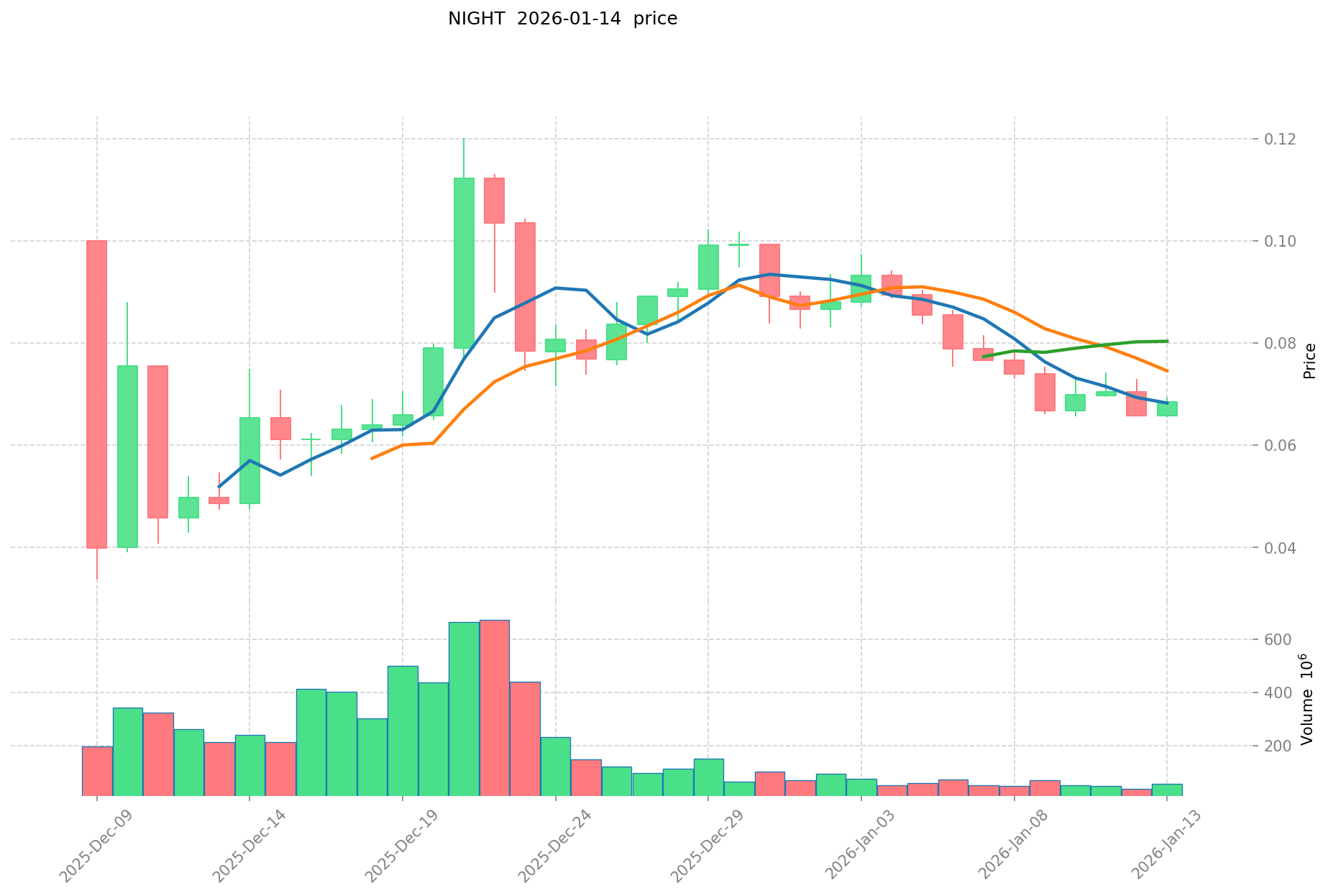
2025: NIGHT, as a newly launched privacy-focused Layer 1 blockchain token created by Charles Hoskinson, experienced initial price discovery phases. The token reached a historical high of $0.12008 on December 21, 2025, before experiencing fluctuations.
-
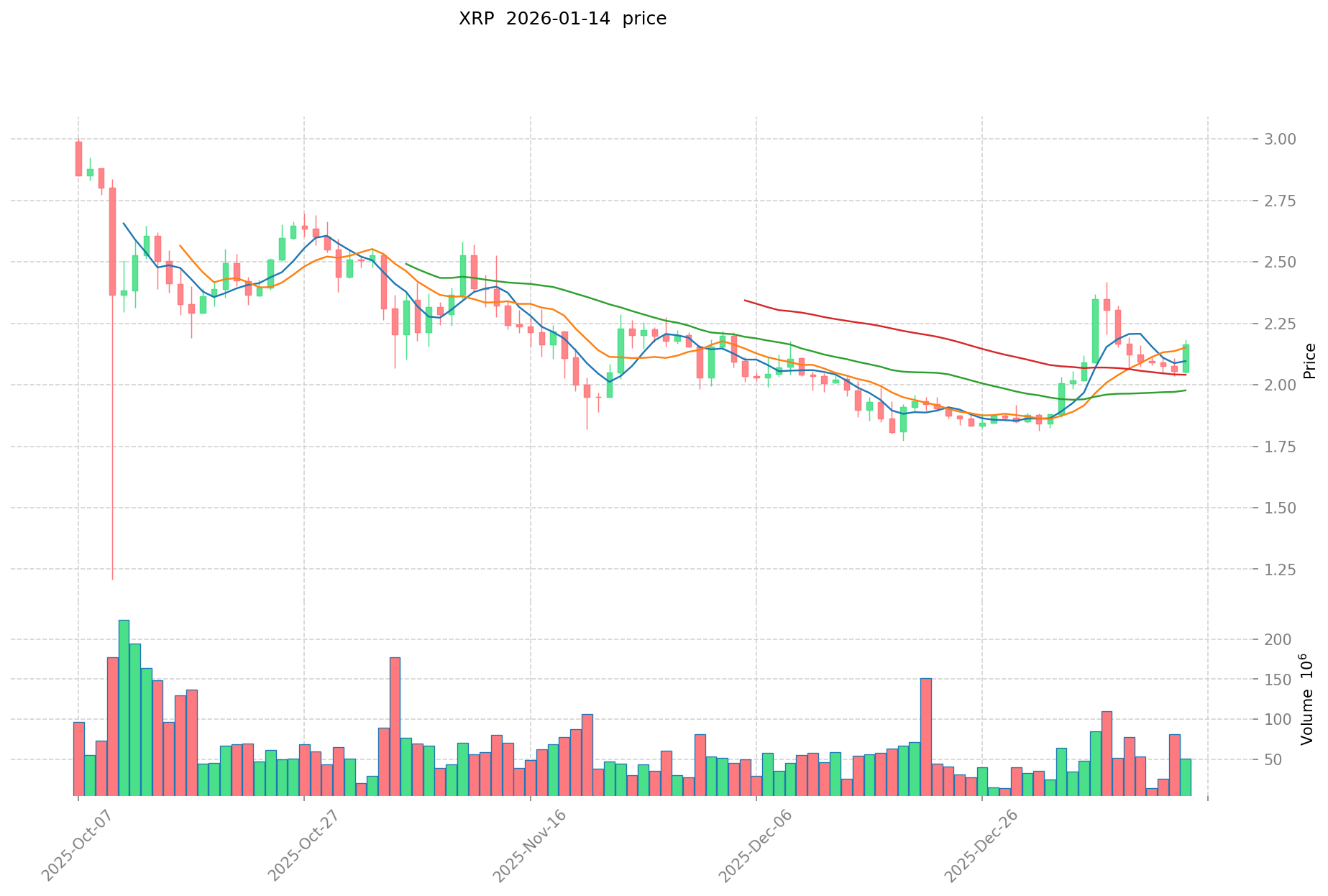
2025: XRP achieved a significant milestone with its all-time high of $3.65 on July 18, 2025. The token has maintained substantial market presence throughout the year, supported by ongoing developments in cross-border payment solutions.
-
Comparative Analysis: During the recent market cycle, NIGHT has shown volatility from its peak of $0.12008 to a low of $0.0337 on December 9, 2025, representing considerable price movement for a newly launched asset. In contrast, XRP has demonstrated relatively more stable price behavior, maintaining its position as an established cryptocurrency with a broader historical range spanning from $0.00268621 (May 22, 2014) to $3.65.
Current Market Status (January 14, 2026)
- NIGHT Current Price: $0.06959
- XRP Current Price: $2.177
- 24-Hour Trading Volume: NIGHT recorded $4.13 million, while XRP maintained significantly higher liquidity with $113.32 million
- Market Capitalization: NIGHT stands at $1.16 billion (ranked #80), whereas XRP holds $132.14 billion (ranked #4)
- Circulating Supply: NIGHT has 16.61 billion tokens in circulation (69.2% of total supply), while XRP has 60.70 billion tokens circulating (60.7% of maximum supply)
- Market Sentiment Index (Fear & Greed Index): 48 (Neutral)
Check real-time prices:
II. Core Factors Influencing NIGHT vs XRP Investment Value
Supply Mechanism Comparison (Tokenomics)
-
XRP: Features a fixed total supply of 100 billion tokens issued at launch. The supply distribution allocated 20% to founders Chris Larsen and Jed McCaleb, 77.8% to Ripple, and 0.2% via airdrops. In 2017, Ripple placed 55 billion XRP into escrow accounts, releasing up to 1 billion tokens monthly to support operations, with unused portions returned to escrow. This controlled release mechanism aims to manage circulation while maintaining price stability.
-
NIGHT: Reference materials contain limited tokenomics information for this asset.
-
📌 Historical Pattern: XRP's managed supply release through escrow mechanisms has contributed to price volatility patterns, particularly during periods of increased institutional adoption and regulatory developments.
Institutional Adoption & Market Applications
-
Institutional Holdings: XRP has demonstrated appeal among institutional participants, particularly through its On-Demand Liquidity (ODL) solution targeting financial institutions seeking efficient cross-border payment infrastructure.
-
Enterprise Adoption: XRP serves as a bridge currency in cross-border transactions, enabling financial institutions to convert between currencies without maintaining large foreign exchange reserves. The Ripple network supports multiple fiat currencies including USD, EUR, and JPY, with potential for broader virtual currency integration. Traditional systems like SWIFT typically charge $30-50 per international transfer, while XRP offers substantially lower transaction costs and settlement speeds of approximately 3 seconds.
-
Regulatory Environment: XRP's regulatory status has been a significant factor, with ongoing legal proceedings and varying jurisdictional approaches affecting market perception. The resolution of certain legal matters has contributed to periods of market activity and institutional interest.
Technical Development & Ecosystem Building
-
XRP Technical Infrastructure: Operates on the XRP Ledger (XRPL) using the Ripple Protocol Consensus Algorithm (RPCA), achieving transaction processing capacity of approximately 1,500 transactions per second. The network requires minimal XRP amounts for transaction fees, primarily serving spam prevention rather than validator rewards. While lacking native smart contract functionality comparable to platforms like Ethereum, recent ecosystem evolution has expanded to support DeFi and NFT applications.
-
NIGHT Technical Development: Available reference materials provide limited technical specification details for this asset.
-
Ecosystem Comparison: XRP's ecosystem has evolved from payment-focused infrastructure toward supporting decentralized applications, though its primary value proposition remains in cross-border payment efficiency. The network's centralized validator selection process through Unique Node Lists (UNL) represents a different architectural approach compared to proof-of-work or proof-of-stake mechanisms.
Macroeconomic Environment & Market Cycles
-
Performance in Inflation Environments: XRP's correlation with broader cryptocurrency market cycles has been evident, with price movements reflecting both sector-wide trends and asset-specific developments. Historical patterns show sensitivity to overall crypto market sentiment alongside responses to regulatory developments.
-
Macroeconomic Policy Impact: XRP price dynamics demonstrate connections to broader financial market conditions, including interest rate environments and dollar strength. Market expectations regarding institutional participation, particularly potential ETF approvals, represent additional factors influencing price trajectories.
-
Geopolitical Considerations: Cross-border payment demand represents a fundamental use case for XRP, with international transaction efficiency serving as a core value proposition. Market activity in various jurisdictions has shown variation based on regional regulatory frameworks and exchange availability.
III. 2026-2031 Price Forecast: NIGHT vs XRP
Short-term Forecast (2026)
- NIGHT: Conservative $0.0384-$0.0698 | Optimistic $0.0698-$0.0788
- XRP: Conservative $1.67-$2.18 | Optimistic $2.18-$2.81
Mid-term Forecast (2028-2029)
- NIGHT may enter a consolidation phase, with estimated price range of $0.0394-$0.0916
- XRP may enter an expansion phase, with estimated price range of $2.06-$4.35
- Key drivers: institutional capital inflows, ETF developments, ecosystem growth
Long-term Forecast (2030-2031)
- NIGHT: Baseline scenario $0.0810-$0.0871 | Optimistic scenario $0.0917-$0.126
- XRP: Baseline scenario $2.68-$3.67 | Optimistic scenario $4.09-$5.48
View detailed price predictions for NIGHT and XRP
Disclaimer
NIGHT:
| Year |
Predicted High Price |
Predicted Average Price |
Predicted Low Price |
Price Change |
| 2026 |
0.0788175 |
0.06975 |
0.0383625 |
0 |
| 2027 |
0.0772551 |
0.07428375 |
0.06239835 |
6 |
| 2028 |
0.0894079215 |
0.075769425 |
0.039400101 |
8 |
| 2029 |
0.0916734273075 |
0.08258867325 |
0.0454237702875 |
18 |
| 2030 |
0.096715465809412 |
0.08713105027875 |
0.081031876759237 |
25 |
| 2031 |
0.125934863520391 |
0.091923258044081 |
0.083650164820113 |
32 |
XRP:
| Year |
Predicted High Price |
Predicted Average Price |
Predicted Low Price |
Price Change |
| 2026 |
2.80575 |
2.175 |
1.67475 |
0 |
| 2027 |
3.38691 |
2.490375 |
1.56893625 |
14 |
| 2028 |
3.026801775 |
2.9386425 |
2.05704975 |
35 |
| 2029 |
4.35477432075 |
2.9827221375 |
1.998423832125 |
37 |
| 2030 |
4.51256032182375 |
3.668748229125 |
2.67818620726125 |
68 |
| 2031 |
5.481476729135662 |
4.090654275474375 |
3.436149591398475 |
87 |
IV. Investment Strategy Comparison: NIGHT vs XRP
Long-term vs Short-term Investment Strategies
-
NIGHT: May appeal to investors interested in emerging privacy-focused blockchain infrastructure and early-stage ecosystem participation. The token's positioning within the Midnight Network suggests potential alignment with privacy-preserving application development scenarios.
-
XRP: May suit investors seeking exposure to established cross-border payment infrastructure with demonstrated institutional engagement. The asset's market positioning reflects a focus on transaction efficiency and financial institution adoption patterns.
Risk Management and Asset Allocation
-
Conservative Investors: Consideration of allocation proportions should reflect individual risk tolerance and market conditions. A sample framework might include 20-30% NIGHT and 70-80% XRP, emphasizing the more established market position of XRP.
-
Aggressive Investors: Higher-risk tolerance portfolios might consider 50-60% NIGHT and 40-50% XRP, reflecting willingness to pursue emerging ecosystem opportunities while maintaining exposure to established infrastructure.
-
Hedging Tools: Portfolio risk management may incorporate stablecoin positions for liquidity preservation, options strategies where available, and diversification across multiple digital assets to manage correlation risks.
V. Potential Risk Comparison
Market Risks
-
NIGHT: The asset demonstrates characteristics common to newly launched tokens, including limited historical price data and potential for elevated volatility. Trading volume of $4.13 million (as of January 14, 2026) reflects early-stage market liquidity conditions. The token's market capitalization ranking at #80 indicates developing market recognition.
-
XRP: Price movements have historically shown sensitivity to regulatory developments and broader cryptocurrency market cycles. The asset's correlation with sector-wide sentiment trends represents a consideration for portfolio construction. Trading volume of $113.32 million reflects established market liquidity, though price fluctuations remain a characteristic feature.
Technical Risks
-
NIGHT: Available reference materials provide limited technical specification details regarding network scalability characteristics, validator infrastructure, or security audit history. Early-stage blockchain networks may encounter challenges during periods of increased adoption or network stress.
-
XRP: The XRP Ledger's validator selection mechanism through Unique Node Lists represents a different architectural approach compared to decentralized consensus models. Transaction processing capacity of approximately 1,500 TPS has been demonstrated, though network performance under various load conditions continues to evolve. The ecosystem's expansion into DeFi and NFT applications involves technical considerations distinct from its primary payment infrastructure focus.
Regulatory Risks
- Global regulatory frameworks for digital assets continue to develop, with varying approaches across jurisdictions. XRP's regulatory experiences, particularly regarding securities classification discussions, illustrate the potential impact of legal proceedings on market activity. Privacy-focused blockchain projects face distinct regulatory considerations in different regions. Both assets remain subject to evolving compliance requirements, exchange listing policies, and cross-border transaction regulations that may affect accessibility and market dynamics.
VI. Conclusion: Which Is the Better Buy?
📌 Investment Value Summary:
-
NIGHT Characteristics: Represents exposure to privacy-focused blockchain infrastructure development. The token's early-stage market position (ranked #80) and association with the Midnight Network reflect emerging ecosystem participation opportunities. Current market capitalization of $1.16 billion indicates developing institutional recognition.
-
XRP Characteristics: Demonstrates established market presence (ranked #4) with market capitalization of $132.14 billion. The asset's historical positioning in cross-border payment infrastructure and institutional engagement patterns reflect mature ecosystem development. Transaction efficiency and settlement speed characteristics support its primary use case focus.
✅ Investment Considerations:
-
New Investors: May benefit from understanding fundamental differences between established payment infrastructure tokens and emerging privacy-focused platforms. Consideration of position sizing relative to overall portfolio risk tolerance remains important. Education regarding market volatility patterns and liquidity conditions supports informed decision-making.
-
Experienced Investors: Portfolio construction may incorporate both established infrastructure exposure (XRP) and emerging ecosystem opportunities (NIGHT) based on individual risk profiles and market outlook. Technical analysis of price patterns, trading volume trends, and ecosystem development metrics can inform allocation decisions. Risk management through diversification and position sizing reflects prudent portfolio management.
-
Institutional Participants: Due diligence considerations include regulatory compliance frameworks, custody infrastructure availability, liquidity depth for large positions, and alignment with institutional investment mandates. XRP's demonstrated institutional adoption patterns and NIGHT's emerging ecosystem positioning represent different opportunity sets requiring distinct evaluation criteria.
⚠️ Risk Disclosure: Cryptocurrency markets demonstrate substantial price volatility. Historical performance does not indicate future results. This analysis does not constitute investment advice. Participants should conduct independent research and consider individual circumstances before making investment decisions.
VII. FAQ
Q1: What is the main difference between NIGHT and XRP in terms of use cases?
XRP focuses on cross-border payment efficiency as a bridge currency for financial institutions, while NIGHT serves as the native token for the Midnight Network, a privacy-focused Layer 1 blockchain. XRP has established itself in the payment infrastructure space with institutional adoption through Ripple's On-Demand Liquidity solution, enabling transactions to settle in approximately 3 seconds at minimal cost. NIGHT, launched by Charles Hoskinson, targets privacy-preserving applications and represents an emerging ecosystem in the privacy-focused blockchain sector. The fundamental distinction lies in XRP's mature payment infrastructure versus NIGHT's early-stage privacy technology platform.
Q2: Which cryptocurrency has better liquidity for trading?
XRP demonstrates significantly superior liquidity with 24-hour trading volume of $113.32 million compared to NIGHT's $4.13 million (as of January 14, 2026). XRP's established market presence since 2011 and ranking as the #4 cryptocurrency by market capitalization ($132.14 billion) provide substantially deeper liquidity pools across major exchanges. NIGHT, ranked #80 with a market cap of $1.16 billion, exhibits early-stage liquidity conditions typical of newly launched tokens. For investors requiring the ability to enter or exit positions with minimal price impact, XRP offers markedly better liquidity characteristics.
Q3: How do the supply mechanisms differ between NIGHT and XRP?
XRP features a fixed total supply of 100 billion tokens established at launch, with Ripple implementing a controlled release mechanism through escrow accounts that distribute up to 1 billion tokens monthly (unused portions return to escrow). Currently, 60.70 billion XRP tokens circulate (60.7% of maximum supply). This managed supply approach aims to balance market circulation with price stability. Reference materials provide limited tokenomics details for NIGHT, though current data shows 16.61 billion tokens in circulation representing 69.2% of total supply. The transparency and historical track record of XRP's supply mechanism contrasts with the limited public information available regarding NIGHT's tokenomics structure.
Q4: What are the price predictions for NIGHT and XRP through 2031?
For 2026, conservative forecasts estimate NIGHT at $0.0384-$0.0698 and XRP at $1.67-$2.18, with optimistic scenarios projecting NIGHT at $0.0698-$0.0788 and XRP at $2.18-$2.81. By 2031, baseline predictions suggest NIGHT reaching $0.0810-$0.0871 and XRP achieving $2.68-$3.67, while optimistic scenarios project NIGHT at $0.0917-$0.126 and XRP at $4.09-$5.48. These forecasts incorporate factors including institutional capital flows, potential ETF developments, and ecosystem growth patterns. However, these predictions should not be considered investment advice, as cryptocurrency markets demonstrate substantial volatility and historical performance does not guarantee future results.
Q5: What regulatory risks should investors consider?
Both assets face evolving regulatory frameworks across different jurisdictions. XRP has experienced significant regulatory scrutiny, particularly regarding securities classification discussions, which have historically impacted market activity and price movements. These legal proceedings demonstrate how regulatory developments can substantially affect established cryptocurrencies. NIGHT, as a privacy-focused blockchain project, faces distinct regulatory considerations in various regions, as privacy technologies encounter different compliance requirements depending on jurisdiction. Both assets remain subject to changing exchange listing policies, cross-border transaction regulations, and compliance requirements that may affect market accessibility and trading dynamics. Investors should monitor regulatory developments in their respective jurisdictions.
Q6: How should different investor types approach allocation between NIGHT and XRP?
Conservative investors may consider allocations emphasizing XRP's established market position (70-80% XRP, 20-30% NIGHT), reflecting the asset's demonstrated institutional engagement and mature infrastructure. Aggressive investors with higher risk tolerance might pursue more balanced allocations (40-50% XRP, 50-60% NIGHT) to capture potential emerging ecosystem opportunities while maintaining exposure to established payment infrastructure. New investors should prioritize understanding fundamental differences between these assets, considering position sizing relative to overall portfolio risk tolerance. Experienced investors may incorporate both established infrastructure exposure and emerging opportunities based on individual risk profiles. Institutional participants require additional due diligence regarding regulatory compliance frameworks, custody infrastructure availability, and liquidity depth for large positions.
Q7: What technical differences exist between the NIGHT and XRP networks?
XRP operates on the XRP Ledger using the Ripple Protocol Consensus Algorithm, processing approximately 1,500 transactions per second with minimal transaction fees primarily for spam prevention. The network employs a validator selection mechanism through Unique Node Lists rather than traditional proof-of-work or proof-of-stake models. While XRP initially lacked native smart contract functionality, the ecosystem has expanded to support DeFi and NFT applications. Available reference materials provide limited technical specifications for NIGHT's network architecture, validator infrastructure, or security audit history. The XRP Ledger's demonstrated transaction processing capacity and multi-year operational history contrast with NIGHT's early-stage technical development phase.
Q8: What market conditions favor each cryptocurrency?
XRP typically demonstrates strength during periods of increased institutional adoption in cross-border payment infrastructure, positive regulatory developments, and growing demand for efficient international transaction solutions. The asset's correlation with broader cryptocurrency market cycles means favorable sector-wide sentiment can support price appreciation. NIGHT may benefit from increased interest in privacy-preserving blockchain applications, successful Midnight Network ecosystem development, and adoption of privacy-focused decentralized applications. Market conditions favoring emerging Layer 1 blockchain platforms and privacy technology innovation could support NIGHT's valuation. Both assets remain sensitive to macroeconomic factors including interest rate environments, dollar strength, and overall risk appetite in financial markets.
* The information is not intended to be and does not constitute financial advice or any other recommendation of any sort offered or endorsed by Gate.