This comprehensive guide compares NIL and ARB as Layer-2 and privacy infrastructure assets in the crypto market. NIL, launched in 2025, specializes in secure data storage and blind computation for blockchain and AI applications, while ARB operates as an established Ethereum scaling solution since 2023. The analysis examines historical price trends, market dynamics, tokenomics, institutional adoption, and technical ecosystems. ARB demonstrates superior liquidity ($1.6M daily volume) compared to NIL ($87K), with price projections through 2031 favoring ARB's growth trajectory. Investment recommendations vary by investor type: conservative investors should prioritize ARB (70-80% allocation), while experienced investors may diversify across both assets based on risk tolerance. The guide addresses key risks including NIL's limited liquidity and shorter operational history versus ARB's broader market exposure and Layer-2 competition.
Introduction: Investment Comparison Between NIL and ARB
In the cryptocurrency market, the comparison between NIL and ARB continues to be a topic investors cannot overlook. Both assets demonstrate notable differences in market capitalization ranking, application scenarios, and price performance, representing distinct positioning within the crypto asset landscape.
Nillion (NIL): Launched in 2025, this permissionless network has gained market recognition through its focus on secure data storage and computation for blockchains and AI, utilizing blind computation technology to handle high-value encrypted data.
Arbitrum (ARB): Since its introduction in 2023, ARB has been recognized as a key Ethereum scaling solution, operating as an Optimistic Rollup protocol that enables faster and cheaper transactions while maintaining Ethereum-level security.
This article will comprehensively analyze the investment value comparison between NIL and ARB across historical price trends, supply mechanisms, institutional adoption, technical ecosystems, and future projections, attempting to address investors' most pressing question:
"Which is the better buy right now?"
I. Historical Price Comparison and Current Market Status
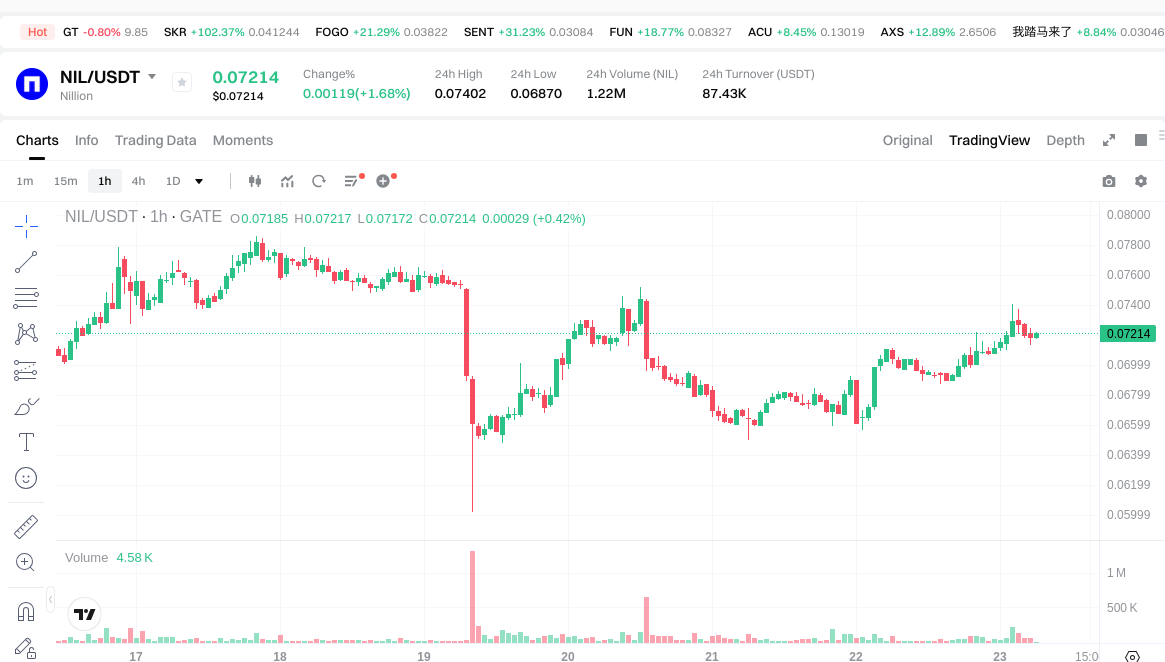
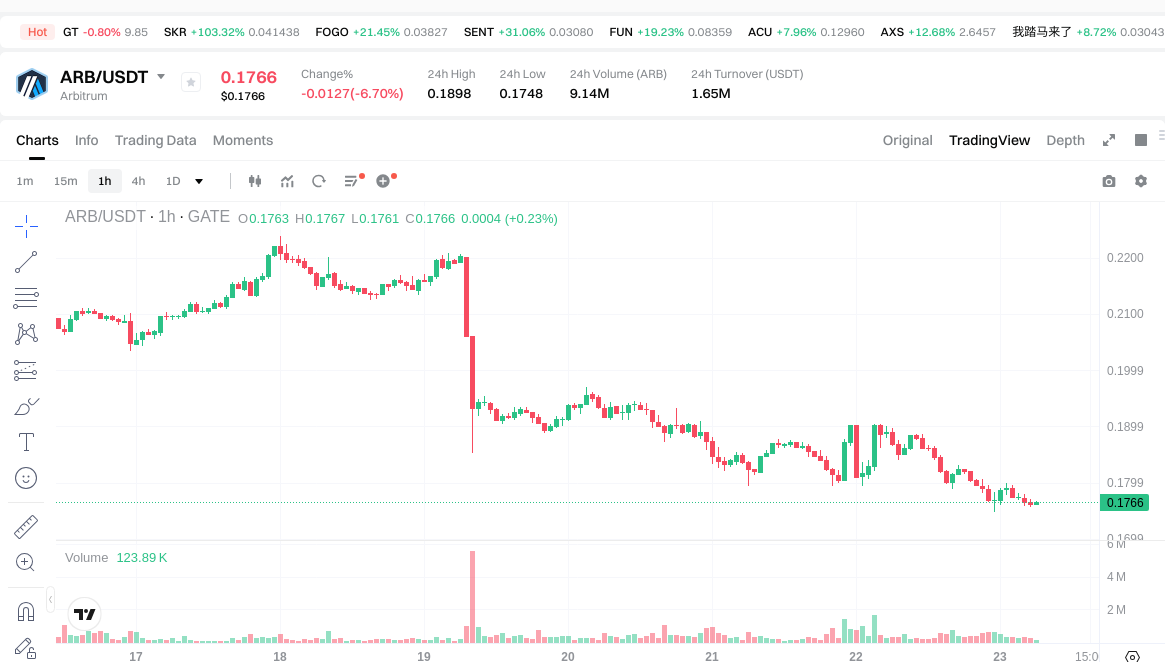
Price History Trends of NIL (Coin A) and ARB (Coin B)
- 2025: NIL reached a historical high of $1.1 on March 24, 2025, following its initial launch period, before experiencing subsequent corrections.
- 2025: ARB witnessed significant volatility, declining from its historical high of $2.39 (recorded in January 2024) to a low of $0.172637 on December 19, 2025.
- Comparative Analysis: During the recent market cycle, NIL demonstrated a price range between $1.1 (high) and $0.0537 (low recorded on December 18, 2025), while ARB experienced a broader fluctuation pattern with a more extended price history since its March 2023 launch.
Current Market Dynamics (January 23, 2026)
- NIL Current Price: $0.07186
- ARB Current Price: $0.1763
- 24-Hour Trading Volume: NIL recorded $87,015.79 compared to ARB's $1,637,139.80
- Market Sentiment Index (Fear & Greed Index): 20 (Extreme Fear)
View real-time prices:
II. Core Factors Affecting NIL vs ARB Investment Value
Supply Mechanism Comparison (Tokenomics)
Due to the absence of detailed supply mechanism information in the provided materials, a comprehensive comparison of tokenomics between NIL and ARB cannot be established at this time.
Institutional Adoption and Market Application
Without available data on institutional holdings, enterprise adoption patterns, or regulatory stances across different jurisdictions, a meaningful comparison of market application between NIL and ARB cannot be presented.
Technical Development and Ecosystem Construction
The provided materials do not contain sufficient information regarding technical upgrades, development roadmaps, or ecosystem activities (such as DeFi integration, NFT support, payment infrastructure, or smart contract implementations) for either NIL or ARB.
Macroeconomic Environment and Market Cycles
In the absence of historical performance data, correlation analysis with macroeconomic indicators (such as inflation rates, interest rate policies, US dollar index movements), or assessment of geopolitical factors affecting cross-border transaction demand, a comparative analysis of how NIL and ARB respond to macroeconomic conditions cannot be constructed.
III. 2026-2031 Price Forecast: NIL vs ARB
Short-term Forecast (2026)
- NIL: Conservative $0.0584-$0.0721 | Optimistic $0.0721-$0.0750
- ARB: Conservative $0.1412-$0.1765 | Optimistic $0.1765-$0.2259
Mid-term Forecast (2028-2029)
- NIL may enter a gradual growth phase, with projected prices ranging from $0.0549 to $0.1153
- ARB may enter an expansion phase, with projected prices ranging from $0.1458 to $0.3465
- Key drivers: institutional capital inflows, ETF developments, ecosystem expansion
Long-term Forecast (2030-2031)
- NIL: Baseline scenario $0.0826-$0.1020 | Optimistic scenario $0.1101-$0.1575
- ARB: Baseline scenario $0.2488-$0.2877 | Optimistic scenario $0.3161-$0.4331
View detailed price predictions for NIL and ARB
Disclaimer
NIL:
| Year |
Predicted High Price |
Predicted Average Price |
Predicted Low Price |
Price Change |
| 2026 |
0.0749528 |
0.07207 |
0.0583767 |
0 |
| 2027 |
0.097035048 |
0.0735114 |
0.063954918 |
2 |
| 2028 |
0.09209508192 |
0.085273224 |
0.06480765024 |
18 |
| 2029 |
0.115289398848 |
0.08868415296 |
0.0549841748352 |
23 |
| 2030 |
0.11830466004864 |
0.101986775904 |
0.08260928848224 |
41 |
| 2031 |
0.157508376706137 |
0.11014571797632 |
0.102435517717977 |
53 |
ARB:
| Year |
Predicted High Price |
Predicted Average Price |
Predicted Low Price |
Price Change |
| 2026 |
0.22592 |
0.1765 |
0.1412 |
0 |
| 2027 |
0.2696214 |
0.20121 |
0.1851132 |
14 |
| 2028 |
0.242478171 |
0.2354157 |
0.225999072 |
33 |
| 2029 |
0.346473056475 |
0.2389469355 |
0.145757630655 |
35 |
| 2030 |
0.3395435953455 |
0.2927099959875 |
0.248803496589375 |
66 |
| 2031 |
0.433093710063105 |
0.3161267956665 |
0.287675384056515 |
79 |
IV. Investment Strategy Comparison: NIL vs ARB
Long-term vs Short-term Investment Strategies
- NIL: May be suitable for investors interested in emerging privacy-focused blockchain infrastructure and secure computation technologies, with a focus on potential long-term ecosystem development
- ARB: May be suitable for investors seeking exposure to established Ethereum scaling solutions with demonstrated network activity and broader market recognition
Risk Management and Asset Allocation
- Conservative Investors: NIL 20-30% vs ARB 70-80%
- Aggressive Investors: NIL 40-50% vs ARB 50-60%
- Hedging Tools: stablecoin allocation, options strategies, cross-asset portfolio diversification
V. Potential Risk Comparison
Market Risks
- NIL: As a newer market entrant (launched 2025), faces higher volatility with limited trading volume ($87,015.79 in 24-hour volume as of January 23, 2026), presenting liquidity constraints during market stress periods
- ARB: Despite longer market presence since 2023, experienced substantial price decline from $2.39 to $0.172637 during 2025, indicating vulnerability to broader market downturns and ecosystem-specific challenges
Technical Risks
- NIL: scalability considerations, network stability during growth phases
- ARB: computational resource distribution, potential security vulnerabilities
Regulatory Risks
- Global regulatory policy developments may impact both assets differently based on their respective use cases, with privacy-focused technologies potentially facing increased scrutiny in certain jurisdictions, while Layer-2 scaling solutions may benefit from clearer regulatory frameworks surrounding Ethereum infrastructure
VI. Conclusion: Which Is the Better Buy?
📌 Investment Value Summary:
- NIL Advantages: represents exposure to privacy-preserving computation technology with potential applications in blockchain and AI data security; early-stage positioning may offer growth opportunities if adoption materializes
- ARB Advantages: established presence as Ethereum scaling infrastructure with demonstrated transaction activity; broader market recognition and higher liquidity relative to NIL; longer operational track record since 2023
✅ Investment Recommendations:
- Beginner Investors: consider focusing on more established assets with higher liquidity and proven use cases; if exploring both assets, maintain conservative position sizing with ARB potentially representing the larger allocation
- Experienced Investors: may consider diversified exposure across both assets based on individual risk tolerance and thesis on privacy infrastructure versus scaling solutions; implement appropriate position sizing and risk management protocols
- Institutional Investors: conduct comprehensive due diligence on technical architecture, adoption metrics, and regulatory considerations for each asset; consider staged allocation strategies aligned with institutional risk parameters
⚠️ Risk Disclosure: Cryptocurrency markets exhibit extreme volatility. This content does not constitute investment advice.
VII. FAQ
Q1: What are the main differences between NIL and ARB in terms of their core technology and use cases?
NIL focuses on privacy-preserving computation and secure data storage for blockchain and AI applications using blind computation technology, while ARB operates as an Ethereum Layer-2 scaling solution utilizing Optimistic Rollup protocol. NIL targets high-value encrypted data processing scenarios, whereas ARB aims to reduce transaction costs and increase throughput for Ethereum-based applications while maintaining network security.
Q2: Which asset demonstrates better liquidity and trading volume for investors?
ARB exhibits significantly superior liquidity with a 24-hour trading volume of $1,637,139.80 compared to NIL's $87,015.79 as of January 23, 2026. This substantial difference indicates ARB offers easier entry and exit points for investors, reduced slippage during trades, and greater market depth. NIL's lower liquidity presents challenges during periods of market volatility and may result in wider bid-ask spreads.
Q3: How do the historical price performances of NIL and ARB compare?
NIL, launched in 2025, reached a historical high of $1.1 on March 24, 2025, before declining to its current price of $0.07186, representing a shorter market history. ARB, introduced in 2023, experienced a broader price range with a historical high of $2.39 in January 2024, subsequently declining to $0.172637 on December 19, 2025. ARB's extended operational track record provides more historical data for analysis, while NIL's recent launch offers limited performance history for comprehensive evaluation.
Q4: What are the price projections for NIL and ARB through 2031?
For 2026, NIL is projected to range between $0.0584-$0.0750, while ARB is expected to trade between $0.1412-$0.2259. By 2031, NIL's baseline scenario suggests $0.1020-$0.1101 (optimistic up to $0.1575), whereas ARB's baseline forecast indicates $0.2488-$0.2877 (optimistic up to $0.4331). ARB demonstrates higher absolute price projections across all timeframes, though percentage growth potential varies based on ecosystem adoption and market conditions.
Q5: What portfolio allocation strategy should different investor types consider between NIL and ARB?
Conservative investors should consider a 20-30% NIL and 70-80% ARB allocation, emphasizing ARB's established market presence and higher liquidity. Aggressive investors may adopt a 40-50% NIL and 50-60% ARB split, accepting higher volatility for potential growth exposure to privacy infrastructure technology. Both strategies should incorporate stablecoin reserves, diversification across other crypto assets, and appropriate risk management tools including options strategies and stop-loss protocols based on individual risk tolerance.
Q6: What are the primary risks associated with investing in NIL versus ARB?
NIL faces elevated risks including limited liquidity ($87,015.79 daily volume), shorter operational history since 2025, and uncertainty regarding adoption of privacy-computation technology. ARB confronts different challenges including substantial historical price decline (from $2.39 to $0.172637 during 2025), competition from alternative Layer-2 solutions, and dependency on Ethereum ecosystem development. Both assets remain subject to broader cryptocurrency market volatility, regulatory developments, and technological risks inherent to their respective infrastructure categories.
Q7: Which asset is more suitable for beginners entering the cryptocurrency market?
ARB represents a more appropriate entry point for beginners due to its established operational track record since 2023, significantly higher liquidity, clearer use case within the Ethereum ecosystem, and broader market recognition. NIL's limited liquidity, recent market introduction, and emerging technology focus present greater complexity and risk unsuitable for investors developing fundamental understanding of cryptocurrency markets. Beginners should prioritize assets with proven use cases, adequate liquidity, and sufficient educational resources before exploring newer, more speculative opportunities.
Q8: How might regulatory developments differently impact NIL and ARB?
Privacy-focused technologies like NIL may face increased regulatory scrutiny in jurisdictions implementing stricter data protection and financial surveillance requirements, potentially limiting adoption in certain markets. Conversely, Layer-2 scaling solutions such as ARB may benefit from clearer regulatory frameworks surrounding Ethereum infrastructure, particularly as institutional adoption of blockchain technology expands. Both assets remain subject to evolving global cryptocurrency regulations, though their distinct technological approaches and use cases suggest divergent regulatory pathways across different jurisdictions.
* The information is not intended to be and does not constitute financial advice or any other recommendation of any sort offered or endorsed by Gate.