This comprehensive analysis compares NODL and CHZ, two emerging blockchain tokens with distinct market positioning. NODL operates as a decentralized IoT infrastructure network leveraging Bluetooth Low Energy technology for Web3 connectivity, while CHZ functions as an established fan engagement platform in sports and entertainment sectors. The article examines historical price trends, tokenomics, institutional adoption, technical ecosystems, and macroeconomic factors influencing both assets. With current market capitalizations of $382K and $411M respectively, CHZ demonstrates substantially higher liquidity and trading volume. Long-term price projections through 2031 suggest differentiated growth trajectories based on ecosystem development and sector adoption. Investment strategy recommendations vary by risk profile, with conservative investors favoring CHZ's established market presence and aggressive investors potentially exploring NODL's early-stage infrastructure opportunities. The analysis addresses regulat
Introduction: Investment Comparison Between NODL and CHZ
In the cryptocurrency market, the comparison between NODL vs CHZ has consistently been a topic investors cannot overlook. Both exhibit notable differences in market capitalization ranking, application scenarios, and price performance, while representing distinct positioning within the crypto asset landscape.
NODL (Nodle Network): Launched as a smartphone-driven decentralized network, it has gained market recognition through its positioning in connecting the physical world to Web3 via edge nodes utilizing Bluetooth Low Energy technology.
CHZ (Chiliz): Since its launch in 2019, it has been positioned as a fan engagement platform token, becoming one of the recognized digital assets in the sports and esports sectors with presence across multiple exchanges.
This article will comprehensively analyze the investment value comparison of NODL vs CHZ through historical price trends, supply mechanisms, institutional adoption, technical ecosystems, and future projections, attempting to address investors' most pressing question:
"Which is the better buy right now?"
I. Historical Price Comparison and Current Market Overview
Historical Price Trends of NODL (Coin A) and CHZ (Coin B)
- 2022: NODL experienced a price peak at $0.02001883 on August 26, 2022, representing a significant high point in its trading history.
- 2021: CHZ reached its all-time high of $0.878633 on March 13, 2021, driven by growing adoption in the sports and entertainment sectors.
- 2025: NODL recorded its historical low at $0.00008563 on December 15, 2025, reflecting market challenges during this period.
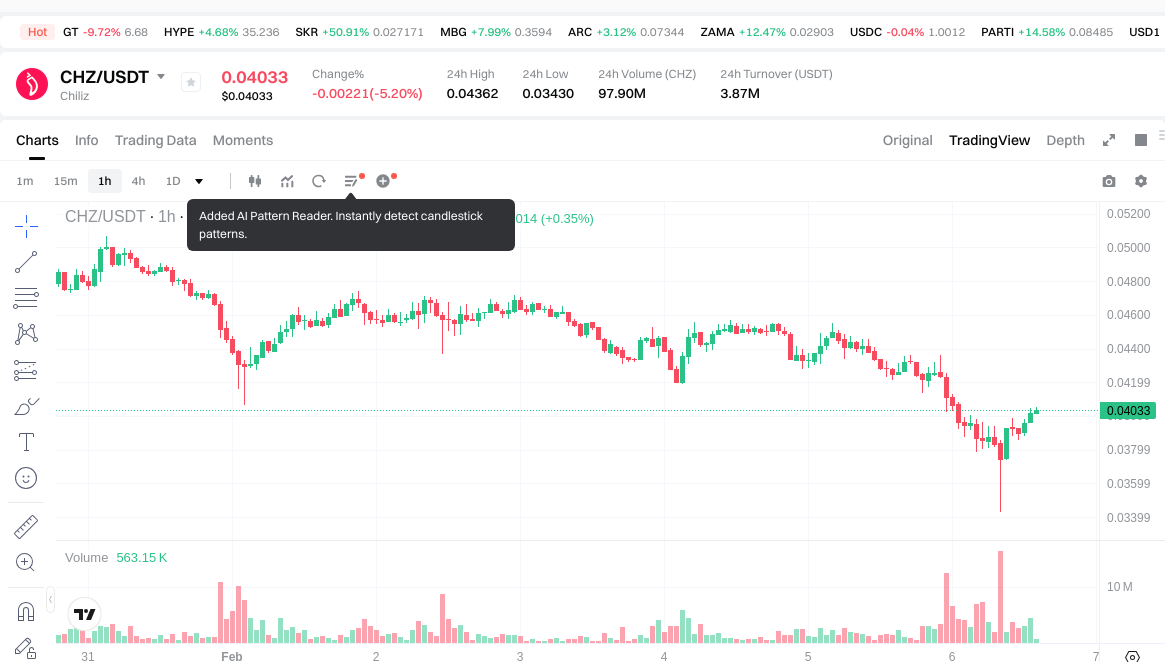
- Comparative Analysis: During the recent market cycle, NODL declined from its historical high of $0.02001883 to its current level of $0.0003154, representing substantial downward movement. CHZ experienced similar market pressures, declining from its peak of $0.878633 to the current price of $0.04008.
Current Market Status (February 6, 2026)
- NODL current price: $0.0003154
- CHZ current price: $0.04008
- 24-hour trading volume: NODL $19,366.79 vs CHZ $3,871,296.45
- Market Sentiment Index (Fear & Greed Index): 9 (Extreme Fear)
- NODL 24-hour price change: -2.43%
- CHZ 24-hour price change: -5.61%
- NODL market capitalization: $382,109.52
- CHZ market capitalization: $411,202,906.68
- NODL circulating supply: 1,211,507,672 tokens
- CHZ circulating supply: 10,259,553,560 tokens
View real-time prices:

II. Core Factors Influencing NODL vs CHZ Investment Value
Tokenomics Comparison
-
NODL: The supply mechanism details are not explicitly documented in the available materials. Market observations suggest that token distribution and emission schedules may influence long-term value retention, though specific parameters require further verification.
-
CHZ: Supply mechanism information is not provided in the reference materials. The token's role within the decentralized finance ecosystem suggests utility-driven demand patterns, but concrete tokenomics data remains unavailable.
-
📌 Historical Pattern: Supply mechanisms typically drive price cycles through scarcity dynamics and distribution schedules, though specific correlations for these assets require additional analysis.
Institutional Adoption and Market Application
-
Institutional Holdings: Comparative institutional preference data is not available in the provided materials. Both assets operate within evolving regulatory frameworks that influence institutional participation.
-
Enterprise Adoption: Application scenarios for NODL and CHZ in cross-border payments, settlement systems, and investment portfolios are not documented in the reference materials. Ecosystem partnerships and real-world use cases would require separate investigation.
-
National Policy: Regulatory attitudes toward these specific assets vary by jurisdiction. The materials note that policy monitoring and regulatory environment assessment form important consideration factors, though specific country-by-country positions are not detailed.
Technology Development and Ecosystem Construction
-
NODL Technical Evolution: Specific technological upgrades and their potential market impact are not documented in the available materials. The ecosystem's growth trajectory and technical partnerships would influence long-term positioning.
-
CHZ Technical Development: The materials reference CHZ's utility within decentralized finance applications, suggesting an ecosystem focus on financial infrastructure, though detailed technical roadmap information is not provided.
-
Ecosystem Comparison: DeFi integration, NFT adoption, payment system deployment, and smart contract implementation vary between projects. NODL's ecosystem development and CHZ's DeFi utility represent different strategic approaches, though comprehensive comparison data is not available in the reference materials.
Macroeconomic Environment and Market Cycles
-
Inflation Environment Performance: The materials note that macroeconomic trends and policy regulation influence cryptocurrency valuations. Specific anti-inflation characteristics for either asset are not documented, requiring analysis of broader market behavior and asset correlations.
-
Macroeconomic Monetary Policy: Interest rate movements and dollar index fluctuations affect cryptocurrency markets generally. The materials reference market sentiment as an investor consideration factor, suggesting sensitivity to monetary policy shifts, though asset-specific responses are not detailed.
-
Geopolitical Factors: Cross-border transaction demand and international situations influence cryptocurrency adoption patterns. The materials indicate that regulatory environment and technological innovation form key assessment dimensions, though specific geopolitical impact analysis for these assets is not provided.
III. 2026-2031 Price Prediction: NODL vs CHZ
Short-term Prediction (2026)
- NODL: Conservative $0.00028152 - $0.0003128 | Optimistic $0.000434792
- CHZ: Conservative $0.0229938 - $0.04034 | Optimistic $0.0512318
Mid-term Prediction (2028-2029)
- NODL may enter a moderate growth phase, with projected prices ranging from $0.0003186984696 to $0.0005387521748
- CHZ may enter a consolidation and expansion phase, with projected prices ranging from $0.0283669290604 to $0.060786276558
- Key drivers: institutional capital inflows, ETF developments, ecosystem expansion
Long-term Prediction (2031)
- NODL: Baseline scenario $0.000324235001852 - $0.000540391669754 | Optimistic scenario $0.000697105253983
- CHZ: Baseline scenario $0.041812853435029 - $0.06240724393288 | Optimistic scenario $0.083625706870059
View detailed price predictions for NODL and CHZ
Disclaimer
NODL:
| Year |
Predicted High Price |
Predicted Average Price |
Predicted Low Price |
Price Change |
| 2026 |
0.000434792 |
0.0003128 |
0.00028152 |
0 |
| 2027 |
0.00038500988 |
0.000373796 |
0.00027660904 |
18 |
| 2028 |
0.0005387521748 |
0.00037940294 |
0.0003186984696 |
20 |
| 2029 |
0.000546302293306 |
0.0004590775574 |
0.000316763514606 |
45 |
| 2030 |
0.000578093414155 |
0.000502689925353 |
0.000407178839535 |
59 |
| 2031 |
0.000697105253983 |
0.000540391669754 |
0.000324235001852 |
71 |
CHZ:
| Year |
Predicted High Price |
Predicted Average Price |
Predicted Low Price |
Price Change |
| 2026 |
0.0512318 |
0.04034 |
0.0229938 |
0 |
| 2027 |
0.054027362 |
0.0457859 |
0.024724386 |
14 |
| 2028 |
0.05140382993 |
0.049906631 |
0.04391783528 |
24 |
| 2029 |
0.060786276558 |
0.050655230465 |
0.0283669290604 |
26 |
| 2030 |
0.06909373435426 |
0.0557207535115 |
0.03677569731759 |
39 |
| 2031 |
0.083625706870059 |
0.06240724393288 |
0.041812853435029 |
55 |
IV. Investment Strategy Comparison: NODL vs CHZ
Long-term vs Short-term Investment Strategies
-
NODL: May appeal to investors focused on emerging IoT connectivity infrastructure and early-stage ecosystem development opportunities. The asset's positioning in decentralized physical infrastructure networks suggests potential alignment with investors seeking exposure to Web3 infrastructure buildout.
-
CHZ: May suit investors interested in sports and entertainment sector tokenization, with established presence in fan engagement platforms. The asset's maturity relative to NODL suggests positioning for those seeking more developed ecosystem participation.
Risk Management and Asset Allocation
-
Conservative Investors: Suggested allocation framework might consider NODL 20-30% vs CHZ 70-80%, reflecting CHZ's comparatively larger market capitalization ($411.2M vs $382K) and established trading infrastructure.
-
Aggressive Investors: Alternative allocation could explore NODL 40-50% vs CHZ 50-60%, incorporating higher exposure to early-stage infrastructure development potential while maintaining diversification.
-
Hedging Instruments: Portfolio risk management approaches may include stablecoin reserves for volatility buffering, options strategies where available, and cross-asset diversification across different cryptocurrency sectors.
V. Potential Risk Comparison
Market Risks
-
NODL: Trading volume of $19,366.79 over 24 hours indicates limited liquidity conditions, which may amplify price volatility during market stress periods. The substantial decline from historical peaks suggests sensitivity to broader market sentiment shifts.
-
CHZ: While demonstrating higher liquidity with $3.87M in 24-hour volume, the asset experienced a -5.61% decline in the measured period, reflecting exposure to sector-specific sentiment and broader cryptocurrency market cycles.
Technical Risks
-
NODL: Scalability requirements for IoT device network expansion and network stability considerations form ongoing technical development areas. The decentralized infrastructure model requires sustained network growth for value proposition realization.
-
CHZ: Platform adoption dependencies and integration requirements with sports organizations create technical execution risks. Smart contract functionality and cross-platform interoperability form critical operational considerations.
Regulatory Risks
- Jurisdictional variations in cryptocurrency regulation affect both assets differently based on their operational focus areas. NODL's IoT infrastructure positioning and CHZ's fan engagement applications face distinct regulatory frameworks across markets. Policy developments regarding decentralized networks and tokenized platforms continue to evolve, creating ongoing compliance considerations for ecosystem participants.
VI. Conclusion: Which Is the Better Buy?
📌 Investment Value Summary:
-
NODL Characteristics: Positioning in decentralized physical infrastructure networks with IoT connectivity focus; early-stage ecosystem development status; limited current liquidity conditions but potential infrastructure growth alignment.
-
CHZ Characteristics: Established presence in sports and entertainment tokenization sector; comparatively higher market capitalization and trading liquidity; operational ecosystem with recognizable brand partnerships in fan engagement space.
✅ Investment Considerations:
-
Beginner Investors: May consider starting with assets demonstrating higher liquidity and established market presence. Understanding fundamental technology and use cases forms important foundation before allocation decisions.
-
Experienced Investors: Portfolio diversification approaches might incorporate both infrastructure-focused assets and sector-specific applications based on individual risk tolerance and market cycle assessment. Position sizing relative to total portfolio and rebalancing mechanisms warrant consideration.
-
Institutional Participants: Due diligence processes typically encompass regulatory compliance frameworks, counterparty risk assessment, custody solutions evaluation, and alignment with investment mandate parameters.
⚠️ Risk Disclaimer: Cryptocurrency markets exhibit substantial volatility characteristics. Price movements may result in significant capital loss. This content does not constitute investment advice, financial guidance, or trading recommendations. Individuals should conduct independent research and consult qualified financial professionals before making investment decisions.
VII. FAQ
Q1: What are the main differences between NODL and CHZ in terms of use cases?
NODL focuses on decentralized IoT infrastructure using smartphone-driven edge nodes with Bluetooth Low Energy technology to connect the physical world to Web3, while CHZ operates as a fan engagement platform token in the sports and entertainment sectors. NODL's application centers on building decentralized physical infrastructure networks (DePIN) for device connectivity, whereas CHZ enables tokenized fan experiences and sports organization partnerships. These fundamental differences mean NODL targets infrastructure development opportunities while CHZ addresses entertainment sector digitalization.
Q2: How do the liquidity levels of NODL and CHZ compare for trading purposes?
CHZ demonstrates significantly higher liquidity with 24-hour trading volume of $3,871,296.45 compared to NODL's $19,366.79. This substantial difference—approximately 200x higher for CHZ—means CHZ offers considerably easier entry and exit positions with reduced slippage risk. For investors requiring frequent trading or larger position sizes, CHZ's liquidity profile provides more practical execution conditions, while NODL's limited volume may present challenges during periods of market volatility or when attempting to execute substantial trades.
Q3: Which asset has experienced greater price volatility historically?
NODL has demonstrated more extreme price movements, declining approximately 98.4% from its August 2022 peak of $0.02001883 to its current price of $0.0003154, while CHZ declined roughly 95.4% from its March 2021 all-time high of $0.878633 to $0.04008. Both assets have experienced substantial corrections from historical peaks, though NODL's percentage decline and lower absolute price level indicate higher volatility characteristics. This pattern suggests NODL carries amplified risk-reward dynamics compared to CHZ's relatively more established price discovery process.
Q4: What factors should investors consider when choosing between NODL and CHZ?
Investment decisions should evaluate several key dimensions: market capitalization disparity ($382,109.52 for NODL vs $411,202,906.68 for CHZ), liquidity requirements for trading strategy execution, sector exposure preferences (IoT infrastructure vs sports entertainment), risk tolerance regarding early-stage versus established ecosystems, and portfolio allocation objectives. Conservative investors might favor CHZ's larger market presence and liquidity, while those seeking higher-risk infrastructure exposure might allocate to NODL. Diversification approaches could incorporate both assets with position sizing reflecting individual risk parameters.
Q5: How do the 2031 price predictions compare between NODL and CHZ?
According to baseline scenarios, NODL projects a 2031 price range of $0.000324 to $0.000540 (optimistic $0.000697), while CHZ forecasts $0.0418 to $0.0624 (optimistic $0.0836). In percentage terms from current levels, NODL's optimistic scenario suggests approximately 121% potential growth, whereas CHZ's optimistic projection indicates roughly 109% upside. However, these predictions carry substantial uncertainty and depend on numerous variables including ecosystem development, adoption rates, and macroeconomic conditions. Investors should treat long-term forecasts as speculative reference points rather than guaranteed outcomes.
Q6: What are the primary regulatory considerations for NODL versus CHZ?
Both assets face jurisdictional variations in cryptocurrency regulation, though their distinct operational focuses create different compliance landscapes. NODL's positioning in decentralized physical infrastructure may encounter regulations governing IoT devices, telecommunications networks, and data transmission protocols across various markets. CHZ's fan engagement applications face frameworks related to securities classification for tokenized assets, sports betting regulations where applicable, and entertainment sector compliance requirements. Ongoing policy developments regarding decentralized networks and tokenized platforms continue to evolve, requiring investors to monitor regulatory changes in their operational jurisdictions.
Q7: Which asset is more suitable for portfolio diversification purposes?
The diversification value depends on existing portfolio composition and correlation objectives. NODL offers exposure to emerging DePIN infrastructure development, potentially providing low correlation to traditional sports and entertainment tokens, while CHZ delivers sector-specific positioning in tokenized fan engagement. For portfolios heavily weighted toward established cryptocurrencies, NODL's early-stage infrastructure focus might add differentiation, though with elevated risk. For portfolios seeking moderate cryptocurrency exposure with operational ecosystems, CHZ's established market presence and recognizable partnerships may provide more suitable diversification characteristics. Optimal allocation requires analysis of individual portfolio construction and risk-return objectives.
Q8: What are the key technical risks that differentiate NODL from CHZ?
NODL faces technical challenges primarily around IoT device network scalability, maintaining stability across distributed edge nodes, and achieving sufficient network density for value proposition realization. The decentralized infrastructure model requires sustained adoption across smartphone users and device manufacturers. CHZ encounters different technical considerations including platform adoption dependencies with sports organizations, smart contract functionality for fan token operations, and cross-platform interoperability requirements. While both face execution risks, NODL's challenges center on infrastructure buildout fundamentals, whereas CHZ's risks relate to operational platform performance and partnership integration capabilities.
* The information is not intended to be and does not constitute financial advice or any other recommendation of any sort offered or endorsed by Gate.