This comprehensive analysis compares Notcoin (NOT) and Stellar (XLM), two distinct blockchain tokens serving different market needs. NOT, a Telegram-based gaming token launched in 2024, targets mainstream users through accessible click-to-earn mechanics, while XLM, established in 2014, operates as payment infrastructure for cross-border transactions with 2-5 second settlement and minimal fees. The article examines historical price trends, tokenomics, institutional adoption, and technical ecosystems to guide investment decisions. NOT currently trades at $0.0006047 with $171,735.80 daily volume, showing high volatility suitable for risk-tolerant investors. XLM trades at $0.22589 with $969,182.94 volume, offering established infrastructure and institutional recognition. Through 2031 price projections, risk comparisons, and diversified investment strategies on Gate, this guide helps both beginner and experienced investors evaluate which token aligns with their portfolio objectives and risk tolerance.
Introduction: Investment Comparison Between NOT and XLM
In the cryptocurrency market, the comparison between NOT vs XLM has become a topic that investors cannot ignore. The two differ significantly in market cap ranking, application scenarios, and price performance, representing distinct positioning within the crypto asset landscape.
Notcoin (NOT): Launched in 2024, this Telegram-based gaming token aims to attract mainstream users into cryptocurrency by removing complex barriers through an accessible click-to-earn mechanism.
Stellar (XLM): Introduced in 2014 by former Ripple co-founder Jed McCaleb, it has established itself as a decentralized gateway for transferring digital assets between banks, payment institutions, and individuals with high network throughput and low transaction costs.
This article will comprehensively analyze the investment value comparison of NOT vs XLM through historical price trends, supply mechanisms, institutional adoption, technical ecosystems, and future predictions, attempting to answer the question that investors care about most:
"Which is the better buy right now?"
I. Historical Price Comparison and Current Market Situation
NOT (Coin A) and XLM (Coin B) Historical Price Trends
- 2024: NOT experienced significant volatility following its launch in May 2024, with the price reaching a notable level of $0.02945 in June 2024, driven by its integration with Telegram and rapid user adoption. The token later declined as initial enthusiasm moderated.
- 2018: XLM was influenced by broader cryptocurrency market expansion, with the price reaching $0.875563 in January 2018 during a period of heightened interest in blockchain-based payment solutions. This milestone represented the asset's historical peak.
- Comparative Analysis: During the 2024-2025 market cycle, NOT declined from its high of $0.02945 to a low of $0.000237 in October 2025, reflecting a substantial correction. In contrast, XLM has experienced a more gradual decline from its 2018 peak, with the current price representing a decrease of approximately 74% from its all-time high.
Current Market Situation (2026-01-19)
- NOT current price: $0.0006047
- XLM current price: $0.22589
- 24-hour trading volume: NOT $171,735.80 vs XLM $969,182.94
- Market sentiment index (Fear & Greed Index): 49 (Neutral)
View real-time prices:
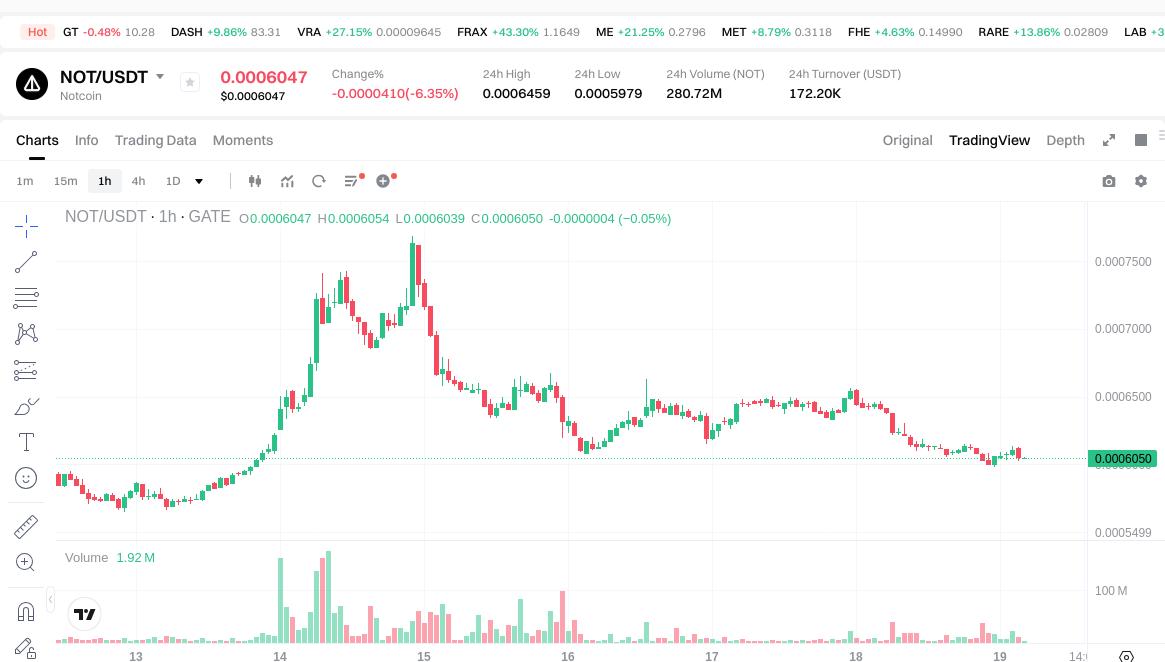
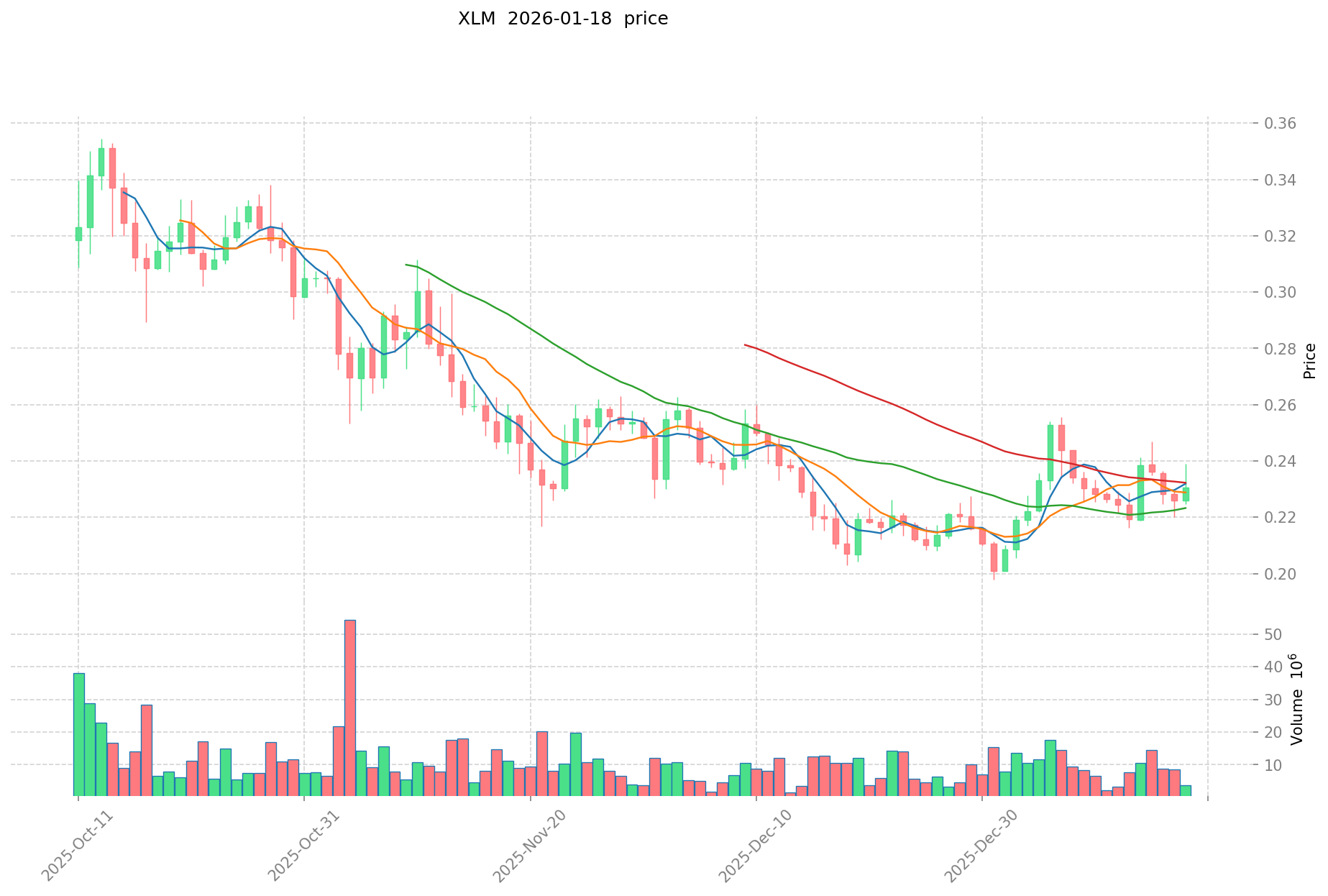
II. Core Factors Influencing NOT vs XLM Investment Value
Supply Mechanism Comparison (Tokenomics)
- XLM: Fixed supply model with no unlimited issuance, designed to avoid inflation risks and maintain long-term scarcity. The total supply is capped, supporting price stability over extended periods.
- NOT: Supply mechanism details were not available in the reference materials.
- 📌 Historical Pattern: Fixed supply mechanisms tend to create scarcity-driven value appreciation cycles, particularly when network adoption expands and demand increases.
Institutional Adoption and Market Application
- Institutional Holdings: XLM has gained traction with financial institutions focused on cross-border payments and digital financial infrastructure. The reference materials noted XLM's positioning as a bridge asset facilitating currency exchange when direct liquidity is limited.
- Enterprise Adoption: XLM demonstrates application in cross-border remittance and payment clearing networks, with partnerships involving financial institutions and payment companies. The network's transaction cost of 0.00001 XLM per operation supports cost-effective international settlements.
- Regulatory Environment: Reference materials mentioned the 2021 partnership between Stellar and Ukraine's central bank for digital currency pilots, indicating recognition in certain jurisdictions for blockchain-based payment infrastructure.
Technical Development and Ecosystem Building
- XLM Technical Features: Stellar network offers transaction completion in 2-5 seconds with minimal fees (0.00001 XLM), providing advantages in small-value payments and cross-border transfers compared to networks with longer confirmation times or volatile fee structures. The network supports multi-asset issuance, including stablecoins and tokenized assets.
- NOT Technical Development: Technical specifications were not available in the reference materials.
- Ecosystem Comparison: XLM operates as a payment clearing network with applications in cross-border remittance, asset tokenization, and financial institution settlement systems. The materials described Stellar's focus on financial inclusion and individual users, distinguishing it from enterprise-focused alternatives.
Macroeconomic Factors and Market Cycles
- Inflation Environment Performance: Reference materials indicated XLM's price movements correlate with broader cryptocurrency market trends, particularly Bitcoin and Ethereum cycles, showing synchronized upward movement during bull markets and downward movement during bear markets.
- Macroeconomic Policy Impact: The materials noted that XLM price dynamics are influenced by external market conditions including overall crypto market sentiment and competitive positioning against similar cross-border payment solutions.
- Geopolitical Factors: XLM's positioning in cross-border payment infrastructure suggests potential sensitivity to international transaction demand and regulatory developments affecting digital payment systems across jurisdictions.
III. 2026-2031 Price Prediction: NOT vs XLM
Short-term Forecast (2026)
- NOT: Conservative $0.00052635-0.000605 | Optimistic $0.0006050-0.0008228
- XLM: Conservative $0.207414-0.22545 | Optimistic $0.22545-0.3088665
Medium-term Forecast (2028-2029)
- NOT may enter a consolidation phase with estimated price range of $0.000489914-0.0008031375 in 2028, potentially expanding to $0.0007589649-0.001222777 by 2029
- XLM may enter a growth phase with estimated price range of $0.25887634-0.304560405 in 2028, potentially reaching $0.255800284-0.394070708 by 2029
- Key drivers: institutional capital inflows, ETF developments, ecosystem expansion
Long-term Forecast (2030-2031)
- NOT: Baseline scenario $0.000764446-0.001033036 (2030) | Optimistic scenario $0.001109274-0.001767524 (2031)
- XLM: Baseline scenario $0.210827829-0.36987338 (2030) | Optimistic scenario $0.27218982-0.486642411 (2031)
View detailed price predictions for NOT and XLM
Disclaimer: Price predictions are based on historical data analysis and market trends. Cryptocurrency markets are highly volatile and subject to numerous unpredictable factors. These forecasts should not be considered as financial advice or guarantee of future performance.
NOT:
| Year |
Predicted High Price |
Predicted Average Price |
Predicted Low Price |
Price Change |
| 2026 |
0.0008228 |
0.000605 |
0.00052635 |
0 |
| 2027 |
0.000892375 |
0.0007139 |
0.000521147 |
18 |
| 2028 |
0.00088345125 |
0.0008031375 |
0.000489913875 |
32 |
| 2029 |
0.00122277684375 |
0.000843294375 |
0.0007589649375 |
39 |
| 2030 |
0.00140492842875 |
0.001033035609375 |
0.000764446350937 |
70 |
| 2031 |
0.00176752392764 |
0.001218982019062 |
0.001109273637346 |
101 |
XLM:
| Year |
Predicted High Price |
Predicted Average Price |
Predicted Low Price |
Price Change |
| 2026 |
0.3088665 |
0.22545 |
0.207414 |
0 |
| 2027 |
0.34196256 |
0.26715825 |
0.2270845125 |
18 |
| 2028 |
0.38679171435 |
0.304560405 |
0.25887634425 |
34 |
| 2029 |
0.3940707080295 |
0.345676059675 |
0.2558002841595 |
53 |
| 2030 |
0.454944262138267 |
0.36987338385225 |
0.210827828795782 |
63 |
| 2031 |
0.486642411134405 |
0.412408822995258 |
0.27218982317687 |
82 |
IV. Investment Strategy Comparison: NOT vs XLM
Long-term vs Short-term Investment Strategies
- NOT: May suit investors with higher risk tolerance seeking speculative opportunities in emerging gaming-based tokens. The asset's volatility patterns suggest positioning for short to medium-term tactical allocations rather than core portfolio holdings.
- XLM: May suit investors focused on payment infrastructure adoption and institutional integration trends. The established network history and cross-border payment use cases support consideration for medium to long-term strategic allocations.
Risk Management and Asset Allocation
- Conservative Investors: NOT 5-10% vs XLM 15-25% - Lower allocation to higher-volatility gaming tokens, moderate exposure to established payment networks
- Aggressive Investors: NOT 15-25% vs XLM 25-35% - Increased exposure to both assets with emphasis on established networks while maintaining speculative positions
- Hedging Instruments: Stablecoin reserves for rebalancing opportunities, options contracts for downside protection, cross-asset diversification across different blockchain use cases
V. Potential Risk Comparison
Market Risks
- NOT: Elevated volatility risk with historical price range showing significant fluctuations from $0.02945 to $0.000237. Limited trading volume of $171,735.80 may contribute to liquidity constraints and price instability during market stress periods.
- XLM: Correlation risk with broader cryptocurrency market cycles, particularly Bitcoin and Ethereum movements. Price sensitivity to competitive developments in cross-border payment solutions and shifting institutional adoption patterns.
Technical Risks
- NOT: Scalability considerations and network stability factors were not available in reference materials, limiting comprehensive technical risk assessment.
- XLM: Network dependency on validator participation and consensus mechanism stability. Competition from alternative payment networks with similar technical capabilities may affect long-term adoption trajectories.
Regulatory Risks
- Global regulatory frameworks for payment-focused networks like XLM may face evolving compliance requirements affecting cross-border transaction operations. Gaming-based tokens such as NOT may encounter jurisdiction-specific restrictions on gaming mechanisms and token distribution models. Regulatory clarity developments in major markets could create asymmetric impacts on different token categories.
VI. Conclusion: Which Is the Better Buy?
📌 Investment Value Summary:
- NOT Advantages: Early-stage positioning in Telegram-integrated gaming ecosystem, potential for user base expansion through accessible click-to-earn mechanisms
- XLM Advantages: Established network infrastructure with institutional recognition, demonstrated use cases in cross-border payments with low transaction costs (0.00001 XLM per operation), fixed supply model supporting scarcity-driven value proposition
✅ Investment Recommendations:
- Beginner Investors: Consider focusing on XLM for exposure to established payment infrastructure with clearer use case validation. Limit initial allocation to 5-10% of total portfolio with emphasis on risk management through stablecoin reserves.
- Experienced Investors: Evaluate portfolio diversification through combined exposure - XLM (15-25%) for core payment network positioning, NOT (5-15%) for speculative gaming sector allocation. Implement systematic rebalancing based on volatility thresholds.
- Institutional Investors: XLM may align with strategic allocations focused on payment infrastructure and cross-border settlement innovations. Consider institutional custody solutions and regulatory compliance frameworks when structuring positions.
⚠️ Risk Warning: Cryptocurrency markets exhibit extreme volatility. This analysis does not constitute investment advice. Conduct independent research and consult qualified financial advisors before making investment decisions.
VII. FAQ
Q1: What is the main difference between NOT and XLM in terms of use cases?
NOT is a gaming-focused token integrated with Telegram's platform, utilizing a click-to-earn mechanism to attract mainstream users into cryptocurrency through accessible gaming experiences. XLM, in contrast, functions as a payment infrastructure network designed for cross-border transactions and digital asset transfers between financial institutions, payment providers, and individuals. While NOT targets gaming and social platform engagement, XLM addresses real-world payment clearing and remittance needs with 2-5 second transaction completion times and minimal fees of 0.00001 XLM per operation.
Q2: Which token offers better liquidity for trading?
XLM demonstrates significantly higher liquidity with 24-hour trading volume of $969,182.94 compared to NOT's $171,735.80. This 5.6x difference in trading volume indicates XLM provides more favorable conditions for executing trades with reduced slippage risk and faster order fulfillment. Higher liquidity also suggests deeper market participation and more stable price discovery mechanisms, which are particularly important considerations for investors planning to enter or exit positions without substantially impacting market prices.
Q3: How do the supply mechanisms of NOT and XLM affect long-term investment potential?
XLM operates with a fixed supply model designed to prevent inflation and maintain scarcity over time. This capped supply structure creates potential for scarcity-driven value appreciation when network adoption expands and demand increases. Unfortunately, detailed supply mechanism information for NOT was not available in the reference materials, limiting comprehensive comparison. Generally, fixed supply models tend to support long-term value retention better than unlimited issuance structures, particularly during periods of sustained demand growth.
Q4: What institutional adoption advantages does XLM have over NOT?
XLM has established partnerships with financial institutions focused on cross-border payment infrastructure, including a notable 2021 collaboration with Ukraine's central bank for digital currency pilots. The network serves as a bridge asset for currency exchange when direct liquidity is limited, demonstrating practical institutional use cases. XLM's positioning in payment clearing networks and cross-border remittance systems reflects recognition from traditional financial entities. In contrast, NOT's institutional adoption status was not documented in available materials, suggesting it remains primarily focused on retail user engagement through gaming mechanisms.
Q5: How volatile are NOT and XLM compared to each other?
NOT exhibits significantly higher volatility, with historical price movements ranging from a peak of $0.02945 in June 2024 to a low of $0.000237 in October 2025—representing a decline exceeding 99%. XLM shows more moderate volatility patterns, currently trading approximately 74% below its 2018 all-time high of $0.875563. The current price of $0.22589 for XLM versus $0.0006047 for NOT, combined with trading volume differentials, suggests NOT carries substantially higher volatility risk. Investors with lower risk tolerance may find XLM's price behavior more aligned with conservative portfolio strategies.
Q6: What are the projected returns for NOT vs XLM by 2031?
According to price prediction models, NOT shows projected growth from current levels to an average price of $0.001218982 by 2031, representing approximately 101% increase from 2026 baseline. XLM forecasts suggest potential growth to an average price of $0.412408 by 2031, indicating approximately 82% increase from 2026 baseline. However, these projections reflect different risk-return profiles—NOT's higher percentage gain potential comes with substantially elevated volatility risk, while XLM's projection reflects more stable growth expectations backed by established network infrastructure and institutional adoption trends.
Q7: Which token is more suitable for beginners entering cryptocurrency markets?
XLM may be more appropriate for beginner investors due to its established market presence, clearer use case validation in payment infrastructure, and relatively lower volatility compared to NOT. The network's institutional recognition and documented applications in cross-border transactions provide tangible value propositions that are easier to understand and evaluate. Beginners are advised to limit initial allocation to 5-10% of total portfolio with emphasis on risk management through stablecoin reserves. NOT's gaming-focused model and higher volatility profile may pose greater challenges for investors still developing market understanding and risk management capabilities.
Q8: How do macroeconomic conditions affect NOT and XLM differently?
XLM demonstrates correlation with broader cryptocurrency market cycles, particularly Bitcoin and Ethereum price movements, showing synchronized upward trends during bull markets and downward movements during bear markets. As a payment infrastructure asset, XLM may also be influenced by international transaction demand patterns and regulatory developments affecting digital payment systems across jurisdictions. NOT's performance drivers were not extensively documented in available materials, though gaming-focused tokens generally exhibit sensitivity to user engagement trends and platform-specific developments. XLM's established positioning suggests it may respond more predictably to macroeconomic policy shifts affecting institutional adoption of blockchain payment solutions.
* The information is not intended to be and does not constitute financial advice or any other recommendation of any sort offered or endorsed by Gate.