This comprehensive guide compares NPC, a memecoin-NFT hybrid launched in 2023, with SOL, an established Layer 1 blockchain protocol since 2017, across multiple dimensions. The article analyzes historical price trends showing NPC's 84% decline from peak versus SOL's 51% correction, examining market capitalizations, trading volumes, and institutional adoption patterns. It evaluates core investment factors including tokenomics, technical ecosystems, and macroeconomic influences while providing price projections through 2031 for both assets. The guide presents tailored investment strategies for conservative to aggressive investors, detailed risk assessments covering market and regulatory factors, and practical portfolio allocation recommendations. With real-time pricing data from Gate and extensive FAQ sections, readers gain clarity on which asset suits their investment profile and risk tolerance.
Introduction: Investment Comparison Between NPC and SOL
In the cryptocurrency market, the comparison between NPC vs SOL has been a topic that investors cannot avoid. The two differ significantly in market cap ranking, application scenarios, and price performance, representing different positioning in the crypto asset landscape.
Non-Playable Coin (NPC): Launched in 2023, it positions itself as the first memecoin-NFT hybrid, or "meme-fungible token" (MFT), backed by one of the internet's most recognizable memes.
Solana (SOL): Since its establishment in 2017 by former engineers from Qualcomm, Intel, and Dropbox, it has been recognized as a high-performance blockchain protocol focusing on scalability without compromising decentralization or security.
This article will provide a comprehensive analysis of NPC vs SOL investment value comparison, covering historical price trends, supply mechanisms, institutional adoption, technical ecosystems, and future forecasts, attempting to answer the question investors care about most:
"Which is the better buy right now?"
I. Historical Price Comparison and Market Status
NPC (Coin A) and SOL (Coin B) Historical Price Trends
- 2023: NPC launched on July 28 with an initial price of $0.02417. The token experienced significant volatility in its early trading period.
- 2024: NPC reached its historical high of $0.07226 on September 4, representing substantial growth from its launch price. However, the token subsequently entered a correction phase.
- 2025: NPC recorded its historical low of $0.005666 on March 11, reflecting broader market pressures and project-specific challenges.
- 2020: SOL was launched in March with an initial price of $0.22. The token recorded its historical low of $0.500801 on May 12.
- 2025: SOL reached its historical high of $293.31 on January 19, demonstrating remarkable growth over its operating period.
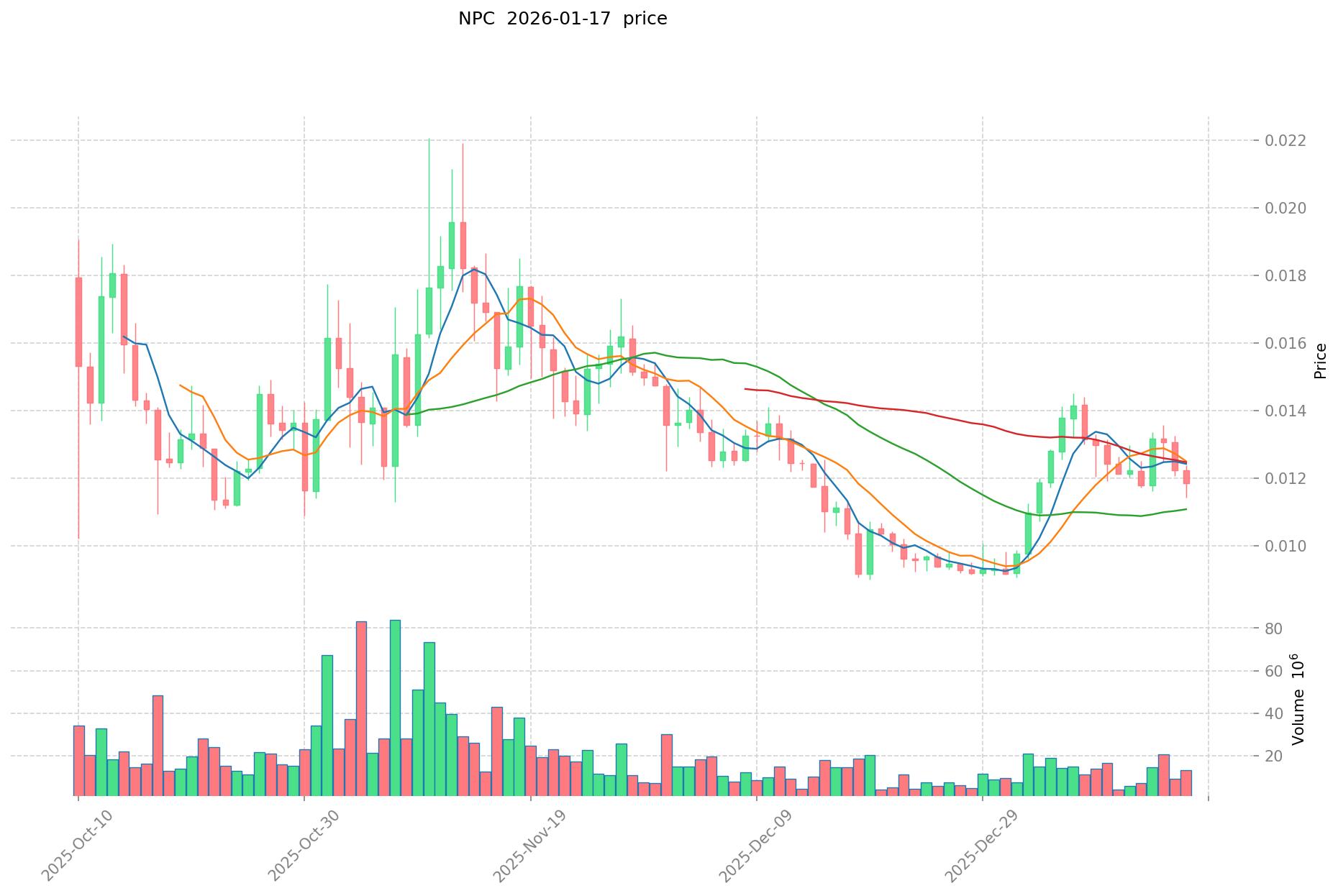
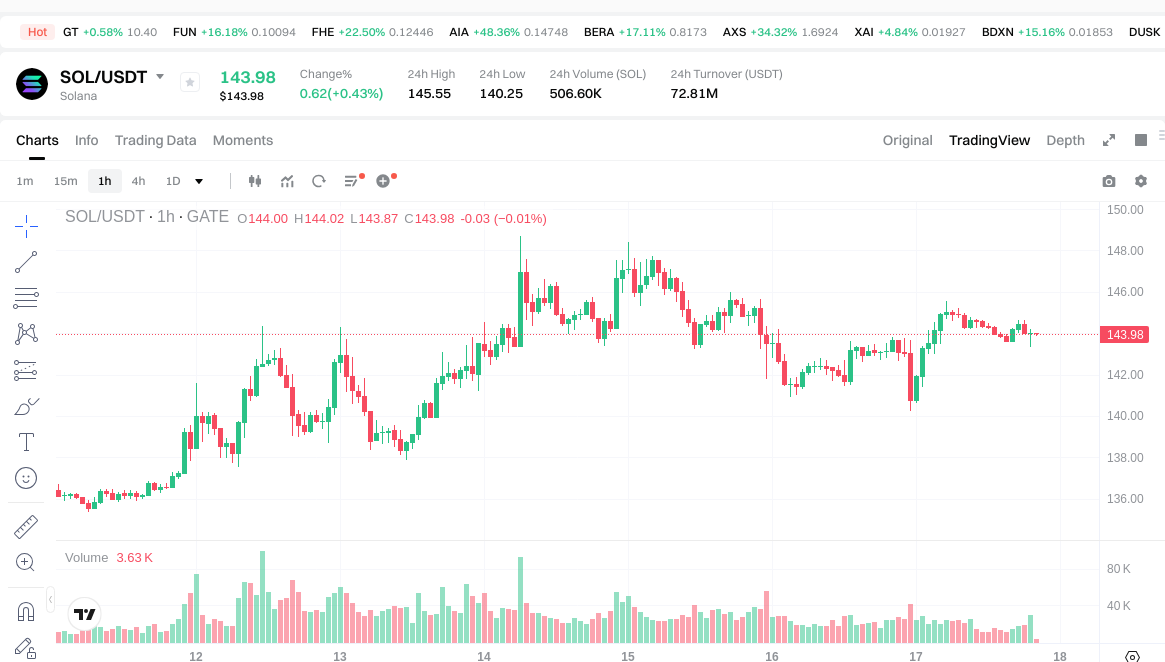
Comparative Analysis: During market cycles, NPC has experienced notable volatility, declining from its peak of $0.07226 to its current trading range around $0.011551, representing approximately an 84% decline from its high. In contrast, SOL, while also experiencing corrections, has maintained significantly higher price levels, currently trading around $144.01 after reaching its peak of $293.31, representing approximately a 51% decline from its historical high.
Current Market Status (2026-01-17)
- NPC Current Price: $0.011551
- SOL Current Price: $144.01
- 24-Hour Trading Volume: NPC recorded $134,935.70 compared to SOL's $72,936,905.42
- 24-Hour Price Change: NPC decreased by 2.17%, while SOL increased by 0.32%
- Market Capitalization: NPC holds $92,987,011.43 versus SOL's $81,432,344,877.36
- Market Sentiment Index (Fear & Greed Index): 50 (Neutral)
View real-time prices:
II. Core Factors Influencing NPC vs SOL Investment Value
Supply Mechanism Comparison (Tokenomics)
- NPC: The reference materials do not provide specific information regarding NPC's supply mechanism or tokenomics structure.
- SOL: SOL serves as the native token of the Solana blockchain, playing a key role in transaction fees, security, and governance while supporting the operation of various decentralized applications (dApps) and service platforms.
- 📌 Historical Pattern: Supply mechanisms tend to influence price cycles through scarcity dynamics and token distribution schedules, though specific historical data for these assets was not available in the provided materials.
Institutional Adoption and Market Application
- Institutional Holdings: The reference materials do not contain comparative data on institutional preference between NPC and SOL.
- Enterprise Adoption: SOL has demonstrated applications across DeFi ecosystems, NFT platforms, and decentralized application infrastructure. Specific enterprise adoption details for cross-border payments or settlement systems were not mentioned in the materials. NPC's enterprise application scenarios were not discussed in the provided sources.
- National Policy: The materials indicate that policy changes and market sentiment represent significant factors affecting SOL price volatility. Regulatory attitudes toward NPC across different jurisdictions were not covered in the reference materials.
Technical Development and Ecosystem Building
- NPC Technical Upgrades: The provided materials do not contain information about NPC's technical development roadmap or upgrades.
- SOL Technical Development: Solana distinguishes itself through high-speed transaction processing and scalability capabilities, positioning it as a strong competitor in the decentralized application (dApp) space. The platform's technical architecture supports diverse applications across the ecosystem.
- Ecosystem Comparison: SOL has established presence across DeFi, NFT, and smart contract implementations. The materials reference SOL's market capitalization positioning among Layer 1 networks, alongside ETH, XRP, and BNB. NPC's ecosystem development details were not available in the reference materials.
Macroeconomic Factors and Market Cycles
- Performance in Inflationary Environments: According to the materials, NPC has shown characteristics of inflation resistance in high-inflation contexts. SOL's anti-inflation properties were not specifically addressed in the provided sources.
- Macroeconomic Monetary Policy: Central bank interest rates and quantitative easing policies directly influence NPC's safe-haven attributes. SOL prices may experience significant volatility due to policy changes, market sentiment, and technological developments, requiring investors to maintain sensitivity to market dynamics.
- Geopolitical Factors: Global economic uncertainty and trade tensions may drive investor interest in certain assets. NPC appears responsive to geopolitical uncertainties according to the materials, while SOL's relationship to geopolitical factors and cross-border transaction demand was not explicitly covered in the reference sources.
III. 2026-2031 Price Prediction: NPC vs SOL
Short-term Forecast (2026)
- NPC: Conservative $0.0059-$0.0116 | Optimistic $0.0116-$0.0172
- SOL: Conservative $97.91-$143.99 | Optimistic $143.99-$151.19
Mid-term Forecast (2028-2029)
- NPC may enter a growth phase, with projected price range of $0.0146-$0.0273
- SOL may enter a consolidation phase, with projected price range of $105.29-$237.23
- Key drivers: institutional capital inflows, ETF developments, ecosystem expansion
Long-term Forecast (2030-2031)
- NPC: Baseline scenario $0.0164-$0.0242 | Optimistic scenario $0.0222-$0.0332
- SOL: Baseline scenario $122.28-$216.64 | Optimistic scenario $230.73-$339.17
View detailed price predictions for NPC and SOL
Disclaimer
NPC:
| Year |
Predicted High Price |
Predicted Average Price |
Predicted Low Price |
Price Change |
| 2026 |
0.01724377 |
0.011573 |
0.00590223 |
0 |
| 2027 |
0.0198835713 |
0.014408385 |
0.0083568633 |
24 |
| 2028 |
0.0248616683175 |
0.01714597815 |
0.0145740814275 |
48 |
| 2029 |
0.027304970203875 |
0.02100382323375 |
0.016382982122325 |
81 |
| 2030 |
0.025362116554753 |
0.024154396718812 |
0.016424989768792 |
109 |
| 2031 |
0.033176063893288 |
0.024758256636782 |
0.022282430973104 |
114 |
SOL:
| Year |
Predicted High Price |
Predicted Average Price |
Predicted Low Price |
Price Change |
| 2026 |
151.1895 |
143.99 |
97.9132 |
0 |
| 2027 |
215.481035 |
147.58975 |
123.97539 |
2 |
| 2028 |
210.5810553 |
181.5353925 |
105.29052765 |
26 |
| 2029 |
237.230450919 |
196.0582239 |
125.477263296 |
36 |
| 2030 |
244.808101272735 |
216.6443374095 |
149.484592812555 |
50 |
| 2031 |
339.167542431442725 |
230.7262193411175 |
122.284896250792275 |
60 |
IV. Investment Strategy Comparison: NPC vs SOL
Long-term vs Short-term Investment Strategies
- NPC: May appeal to investors with higher risk tolerance seeking exposure to innovative memecoin-NFT hybrid concepts and potential early-stage growth opportunities in emerging token categories.
- SOL: May suit investors interested in established blockchain infrastructure with demonstrated ecosystem development across DeFi, NFT platforms, and decentralized applications.
Risk Management and Asset Allocation
- Conservative Investors: NPC: 5-10% vs SOL: 15-25%
- Aggressive Investors: NPC: 15-25% vs SOL: 30-40%
- Hedging Tools: Stablecoin allocation, options strategies, cross-asset portfolio diversification
V. Potential Risk Comparison
Market Risk
- NPC: The token has experienced approximately 84% decline from its historical high, demonstrating substantial volatility patterns. Lower liquidity levels, as reflected in its 24-hour trading volume of $134,935.70, may amplify price fluctuations during market stress periods.
- SOL: While demonstrating approximately 51% correction from its peak, SOL maintains significantly higher trading volumes at $72,936,905.42 daily. Price movements may be influenced by policy changes, market sentiment shifts, and technological developments within the broader blockchain ecosystem.
Technical Risk
- NPC: The reference materials do not provide detailed information regarding technical infrastructure, scalability considerations, or network stability metrics.
- SOL: As a high-performance blockchain protocol, considerations include network scalability maintenance, potential security vulnerabilities inherent in complex systems, and ongoing technical development requirements to maintain competitive positioning.
Regulatory Risk
- Global regulatory frameworks continue evolving, with potential differential impacts on established blockchain infrastructures versus newer token categories. Policy developments regarding digital assets, securities classifications, and cross-border transaction regulations may affect both assets differently based on their respective use cases and market positioning.
VI. Conclusion: Which Is the Better Buy?
📌 Investment Value Summary:
- NPC Characteristics: Represents exposure to innovative memecoin-NFT hybrid concepts; demonstrates higher volatility profile with approximately 84% decline from peak; lower market capitalization of $92,987,011.43 suggests potential for growth alongside elevated risk.
- SOL Characteristics: Established blockchain infrastructure with market capitalization of $81,432,344,877.36; demonstrated ecosystem development across DeFi, NFT, and dApp sectors; higher liquidity levels with daily trading volume exceeding $72 million; technical architecture supporting scalability and high-speed transactions.
✅ Investment Considerations:
- Beginning Investors: May consider focusing on assets with established track records, higher liquidity levels, and demonstrated ecosystem development before exploring higher-volatility opportunities.
- Experienced Investors: Could evaluate portfolio diversification strategies incorporating both established infrastructure tokens and emerging concepts based on individual risk tolerance, investment horizons, and market analysis.
- Institutional Investors: May prioritize assets with substantial liquidity, established regulatory clarity, demonstrated technical infrastructure, and documented ecosystem adoption patterns.
⚠️ Risk Disclosure: Cryptocurrency markets exhibit extreme volatility. This analysis does not constitute investment advice. Investors should conduct independent research, assess personal risk tolerance, and consider consulting financial advisors before making investment decisions.
VII. FAQ
Q1: What are the primary differences between NPC and SOL in terms of market positioning?
NPC represents a memecoin-NFT hybrid (meme-fungible token) launched in 2023 with a market capitalization of $92.99 million, while SOL is an established Layer 1 blockchain protocol launched in 2017 with a market capitalization of $81.43 billion. NPC focuses on innovative token categorization within the memecoin space, whereas SOL provides high-performance blockchain infrastructure supporting DeFi, NFT platforms, and decentralized applications. The fundamental difference lies in their use cases: NPC serves primarily as a speculative asset with hybrid tokenomics, while SOL functions as foundational infrastructure for transaction processing, network security, and governance across a developed ecosystem.
Q2: How have NPC and SOL performed during their respective market cycles?
NPC has experienced approximately 84% decline from its historical high of $0.07226 (September 2024) to its current price of $0.011551, demonstrating significant volatility since its 2023 launch. SOL has shown approximately 51% correction from its peak of $293.31 (January 2025) to its current price of $144.01, reflecting relatively stronger price stability despite market fluctuations. The performance differential reflects SOL's established market position and ecosystem maturity compared to NPC's emerging status and higher volatility profile characteristic of newer token launches.
Q3: What factors should investors consider when choosing between NPC and SOL?
Investors should evaluate several key factors: risk tolerance (NPC demonstrates higher volatility with 84% peak decline versus SOL's 51%), liquidity levels (SOL's $72.94 million daily volume versus NPC's $134,935.70), market capitalization differential ($81.43 billion for SOL versus $92.99 million for NPC), ecosystem development (SOL's established DeFi and dApp infrastructure versus NPC's hybrid token concept), and investment horizon. Conservative investors may prefer SOL's established infrastructure and higher liquidity, while aggressive investors with higher risk tolerance might consider NPC for potential early-stage growth opportunities, though this comes with substantially elevated risk.
Q4: What are the price projections for NPC and SOL through 2031?
Short-term projections for 2026 suggest NPC may range between $0.0059-$0.0172 (conservative to optimistic scenarios), while SOL projects $97.91-$151.19. Long-term forecasts for 2031 indicate NPC baseline scenario of $0.0164-$0.0242 (optimistic $0.0222-$0.0332), and SOL baseline scenario of $122.28-$216.64 (optimistic $230.73-$339.17). These projections reflect different growth trajectories based on each asset's market positioning, ecosystem development potential, and risk profiles. However, investors should recognize that cryptocurrency price predictions carry significant uncertainty and should not be considered guaranteed outcomes.
Q5: What are the main risks associated with investing in NPC versus SOL?
NPC carries elevated market risk due to its 84% historical decline, lower liquidity ($134,935.70 daily volume), and limited track record since its 2023 launch, making it susceptible to higher price volatility and potential liquidity challenges. SOL faces risks including technical infrastructure maintenance requirements, network scalability considerations, and sensitivity to policy changes and market sentiment shifts, though these are partially offset by established ecosystem presence and higher liquidity ($72.94 million daily volume). Both assets face regulatory uncertainty as global digital asset frameworks continue evolving, though implications may differ based on their respective classifications and use cases.
Q6: How do institutional adoption patterns differ between NPC and SOL?
SOL has demonstrated established presence across institutional applications including DeFi ecosystems, NFT platforms, and decentralized application infrastructure, supported by its technical architecture enabling high-speed transaction processing and scalability. The reference materials do not provide specific institutional adoption data for NPC, suggesting limited documented enterprise integration compared to SOL's established market position among Layer 1 networks alongside ETH, XRP, and BNB. This adoption differential reflects SOL's longer operating history (since 2017) and mature ecosystem versus NPC's recent launch (2023) and emerging market positioning.
Q7: What portfolio allocation strategies are appropriate for NPC and SOL?
Conservative investors might consider 5-10% allocation to NPC and 15-25% to SOL, prioritizing established infrastructure with demonstrated ecosystem development. Aggressive investors with higher risk tolerance could allocate 15-25% to NPC and 30-40% to SOL, accepting elevated volatility for potential growth opportunities. These allocations should be considered within broader portfolio diversification strategies incorporating stablecoin positions, cross-asset hedging mechanisms, and individual risk assessment parameters. Beginning investors should prioritize understanding market dynamics and establishing risk management frameworks before pursuing higher-volatility opportunities like NPC.
Q8: How do supply mechanisms influence the investment value of NPC versus SOL?
SOL functions as the native token supporting transaction fees, network security, and governance across the Solana blockchain, with tokenomics designed to sustain ecosystem operations and incentivize network participation. Specific supply mechanism details for NPC were not available in the reference materials, limiting comparative analysis of tokenomics structures. Supply mechanisms generally influence investment value through scarcity dynamics, token distribution schedules, and utility functions within respective ecosystems. SOL's established tokenomics supporting a developed ecosystem contrasts with NPC's undocumented supply structure, representing a consideration for investors evaluating long-term value propositions.
* The information is not intended to be and does not constitute financial advice or any other recommendation of any sort offered or endorsed by Gate.