This comprehensive guide compares NS (SuiNS) and STX (Stacks) across performance, features, and investment considerations. NS, launched in 2024, functions as a digital identity management solution, while STX, operational since 2019, serves as a Bitcoin Layer 2 platform with smart contract capabilities. The article examines historical price trends, tokenomics, institutional adoption, and technical ecosystems, revealing NS declined 97.6% from peak while STX declined 92.5%. It provides detailed price forecasts through 2031, investment allocation strategies for conservative and aggressive investors, comparative risk assessments, and addresses regulatory considerations. Suitable for investors seeking exposure to emerging digital identity infrastructure or established blockchain application platforms, the analysis includes liquidity analysis, ecosystem maturity evaluation, and practical allocation frameworks without providing definitive investment recommendations.
Introduction: NS vs STX Investment Comparison
In the cryptocurrency market, the comparison between NS and STX remains a topic of ongoing interest for investors. The two assets exhibit notable differences in market cap ranking, application scenarios, and price performance, representing distinct positioning within the crypto asset landscape.
NS (SuiNS): Launched in 2024, SuiNS positions itself as a digital identity management solution within blockchain ecosystems, enabling users to transfer, update, and secure their digital identities while maintaining privacy and control.
STX (Stacks): Introduced in 2019, Stacks functions as a platform for decentralized applications with integrated smart contract capabilities through its Clarity programming language, aiming to create a new internet infrastructure for distributed applications.
This article will examine historical price trends, supply mechanisms, institutional adoption, technological ecosystems, and future outlook to provide a comprehensive analysis of NS vs STX investment considerations, addressing key questions that concern investors:
"Which asset presents a more suitable investment opportunity based on current market conditions?"
The analysis will draw upon available market data, project fundamentals, and observable trends without making definitive investment recommendations.
I. Historical Price Comparison and Current Market Status
NS (SuiNS) and STX (Stacks) Historical Price Trends
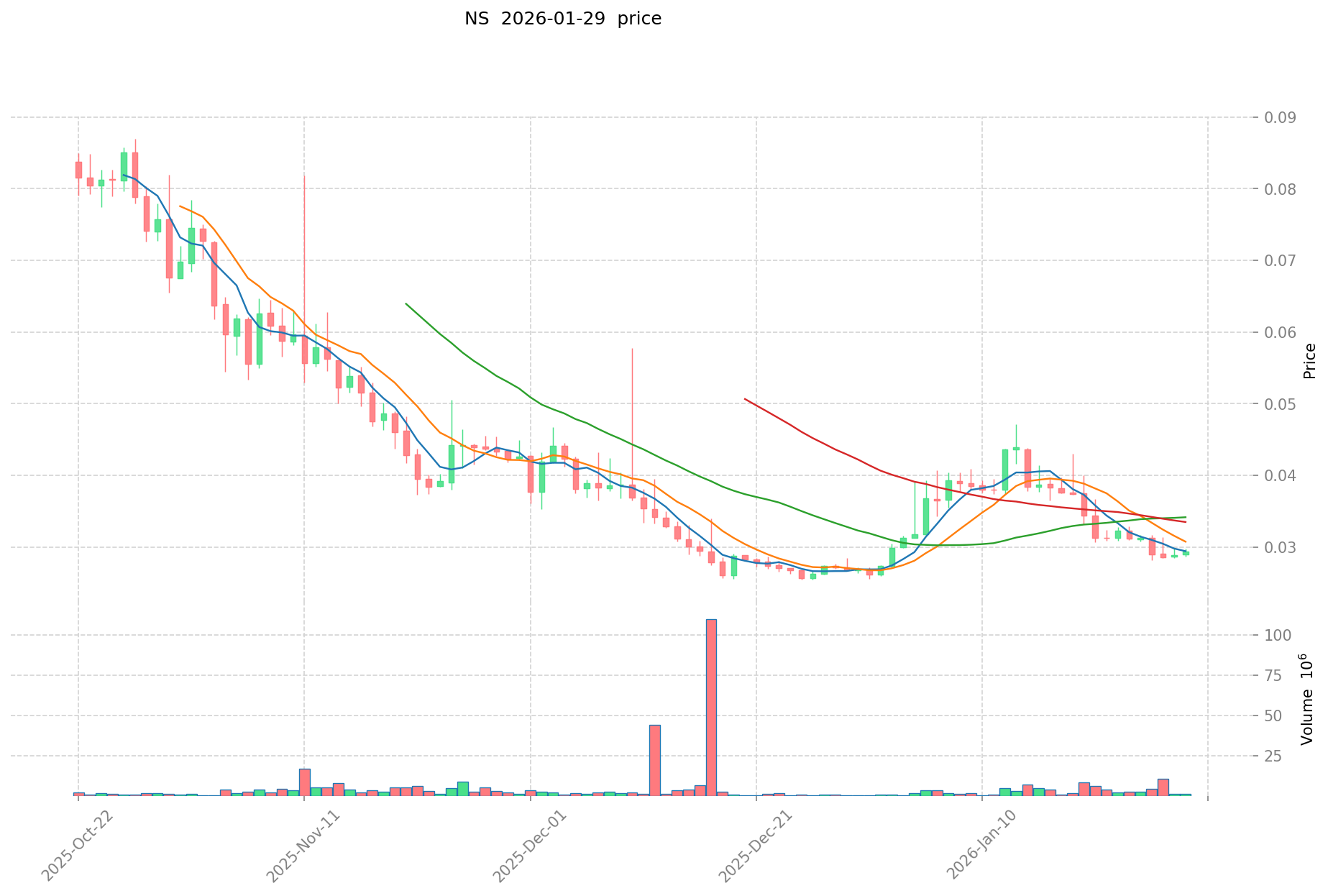
- 2024: NS experienced significant price movement following its launch in November 2024, with the price initially moving from a launch price of $0.09 and reaching a peak of $1.1936 on November 14, 2024.
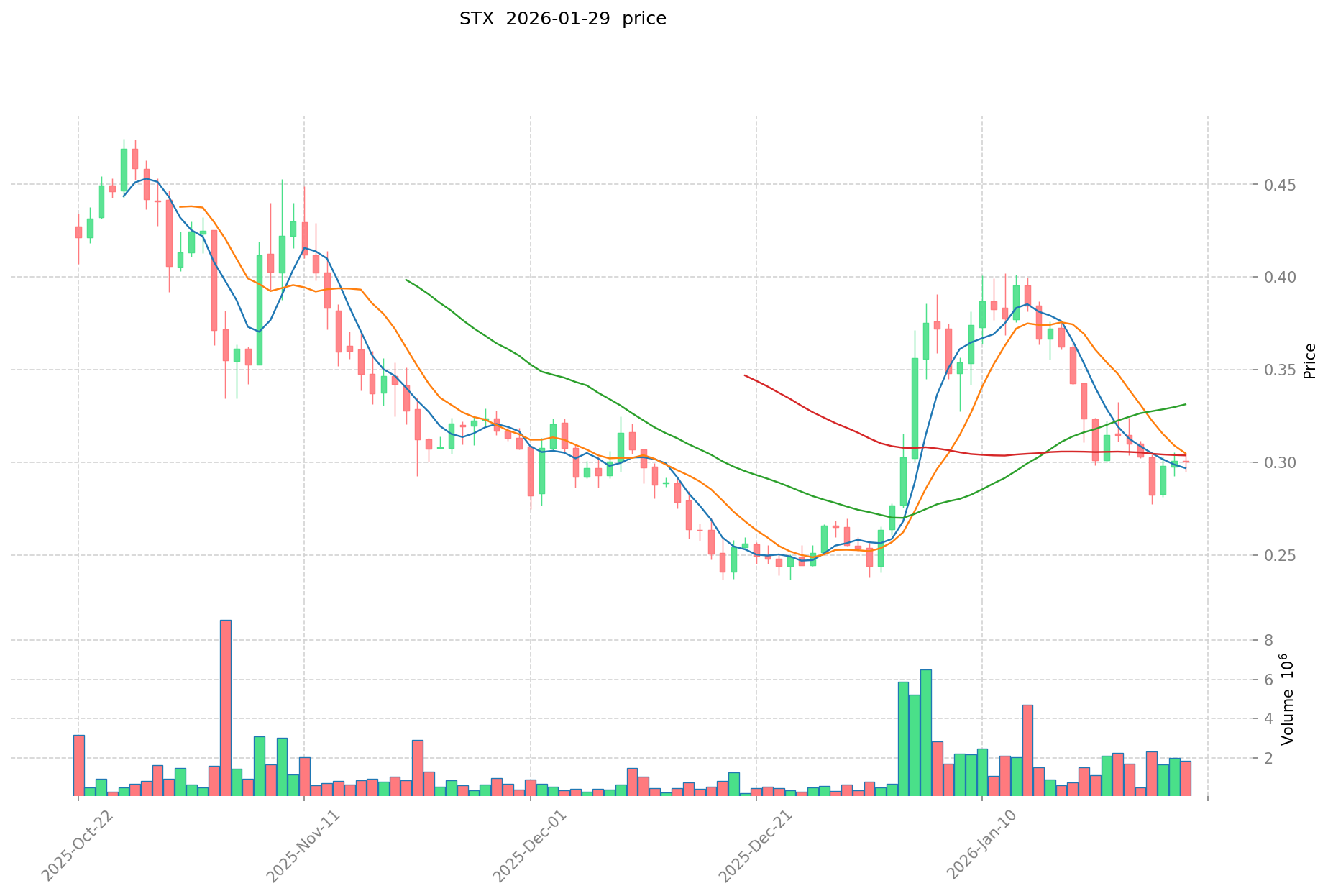
- 2024: STX was influenced by market cycles during the year, with its price reaching an all-time high of $3.86 on April 1, 2024.
- Comparative Analysis: During the recent market cycle, NS declined from its peak of $1.1936 to a current level of $0.02818, representing a decline of approximately 97.6%, while STX declined from its peak of $3.86 to $0.291, representing a decline of approximately 92.5%.
Current Market Status (2026-01-29)
- NS Current Price: $0.02818
- STX Current Price: $0.291
- 24-Hour Trading Volume: NS recorded $76,219 compared to STX's $517,811
- Market Sentiment Index (Fear & Greed Index): 26 (Fear)
View Real-Time Prices:
II. Core Factors Influencing NS vs STX Investment Value
Based on available information, a comprehensive comparison framework can be established:
Supply Mechanism Comparison (Tokenomics)
- NS: Specific supply mechanism details are not available in the reference materials
- STX: Token supply structure and distribution mechanisms require further investigation
- 📌 Historical Pattern: Supply mechanisms typically drive price cycles through scarcity dynamics and emission schedules
Institutional Adoption and Market Applications
- Institutional Holdings: Comparative institutional interest levels require additional market data
- Enterprise Adoption: Applications in cross-border payments, settlements, and investment portfolios need further analysis
- National Policies: Regulatory attitudes toward both assets vary across jurisdictions and evolve continuously
Technical Development and Ecosystem Building
- NS Technical Progress: Development roadmap and ecosystem expansion details are limited in current materials
- STX Technical Evolution: Smart contract capabilities and Bitcoin Layer 2 functionalities represent key differentiators
- Ecosystem Comparison: DeFi integration, NFT applications, payment systems, and smart contract deployment require detailed evaluation
Macroeconomic Environment and Market Cycles
- Inflation Hedge Properties: Performance characteristics during inflationary periods depend on adoption rates and market positioning
- Macro Monetary Policy: Interest rate movements and dollar index fluctuations affect both assets differently based on use cases
- Geopolitical Factors: Cross-border transaction demand and international developments influence adoption trajectories
III. 2026-2031 Price Forecast: NS vs STX
Short-term Forecast (2026)
- NS: Conservative $0.0164-$0.0282 | Optimistic $0.0282-$0.0361
- STX: Conservative $0.2762-$0.2907 | Optimistic $0.2907-$0.3663
Mid-term Forecast (2028-2029)
- NS may enter a gradual growth phase, with estimated price range of $0.0270-$0.0495
- STX may enter a consolidation phase, with estimated price range of $0.2009-$0.4202
- Key drivers: institutional capital inflows, ETF developments, ecosystem expansion
Long-term Forecast (2030-2031)
- NS: Baseline scenario $0.0320-$0.0571 | Optimistic scenario $0.0461-$0.0842
- STX: Baseline scenario $0.2126-$0.4504 | Optimistic scenario $0.3513-$0.5765
View detailed price predictions for NS and STX
Disclaimer
NS:
| Year |
Predicted High Price |
Predicted Average Price |
Predicted Low Price |
Price Change |
| 2026 |
0.0361472 |
0.02824 |
0.0163792 |
0 |
| 2027 |
0.046358784 |
0.0321936 |
0.0241452 |
14 |
| 2028 |
0.04948800192 |
0.039276192 |
0.029457144 |
39 |
| 2029 |
0.0470450227776 |
0.04438209696 |
0.0270730791456 |
57 |
| 2030 |
0.068113204204512 |
0.0457135598688 |
0.03199949190816 |
62 |
| 2031 |
0.08423180541425 |
0.056913382036656 |
0.046099839449691 |
101 |
STX:
| Year |
Predicted High Price |
Predicted Average Price |
Predicted Low Price |
Price Change |
| 2026 |
0.366282 |
0.2907 |
0.276165 |
0 |
| 2027 |
0.35477028 |
0.328491 |
0.20037951 |
12 |
| 2028 |
0.4202056872 |
0.34163064 |
0.2664718992 |
17 |
| 2029 |
0.392345708508 |
0.3809181636 |
0.300925349244 |
30 |
| 2030 |
0.51422047495182 |
0.386631936054 |
0.2126475648297 |
32 |
| 2031 |
0.576545543043724 |
0.45042620550291 |
0.351332440292269 |
54 |
IV. Investment Strategy Comparison: NS vs STX
Long-term vs Short-term Investment Strategies
- NS: May appeal to investors focusing on digital identity infrastructure and emerging blockchain utility cases, though limited historical data suggests higher uncertainty in performance projections
- STX: May suit investors seeking exposure to Bitcoin Layer 2 development and smart contract platforms with established market presence since 2019
Risk Management and Asset Allocation
- Conservative Investors: NS 20-30% vs STX 70-80% allocation could balance exposure between emerging and established projects
- Aggressive Investors: NS 40-50% vs STX 50-60% allocation may provide higher risk-reward positioning across different market segments
- Hedging Tools: Stablecoin reserves, diversified crypto portfolio construction, and position sizing relative to total portfolio exposure
V. Potential Risk Comparison
Market Risks
- NS: Experienced approximately 97.6% decline from peak levels, reflecting volatility common to newer market entrants with limited trading history and lower liquidity ($76,219 24-hour volume)
- STX: Demonstrated approximately 92.5% decline from peak, indicating substantial volatility despite longer market presence and comparatively higher liquidity ($517,811 24-hour volume)
Technical Risks
- NS: Limited available information regarding network scalability, operational track record, and technical infrastructure maturity
- STX: Network performance dependencies on Bitcoin infrastructure, smart contract execution considerations, and ecosystem development progress
Regulatory Risks
- Evolving regulatory frameworks across jurisdictions may impact both assets differently based on their functional characteristics, with identity management solutions and Layer 2 platforms potentially subject to distinct compliance requirements
VI. Conclusion: Which Is the Better Buy?
📌 Investment Value Summary
- NS Characteristics: Represents exposure to digital identity management within blockchain ecosystems, launched in 2024 with developing market presence
- STX Characteristics: Offers participation in Bitcoin Layer 2 development and decentralized application infrastructure with operational history since 2019
✅ Investment Considerations
- New Investors: Consider beginning with established assets demonstrating longer operational history and higher liquidity levels while researching fundamental differences between projects
- Experienced Investors: May evaluate portfolio diversification across different blockchain utility categories while applying risk management through position sizing and stablecoin reserves
- Institutional Investors: Assess alignment with investment mandates, liquidity requirements, custody solutions, and regulatory compliance frameworks for each asset category
⚠️ Risk Disclosure: Cryptocurrency markets demonstrate significant volatility. This analysis does not constitute investment advice. Conduct independent research and consult qualified financial advisors before making investment decisions.
VII. FAQ
Q1: What are the main differences between NS and STX in terms of market positioning?
NS (SuiNS) functions as a digital identity management solution within blockchain ecosystems, launched in November 2024, while STX (Stacks) operates as a Bitcoin Layer 2 platform for decentralized applications with smart contract capabilities, operational since 2019. The fundamental distinction lies in their core utilities: NS focuses on digital identity infrastructure enabling users to manage, transfer, and secure their identities with privacy controls, whereas STX provides smart contract functionality through its Clarity programming language aimed at building distributed application infrastructure. Additionally, STX demonstrates significantly higher market liquidity with 24-hour trading volume of $517,811 compared to NS's $76,219, reflecting STX's longer market presence and more established ecosystem.
Q2: How have NS and STX performed during recent market downturns?
Both assets experienced substantial declines from their respective peak prices, with NS declining approximately 97.6% from its November 2024 peak of $1.1936 to the current price of $0.02818, while STX declined approximately 92.5% from its April 2024 all-time high of $3.86 to $0.291. NS's steeper decline reflects characteristics common to newly launched assets with limited trading history and lower liquidity, whereas STX's decline, though significant, demonstrates relatively more established price discovery mechanisms due to its longer operational history since 2019. The current market sentiment index of 26 (Fear) indicates broader market apprehension affecting both assets, though their distinct utility categories and liquidity profiles result in different volatility patterns.
Q3: What are the projected price ranges for NS and STX through 2031?
Short-term forecasts for 2026 project NS within a conservative range of $0.0164-$0.0282 and optimistic range of $0.0282-$0.0361, while STX ranges from $0.2762-$0.2907 (conservative) to $0.2907-$0.3663 (optimistic). Long-term projections for 2031 estimate NS baseline scenario of $0.0320-$0.0571 with optimistic scenario reaching $0.0461-$0.0842, compared to STX's baseline scenario of $0.2126-$0.4504 and optimistic scenario of $0.3513-$0.5765. These projections incorporate factors including institutional capital inflows, ecosystem expansion, and potential ETF developments, though actual performance will depend on market cycles, technological adoption rates, and macroeconomic conditions. Investors should note that cryptocurrency forecasts contain substantial uncertainty and should not be interpreted as guaranteed outcomes.
Q4: Which asset presents lower investment risk for new cryptocurrency investors?
STX generally presents relatively lower risk characteristics for new investors based on several observable factors: longer operational history since 2019 providing more extensive price performance data, higher trading volume ($517,811 vs. $76,219) indicating better liquidity for entry and exit positions, and more established ecosystem infrastructure. NS, launched in November 2024, carries higher uncertainty associated with newer market entrants including limited historical performance data, lower liquidity levels, and developing ecosystem maturity. However, risk assessment extends beyond these factors to include individual investor circumstances, portfolio diversification strategies, and investment timeframes. New investors should consider beginning with smaller position sizes, implementing risk management through stablecoin reserves, and conducting thorough independent research before committing capital to either asset.
Q5: How do NS and STX differ in their technological infrastructure and development focus?
STX operates as a Bitcoin Layer 2 solution implementing smart contract functionality through its Clarity programming language, enabling developers to build decentralized applications while leveraging Bitcoin's security infrastructure. This positioning focuses on creating distributed application infrastructure with emphasis on Bitcoin ecosystem integration. NS concentrates on digital identity management within blockchain environments, enabling users to control, transfer, and update their digital identities while maintaining privacy. The technological distinction reflects different utility categories: STX addresses programmability and application development requirements, while NS targets identity infrastructure needs. However, detailed technical specifications for NS's implementation mechanisms remain limited in current reference materials, whereas STX benefits from longer operational history providing more extensive documentation of its technical architecture and ecosystem development progress.
Q6: What allocation strategies might investors consider when comparing NS and STX?
Conservative investors might consider a 20-30% NS allocation versus 70-80% STX allocation to balance exposure between emerging digital identity infrastructure and established Bitcoin Layer 2 platforms, prioritizing STX's longer operational history and higher liquidity. Aggressive investors seeking higher risk-reward positioning might allocate 40-50% to NS and 50-60% to STX, accepting greater exposure to newer market entrants while maintaining substantial positioning in more established assets. These allocation frameworks should be adjusted based on individual risk tolerance, investment timeframes, portfolio size, and overall cryptocurrency exposure relative to total investment portfolios. All allocation strategies should incorporate risk management tools including stablecoin reserves for opportunistic rebalancing, diversification across multiple blockchain utility categories, and position sizing that reflects each investor's capacity to absorb potential volatility and drawdowns.
Q7: What regulatory considerations distinguish NS and STX investment profiles?
NS's focus on digital identity management may subject it to evolving regulatory frameworks concerning privacy protection, data management, and identity verification systems, which vary significantly across jurisdictions and continue developing as governments establish cryptocurrency oversight mechanisms. STX's positioning as a Bitcoin Layer 2 platform with smart contract capabilities may encounter regulatory considerations related to securities classifications, decentralized application oversight, and cryptocurrency derivatives depending on specific implementations and jurisdictional interpretations. Both assets face ongoing regulatory uncertainty as global frameworks continue evolving, though their distinct functional characteristics—identity infrastructure versus application platform—may result in different compliance requirements and regulatory treatment. Investors should monitor regulatory developments in their relevant jurisdictions and consider consulting qualified legal advisors regarding specific regulatory implications before establishing positions in either asset.
Q8: What factors should institutional investors prioritize when evaluating NS versus STX?
Institutional investors should assess several critical factors: liquidity requirements favoring STX's higher trading volume ($517,811) over NS ($76,219) for significant position building and liquidation; operational history with STX's five-year track record since 2019 providing more extensive performance data compared to NS's recent November 2024 launch; custody solutions availability and institutional-grade security infrastructure for each asset; regulatory compliance frameworks including securities classification considerations and jurisdictional requirements; alignment with investment mandates distinguishing between digital identity infrastructure exposure (NS) and Bitcoin Layer 2 application platform participation (STX); and portfolio construction strategies considering correlation with existing holdings, diversification objectives, and risk management protocols. Additionally, institutional investors should evaluate technical due diligence requirements, ecosystem maturity indicators, and long-term sustainability assessments while ensuring compliance with fiduciary responsibilities and internal investment policy guidelines.
* The information is not intended to be and does not constitute financial advice or any other recommendation of any sort offered or endorsed by Gate.