This comprehensive guide compares Numbers Protocol (NUM) and Cardano (ADA), two distinct blockchain ecosystems serving different investment profiles. NUM operates as a decentralized photo network for digital media authentication with current price of $0.008513, while ADA functions as established blockchain infrastructure for financial applications priced at $0.3493. The article analyzes historical price performance, supply mechanisms, institutional adoption, and technical ecosystems to address investor concerns. ADA demonstrates higher liquidity ($2,526,999.79 daily volume) and broader ecosystem development with 1,300+ projects, making it suitable for conservative investors seeking infrastructure exposure. NUM presents speculative potential for experienced investors willing to tolerate niche market positioning and 99.7% historical volatility. Coverage includes 2026-2031 price predictions, risk comparisons, and tailored investment strategies on Gate, concluding with actionable recommendations for novice and in
Introduction: Investment Comparison Between NUM and ADA
In the cryptocurrency market, the comparison between Numbers Protocol (NUM) and Cardano (ADA) represents a noteworthy topic for investors. These two digital assets demonstrate distinct differences in market capitalization ranking, application scenarios, and price performance, representing different positioning within the crypto asset landscape.
Numbers Protocol (NUM): A decentralized photo network launched to create community, value, and trust for digital media. As the native token of this network, NUM enables users to purchase, transfer, register copyrights, and perform various operations for images and videos.
Cardano (ADA): Launched in October 2017, Cardano has been recognized as a technology platform capable of running financial applications used by individuals, organizations, and governments worldwide. The platform is built in layers, providing flexibility for maintenance and allowing upgrades through soft forks.
This article will provide a comprehensive analysis of the investment value comparison between NUM and ADA, covering historical price trends, supply mechanisms, institutional adoption, technical ecosystems, and future predictions, attempting to address investors' most pressing question:
"Which is the better buy right now?"
I. Historical Price Comparison and Current Market Status
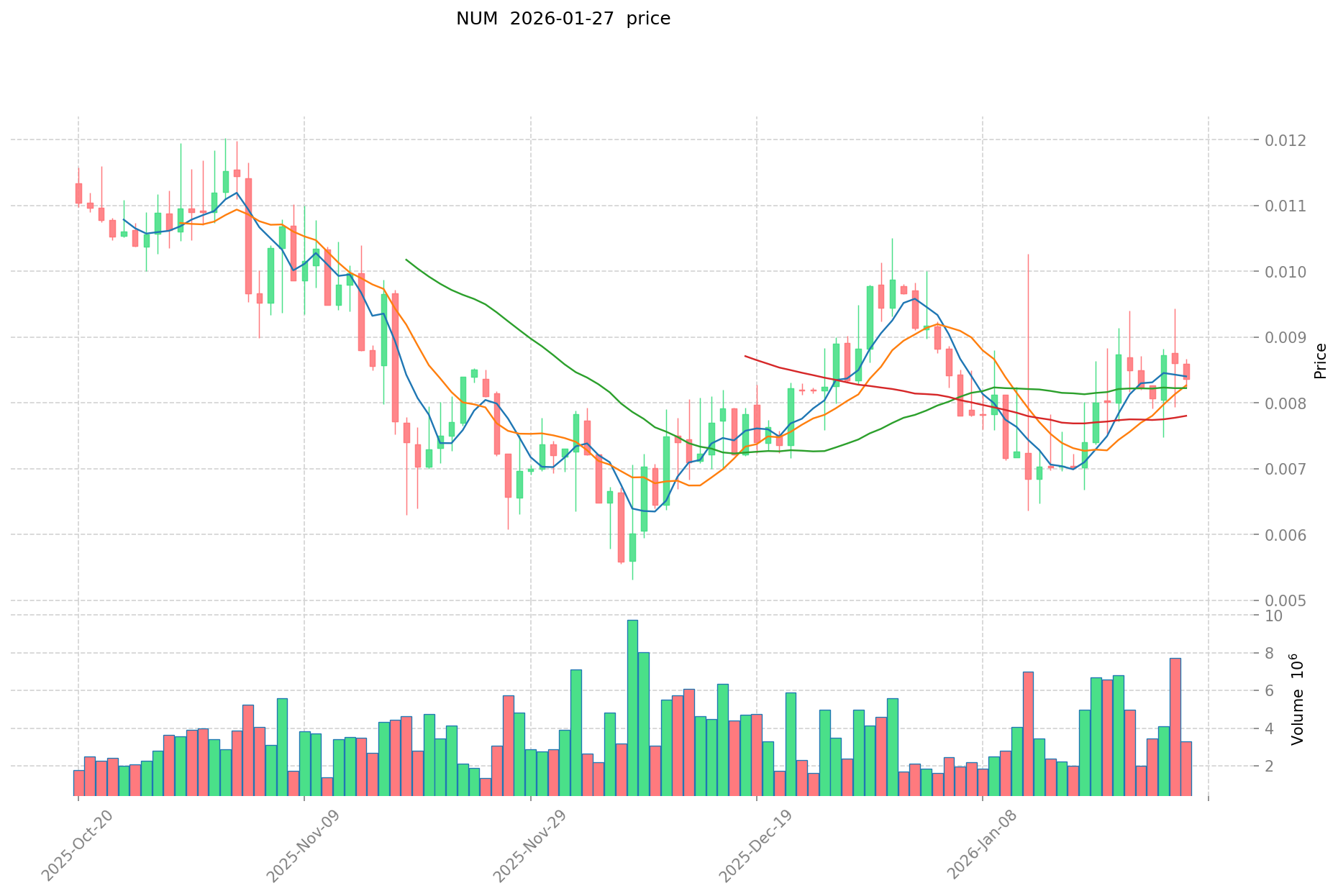
NUM (Coin A) and ADA (Coin B) Historical Price Trends
- 2021: NUM reached its historical high of $2.52 on November 28, 2021, reflecting early market enthusiasm. ADA also peaked at $3.09 on September 2, 2021, driven by significant protocol developments and broader market momentum.
- 2020-2025: NUM experienced substantial volatility, declining from its peak to a historical low of $0.00532095 on December 8, 2025. During this period, ADA demonstrated relative resilience, though it also faced downward pressure, reaching a historical low of $0.01925275 on March 13, 2020.
- Comparative Analysis: Throughout the recent market cycle, NUM declined approximately 99.7% from its high to its low, while ADA showed a comparatively smaller decline of approximately 99.4% from peak to trough, suggesting different market dynamics and project fundamentals.
Current Market Status (2026-01-27)
- NUM Current Price: $0.008513
- ADA Current Price: $0.3493
- 24-Hour Trading Volume: NUM recorded $47,272.62 vs ADA's $2,526,999.79, indicating significantly higher liquidity for ADA
- Market Sentiment Index (Fear & Greed Index): 29 (Fear)
View real-time prices:

II. Core Factors Influencing NUM vs ADA Investment Value
Supply Mechanism Comparison (Tokenomics)
- ADA: Fixed maximum supply of 45 billion tokens with a current circulating supply of approximately 36 billion ADA. The token employs a Proof-of-Stake (PoS) consensus mechanism where staking rewards are distributed to network participants.
- 📌 Historical Pattern: The fixed supply model creates potential scarcity dynamics as circulation approaches maximum supply, while staking mechanisms influence token velocity and holder behavior.
Institutional Adoption and Market Applications
- Institutional Holdings: Reference materials indicate discussions around potential inclusion of Cardano in strategic cryptocurrency reserves, which could influence institutional adoption patterns.
- Enterprise Adoption: ADA serves multiple functions including transaction fee payments, staking participation, and governance voting within the Cardano ecosystem. The platform targets applications in cross-border financial services and decentralized finance.
- Regulatory Landscape: Different jurisdictions maintain varying approaches toward cryptocurrency regulation, with monitoring policies evolving across regions.
Technical Development and Ecosystem Building
- ADA Technical Development: Cardano utilizes the Ouroboros Proof-of-Stake consensus algorithm, which emphasizes energy efficiency compared to Proof-of-Work systems. The platform implements a dual-layer architecture separating settlement and computation functions.
- Ecosystem Status: Over 1,300 projects are reportedly building on the Cardano platform. The ecosystem encompasses DeFi applications with growing Total Value Locked (TVL), smart contract functionality, and governance mechanisms through Project Catalyst.
- Community Governance: ADA holders can participate in platform governance through proposal submissions and voting, contributing to protocol evolution and resource allocation.
Macroeconomic Environment and Market Cycles
- Inflation Context: Digital assets demonstrate varying responses to inflationary environments, influenced by their positioning as alternative stores of value versus utility tokens.
- Monetary Policy Impact: Rising interest rates and strengthening dollar conditions typically reduce appetite for risk assets including cryptocurrencies, while accommodative monetary policies tend to support such assets.
- Market Dynamics: Technical indicators including trading volume, market capitalization, and price movements inform analysis. Community support, social sentiment, and development progress influence market perception and valuation trends.
III. 2026-2031 Price Prediction: NUM vs ADA
Short-term Prediction (2026)
- NUM: Conservative $0.00816 - $0.00850 | Optimistic $0.01249
- ADA: Conservative $0.273 - $0.350 | Optimistic $0.504
Mid-term Prediction (2028-2029)
- NUM may enter a consolidation phase, with projected price range of $0.00785 - $0.01454
- ADA may enter an expansion phase, with projected price range of $0.302 - $0.733
- Key drivers: institutional capital inflows, ETF developments, ecosystem growth
Long-term Prediction (2031)
- NUM: Base scenario $0.0104 - $0.0158 | Optimistic scenario $0.0214
- ADA: Base scenario $0.592 - $0.688 | Optimistic scenario $0.819
View detailed price predictions for NUM and ADA
Disclaimer
NUM:
| Year |
Predicted High Price |
Predicted Average Price |
Predicted Low Price |
Price Change |
| 2026 |
0.01249206 |
0.008498 |
0.00815808 |
0 |
| 2027 |
0.0122791851 |
0.01049503 |
0.0074514713 |
23 |
| 2028 |
0.012070334003 |
0.01138710755 |
0.0078571042095 |
33 |
| 2029 |
0.01454361376286 |
0.0117287207765 |
0.010673135906615 |
37 |
| 2030 |
0.018521995850248 |
0.01313616726968 |
0.012216635560802 |
54 |
| 2031 |
0.021369260105951 |
0.015829081559964 |
0.010447193829576 |
85 |
ADA:
| Year |
Predicted High Price |
Predicted Average Price |
Predicted Low Price |
Price Change |
| 2026 |
0.503712 |
0.3498 |
0.272844 |
0 |
| 2027 |
0.54624768 |
0.426756 |
0.37554528 |
22 |
| 2028 |
0.583802208 |
0.48650184 |
0.3016311408 |
39 |
| 2029 |
0.73315827288 |
0.535152024 |
0.32644273464 |
53 |
| 2030 |
0.7419615236748 |
0.63415514844 |
0.5326903246896 |
81 |
| 2031 |
0.818789419908306 |
0.6880583360574 |
0.591730169009364 |
97 |
IV. Investment Strategy Comparison: NUM vs ADA
Long-term vs Short-term Investment Strategies
- NUM: May suit investors focused on niche applications in digital media authentication and copyright management, with tolerance for higher volatility and smaller market capitalization exposure. The asset's historical price patterns suggest substantial risk alongside speculative potential.
- ADA: May suit investors seeking exposure to established blockchain infrastructure with broader ecosystem development, decentralized finance applications, and institutional adoption narratives. The platform's technical architecture and governance mechanisms target longer-term utility.
Risk Management and Asset Allocation
- Conservative Investors: NUM 5-10% vs ADA 15-20% (within overall crypto allocation)
- Aggressive Investors: NUM 15-20% vs ADA 25-35% (within overall crypto allocation)
- Hedging Instruments: Stablecoin positions for rebalancing opportunities, diversification across multiple blockchain ecosystems, periodic profit-taking mechanisms
V. Potential Risk Comparison
Market Risks
- NUM: Lower liquidity with 24-hour trading volume of $47,272.62 may result in higher price slippage and difficulty executing larger positions. The asset experienced approximately 99.7% decline from historical peak, indicating susceptibility to market sentiment shifts.
- ADA: While demonstrating higher liquidity ($2,526,999.79 daily volume), the asset remains exposed to broader cryptocurrency market cycles and sentiment fluctuations. The correlation with macro risk-on/risk-off dynamics influences price movements.
Technical Risks
- NUM: Limited ecosystem visibility and adoption metrics create uncertainty around sustained network usage and token utility. Smaller developer community may impact protocol maintenance and innovation pace.
- ADA: Network scalability under increasing transaction loads, smart contract execution efficiency, and interoperability with other blockchain systems represent ongoing technical considerations. The dual-layer architecture introduces complexity requiring continuous optimization.
Regulatory Risks
- Evolving regulatory frameworks across jurisdictions may impact both assets differently based on their classification and use cases. Digital media authentication protocols (NUM) and financial infrastructure platforms (ADA) face distinct regulatory scrutiny. Policy developments around staking mechanisms, securities classification, and cross-border transactions influence operational parameters.
VI. Conclusion: Which Is the Better Buy?
📌 Investment Value Summary:
- NUM Characteristics: Specialized focus on digital media authentication with niche market positioning, higher volatility profile, lower market capitalization providing speculative upside potential alongside substantial downside risk
- ADA Characteristics: Established blockchain infrastructure with broader ecosystem development (1,300+ projects), governance participation mechanisms, institutional consideration for strategic allocations, Proof-of-Stake consensus offering staking yield opportunities
✅ Investment Considerations:
- Novice Investors: Consider ADA for initial cryptocurrency exposure due to higher liquidity, established ecosystem, and broader information availability. Limit position sizing to manageable portfolio percentages aligned with risk tolerance.
- Experienced Investors: Evaluate both assets within diversified cryptocurrency portfolios, considering NUM's speculative characteristics against ADA's infrastructure positioning. Apply technical analysis and fundamental research to inform allocation decisions.
- Institutional Participants: ADA demonstrates characteristics potentially aligning with institutional allocation criteria including liquidity depth, governance frameworks, and ecosystem maturity. NUM represents higher-risk exposure suitable for venture-style positioning.
⚠️ Risk Disclosure: Cryptocurrency markets exhibit extreme volatility with potential for total capital loss. This content does not constitute investment advice, financial recommendations, or solicitation for trading activities. Conduct independent research and consult qualified financial advisors before making investment decisions.
VII. FAQ
Q1: What is the fundamental difference between NUM and ADA in terms of their use cases?
NUM focuses specifically on digital media authentication and copyright management as a decentralized photo network, while ADA serves as the native token for Cardano, a comprehensive blockchain platform designed for financial applications and smart contracts. NUM targets a niche market in content verification and creator rights, whereas ADA positions itself as broad infrastructure for decentralized finance, cross-border payments, and enterprise applications with over 1,300 projects building on its ecosystem.
Q2: Why does ADA have significantly higher trading volume compared to NUM?
ADA's 24-hour trading volume of $2,526,999.79 vastly exceeds NUM's $47,272.62 due to several factors: ADA's establishment since October 2017 has built substantial market recognition, its listing on major exchanges provides greater accessibility, and its positioning as layer-1 infrastructure attracts broader institutional and retail participation. NUM's specialized focus on digital media creates a narrower user base, resulting in lower liquidity and potentially higher price slippage for larger transactions.
Q3: How does the staking mechanism in ADA affect its investment characteristics?
ADA's Proof-of-Stake consensus mechanism allows token holders to stake their assets and earn rewards while participating in network security, creating an additional yield component beyond price appreciation. This staking functionality reduces circulating supply as tokens are locked for validation, potentially creating scarcity dynamics. The mechanism also encourages longer holding periods among participants seeking staking rewards, which may reduce selling pressure during market downturns compared to non-stakeable assets.
Q4: Which asset experienced a larger percentage decline from its historical peak?
NUM experienced approximately 99.7% decline from its peak of $2.52 to its low of $0.00532095, while ADA declined approximately 99.4% from $3.09 to $0.01925275. Though both suffered severe drawdowns, NUM's slightly larger percentage decline reflects its smaller market capitalization and lower liquidity, which amplify volatility in both directions. The magnitude of these declines underscores the extreme risk inherent in cryptocurrency investments and the importance of position sizing.
Q5: What role does governance play in the ADA ecosystem?
ADA holders participate in platform governance through Project Catalyst, where they can submit proposals for ecosystem development and vote on resource allocation decisions. This governance mechanism allows the community to influence protocol evolution, funding priorities, and technical roadmap decisions. Governance participation provides token utility beyond transactional purposes and creates stakeholder alignment between holders and long-term platform success, though it also introduces complexity in decision-making processes.
Q6: How should investors interpret the 2031 price predictions for NUM and ADA?
The 2031 predictions show NUM ranging from $0.0104 to $0.0214 (optimistic) and ADA ranging from $0.592 to $0.819 (optimistic). These projections assume continued ecosystem development, adoption growth, and favorable macroeconomic conditions. However, cryptocurrency price predictions carry substantial uncertainty due to market volatility, regulatory changes, technological disruptions, and competition. Investors should treat these figures as scenario analyses rather than guaranteed outcomes and maintain risk management protocols regardless of prediction frameworks.
Q7: What are the primary regulatory risks differentiating NUM from ADA?
NUM's focus on digital media authentication may face intellectual property regulations, content moderation requirements, and data privacy frameworks as jurisdictions develop policies around blockchain-based copyright systems. ADA faces financial services regulation given its positioning for payments and DeFi applications, including securities classification debates around staking mechanisms and potential requirements for transaction monitoring. Both assets face general cryptocurrency regulatory uncertainty, but their distinct use cases expose them to different regulatory domains and compliance obligations.
Q8: Why might NUM suit a different investor profile than ADA?
NUM may attract investors specifically interested in the digital media authentication sector with higher risk tolerance for speculative positions in emerging niches, accepting lower liquidity and greater volatility for potential asymmetric returns. ADA may suit investors seeking exposure to established blockchain infrastructure with broader ecosystem validation, preferring higher liquidity for position management and additional yield opportunities through staking. The choice reflects preferences between specialized sector bets (NUM) versus foundational platform exposure (ADA) within diversified cryptocurrency portfolios.
* The information is not intended to be and does not constitute financial advice or any other recommendation of any sort offered or endorsed by Gate.