This comprehensive comparison evaluates NUM and THETA tokens across market performance, technical fundamentals, and investment potential. NUM ranks 1354th with a $7.26 million market cap, positioning itself as a decentralized photo network for digital media copyright. THETA ranks 191st with $265 million market cap, operating as an established decentralized video streaming platform since December 2017. The article analyzes historical price trajectories, supply mechanisms, institutional adoption patterns, and ecosystem development while examining tokenomics and market applications. Investment strategies address conservative to aggressive profiles, with THETA offering superior liquidity ($174,245.16 daily) and stability, while NUM presents early-stage growth potential. Risk assessments cover market volatility, technical infrastructure challenges, and regulatory considerations. Based on current market conditions and comparative metrics, the analysis provides tailored recommendations for novice, experienced, and i
Introduction: Investment Comparison Between NUM and THETA
In the cryptocurrency market, the comparison between NUM vs THETA has become a topic of interest for investors. The two tokens differ significantly in market cap ranking, application scenarios, and price performance, representing distinct positioning within the crypto asset landscape.
NUM (Numbers Protocol): Launched as a decentralized photo network, NUM aims to create community, value, and trust for digital media. The token serves as the native asset for its decentralized photo network, enabling users to buy, gift, register copyrights, and perform various operations with their images and videos.
THETA (Theta Network): Since its launch in December 2017, THETA has been positioned as a next-generation decentralized video streaming platform built on native blockchain technology. The platform incentivizes content viewers who share bandwidth with THETA token rewards, providing high-definition streaming content while reducing video distribution costs.
This article will analyze the investment value comparison between NUM vs THETA across multiple dimensions including historical price trends, supply mechanisms, adoption patterns, technological ecosystems, and future outlook, attempting to address investors' most pressing question:
"Which token presents a more compelling investment case based on current market conditions?"
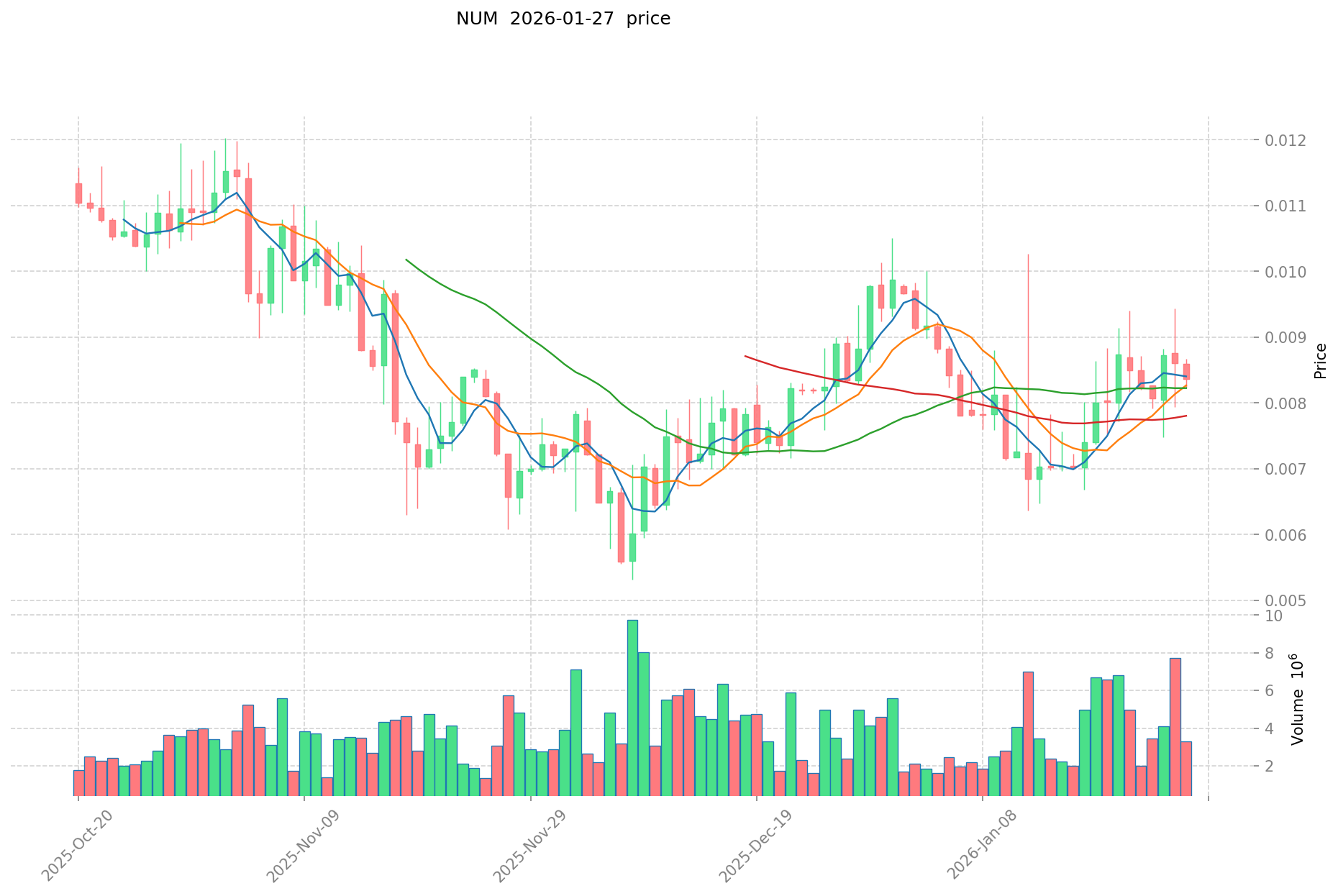
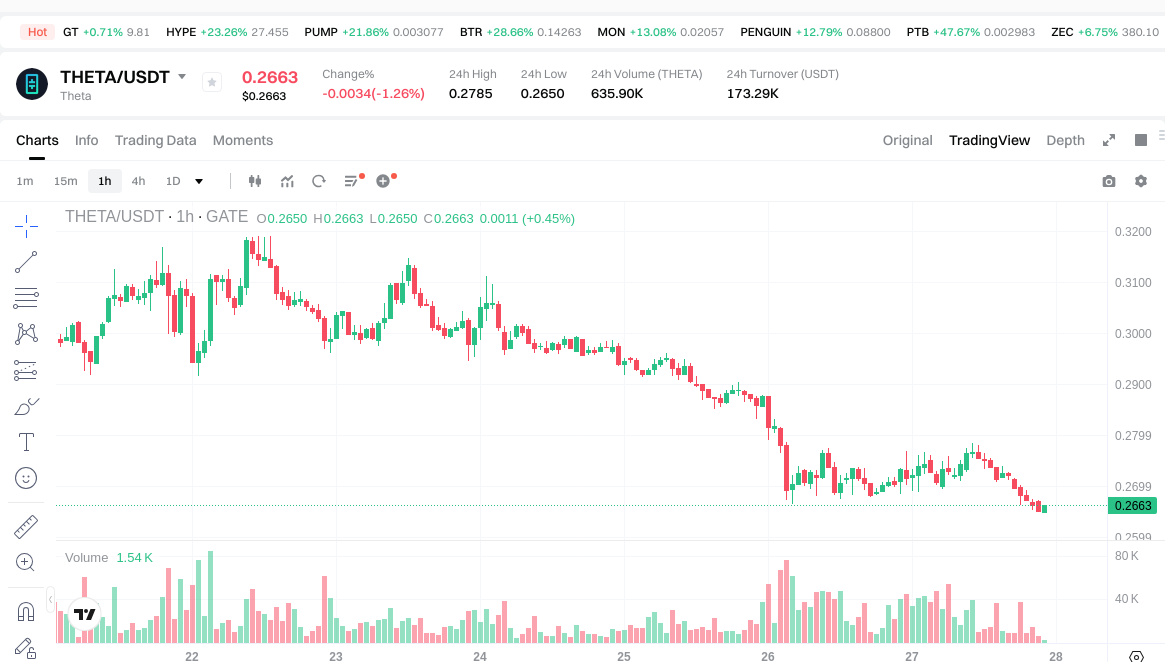
As of January 27, 2026, NUM ranks 1354th with a market cap of approximately 7.26 million USD, while THETA holds the 191st position with a market cap of 265 million USD. Both tokens have experienced notable price fluctuations, with NUM showing a 1-year decline of 79.66% and THETA experiencing an 86.28% decrease over the same period. Understanding these contrasting trajectories and underlying fundamentals is essential for informed investment decision-making.
I. Historical Price Comparison and Current Market Status
NUM (Coin A) and THETA (Coin B) Historical Price Trends
- 2021: NUM recorded its all-time high of $2.52 on November 28, 2021, reflecting peak market enthusiasm during the broader cryptocurrency bull cycle.
- 2021: THETA reached its historical peak of $15.72 on April 16, 2021, driven by growing adoption of decentralized video streaming solutions.
- Comparative Analysis: During the bear market cycle from 2021 to 2025, NUM declined from its high of $2.52 to a low of $0.00532095 (recorded on December 8, 2025), representing a substantial correction. Meanwhile, THETA experienced a decline from $15.72 to $0.04039979 (recorded on March 13, 2020), with both assets facing similar market pressures.
Current Market Status (January 27, 2026)
- NUM current price: $0.008277
- THETA current price: $0.265
- 24-hour trading volume: NUM $46,686.97 vs THETA $174,245.16
- Market Sentiment Index (Fear & Greed Index): 29 (Fear)
Click to view real-time prices:
II. Core Factors Influencing NUM vs THETA Investment Value
Supply Mechanism Comparison (Tokenomics)
Based on available materials, the investment value analysis of NUM and THETA primarily centers on options trading Greeks rather than cryptocurrency tokenomics. The reference materials focus on Theta as a Greek letter measuring time decay in options pricing, rather than discussing supply mechanisms of digital assets.
- Theta Factor: Represents the time decay component in options valuation, measuring how option value diminishes as expiration approaches
- Implied Volatility Impact: Affects both intrinsic and time value components of option pricing structures
- 📌 Historical Pattern: Time decay accelerates as options approach expiration, particularly following events that reduce implied volatility
Institutional Adoption and Market Applications
The materials provided focus on options trading mechanics rather than institutional cryptocurrency adoption patterns. Key applications identified relate to derivatives markets:
- Trading Strategy Deployment: Risk management through time decay capture and volatility positioning
- Market Participant Usage: Implementation across income generation strategies and hedging frameworks
- Regulatory Framework: Options markets operate within established derivatives regulations across multiple jurisdictions
Technical Development and Ecosystem Construction
The reference materials emphasize options pricing models and Greek risk parameters rather than blockchain technology development:
- Pricing Model Evolution: Black-Scholes model, Binomial model, and Monte Carlo simulation methodologies inform valuation frameworks
- Greek Risk Parameters: Delta, Gamma, Theta, Vega, and Rho collectively describe sensitivity to various market factors
- Ecosystem Application: Options strategies span portfolio hedging, income generation, and directional positioning across equity and derivatives markets
Macroeconomic Factors and Market Cycles
The materials address options pricing sensitivity to macroeconomic variables:
- Interest Rate Environment: Risk-free rate (Rho) affects options pricing, with varying impacts on calls versus puts
- Volatility Regimes: Market uncertainty drives implied volatility changes, significantly impacting options valuations through Vega exposure
- Market Event Response: Earnings announcements, economic releases, and geopolitical developments influence both time decay rates and volatility levels
III. 2026-2031 Price Prediction: NUM vs THETA
Short-term Forecast (2026)
- NUM: Conservative $0.004814 - $0.0083 | Optimistic $0.0083 - $0.009711
- THETA: Conservative $0.180812 - $0.2659 | Optimistic $0.2659 - $0.316421
Mid-term Forecast (2028-2029)
- NUM may enter a gradual growth phase, with projected price range of $0.0054321176 - $0.0106769208 in 2028 and $0.008317695932 - $0.010722812828 in 2029
- THETA may enter a consolidation and expansion phase, with projected price range of $0.30528178425 - $0.356162081625 in 2028 and $0.288576086611875 - $0.518046227773125 in 2029
- Key drivers: institutional capital inflows, ETF developments, ecosystem expansion
Long-term Forecast (2030-2031)
- NUM: Baseline scenario $0.00912741862032 - $0.010372066614 (2030), $0.009903249203047 - $0.01286136260136 (2031) | Optimistic scenario $0.01535065858872 (2030), $0.013890271609468 (2031)
- THETA: Baseline scenario $0.303004890942468 - $0.432864129917812 (2030), $0.292529578998457 - $0.471821901610415 (2031) | Optimistic scenario $0.510779673303018 (2030), $0.575622719964707 (2031)
View detailed price predictions for NUM and THETA
Disclaimer
This price prediction analysis is for informational purposes only and should not be considered as investment advice. Cryptocurrency markets are highly volatile and subject to various risks. Past performance and predictive models do not guarantee future results. Users should conduct their own research and consult with qualified financial advisors before making any investment decisions.
NUM:
| Year |
Predicted High Price |
Predicted Average Price |
Predicted Low Price |
Price Change |
| 2026 |
0.009711 |
0.0083 |
0.004814 |
0 |
| 2027 |
0.00972594 |
0.0090055 |
0.00468286 |
8 |
| 2028 |
0.0106769208 |
0.00936572 |
0.0054321176 |
13 |
| 2029 |
0.010722812828 |
0.0100213204 |
0.008317695932 |
21 |
| 2030 |
0.01535065858872 |
0.010372066614 |
0.00912741862032 |
25 |
| 2031 |
0.013890271609468 |
0.01286136260136 |
0.009903249203047 |
55 |
THETA:
| Year |
Predicted High Price |
Predicted Average Price |
Predicted Low Price |
Price Change |
| 2026 |
0.316421 |
0.2659 |
0.180812 |
0 |
| 2027 |
0.387243465 |
0.2911605 |
0.218370375 |
9 |
| 2028 |
0.356162081625 |
0.3392019825 |
0.30528178425 |
27 |
| 2029 |
0.518046227773125 |
0.3476820320625 |
0.288576086611875 |
31 |
| 2030 |
0.510779673303018 |
0.432864129917812 |
0.303004890942468 |
63 |
| 2031 |
0.575622719964707 |
0.471821901610415 |
0.292529578998457 |
77 |
IV. Investment Strategy Comparison: NUM vs THETA
Long-term vs Short-term Investment Strategies
- NUM: Suitable for investors focused on emerging digital media copyright solutions and early-stage ecosystem growth potential, with higher risk tolerance for nascent decentralized photo network applications
- THETA: Suitable for investors seeking exposure to established decentralized video streaming infrastructure with broader institutional recognition and market liquidity
Risk Management and Asset Allocation
- Conservative Investors: NUM 15-20% vs THETA 80-85%
- Aggressive Investors: NUM 40-50% vs THETA 50-60%
- Hedging Tools: Stablecoin allocation, options strategies, cross-asset portfolio diversification
V. Comparative Risk Analysis
Market Risks
- NUM: Higher volatility risk due to lower market capitalization ($7.26 million), limited trading volume ($46,686.97 daily), and ranking position (1354th), which may result in reduced liquidity and increased price sensitivity to market movements
- THETA: Moderate volatility exposure with mid-tier market capitalization ($265 million) and ranking (191st position), subject to broader video streaming sector sentiment and competitive pressures from alternative decentralized content delivery networks
Technical Risks
- NUM: Scalability challenges related to decentralized photo network infrastructure, network stability concerns during early adoption phases
- THETA: Network participation concentration risks, potential security vulnerabilities in bandwidth-sharing mechanisms, dependency on content viewer engagement for ecosystem sustainability
Regulatory Risks
- Global regulatory frameworks may impact both assets differently, with NUM facing potential copyright law compliance requirements across jurisdictions, while THETA may encounter content distribution regulations and data transmission policies that affect decentralized streaming operations
VI. Conclusion: Which Is the Better Buy?
📌 Investment Value Summary:
- NUM Advantages: Early-stage positioning in digital media copyright space, potential for growth as decentralized content authentication gains adoption, lower entry price point for speculative allocation
- THETA Advantages: Established market presence since December 2017, higher liquidity with $174,245.16 daily trading volume, broader ecosystem recognition in decentralized video streaming sector, mid-term price projections suggesting potential recovery trajectory
✅ Investment Recommendations:
- Novice Investors: Consider THETA for relative stability and established market positioning, limit exposure to 5-10% of portfolio with focus on dollar-cost averaging approach
- Experienced Investors: Evaluate balanced allocation between NUM (20-30%) and THETA (70-80%) based on risk appetite, with active monitoring of ecosystem developments and market sentiment indicators
- Institutional Investors: Prioritize THETA for infrastructure exposure while maintaining research focus on NUM's digital media authentication use cases for potential early-stage allocation opportunities
⚠️ Risk Warning: Cryptocurrency markets exhibit high volatility characteristics. This analysis does not constitute investment advice.
VII. FAQ
Q1: Which token has better liquidity - NUM or THETA?
THETA demonstrates significantly superior liquidity. As of January 27, 2026, THETA's daily trading volume reaches $174,245.16 compared to NUM's $46,686.97, representing nearly 3.7 times higher liquidity. This substantial difference stems from THETA's higher market capitalization ($265 million vs $7.26 million) and established market presence since December 2017. Higher liquidity reduces slippage risk and provides more efficient entry and exit opportunities for investors across various position sizes.
Q2: What are the primary use cases differentiating NUM from THETA?
NUM focuses on decentralized photo network infrastructure for digital media copyright authentication, enabling users to register copyrights, buy, and gift images and videos. THETA operates as a decentralized video streaming platform that incentivizes content viewers who share bandwidth with token rewards, reducing video distribution costs while providing high-definition streaming. The fundamental distinction lies in static media authentication (NUM) versus dynamic video content delivery (THETA), positioning them in complementary rather than directly competitive market segments.
Q3: Which token experienced greater price decline during the 2021-2025 bear market?
NUM experienced a more severe correction during this period. From its all-time high of $2.52 on November 28, 2021, NUM declined to $0.00532095 by December 8, 2025, representing a decline exceeding 99%. THETA declined from $15.72 on April 16, 2021, to $0.04039979 on March 13, 2020, showing substantial but comparatively less severe drawdown. This reflects NUM's higher volatility profile as a lower market cap asset and its earlier development stage compared to THETA's more established market position.
Q4: What portfolio allocation strategy is recommended for risk-conscious investors?
Conservative investors should consider an allocation weighted 80-85% toward THETA and 15-20% toward NUM. This approach prioritizes THETA's relative stability, higher liquidity, and established ecosystem while maintaining limited exposure to NUM's early-stage growth potential. This allocation acknowledges THETA's mid-tier market positioning (191st ranking) compared to NUM's nascent status (1354th ranking), balancing potential upside against volatility management objectives and liquidity requirements for portfolio rebalancing.
Q5: How do the 2030 price predictions compare between NUM and THETA?
By 2030, baseline scenarios project NUM reaching $0.00912741862032 - $0.010372066614, while THETA targets $0.303004890942468 - $0.432864129917812. In optimistic scenarios, NUM may achieve $0.01535065858872 and THETA $0.510779673303018. These projections suggest THETA maintaining significantly higher absolute price levels while both tokens show potential percentage gains from current valuations. However, these predictions remain speculative and subject to ecosystem development, adoption patterns, and broader market conditions across the 2026-2030 forecast period.
Q6: What are the key technical risks specific to each token?
NUM faces scalability challenges related to decentralized photo network infrastructure and network stability concerns during early adoption phases, given its nascent market position and limited ecosystem maturity. THETA confronts network participation concentration risks, potential security vulnerabilities in bandwidth-sharing mechanisms, and dependency on sustained content viewer engagement for ecosystem functionality. These distinct technical risk profiles reflect their different technological architectures and adoption maturity stages within the decentralized media infrastructure landscape.
Q7: Which token is more suitable for institutional investment consideration?
THETA presents a more appropriate institutional investment candidate due to its established market presence since December 2017, higher market capitalization ($265 million), superior daily liquidity ($174,245.16), and mid-tier ranking position (191st). These characteristics align better with institutional requirements for liquidity depth, market validation, and portfolio risk management frameworks. NUM remains primarily suitable for research-focused institutional allocation exploring early-stage digital media authentication use cases, with position sizing constrained by liquidity limitations and heightened volatility exposure.
Q8: How does current market sentiment affect investment timing for NUM vs THETA?
As of January 27, 2026, the Fear & Greed Index registers 29 (Fear), indicating prevailing negative market sentiment. This environment typically creates potential accumulation opportunities for quality assets trading below intrinsic value estimates. For THETA, fear-driven pricing may represent strategic entry points given its established ecosystem and infrastructure positioning. For NUM, heightened fear amplifies volatility risks inherent to lower market cap assets, suggesting cautious position building through dollar-cost averaging rather than concentrated entry positions during elevated market uncertainty periods.
* The information is not intended to be and does not constitute financial advice or any other recommendation of any sort offered or endorsed by Gate.