This comprehensive guide compares OAS and STX, two leading blockchain platforms for smart contracts and DeFi applications. OAS, a gaming-specialized blockchain launched in 2022, currently trades at $0.001302 with significant price decline. STX, a decentralized application platform since 2019, trades at $0.2982 with stronger market position. The article analyzes historical price trends, supply mechanisms, institutional adoption, and technological ecosystems. It provides price projections through 2031, investment strategies for conservative and aggressive investors, and risk assessments covering market, technical, and regulatory factors. Key findings show STX demonstrates superior liquidity and price retention compared to OAS. The guide offers tailored investment guidance for novice, experienced, and institutional investors, with detailed risk disclosures highlighting cryptocurrency market volatility and the importance of conducting independent research before making investment decisions on these blockchain ass
Introduction: Investment Comparison Between OAS and STX
In the cryptocurrency market, the comparison of OAS vs STX has become a topic that investors cannot avoid. Both show notable differences in market cap ranking, application scenarios, and price performance, representing distinct positions in the crypto asset landscape.
Oasys (OAS): Launched in 2022, it has gained recognition in the market through its positioning as a gaming-specialized public blockchain. The project adopts a unique multi-layer architecture consisting of Hub-Layer and Verse-Layer, aiming to transform blockchain gaming.
Stacks (STX): Since its launch in 2019, it has been recognized as a decentralized application platform, featuring a hybrid consensus mechanism called Proof of Transfer (PoX). It represents one of the prominent projects enabling decentralized internet infrastructure with built-in privacy features.
This article will comprehensively analyze the investment value comparison between OAS vs STX, focusing on historical price trends, supply mechanisms, institutional adoption, technical ecosystems, and future predictions, attempting to answer the most pressing question for investors:
"Which is the better buy right now?"
I. Historical Price Comparison and Current Market Overview
Historical Price Trends of OAS (Coin A) and STX (Coin B)
-
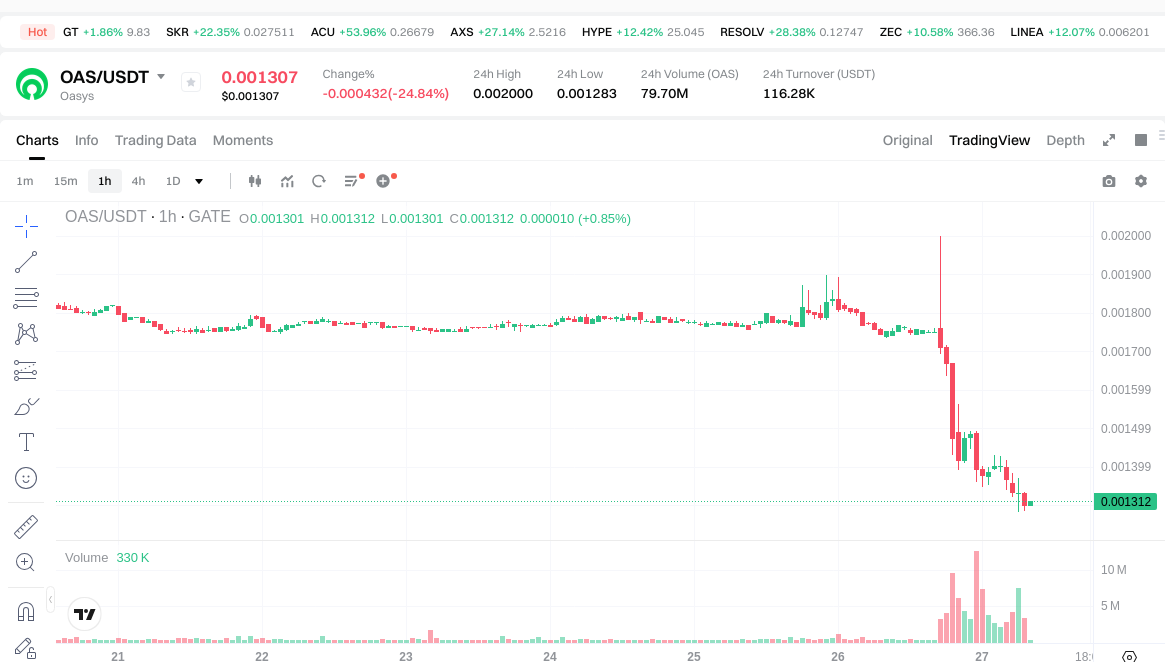
2024: OAS reached its all-time high of $0.141992 on February 13, 2024. Following this peak, the token experienced significant downward pressure, declining substantially throughout the year.
-
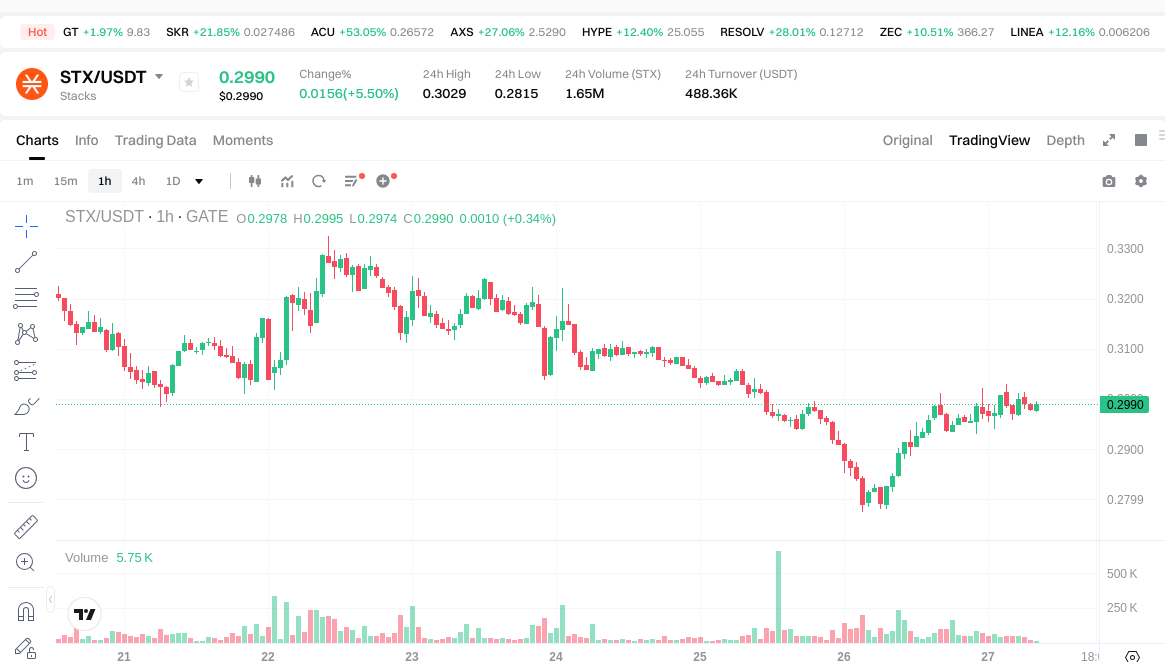
2020: STX recorded its all-time low of $0.04559639 on March 13, 2020. The token later achieved its all-time high of $3.86 on April 1, 2024, reflecting considerable growth during the bull market cycle.
-
Comparative Analysis: During the 2024 market cycle, OAS declined from its all-time high of $0.141992 to its current trading range near all-time lows around $0.001302, representing a decline of over 99%. In contrast, STX, while also experiencing downward pressure from its April 2024 peak of $3.86, has maintained a relatively stronger position at $0.2982, demonstrating comparatively better price retention during the market correction phase.
Current Market Status (January 27, 2026)
- OAS Current Price: $0.001302
- STX Current Price: $0.2982
- 24-Hour Trading Volume: OAS recorded $116,178.94, while STX showed significantly higher liquidity with $492,754.83
- Market Sentiment Index (Fear & Greed Index): 20 (Extreme Fear)
View real-time prices:
II. Core Factors Influencing OAS vs STX Investment Value
Supply Mechanism Comparison (Tokenomics)
- OAS: Specific supply mechanism details were not available in the provided materials
- STX: Specific supply mechanism details were not available in the provided materials
- 📌 Historical Pattern: Supply mechanisms play a role in driving price cycle variations through controlled token release schedules and economic incentive structures
Institutional Adoption and Market Application
- Institutional Holdings: Comparative institutional preference data between OAS and STX was not available in the provided materials
- Enterprise Adoption: Specific application comparisons in cross-border payments, settlements, and investment portfolios were not documented in the reference materials
- National Policies: Regulatory attitudes from different jurisdictions toward these assets require careful monitoring as regulatory frameworks continue to evolve
Technological Development and Ecosystem Building
- OAS Technical Development: Analysis indicates OAS investment value is connected to blockchain technology adoption and Oasys's positioning within the gaming sector
- STX Technical Development: Investment considerations for STX relate to sector performance and underlying company fundamentals
- Ecosystem Comparison: Both assets require evaluation of their respective ecosystems, though specific comparative data on DeFi, NFT, payment systems, and smart contract implementation was not available in the provided materials
Macroeconomic Factors and Market Cycles
- Inflation Environment Performance: Comparative anti-inflation properties require assessment based on asset characteristics and market positioning
- Macroeconomic Monetary Policy: Interest rate fluctuations and US dollar index movements can influence both assets, requiring careful market analysis
- Geopolitical Factors: Cross-border transaction demand and international dynamics may affect adoption patterns and market performance for both assets
III. 2026-2031 Price Prediction: OAS vs STX
Short-term Forecast (2026)
- OAS: Conservative $0.001044 - $0.001305 | Optimistic $0.001305 - $0.0016443
- STX: Conservative $0.262504 - $0.2983 | Optimistic $0.2983 - $0.334096
Mid-term Forecast (2028-2029)
- OAS may enter a consolidation phase with projected price range of $0.00131892696 - $0.00190170864 in 2028, potentially adjusting to $0.001374137856 - $0.0017692024896 by 2029
- STX may experience moderate growth trajectory, with estimated range of $0.1830312123 - $0.3875955084 in 2028, expanding to $0.332183706088 - $0.388169723968 in 2029
- Key drivers: institutional capital inflows, ETF developments, ecosystem expansion
Long-term Forecast (2030-2031)
- OAS: Baseline scenario $0.001534224916224 - $0.0017434374048 (2030) | Optimistic scenario $0.001556017883784 - $0.002302906468 (2031)
- STX: Baseline scenario $0.33502033099392 - $0.380704921584 (2030) | Optimistic scenario $0.307799929100664 - $0.471693397842576 (2031)
View detailed price predictions for OAS and STX
Disclaimer
This analysis is for informational purposes only and does not constitute investment advice. Cryptocurrency markets are highly volatile and unpredictable. Past performance and projections do not guarantee future results. Investors should conduct their own research and consult with financial advisors before making investment decisions.
OAS:
| Year |
Predicted High Price |
Predicted Average Price |
Predicted Low Price |
Price Change |
| 2026 |
0.0016443 |
0.001305 |
0.001044 |
0 |
| 2027 |
0.001592622 |
0.00147465 |
0.0008110575 |
13 |
| 2028 |
0.00190170864 |
0.001533636 |
0.00131892696 |
17 |
| 2029 |
0.0017692024896 |
0.00171767232 |
0.001374137856 |
31 |
| 2030 |
0.002405943618624 |
0.0017434374048 |
0.001534224916224 |
33 |
| 2031 |
0.002302906468 |
0.002074690511712 |
0.001556017883784 |
59 |
STX:
| Year |
Predicted High Price |
Predicted Average Price |
Predicted Low Price |
Price Change |
| 2026 |
0.334096 |
0.2983 |
0.262504 |
0 |
| 2027 |
0.40157146 |
0.316198 |
0.2845782 |
6 |
| 2028 |
0.3875955084 |
0.35888473 |
0.1830312123 |
20 |
| 2029 |
0.388169723968 |
0.3732401192 |
0.332183706088 |
25 |
| 2030 |
0.4187754137424 |
0.380704921584 |
0.33502033099392 |
27 |
| 2031 |
0.471693397842576 |
0.3997401676632 |
0.307799929100664 |
34 |
IV. Investment Strategy Comparison: OAS vs STX
Long-term vs Short-term Investment Strategies
- OAS: May be suitable for investors focused on gaming sector developments and blockchain technology adoption in entertainment applications, though the asset requires careful consideration given recent price performance and limited liquidity indicators
- STX: May appeal to investors interested in decentralized application platforms and infrastructure development, with attention to the project's established market presence since 2019 and technical positioning
Risk Management and Asset Allocation
- Conservative Investors: OAS 10-20% vs STX 20-30%, with remaining allocation to established assets and stablecoins for volatility mitigation
- Aggressive Investors: OAS 25-35% vs STX 35-45%, accepting higher volatility exposure in exchange for potential sector-specific growth opportunities
- Hedging Tools: Stablecoin allocation for liquidity management, options strategies where available, cross-asset portfolio diversification to reduce concentration risk
V. Potential Risk Comparison
Market Risks
- OAS: The token has experienced substantial price decline from its February 2024 peak, with current trading near historical lows; 24-hour trading volume of $116,178.94 indicates relatively lower market liquidity compared to established assets
- STX: While demonstrating better price retention during market corrections, the asset has declined from its April 2024 peak; market performance remains subject to broader cryptocurrency market cycles and sentiment shifts
Technical Risks
- OAS: Scalability considerations and network stability factors require ongoing monitoring as the gaming-focused blockchain ecosystem develops
- STX: Network architecture assessment, security considerations, and technical infrastructure evaluation remain important factors for investment analysis
Regulatory Risks
- Global regulatory frameworks continue to evolve, with different jurisdictions developing varied approaches to cryptocurrency asset classification and oversight; both assets may experience different regulatory treatment based on their respective use cases and technical architectures
VI. Conclusion: Which Is the Better Buy?
📌 Investment Value Summary:
- OAS Considerations: Gaming sector positioning and blockchain technology focus in entertainment applications; however, recent price performance and current market metrics require careful evaluation
- STX Considerations: Established market presence since 2019, positioning in decentralized application infrastructure, and technical architecture with Proof of Transfer consensus mechanism
✅ Investment Guidance:
- Novice Investors: Consider starting with smaller position sizes in established assets with higher liquidity, conducting thorough research on both projects' fundamentals, technical developments, and ecosystem activities before allocation decisions
- Experienced Investors: Evaluate portfolio diversification opportunities based on sector exposure preferences, risk tolerance levels, and investment timeframes; consider both short-term volatility patterns and long-term technical development trajectories
- Institutional Investors: Conduct comprehensive due diligence on both assets' technical infrastructure, ecosystem partnerships, regulatory compliance frameworks, and liquidity profiles; assess alignment with institutional investment mandates and risk management protocols
⚠️ Risk Disclosure: Cryptocurrency markets exhibit extreme volatility characteristics. This analysis is for informational purposes only and does not constitute investment advice. Market conditions can change rapidly, and past performance does not guarantee future results. Investors should conduct independent research and consult with qualified financial advisors before making investment decisions.
VII. FAQ
Q1: What are the key differences between OAS and STX in terms of their blockchain architecture and primary use cases?
OAS (Oasys) is a gaming-specialized public blockchain utilizing a unique multi-layer architecture consisting of Hub-Layer and Verse-Layer, launched in 2022 specifically to transform blockchain gaming applications. STX (Stacks), on the other hand, operates as a decentralized application platform since 2019, featuring a Proof of Transfer (PoX) hybrid consensus mechanism designed to enable decentralized internet infrastructure with built-in privacy features. While OAS focuses narrowly on entertainment and gaming sector applications, STX provides broader infrastructure capabilities for various decentralized applications and services across multiple sectors.
Q2: How has the price performance of OAS compared to STX during the 2024 market cycle?
OAS experienced a catastrophic decline exceeding 99% from its all-time high of $0.141992 (February 13, 2024) to its current trading level near $0.001302, essentially reaching all-time lows. STX, while also experiencing significant downward pressure from its April 2024 peak of $3.86, has demonstrated substantially better price retention at $0.2982, maintaining a comparatively stronger market position during the correction phase. This stark contrast in price performance reflects differences in market confidence, liquidity levels, and ecosystem resilience between the two assets.
Q3: What are the current liquidity indicators for OAS versus STX, and why do they matter for investors?
As of January 27, 2026, OAS recorded a 24-hour trading volume of $116,178.94, while STX demonstrated significantly higher market liquidity with $492,754.83 in trading volume—over 4 times greater. This substantial difference in liquidity is critically important for investors because higher trading volumes typically enable easier entry and exit positions, reduce slippage on larger trades, provide better price discovery mechanisms, and generally indicate stronger market participation and confidence in the asset. Lower liquidity assets like OAS present increased execution risks and potential difficulty in converting positions to cash during volatile market conditions.
Q4: What are the projected price ranges for OAS and STX in 2030-2031?
For 2030, OAS baseline scenario projects a range of $0.001534224916224 - $0.0017434374048, while the optimistic 2031 scenario estimates $0.001556017883784 - $0.002302906468. STX demonstrates substantially higher projected valuations, with 2030 baseline scenario of $0.33502033099392 - $0.380704921584 and 2031 optimistic scenario of $0.307799929100664 - $0.471693397842576. However, it's crucial to note that these projections are highly speculative, based on historical patterns and current trajectories, and do not guarantee future performance. Cryptocurrency markets remain extremely volatile and unpredictable, with numerous factors potentially altering these trajectories significantly.
Q5: How should conservative versus aggressive investors approach portfolio allocation between OAS and STX?
Conservative investors should consider limited exposure with OAS allocation of 10-20% and STX allocation of 20-30%, maintaining the majority of their portfolio in established assets and stablecoins to mitigate volatility risks. Aggressive investors willing to accept higher volatility may allocate OAS 25-35% and STX 35-45% of their cryptocurrency portfolio, recognizing the increased risk exposure in exchange for potential sector-specific growth opportunities. Both investor types should maintain adequate liquidity through stablecoin holdings, implement diversification across multiple asset classes, and regularly rebalance positions based on changing market conditions and risk tolerance levels.
Q6: What are the primary regulatory risks facing OAS and STX investments?
Both OAS and STX face evolving global regulatory frameworks with different jurisdictions developing varied approaches to cryptocurrency classification and oversight. These assets may experience different regulatory treatment based on their respective use cases—gaming applications for OAS versus decentralized infrastructure for STX. Regulatory changes can impact trading availability, tax treatment, institutional adoption rates, and overall market accessibility. Investors must monitor regulatory developments in major jurisdictions including the United States, European Union, and Asia-Pacific regions, as regulatory clarity or restrictions can significantly affect asset valuations and investment viability.
Q7: Given the current market conditions showing "Extreme Fear" (Fear & Greed Index at 20), which asset presents better risk-adjusted opportunities?
During extreme fear conditions, STX may present relatively better risk-adjusted opportunities due to its established market presence since 2019, significantly higher liquidity ($492,754.83 vs $116,178.94 daily volume), and stronger price retention during the recent correction phase. OAS, having declined over 99% from its peak and trading near all-time lows with limited liquidity, presents substantially higher risk despite potentially offering recovery opportunities if gaming sector adoption accelerates. However, extreme fear conditions can signal either capitulation selling (potential bottoms) or deteriorating fundamentals—investors should conduct thorough due diligence on both projects' ongoing development activities, ecosystem growth metrics, and partnership developments rather than relying solely on sentiment indicators.
Q8: What technical development factors should investors monitor when evaluating OAS versus STX?
For OAS, investors should monitor gaming blockchain adoption rates, successful implementation of the Hub-Layer and Verse-Layer architecture, partnerships with gaming companies, scalability performance metrics, and network stability indicators. For STX, key monitoring factors include Proof of Transfer consensus mechanism performance, decentralized application ecosystem growth, smart contract deployment statistics, network security audits, infrastructure partnerships, and integration progress with broader blockchain ecosystems. Both assets require assessment of developer activity levels, code repository updates, technological roadmap execution, and competitive positioning relative to alternative blockchain platforms in their respective sectors.
* The information is not intended to be and does not constitute financial advice or any other recommendation of any sort offered or endorsed by Gate.