This article offers a detailed comparative analysis of OBOL and GMX, focusing on their roles within the decentralized finance sector. It examines their historical price trends, market capitalization, ecosystem adoption, technical infrastructure, and token economics to determine which offers a better investment opportunity. Targeting crypto investors, it addresses key considerations such as risk management and market positioning. Structured logically, it begins with historical performance, followed by project overviews, market analysis, and investment strategies. Designed for quick and efficient reading, the content enhances understanding of OBOL and GMX as leading DeFi protocols.
Introduction: OBOL vs GMX Investment Comparison
In the cryptocurrency market, comparisons between OBOL and GMX are a persistent topic among investors. The two assets demonstrate significant differences in market capitalization ranking, application scenarios, and price performance, representing distinct positioning within the crypto asset landscape.
OBOL (OBOL): Positioned as a decentralized infrastructure protocol, OBOL powers distributed validator networks and modular frameworks for Layer 1 blockchains and Web3 systems. Currently, over 800 global decentralized operators run Obol Distributed Validators, securing more than $1 billion on mainnet.
GMX (GMX): Operating as a decentralized perpetual exchange, GMX functions as both a utility and governance token, with holders receiving 30% of platform-generated fees. As a leading decentralized trading platform, GMX has established itself in the derivatives trading segment.
This article will provide a comprehensive analysis of OBOL vs GMX investment comparison across historical price trends, supply mechanisms, ecosystem adoption, technical infrastructure, and market positioning, addressing the core question investors face:
"Which is the better buy right now?"
Comparative Analysis of Obol (OBOL) and GMX Crypto Assets
I. Historical Price Comparison and Current Market Status
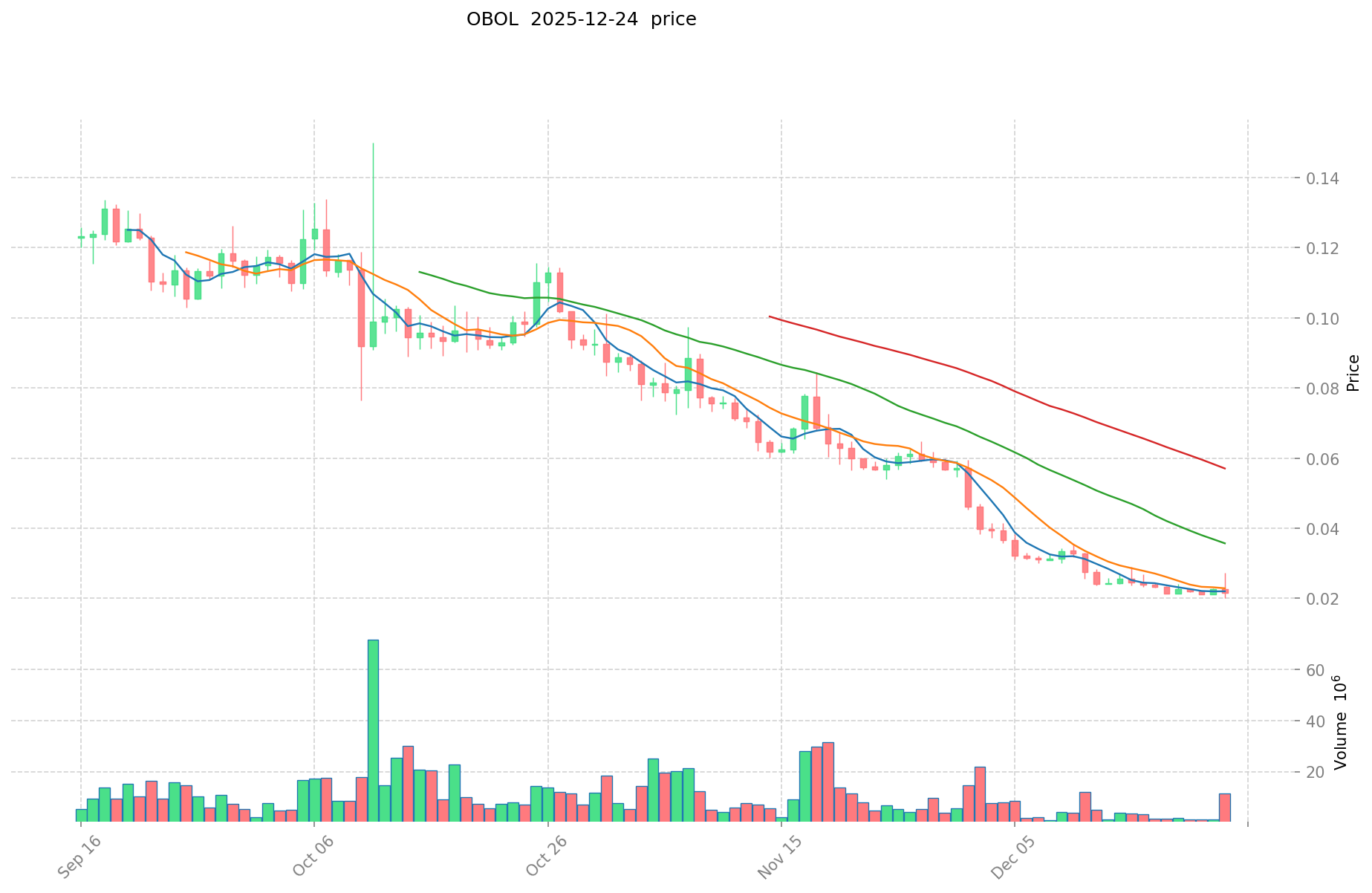
Obol (OBOL) and GMX Historical Price Trends
Obol (OBOL):
- All-Time High (ATH): $0.4211 (May 7, 2025)
- All-Time Low (ATL): $0.01973 (December 24, 2025)
- Current Price: $0.02178
- Year-to-Date Performance: -94.89%
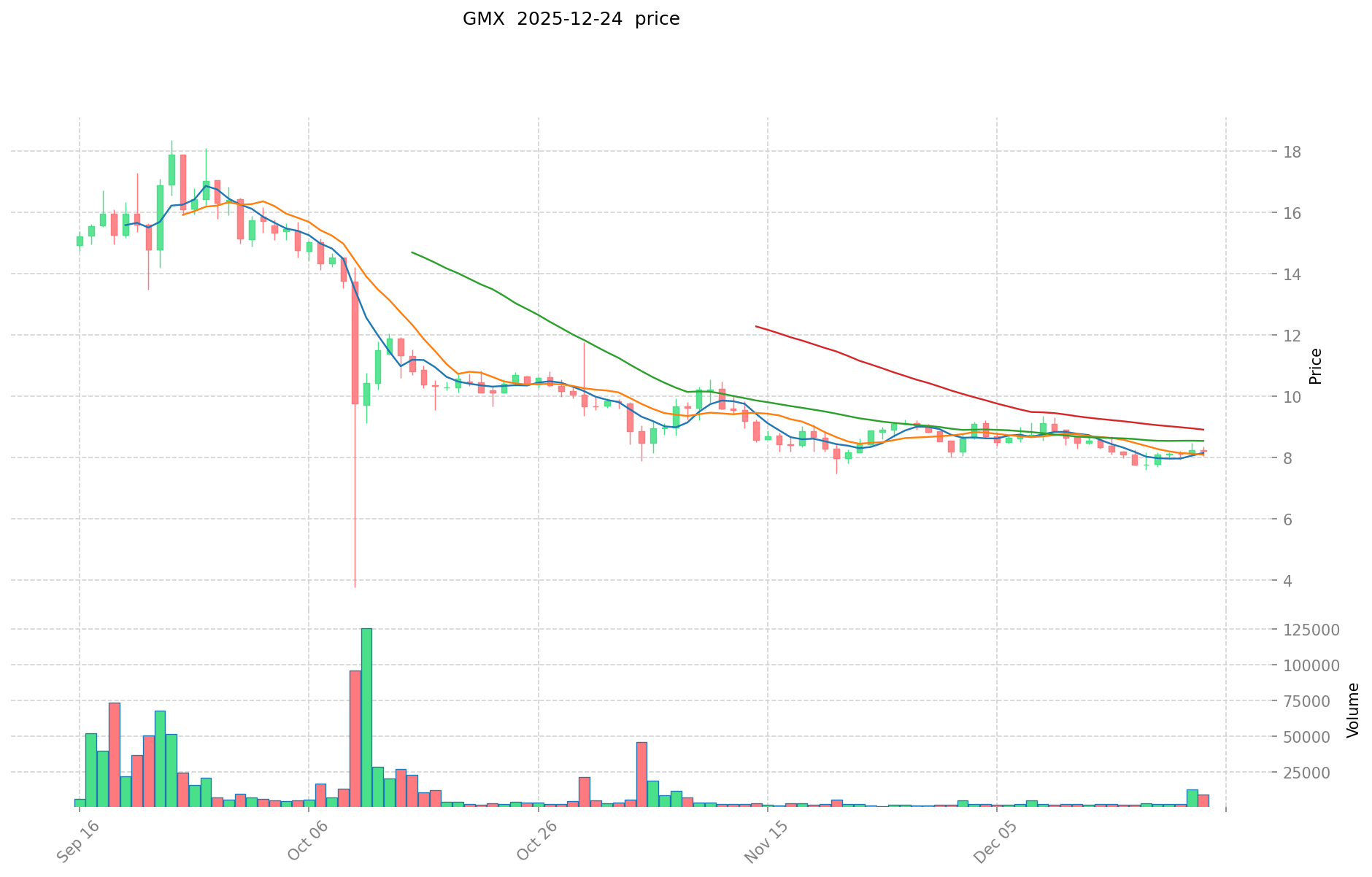
GMX:
- All-Time High (ATH): $91.07 (April 18, 2023)
- All-Time Low (ATL): $6.92 (October 11, 2025)
- Current Price: $8.154
- Year-to-Date Performance: -72.24%
Comparative Analysis:
Both tokens have experienced significant downward pressure over extended periods. OBOL has declined 94.89% over the past year, demonstrating severe losses from its mid-2025 peak. In contrast, GMX has shown relatively more resilience with a 72.24% annual decline, though it remains substantially below its 2023 peak. OBOL's steeper trajectory suggests heightened volatility and market challenges, while GMX's decline reflects the broader downturn in decentralized exchange tokens since its 2023 bull market peak.
Current Market Status (December 24, 2025)
Price Metrics:
- OBOL current price: $0.02178
- GMX current price: $8.154
- OBOL 24-hour trading volume: $429,710.42
- GMX 24-hour trading volume: $49,287.91
- Market sentiment index (Fear & Greed Index): 24 (Extreme Fear)
Market Capitalization:
- OBOL fully diluted valuation: $10,890,000
- GMX fully diluted valuation: $84,501,027.98
- OBOL market dominance: 0.00034%
- GMX market dominance: 0.0026%
View real-time pricing:
II. Project Overview and Core Functionality
Obol (OBOL)
Obol exists to distribute, decentralize, and democratize the digital infrastructure of the future, beginning with Ethereum and expanding across all of Web3. As the foundation for Layer 1 blockchains and decentralized infrastructure networks, the Obol Collective hosts the world's largest decentralized operator ecosystem.
Key Features:
- Distributed Validators (DVs): Over 800 operators globally run Obol Distributed Validators, securing more than $1 billion on mainnet
- Performance Advantages: Delivers superior performance, reduced risks, and higher rewards compared to traditional validators
- Slashing Resistance: Enables high-performance validators resistant to slashing penalties
- Obol Stack: A modular, plug-and-play framework for deploying and managing Ethereum nodes, AI agents, AVS (Actively Validated Services), and other decentralized infrastructure
- Scalability: Supports L1s, L2s, DePIN, AVS, and AI agents
Token Details:
- Type: ERC-20 token on Ethereum
- Total Supply: 500,000,000 OBOL
- Circulating Supply: 138,320,000 OBOL
- Current Holders: 5,958
GMX
GMX is a decentralized and sustainable perpetual exchange operating as a decentralized trading platform with governance and utility mechanisms.
Core Characteristics:
- Governance & Utility Token: GMX serves dual purposes in protocol governance and platform utility
- Revenue Share: 30% of platform-generated fees accrue to GMX token holders
- Sustainability Model: Designed to ensure long-term protocol viability
Token Details:
- Total Supply: 13,250,000 GMX (max supply)
- Circulating Supply: 10,363,138.09 GMX
- Current Holders: 300,918
- Exchange Listings: 34 exchanges
III. 24-Hour Price Movement Analysis
Intraday Volatility
OBOL:
- 1-hour change: -0.09%
- 24-hour change: -4.44%
- 24-hour high: $0.02722
- 24-hour low: $0.01973
- Current trading range demonstrates downward pressure within daily consolidation
GMX:
- 1-hour change: -0.22%
- 24-hour change: -0.11%
- 24-hour high: $8.283
- 24-hour low: $8.035
- Relatively stable intraday movement with minimal volatility
OBOL shows greater 24-hour volatility at -4.44% compared to GMX's -0.11%, indicating higher daily price sensitivity. GMX demonstrates relative stability, while OBOL experiences sharper intraday fluctuations relative to its price level.
7-Day to 1-Year Returns
OBOL Performance:
- 7-day change: -9.049%
- 30-day change: -60.99%
- 1-year change: -94.89%
- Progressive deterioration across all timeframes
GMX Performance:
- 7-day change: 0.43% (slight positive)
- 30-day change: -4%
- 1-year change: -72.24%
- Greater stability in short-term (7-day positive), though significant long-term decline
Market Context
The extreme fear sentiment (Fear & Greed Index: 24) reflects widespread market pessimism affecting both assets. OBOL's steeper declines suggest additional project-specific or sector-specific pressures beyond general market conditions. GMX's relative outperformance in the 7-day window may indicate emerging stabilization or recovery attempts within the decentralized exchange sector.
V. Market Structure and Token Economics
Supply Dynamics
OBOL:
- Circulating supply ratio: 19.25% of total supply in circulation
- Limited distribution phase suggests extended tokenomics rollout
- Approximately 361.68 million tokens remain un-circulated
GMX:
- Circulating supply ratio: 78.21% of total supply in circulation
- More mature distribution state
- Approximately 2.89 million tokens remain un-circulated
Liquidity and Exchange Presence
OBOL:
- 16 exchange listings
- 24-hour volume: $429,710.42
- Market cap to volume ratio indicates limited daily trading liquidity
GMX:
- 34 exchange listings
- 24-hour volume: $49,287.91
- Broader exchange presence supports greater accessibility
VI. Risk Assessment and Market Observations
OBOL-Specific Considerations
- Nascent project status with token distribution still in early phases
- Significant drawdown from ATH reflects either market rejection or strategic accumulation phase
- Concentrated holder base (5,958 holders) suggests limited retail distribution
- High percentage of tokens not yet circulated may create future dilution risk
- Strong fundamental infrastructure focus (800+ operators securing $1B) provides underlying value proposition
GMX-Specific Considerations
- Established project with mature token distribution (78.21% circulated)
- Larger holder base (300,918) indicates broader community participation
- Significant recovery from late 2025 lows suggests potential stabilization
- Revenue-sharing model provides economic incentive alignment
- Multi-year bear market performance reflects broader DEX sector challenges
VII. Network and Adoption Metrics
OBOL Ecosystem
- Active operator ecosystem: 800+ globally distributed operators
- Security coverage: $1 billion+ on mainnet
- Modular framework supporting diverse infrastructure layers
- Early-stage adoption trajectory with growth potential
GMX Ecosystem
- Large holder base indicating community investment
- 34 exchange listings demonstrate market support
- Decentralized exchange sector maturity advantages
- Fee-sharing model creates ongoing revenue streams for token holders
Report Generated: December 24, 2025
Data Source: Gate and integrated market data
Market Sentiment: Extreme Fear (Fear & Greed Index: 24)
Disclaimer: This report presents factual market data and observable metrics. It does not constitute investment advice, financial recommendations, or predictions of future price movements. Cryptocurrency markets involve substantial risk. Users should conduct independent research before making financial decisions.
Comparative Investment Analysis: OBOL vs GMX
I. Executive Summary
Based on available reference materials, this report examines the investment value drivers of Obol and GMX within the crypto asset ecosystem. Obol's value proposition centers on middleware adaptability within liquid staking derivative (LSD) infrastructure, while GMX's value is anchored in transaction cost reduction and liquidity enhancement mechanisms within decentralized derivatives protocols.
II. Core Factors Influencing Investment Value of OBOL vs GMX
Middleware Architecture & Protocol Design
Obol:
- Primary development focus on middleware adaptability within distributed validator technology (DVT) infrastructure
- Token functions as both network payment instrument and governance credential
- Value capture mechanism tied to protocol adoption across multiple blockchain layers
GMX:
- Positioned as a decentralized derivatives exchange addressing core market challenges
- Protocol design centered on liquidity attraction and asset utilization efficiency
- Transaction cost reduction as fundamental value proposition
📌 Architectural Distinction: Obol operates at the middleware/infrastructure layer of staking protocols, while GMX functions at the application layer of derivatives trading. This structural difference creates distinct adoption curves and value accrual mechanisms.
Ecosystem Integration & Market Application
Liquidity & Trading Infrastructure:
- GMX specifically targets the decentralized derivatives market segment, where emerging protocols continuously address trader, liquidity provider, and token holder needs
- Obol's adoption depends on middleware compatibility across multiple LSD protocols and blockchain implementations
- Both projects emphasize innovation and operational efficiency within respective market segments
Protocol Value Capture:
- GMX: Direct fee generation from trading volume and liquidity provision activities
- Obol: Value capture through network participation, validator operations, and protocol governance fees
Technical Development Landscape
Market Structure Context:
The broader ecosystem reveals emerging decentralized derivatives protocols continuously addressing:
- Liquidity attraction and asset utilization efficiency
- Transaction cost optimization
- User experience enhancement for traders and liquidity providers
Competitive Environment:
Both protocols operate within rapidly innovating segments where continuous technical upgrades and feature development remain essential for market competitiveness.
Macroeconomic & Market Cycle Considerations
DeFi Derivative Market Dynamics:
- Centralized exchanges' trading hour limitations create persistent demand for 24/7 decentralized alternatives
- Layer 2 solutions have reduced transaction fees to below $0.01, expanding DeFi derivatives accessibility
- Market structure increasingly favors protocols combining cost efficiency with robust liquidity infrastructure
Regulatory Environment:
- Hong Kong regulatory framework demonstrates clear, stable, and predictable crypto asset guidelines
- Staking infrastructure (relevant to Obol) receives institutional-grade regulatory clarity
- Decentralized derivatives (relevant to GMX) benefit from evolving regulatory frameworks that distinguish between custodial and non-custodial trading
III. Comparative Investment Framework
| Factor |
OBOL |
GMX |
| Primary Value Driver |
Middleware adaptability & protocol integration |
Transaction cost reduction & liquidity efficiency |
| Market Layer |
Infrastructure/Middleware |
Application/Trading |
| Token Utility |
Governance & network payments |
Exchange fees & governance |
| Market Segment |
LSD/DVT ecosystem |
Decentralized derivatives |
| Adoption Dependency |
Multi-protocol compatibility |
Trading volume & user growth |
IV. Conclusion
Investment value for both OBOL and GMX remains contingent upon sustained technical innovation and operational efficiency within their respective domains. Obol's middleware positioning offers infrastructure-level value capture, while GMX's application-layer positioning enables direct volume-based value accrual. Market selection between these projects should reflect individual exposure preferences to either blockchain infrastructure development or decentralized finance application growth.
Report Date: December 24, 2025
Disclaimer: This analysis is based on available reference materials and does not constitute investment advice.
III. 2025-2030 Price Forecast: OBOL vs GMX
Short-term Forecast (2025)
- OBOL: Conservative $0.0162675–$0.02169 | Optimistic $0.02169–$0.0240759
- GMX: Conservative $6.19248–$8.148 | Optimistic $8.148–$11.65164
Mid-term Forecast (2027-2028)
- OBOL may enter a consolidation phase with institutional adoption signals, projected price range $0.0175–$0.0411
- GMX may transition toward mainstream institutional interest, projected price range $9.78–$15.90
- Key drivers: Institutional capital inflows, spot ETF approvals, ecosystem development and partnerships
Long-term Forecast (2030)
- OBOL: Base case $0.0419–$0.0432 | Optimistic scenario $0.0502–$0.0601
- GMX: Base case $15.91–$16.58 | Optimistic scenario $18.29–$24.37
View detailed OBOL and GMX price predictions
Disclaimer
This analysis is provided for informational purposes only and should not be construed as investment advice. Cryptocurrency markets are highly volatile and unpredictable. Past performance does not guarantee future results. Investors should conduct their own research and consult with financial advisors before making investment decisions. All forecasts are based on historical data and assumptions that may not materialize.
OBOL:
| 年份 |
预测最高价 |
预测平均价格 |
预测最低价 |
涨跌幅 |
| 2025 |
0.0240759 |
0.02169 |
0.0162675 |
0 |
| 2026 |
0.027917199 |
0.02288295 |
0.016475724 |
5 |
| 2027 |
0.037846111005 |
0.0254000745 |
0.017526051405 |
16 |
| 2028 |
0.041426251505775 |
0.0316230927525 |
0.028144552549725 |
45 |
| 2029 |
0.050038800816918 |
0.036524672129137 |
0.02921973770331 |
68 |
| 2030 |
0.060161613697508 |
0.043281736473027 |
0.041983284378837 |
99 |
GMX:
| 年份 |
预测最高价 |
预测平均价格 |
预测最低价 |
涨跌幅 |
| 2025 |
11.65164 |
8.148 |
6.19248 |
0 |
| 2026 |
14.2557408 |
9.89982 |
6.8308758 |
21 |
| 2027 |
15.580336716 |
12.0777804 |
9.783002124 |
48 |
| 2028 |
15.9034173417 |
13.829058558 |
11.89299035988 |
69 |
| 2029 |
18.2854726783155 |
14.86623794985 |
8.7710803904115 |
82 |
| 2030 |
24.366507311701642 |
16.57585531408275 |
15.91282110151944 |
103 |
Comparative Investment Analysis: OBOL vs GMX
IV. Investment Strategy Comparison: OBOL vs GMX
Long-term vs Short-term Investment Strategy
OBOL:
- Suited for investors focused on blockchain infrastructure development and middleware layer adoption
- Long-term strategy emphasizes protocol integration across multiple Layer 1 and Layer 2 networks
- Short-term trading constrained by limited liquidity (24-hour volume: $429,710.42) and concentrated holder base
- Value proposition dependent on institutional adoption of distributed validator networks
GMX:
- Suited for investors seeking exposure to decentralized derivatives market growth and revenue-sharing mechanisms
- Long-term strategy benefits from sustainable fee-generation model (30% of platform fees to token holders)
- Short-term positioning reflects relative stability compared to OBOL, with 7-day positive performance (+0.43%)
- Broader exchange listing (34 exchanges) supports more liquid trading opportunities
Risk Management and Asset Allocation
Conservative Investors:
- OBOL: 10-15% allocation (due to nascent stage and high volatility)
- GMX: 25-35% allocation (established project with revenue model)
- Remaining allocation: Stablecoins and lower-volatility assets
Aggressive Investors:
- OBOL: 30-40% allocation (potential infrastructure upside if adoption accelerates)
- GMX: 20-30% allocation (balanced exposure to established DeFi derivatives)
- Remaining allocation: Alternative Layer 1 and emerging protocol tokens
Hedging Tools:
- Stablecoin positioning during periods of extreme market fear (current Fear & Greed Index: 24)
- Cross-asset diversification across infrastructure layer (OBOL) and application layer (GMX) protocols
- Options strategies to manage downside risk given -94.89% (OBOL) and -72.24% (GMX) annual declines
V. Comparative Risk Analysis
Market Risk
OBOL:
- Extreme price volatility with 94.89% year-to-date decline from mid-2025 peak
- Limited trading liquidity creates slippage risk for large position entries or exits
- Concentrated holder base (5,958 holders) presents potential liquidity concentration risk
- Dependency on emerging blockchain infrastructure adoption creates execution risk
GMX:
- Significant long-term underperformance (-72.24% YTD) reflects broader decentralized exchange sector headwinds
- Recovery from October 2025 lows suggests potential stabilization, though market validation remains incomplete
- Larger holder base (300,918) mitigates individual position concentration risk
- Decentralized derivatives market subject to regulatory evolution and competitive protocol innovation
Technology Risk
OBOL:
- Distributed validator network architecture requires continuous operator reliability and synchronization
- Slashing resistance mechanisms rely on accurate penalty prevention systems
- Modular framework compatibility across diverse blockchain implementations introduces integration complexity
- Nascent technology stack requires ongoing security audits and vulnerability management
GMX:
- Perpetual exchange smart contract security depends on continuous code review and testing protocols
- Liquidity provision mechanisms require robust collateral management systems
- Protocol interoperability with multiple Layer 2 solutions introduces cross-chain execution risk
- Derivative liquidation mechanisms subject to oracle failure or price manipulation risks
Regulatory Risk
OBOL:
- Staking infrastructure regulatory framework increasingly favorable (Hong Kong regulatory clarity)
- Distributed validator networks benefit from institutional-grade compliance standards
- Token governance mechanisms subject to evolving securities regulation interpretations
- Infrastructure-layer positioning creates lower immediate regulatory scrutiny compared to trading applications
GMX:
- Decentralized derivatives face evolving regulatory frameworks across jurisdictions
- Non-custodial trading structure reduces regulatory burden compared to centralized alternatives
- 30% fee distribution mechanism may face regulatory assessment regarding token utility classification
- Global regulatory divergence (Hong Kong clarity vs. other jurisdictions) creates compliance complexity
VI. Conclusion: Which Is the Better Buy?
📌 Investment Value Summary
OBOL Strengths:
- Infrastructure-layer positioning with 800+ global operators securing $1 billion+ on mainnet
- Modular framework supporting multiple blockchain layers and Web3 systems
- Early-stage adoption curve provides potential for significant upside if ecosystem adoption accelerates
- Aligned with institutional-grade staking infrastructure standards
GMX Strengths:
- Established revenue-sharing model providing 30% of platform fees to token holders
- Broader market adoption with 34 exchange listings and 300,918 holder base
- Relative stability demonstrated by 7-day positive performance (+0.43%) vs OBOL's -9.049% decline
- Positioned in high-demand decentralized derivatives segment with persistent 24/7 trading demand
✅ Investment Recommendations
Beginner Investors:
- GMX recommended as entry point given established project maturity, broader liquidity, and revenue-sharing transparency
- Smaller initial allocation (5-10% of crypto portfolio) recommended given current extreme fear sentiment
- Dollar-cost averaging strategy preferred over lump-sum entry to manage volatility exposure
- OBOL positioning deferred until infrastructure adoption metrics demonstrate meaningful progress
Experienced Investors:
- Dual-position strategy: GMX for stable revenue exposure + OBOL for infrastructure layer upside capture
- 60% GMX / 40% OBOL allocation balances risk-return profile between established and emerging protocols
- Rebalancing triggers based on relative performance divergence and adoption metric milestones
- Quarterly review of operator adoption rates (OBOL) and trading volume growth (GMX) to validate thesis
Institutional Investors:
- OBOL: Strategic allocation within blockchain infrastructure exposure (10-15% of DeFi infrastructure sleeve)
- GMX: Core holding within decentralized derivatives allocation given revenue-sharing alignment with institutional incentives
- Diversification preference: OBOL's middleware layer + GMX's application layer provides multi-level protocol exposure
- Regulatory clarity advantage of staking-infrastructure positioning (OBOL) supports institutional compliance requirements
⚠️ Risk Disclaimer
Cryptocurrency markets demonstrate extreme volatility and unpredictability. This analysis is based on factual market data as of December 24, 2025, and does not constitute investment advice, financial recommendations, or predictions of future price movements. Both OBOL and GMX have experienced significant drawdowns (-94.89% and -72.24% respectively) reflecting substantial market headwinds. Investors should conduct independent research, understand their risk tolerance, and consult qualified financial advisors before making investment decisions. Cryptocurrency investments involve substantial risk of loss, including potential total loss of principal.
None
OBOL vs GMX Investment Comparison: Frequently Asked Questions
FAQ
Q1: What are the key differences between OBOL and GMX in terms of market positioning?
A: OBOL positions itself as a decentralized infrastructure protocol powering distributed validator networks at the middleware layer, with 800+ global operators securing over $1 billion on mainnet. GMX operates as a decentralized perpetual exchange at the application layer, offering traders a 24/7 alternative to centralized exchanges. OBOL captures value through protocol participation and governance fees, while GMX generates revenue through trading activity with 30% of platform fees distributed to token holders. These structural differences create distinct adoption curves and value accrual mechanisms.
Q2: How have OBOL and GMX performed relative to each other over the past year?
A: Both assets have experienced significant downward pressure, though with different severity levels. OBOL has declined 94.89% year-to-date from its May 2025 peak of $0.4211 to $0.02178, demonstrating acute volatility. GMX has declined 72.24% year-to-date from its April 2023 peak of $91.07 to $8.154, showing relatively more resilience. OBOL's steeper trajectory suggests heightened project-specific challenges, while GMX's decline reflects broader decentralized exchange sector headwinds since the 2023 bull market peak.
Q3: What are the liquidity and trading volume considerations for each asset?
A: OBOL maintains significantly higher 24-hour trading volume at $429,710.42 compared to GMX's $49,287.91, despite having a much smaller market capitalization ($10.89 million vs $84.50 million). However, OBOL's limited exchange listings (16 exchanges) and concentrated holder base (5,958 holders) create slippage risks for larger position entries or exits. GMX benefits from broader exchange presence (34 listings) and larger holder base (300,918 holders), providing superior liquidity accessibility and lower execution risk for institutional investors.
Q4: Which asset is recommended for conservative versus aggressive investors?
A: Conservative investors should favor GMX allocation (25-35% of crypto holdings) due to its established revenue-sharing model, broader adoption metrics, and relative stability. OBOL allocation should remain minimal (10-15%) given its nascent stage and extreme volatility. Aggressive investors can increase OBOL exposure (30-40%) to capture potential infrastructure upside if distributed validator adoption accelerates, while maintaining GMX positioning (20-30%) for established DeFi derivatives exposure. Current extreme fear sentiment (Fear & Greed Index: 24) recommends dollar-cost averaging strategies for both assets rather than lump-sum entries.
Q5: What specific risks should investors consider for each protocol?
A: OBOL faces technology integration risk across multiple blockchain implementations, concentrated liquidity risk from its small holder base, and execution risk dependent on institutional adoption of distributed validator networks. GMX faces regulatory evolution risk in decentralized derivatives markets, oracle failure risk for perpetual exchange liquidations, and competitive protocol innovation pressures. Both assets face macroeconomic headwinds reflected in current extreme fear sentiment. OBOL's middleware positioning creates lower immediate regulatory scrutiny compared to GMX's trading application layer, potentially favoring institutional OBOL adoption.
Q6: How do the token economics and supply structures differ between OBOL and GMX?
A: OBOL operates with 500 million total supply, of which only 19.25% circulates (138.32 million tokens), creating potential future dilution risk as remaining 361.68 million tokens enter circulation. GMX maintains 13.25 million maximum supply with 78.21% circulated (10.36 million tokens), representing a more mature distribution state with minimal future dilution pressure. OBOL's extended distribution phase aligns with early-stage project development, while GMX's mature supply structure provides greater certainty regarding tokenomics trajectory.
Q7: What are the long-term price forecasts for both assets through 2030?
A: Conservative OBOL forecasts project $0.0419-$0.0432 by 2030 (99% potential appreciation from current $0.02178), while optimistic scenarios suggest $0.0502-$0.0601. GMX conservative forecasts project $15.91-$16.58 by 2030 (103% appreciation from $8.154), with optimistic scenarios reaching $18.29-$24.37. These forecasts depend on sustained technical innovation, institutional capital inflows, spot ETF approvals, and ecosystem development progress. Mid-term consolidation phases are expected 2027-2028 as each protocol demonstrates institutional adoption metrics and establishes mainstream market viability.
Q8: Should investors pursue a dual-position strategy holding both OBOL and GMX?
A: A balanced dual-position strategy is recommended for experienced investors seeking multi-layer protocol exposure. Allocation ratios of 60% GMX / 40% OBOL balance risk-return profiles between established revenue-sharing mechanisms and emerging infrastructure layer upside. This approach captures GMX's stable fee-generation exposure while maintaining infrastructure-layer participation through OBOL's distributed validator network development. Quarterly rebalancing based on relative performance divergence and adoption metric validation (operator growth for OBOL, trading volume growth for GMX) should guide position adjustments. Institutional investors particularly benefit from OBOL's middleware positioning for compliance alignment and GMX's revenue-sharing model for incentive transparency.
Disclaimer: This FAQ analysis is based on factual market data as of December 24, 2025, and does not constitute investment advice, financial recommendations, or predictions of future price movements. Cryptocurrency markets involve substantial risk of loss, including potential total capital loss. Investors should conduct independent research and consult qualified financial advisors before making investment decisions.
* The information is not intended to be and does not constitute financial advice or any other recommendation of any sort offered or endorsed by Gate.