This comprehensive analysis compares Harmony (ONE) and Quant (QNT) as layer-1 blockchain investment opportunities, evaluating their distinct technological approaches and market positions. ONE focuses on sharding-based scalability for decentralized applications, while QNT addresses enterprise blockchain interoperability through its Overledger operating system. As of January 2026, QNT demonstrates stronger institutional adoption with a $1.18 billion market cap (#76 ranked) and higher liquidity, compared to ONE's $61.98 million market cap (#472 ranked). The analysis examines critical investment factors including tokenomics, regulatory oversight (QNT's FINMA compliance), ecosystem development, and risk profiles across different investor types. Price projections through 2031 suggest QNT's enterprise trajectory may deliver stronger long-term returns, while ONE presents asymmetric upside potential from depressed valuations. Strategic asset allocation recommendations range from conservative (QNT 70-80%) to aggressive
Introduction: Investment Comparison Between ONE and QNT
In the cryptocurrency market, the comparison between Harmony (ONE) and Quant (QNT) represents an intriguing contrast between different blockchain technology approaches and market positions. These two assets not only differ significantly in market capitalization rankings, application scenarios, and price performance, but also represent distinct positioning within the crypto asset ecosystem.
Harmony (ONE): Launched in June 2019, Harmony has positioned itself as a sharding-based blockchain platform focused on scalability, security, and decentralization. The project aims to support mainstream decentralized applications including gaming, decentralized exchanges, and IoT through protocol and network layer optimizations.
Quant (QNT): Since its launch in August 2018, Quant Network has been recognized as a technology provider enabling trusted digital interactions through its Overledger operating system, which addresses blockchain interoperability challenges. Headquartered in London, UK, the platform serves enterprises, regulators, governments, and individuals.
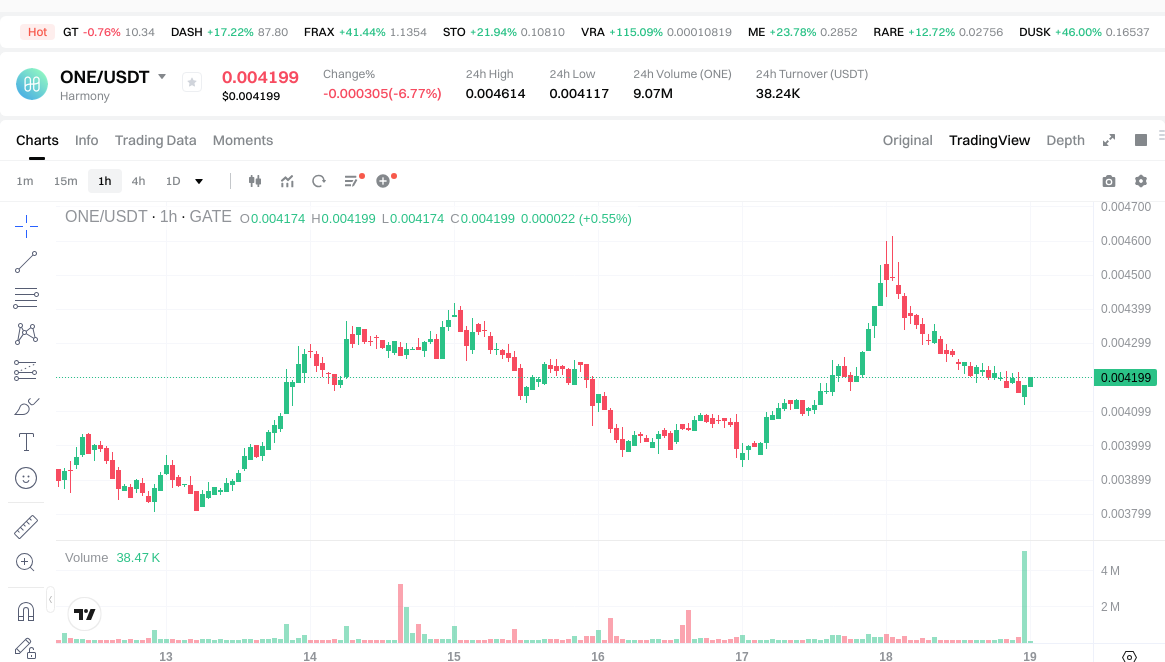
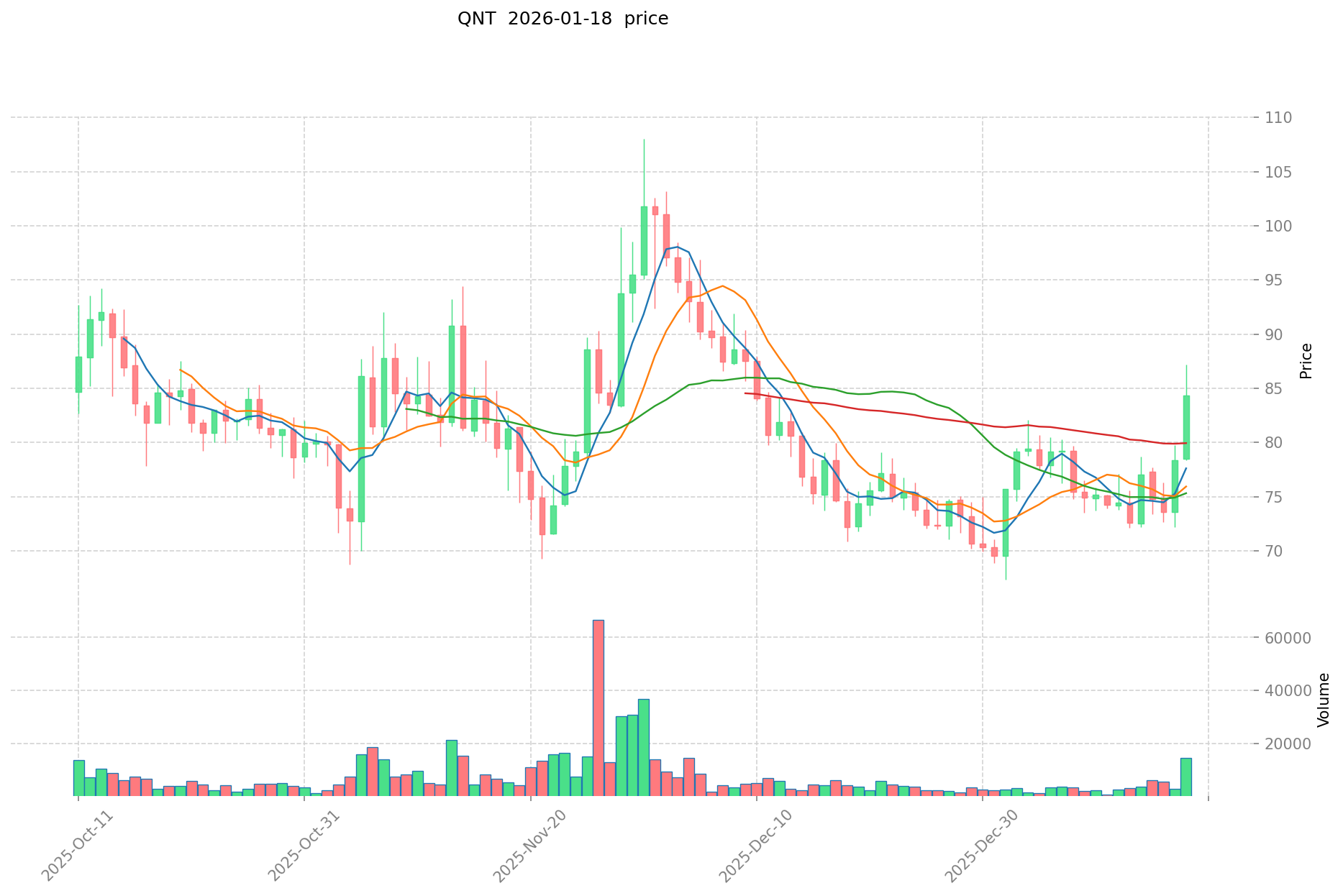
As of January 19, 2026, the market data presents a clear contrast: ONE trades at $0.004181 with a market cap of approximately $61.98 million (ranked #472), while QNT trades at $80.95 with a market cap of approximately $1.18 billion (ranked #76). This article will provide a comprehensive analysis of the investment value comparison between ONE and QNT, examining historical price trends, supply mechanisms, institutional adoption, technical ecosystems, and future projections to help investors address the key question:
"Which represents a more suitable investment opportunity based on current market conditions and project fundamentals?"
I. Historical Price Comparison and Current Market Status
Historical Price Trends of ONE (Coin A) and QNT (Coin B)
- 2021: ONE experienced price movements influenced by market conditions during the broader cryptocurrency rally, with fluctuations reflecting overall blockchain adoption trends.
- 2021: QNT showed price development in response to enterprise blockchain infrastructure developments and institutional interest in interoperability solutions.
- Comparative Analysis: During various market cycles, ONE moved from its recorded peak of $0.37902 to lower levels, while QNT demonstrated different price dynamics with its peak at $427.42, reflecting distinct market positioning and use cases.
Current Market Status (2026-01-19)
- ONE Current Price: $0.004181
- QNT Current Price: $80.95
- 24-Hour Trading Volume: ONE $38,238.41 vs QNT $632,297.35
- Market Sentiment Index (Fear & Greed Index): 49 (Neutral)
Check real-time prices:
II. Core Factors Influencing ONE vs QNT Investment Value
Supply Mechanism Comparison (Tokenomics)
-
QNT: QNT is the native utility token of Quant Network with no inflation. The token operates under a fixed supply model, as it is not mined through traditional Proof of Work mechanisms. Instead, QNT employs a Proof of Stake (PoS) consensus algorithm where token holders stake their QNT tokens to support network consensus and security.
-
ONE: Information regarding ONE's supply mechanism is not available in the provided materials.
-
📌 Historical Pattern: Supply mechanisms can influence price cycles through scarcity dynamics and token distribution models, though specific historical patterns for these tokens require additional data.
Institutional Adoption and Market Application
-
Institutional Holdings: Specific comparative data on institutional preference between ONE and QNT is not available in the provided materials.
-
Enterprise Adoption: QNT serves multiple enterprise functions within the Quant ecosystem. Developers require QNT tokens to purchase Overledger licenses for platform access and MApp development. Enterprises may need QNT to pay licensing fees and access Quant Network's enterprise-oriented solutions. The Quant Treasury facilitates compliant procurement by converting fiat currency payments into QNT tokens, enabling enterprises to adopt blockchain technology without directly engaging with exchanges. QNT's potential role in Central Bank Digital Currency (CBDC) architecture, due to Quant Network's ability to facilitate communication between private and public blockchains, may influence its enterprise adoption trajectory.
-
National Policies: QNT is regulated by the Swiss Financial Market Supervisory Authority (FINMA). Regulatory conditions and governmental attitudes toward both tokens vary across different jurisdictions, and economic conditions alongside regulatory frameworks play an important role in their market performance.
Technical Development and Ecosystem Building
-
QNT Technical Development: Quant (QNT) operates as the native cryptocurrency of Quant Network within the Overledger ecosystem, which addresses blockchain interoperability challenges. The Overledger OS enables developers to build multi-chain decentralized applications (MApps) that can connect various blockchains. QNT functions primarily as a utility token within the Quant ecosystem, serving as a medium of exchange within the Overledger framework. While QNT currently does not offer staking options, its roadmap suggests potential future staking functionality, which could enable QNT holders to lock their tokens, facilitate network consensus, and earn rewards. Future iterations may also introduce governance capabilities, allowing token holders to participate in network decision-making through voting on proposals and modifications.
-
ONE Technical Development: Information regarding ONE's technical upgrades and developments is not available in the provided materials.
-
Ecosystem Comparison: QNT's ecosystem centers on enterprise blockchain adoption and interoperability solutions. QNT can manage digital assets within the Quant Network ecosystem, serving as a medium of exchange for transactions involving digital assets such as cryptocurrencies and tokens. This enables digital asset transfers across different blockchains for various purposes including payments, remittances, and asset transfers. The adoption of Quant's blockchain interoperability solutions by institutions may influence market demand and value.
Macroeconomic Factors and Market Cycles
-
Performance in Inflationary Environments: Specific comparative data on anti-inflation properties between ONE and QNT is not available in the provided materials.
-
Macroeconomic Monetary Policy: Economic conditions and regulatory frameworks play significant roles in the performance of cryptocurrencies including QNT. The relationship between interest rates, US dollar index movements, and their specific impacts on these tokens requires additional analysis.
-
Geopolitical Factors: Cross-border transaction demand and international situations may influence market dynamics, though specific comparative impacts on ONE versus QNT are not detailed in the provided materials.
III. 2026-2031 Price Prediction: ONE vs QNT
Short-term Forecast (2026)
- ONE: Conservative $0.00407303 - $0.004199 | Optimistic $0.004199 - $0.00445094
- QNT: Conservative $43.8534 - $81.21 | Optimistic $81.21 - $104.7609
Mid-term Forecast (2028-2029)
- ONE may enter a consolidation phase with projected prices ranging from $0.004440014202 to $0.006328296104, showing potential growth momentum through 2029
- QNT may enter an expansion phase with projected prices ranging from $97.9495712337 to $169.8619146711, indicating stronger upward trajectory
- Key drivers: institutional capital flows, ETF developments, ecosystem expansion
Long-term Forecast (2030-2031)
- ONE: Baseline scenario $0.004121149733792 - $0.00588735676256 | Optimistic scenario $0.00588735676256 - $0.00658383106757
- QNT: Baseline scenario $107.2547805009015 - $146.92435685055 | Optimistic scenario $146.92435685055 - $231.58217126783691
View detailed price predictions for ONE and QNT
Disclaimer
ONE:
| Year |
Predicted High Price |
Predicted Average Price |
Predicted Low Price |
Price Change |
| 2026 |
0.00445094 |
0.004199 |
0.00407303 |
0 |
| 2027 |
0.0058819592 |
0.00432497 |
0.0041952209 |
3 |
| 2028 |
0.006328296104 |
0.0051034646 |
0.004440014202 |
22 |
| 2029 |
0.00605883317312 |
0.005715880352 |
0.00440122787104 |
36 |
| 2030 |
0.006534966006441 |
0.00588735676256 |
0.004121149733792 |
40 |
| 2031 |
0.00658383106757 |
0.0062111613845 |
0.005527933632205 |
48 |
QNT:
| Year |
Predicted High Price |
Predicted Average Price |
Predicted Low Price |
Price Change |
| 2026 |
104.7609 |
81.21 |
43.8534 |
0 |
| 2027 |
126.460212 |
92.98545 |
79.967487 |
14 |
| 2028 |
138.25076706 |
109.722831 |
102.04223283 |
35 |
| 2029 |
169.8619146711 |
123.98679903 |
97.9495712337 |
52 |
| 2030 |
166.0245232411215 |
146.92435685055 |
107.2547805009015 |
81 |
| 2031 |
231.58217126783691 |
156.47444004583575 |
111.096852432543382 |
93 |
IV. Investment Strategy Comparison: ONE vs QNT
Long-term vs Short-term Investment Strategies
-
ONE: May suit investors focused on scalability-oriented blockchain infrastructure with tolerance for higher volatility, given its lower market capitalization positioning and price fluctuation patterns. The token's trajectory suggests potential for growth cycles, though with substantial downside risk from historical peaks.
-
QNT: May suit investors seeking exposure to enterprise blockchain interoperability solutions with relatively established market positioning. QNT's focus on institutional adoption and regulatory compliance through FINMA oversight presents a different risk-reward profile compared to smaller-cap alternatives.
Risk Management and Asset Allocation
-
Conservative Investors: ONE 20-30% vs QNT 70-80% - allocation weighted toward QNT's comparatively established market position and enterprise focus, while maintaining limited exposure to ONE's higher-risk, higher-potential-reward profile.
-
Aggressive Investors: ONE 40-50% vs QNT 50-60% - balanced allocation recognizing QNT's institutional adoption trajectory while capturing ONE's potential upside from lower valuation base, accepting elevated volatility.
-
Hedging Tools: Stablecoin reserves for rebalancing opportunities, options strategies for downside protection, cross-asset correlation analysis between blockchain infrastructure tokens and enterprise-focused solutions.
V. Potential Risk Comparison
Market Risks
-
ONE: Trading volume of $38,238.41 indicates lower liquidity conditions, which may amplify price volatility during market stress. The substantial distance from historical peak levels ($0.37902 to current $0.004181) reflects elevated drawdown risk and recovery uncertainty.
-
QNT: Trading volume of $632,297.35 suggests relatively improved liquidity profile. Historical peak decline (from $427.42 to current $80.95) presents revaluation risk, though enterprise adoption trajectory may influence recovery dynamics differently than retail-driven tokens.
Technical Risks
-
ONE: Limited information on current technical developments constrains assessment of scalability improvements, network stability enhancements, or competitive positioning relative to other sharding-based solutions.
-
QNT: Interoperability architecture dependency on multiple blockchain networks introduces complexity risks. Future staking functionality and governance mechanisms remain under development, creating uncertainty around network security model evolution and decentralization trajectory.
Regulatory Risks
- Divergent regulatory frameworks impact these assets differently: QNT's Swiss FINMA regulation provides clearer compliance pathway for institutional adoption, potentially reducing regulatory uncertainty compared to assets without established supervisory relationships. Jurisdictional variations in cryptocurrency classification, securities law application, and cross-border transaction regulations may affect market access and liquidity conditions. Changes in enterprise blockchain adoption policies or interoperability standards could disproportionately impact QNT's value proposition, while network infrastructure regulations may influence ONE's operational environment.
VI. Conclusion: Which Is the Better Buy?
📌 Investment Value Summary:
-
ONE Advantages: Lower entry valuation at $0.004181 with market cap of $61.98 million presents asymmetric upside potential if scalability solutions gain adoption. Sharding-based architecture addresses blockchain scalability challenges relevant to decentralized application growth. Price predictions suggest potential growth trajectory from 2026-2031, though from substantially depressed levels.
-
QNT Advantages: Established market position at rank #76 with $1.18 billion market capitalization reflects institutional recognition. Enterprise-focused interoperability solutions address practical blockchain adoption challenges across sectors. FINMA regulatory oversight provides compliance framework potentially attractive to institutional capital. Overledger ecosystem development and potential CBDC architecture involvement present distinctive value drivers compared to general-purpose blockchain platforms.
✅ Investment Recommendations:
-
Novice Investors: Consider starting with smaller position sizes in either asset, prioritizing understanding of blockchain interoperability (QNT) versus scalability (ONE) use cases. QNT's enterprise focus and regulatory framework may offer more comprehensible value proposition, though higher per-token price requires appropriate position sizing. Risk management through diversification across multiple blockchain infrastructure assets recommended.
-
Experienced Investors: Evaluate portfolio allocation based on thesis regarding enterprise blockchain adoption trajectory versus decentralized application infrastructure demand. QNT positioning in institutional interoperability solutions presents different risk-return profile than ONE's scalability-focused approach. Consider correlation analysis with broader blockchain sector movements and macroeconomic conditions. Technical analysis of support-resistance levels relative to historical peaks may inform entry timing.
-
Institutional Investors: QNT's regulatory compliance framework, enterprise solution focus, and established market position may align with institutional risk management requirements. Due diligence on Overledger adoption metrics, enterprise partnership developments, and competitive positioning against alternative interoperability solutions recommended. ONE's lower market capitalization and liquidity profile may present challenges for larger allocation sizes, though venture-style exposure to scalability infrastructure could complement broader blockchain portfolio strategies.
⚠️ Risk Warning: The cryptocurrency market exhibits extreme volatility characteristics. This analysis does not constitute investment advice. Conduct independent research and consult qualified financial advisors before making investment decisions.
VII. FAQ
Q1: What is the fundamental difference between ONE and QNT's technological approach?
ONE focuses on blockchain scalability through sharding technology for decentralized applications, while QNT addresses blockchain interoperability through its Overledger operating system for enterprise solutions. ONE's architecture aims to optimize protocol and network layers to support gaming, decentralized exchanges, and IoT applications. In contrast, QNT's Overledger OS enables developers to build multi-chain decentralized applications (MApps) that connect various blockchains, serving enterprises, regulators, and governments with interoperability solutions.
Q2: Why does QNT have significantly higher trading volume compared to ONE?
QNT's 24-hour trading volume of $632,297.35 substantially exceeds ONE's $38,238.41 due to its larger market capitalization ($1.18 billion vs $61.98 million) and stronger institutional adoption. QNT's enterprise-focused positioning, regulatory compliance through Swiss FINMA oversight, and established market rank (#76 vs #472) attract greater market participation and liquidity. The higher liquidity profile reduces price volatility during market stress, whereas ONE's lower volume amplifies price movements and presents elevated execution risks for larger transactions.
Q3: How do the supply mechanisms of ONE and QNT affect their investment characteristics?
QNT operates under a fixed supply model with no inflation, utilizing a Proof of Stake (PoS) consensus algorithm where token holders stake QNT to support network security. This non-inflationary structure creates scarcity dynamics that may support long-term value retention. Unfortunately, specific information regarding ONE's supply mechanism is not available in current materials, making direct tokenomics comparison incomplete. However, QNT's fixed supply and potential future staking rewards present clearer economic incentives for long-term holders compared to tokens with inflationary models.
Q4: Which asset is more suitable for institutional investors?
QNT demonstrates stronger suitability for institutional investors due to several factors: regulatory compliance through Swiss FINMA oversight, enterprise-focused interoperability solutions, established market position with $1.18 billion market capitalization, and higher liquidity profile. The Quant Treasury facilitates compliant procurement by converting fiat payments into QNT tokens, enabling enterprises to adopt blockchain technology without direct exchange engagement. ONE's lower market capitalization ($61.98 million), limited liquidity ($38,238.41 trading volume), and substantial distance from historical peaks present challenges for institutional allocation sizes, though it may serve venture-style exposure within diversified blockchain portfolios.
Q5: What are the primary risks associated with investing in ONE versus QNT?
ONE's primary risks include: extremely low liquidity ($38,238.41 trading volume) amplifying volatility, substantial drawdown from historical peak ($0.37902 to $0.004181 representing 98.9% decline), limited information on current technical developments, and higher execution risk for larger positions. QNT's risks encompass: interoperability architecture dependency on multiple blockchain networks introducing complexity, undeveloped staking and governance mechanisms creating uncertainty, potential revaluation from historical peak ($427.42 to $80.95 representing 81.1% decline), and concentration risk in enterprise blockchain adoption trajectory. Both assets face regulatory uncertainty, though QNT's FINMA oversight provides clearer compliance pathway.
Q6: How do macroeconomic conditions affect ONE and QNT differently?
Economic conditions and regulatory frameworks influence both cryptocurrencies, though their distinct positioning creates differential impacts. QNT's enterprise-focused interoperability solutions may demonstrate relative resilience during economic uncertainty as institutional blockchain adoption continues independent of retail market sentiment. The token's utility in facilitating compliant enterprise blockchain integration through the Quant Treasury mechanism creates demand drivers beyond speculative trading. ONE's positioning in decentralized application infrastructure ties its performance more closely to broader cryptocurrency market cycles and retail adoption trends. Interest rate environments, US dollar movements, and institutional capital flows affect both assets, though QNT's established institutional relationships may provide buffer against pure risk-off scenarios.
Q7: What timeline suits different investment strategies for ONE versus QNT?
Short-term traders (2026) may find QNT's higher liquidity and established volatility patterns more suitable for technical analysis strategies, with conservative predictions ranging $43.85-$81.21 and optimistic scenarios reaching $104.76. ONE's lower liquidity creates challenging conditions for short-term position management despite potential price movements between $0.00407-$0.00445. Mid-term investors (2028-2029) evaluating ecosystem development may favor QNT's enterprise adoption trajectory with projected ranges of $97.95-$169.86, while ONE's scalability thesis requires longer validation periods with projections of $0.00444-$0.00633. Long-term holders (2030-2031) must weigh QNT's institutional integration pathway (projected $107.25-$231.58) against ONE's speculative infrastructure bet (projected $0.00412-$0.00658), recognizing substantially different risk-reward profiles and capital requirements.
Q8: Should investors hold both ONE and QNT in a diversified crypto portfolio?
Portfolio diversification benefits arise from ONE and QNT's distinct technological approaches, market positioning, and risk profiles. Conservative investors might allocate 20-30% to ONE and 70-80% to QNT, emphasizing QNT's established market position while maintaining limited exposure to ONE's asymmetric upside potential. Aggressive investors could balance 40-50% allocations, recognizing QNT's institutional trajectory while capturing ONE's potential recovery from depressed valuation levels. The complementary nature of scalability solutions (ONE) versus interoperability infrastructure (QNT) provides exposure to different blockchain adoption scenarios. However, correlation with broader cryptocurrency market movements suggests both assets may decline simultaneously during sector-wide downturns, limiting diversification benefits during extreme market stress periods. Position sizing should reflect individual risk tolerance and conviction in respective technological theses.
* The information is not intended to be and does not constitute financial advice or any other recommendation of any sort offered or endorsed by Gate.