This comprehensive guide compares ONG and XLM, two distinct blockchain tokens serving different cryptocurrency market segments. ONG functions as a network utility token for Ontology's distributed trust platform since 2018, while XLM operates as a decentralized payment gateway established in 2014. The analysis examines historical price trends, current market status, institutional adoption, technological ecosystems, and 2026-2031 price projections. As of January 2026, ONG trades at $0.08216 with limited liquidity ($13,046.68 daily volume), while XLM trades at $0.21138 with significantly higher activity ($1,974,298.42 daily volume). Investors receive detailed investment strategies, risk assessments, and allocation recommendations tailored to different experience levels on Gate exchange, enabling informed decision-making within current market conditions showing fear sentiment index of 32.
Introduction: ONG vs XLM Investment Comparison
In the cryptocurrency market, the comparison between ONG vs XLM remains a topic of interest for investors. These two assets exhibit notable differences in market cap ranking, application scenarios, and price performance, representing distinct positioning within the crypto asset landscape.
ONG (OntologyGas): Launched in 2018, this utility token serves as the network usage rights token for the Ontology blockchain, functioning as compensation for network node contributions and supporting distributed trust collaboration platforms.
XLM (Stellar): Introduced in 2014 by Jed McCaleb, one of Ripple's former founders, Stellar has established itself as a decentralized gateway facilitating rapid, stable, and low-cost transfers of digital assets among banks, payment institutions, and individuals.
This article examines historical price trends, supply mechanisms, institutional adoption, technical ecosystems, and future projections to provide a comprehensive analysis of ONG vs XLM investment value comparison, addressing the question investors frequently ask:
"Which is the better buy right now?"
I. Historical Price Comparison and Current Market Status
Historical Price Trends of ONG (Coin A) and XLM (Coin B)
- 2018: ONG recorded its all-time high of $4.39 on September 28, 2018, during the broader cryptocurrency market rally period. Following this peak, the asset experienced a significant price decline.
- 2020: ONG reached its historical low of $0.04242318 on March 13, 2020, coinciding with the broader market downturn during the global economic uncertainty period.
- 2018: XLM achieved its all-time high of $0.875563 on January 3, 2018, benefiting from increased market interest in blockchain-based payment solutions.
- 2015: XLM recorded its historical low of $0.00047612 on March 5, 2015, during the early stages of the project's development.
- Comparative Analysis: During different market cycles, ONG declined from its peak of $4.39 to a low of $0.04242318, representing a substantial correction. In comparison, XLM demonstrated relatively smaller price volatility, moving from $0.875563 to $0.00047612 across a different timeframe, reflecting distinct market dynamics between the two assets.
Current Market Status (2026-01-20)
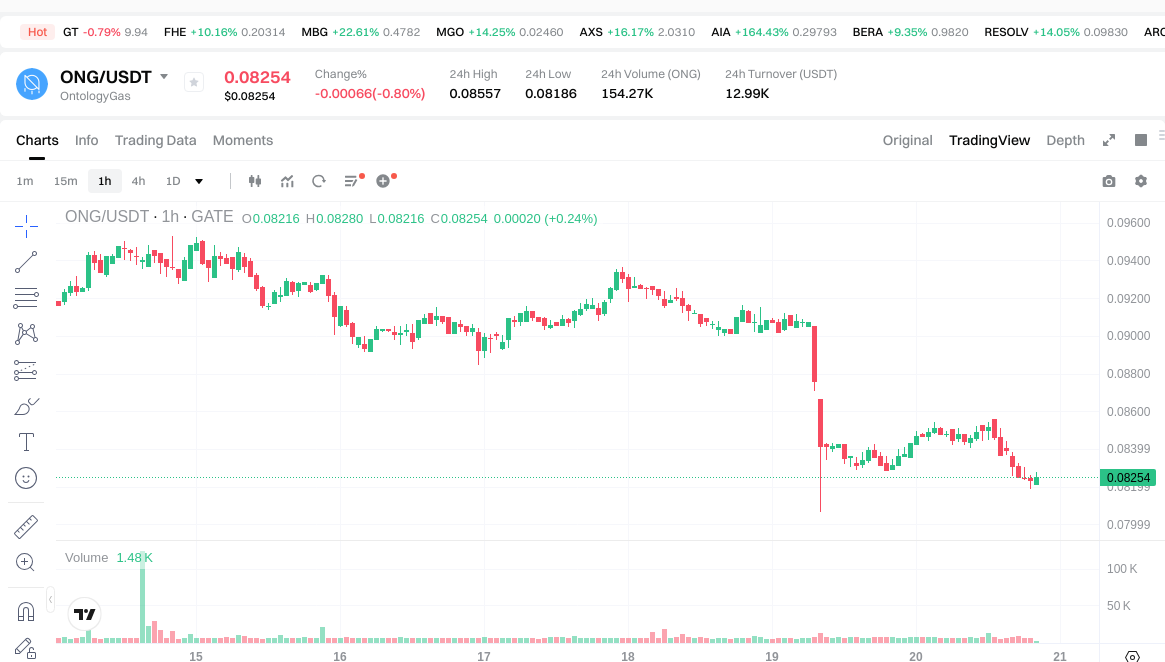
- ONG Current Price: $0.08216
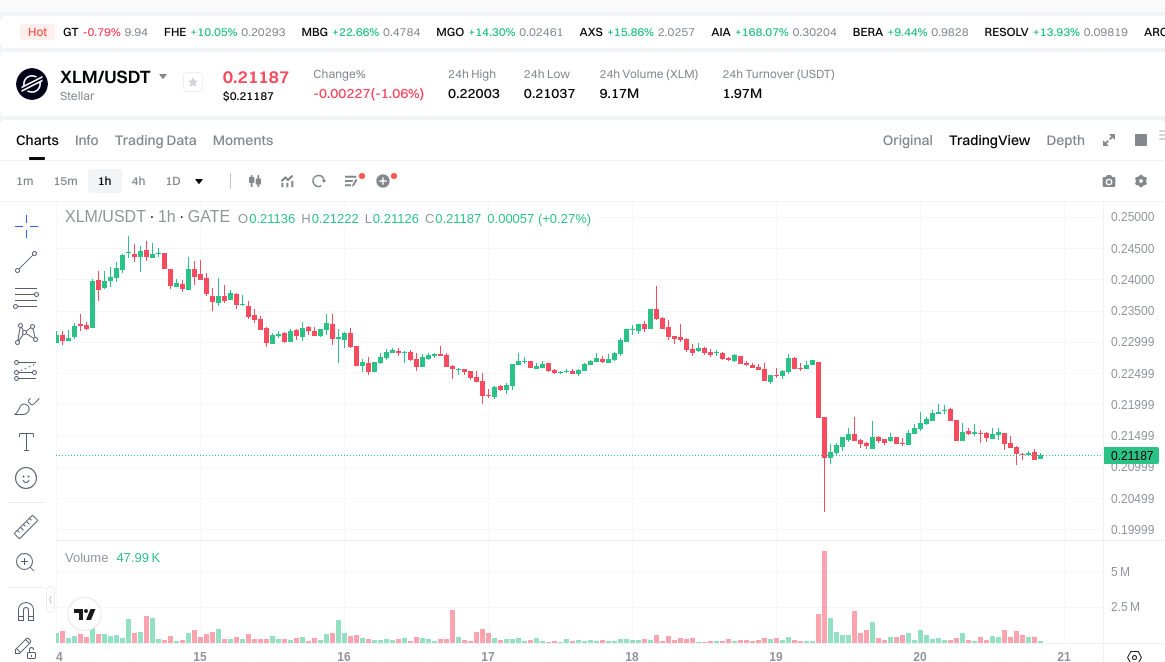
- XLM Current Price: $0.21138
- 24-hour Trading Volume: ONG recorded $13,046.68 vs XLM recorded $1,974,298.42
- Market Sentiment Index (Fear & Greed Index): 32 (Fear)
View Real-time Prices:
II. Core Factors Influencing ONG vs XLM Investment Value
Supply Mechanism Comparison (Tokenomics)
Due to limited reference materials, specific supply mechanism details for ONG and XLM cannot be provided at this time. Historical patterns suggest that supply mechanisms play a significant role in shaping price cycles, with factors such as emission schedules, burning mechanisms, and maximum supply caps potentially influencing long-term value trajectories.
Institutional Adoption and Market Applications
Institutional Holdings: Comparative data on institutional preference between ONG and XLM is not available in the provided materials.
Enterprise Adoption: Information regarding the application of ONG and XLM in cross-border payments, settlements, and investment portfolios is not included in the reference materials.
National Policies: Specific regulatory attitudes of different countries toward ONG and XLM are not documented in the available sources.
Technology Development and Ecosystem Building
ONG Technology Upgrades: Details on technological advancements for ONG and their potential impacts are not available in the provided materials.
XLM Technology Development: Information on XLM's technological progress and potential implications is not included in the reference sources.
Ecosystem Comparison: Comparative analysis of DeFi, NFT, payment solutions, and smart contract implementation for both assets is not available in the provided materials.
Macroeconomic Environment and Market Cycles
Performance in Inflationary Environments: Comparative analysis of inflation-hedge characteristics between ONG and XLM is not available in the reference materials.
Macroeconomic Monetary Policy: The impact of interest rates and dollar index fluctuations on both assets is not documented in the provided sources.
Geopolitical Factors: Information regarding cross-border transaction demand and international situations affecting ONG and XLM is not included in the available materials.
III. 2026-2031 Price Prediction: ONG vs XLM
Short-term Forecast (2026)
- ONG: Conservative $0.063756 - $0.0828 | Optimistic $0.0828 - $0.096876
- XLM: Conservative $0.15264 - $0.212 | Optimistic $0.212 - $0.22472
Mid-term Forecast (2028-2029)
- ONG may enter a gradual growth phase, with projected price range of $0.0593200314 - $0.1416026556 in 2028, potentially reaching $0.111521659032 - $0.137622472848 by 2029
- XLM may enter an expansion phase, with projected price range of $0.218272656 - $0.348196856 in 2028, potentially reaching $0.24017787612 - $0.43171213176 by 2029
- Key drivers: institutional capital flows, ETF developments, ecosystem expansion
Long-term Forecast (2030-2031)
- ONG: Baseline scenario $0.09097320015504 - $0.128131267824 (2030) | Optimistic scenario $0.088391355108386 - $0.16555841115539 (2031)
- XLM: Baseline scenario $0.2979725777028 - $0.36786737988 (2030) | Optimistic scenario $0.377652652184808 - $0.52090020991008 (2031)
View detailed price predictions for ONG and XLM
Disclaimer
ONG:
| Year |
Predicted High Price |
Predicted Average Price |
Predicted Low Price |
Price Change |
| 2026 |
0.096876 |
0.0828 |
0.063756 |
0 |
| 2027 |
0.10151694 |
0.089838 |
0.05480118 |
9 |
| 2028 |
0.1416026556 |
0.09567747 |
0.0593200314 |
16 |
| 2029 |
0.137622472848 |
0.1186400628 |
0.111521659032 |
44 |
| 2030 |
0.15247620871056 |
0.128131267824 |
0.09097320015504 |
55 |
| 2031 |
0.16555841115539 |
0.14030373826728 |
0.088391355108386 |
70 |
XLM:
| Year |
Predicted High Price |
Predicted Average Price |
Predicted Low Price |
Price Change |
| 2026 |
0.22472 |
0.212 |
0.15264 |
0 |
| 2027 |
0.3013368 |
0.21836 |
0.1506684 |
3 |
| 2028 |
0.348196856 |
0.2598484 |
0.218272656 |
22 |
| 2029 |
0.43171213176 |
0.304022628 |
0.24017787612 |
43 |
| 2030 |
0.5002996366368 |
0.36786737988 |
0.2979725777028 |
73 |
| 2031 |
0.52090020991008 |
0.4340835082584 |
0.377652652184808 |
105 |
IV. Investment Strategy Comparison: ONG vs XLM
Long-term vs Short-term Investment Strategies
- ONG: May appeal to investors focused on distributed trust collaboration platforms and network utility token ecosystems, with a consideration for higher volatility patterns observed in historical price movements
- XLM: May suit investors interested in blockchain-based payment solutions and cross-border transfer infrastructure, given its positioning as a decentralized gateway for digital asset transfers
Risk Management and Asset Allocation
- Conservative Investors: ONG 30% vs XLM 70% - allocation reflecting XLM's relatively established market presence since 2014 compared to ONG's 2018 launch
- Aggressive Investors: ONG 50% vs XLM 50% - balanced exposure considering different technological focuses and market dynamics
- Hedging Tools: stablecoin allocation, options strategies, cross-asset portfolio diversification
V. Potential Risk Comparison
Market Risks
- ONG: Historical price volatility demonstrates significant correction from $4.39 (September 2018) to $0.04242318 (March 2020), with current 24-hour trading volume of $13,046.68 indicating relatively limited liquidity compared to larger market cap assets
- XLM: Price movements from $0.875563 (January 2018) to lower ranges reflect market cycle sensitivity, with current 24-hour trading volume of $1,974,298.42 showing comparatively higher market activity
Technical Risks
- ONG: Network scalability considerations and ecosystem development dependencies related to the Ontology blockchain infrastructure
- XLM: Operational stability factors associated with maintaining decentralized gateway functionality for cross-border transfers
Regulatory Risks
- Both assets may face evolving regulatory frameworks affecting utility tokens and payment-focused blockchain networks across different jurisdictions, with potential varying impacts based on their distinct use cases and operational models
VI. Conclusion: Which Is the Better Buy?
📌 Investment Value Summary:
- ONG Characteristics: Functions as a network usage rights token with positioning in distributed trust collaboration, launched in 2018 with historical peak at $4.39
- XLM Characteristics: Established presence since 2014 as a decentralized gateway for digital asset transfers, focusing on payment infrastructure with connections to experienced blockchain development teams
✅ Investment Considerations:
- Beginner Investors: Consider starting with smaller position sizes in XLM given its relatively longer market presence and higher current trading volume ($1,974,298.42 vs $13,046.68), while maintaining diversification principles
- Experienced Investors: Evaluate portfolio allocation based on risk tolerance, with potential consideration for ONG exposure in speculative portions and XLM in core holdings, aligned with individual research and market cycle positioning
- Institutional Investors: Conduct comprehensive due diligence on use case alignment, liquidity profiles, and ecosystem development trajectories for both assets within broader digital asset allocation frameworks
⚠️ Risk Disclosure: Cryptocurrency markets exhibit substantial volatility. This content does not constitute investment advice. The current market sentiment index stands at 32 (Fear) as of 2026-01-20. Historical price performance does not guarantee future results. Investors should conduct independent research and consider personal financial circumstances before making investment decisions.
VII. FAQ
Q1: What are the main differences between ONG and XLM in terms of their core functions?
ONG serves as a network usage rights token for the Ontology blockchain's distributed trust collaboration platform, while XLM operates as a decentralized gateway facilitating cross-border digital asset transfers. ONG primarily functions to compensate network node contributions within the Ontology ecosystem, whereas XLM focuses on enabling rapid, stable, and low-cost transfers among banks, payment institutions, and individuals. The fundamental distinction lies in their application scope: ONG targets blockchain infrastructure utility within a specific network, while XLM addresses broader payment and settlement use cases across multiple institutions.
Q2: How do the historical price volatilities of ONG and XLM compare?
ONG demonstrates significantly higher historical volatility compared to XLM. ONG experienced a dramatic decline from its all-time high of $4.39 (September 2018) to a low of $0.04242318 (March 2020), representing approximately a 99% correction. In contrast, XLM moved from its peak of $0.875563 (January 2018) to a historical low of $0.00047612 (March 2015), though these occurred across different timeframes. As of 2026-01-20, ONG's 24-hour trading volume of $13,046.68 versus XLM's $1,974,298.42 indicates substantially different liquidity profiles, with XLM showing approximately 150 times higher trading activity, suggesting more stable price discovery mechanisms.
Q3: Which asset offers better growth potential according to 2026-2031 price predictions?
Based on the provided forecasts, XLM demonstrates higher projected growth rates across all timeframes. For 2031, XLM shows a potential optimistic scenario reaching $0.52090020991008 with a cumulative price change of 105%, while ONG's optimistic projection reaches $0.16555841115539 with a 70% cumulative change. The mid-term outlook (2028-2029) also favors XLM, with projected ranges of $0.218272656 - $0.43171213176 by 2029, compared to ONG's $0.111521659032 - $0.137622472848. However, these predictions should be interpreted cautiously, as they depend on multiple variables including ecosystem development, market adoption, and macroeconomic conditions.
Q4: What trading volume differences exist between ONG and XLM, and why does this matter?
The current 24-hour trading volume disparity is substantial: XLM records $1,974,298.42 compared to ONG's $13,046.68. This approximately 150-fold difference has significant implications for investors. Higher trading volume typically indicates better liquidity, meaning easier entry and exit positions without substantial price slippage. XLM's superior liquidity reduces execution risk and provides more accurate price discovery, particularly important during volatile market conditions. For institutional investors managing larger positions, XLM's volume profile offers practical advantages in portfolio rebalancing and risk management. Conversely, ONG's lower volume may present higher volatility opportunities for experienced traders but increases execution challenges.
Q5: How should different investor types approach allocation between ONG and XLM?
The suggested allocation strategies vary by risk profile. Conservative investors might consider a 30% ONG / 70% XLM allocation, reflecting XLM's relatively established market presence since 2014 and higher liquidity profile. Aggressive investors could adopt a balanced 50% ONG / 50% XLM approach, accepting higher volatility in exchange for diversified exposure to different technological focuses. Beginner investors should consider starting with smaller positions, potentially favoring XLM given its longer market track record and substantially higher trading volume. All allocations should incorporate broader portfolio diversification principles, stablecoin hedging strategies, and alignment with individual risk tolerance and investment timeframes.
Q6: What are the primary risk factors investors should consider for each asset?
For ONG, key risks include historical extreme volatility (99% peak-to-trough decline), significantly lower liquidity as evidenced by limited trading volume, network scalability dependencies tied to Ontology blockchain development, and relatively shorter market history since 2018. For XLM, considerations include market cycle sensitivity demonstrated in historical price movements, operational dependencies on maintaining decentralized gateway functionality, and potential regulatory scrutiny affecting payment-focused blockchain networks. Both assets face common regulatory uncertainties across jurisdictions, potential impacts from evolving utility token frameworks, and exposure to broader cryptocurrency market volatility, currently reflected in the Fear & Greed Index reading of 32 (Fear) as of 2026-01-20.
Q7: What role did founding teams and launch timing play in each project's development?
XLM benefits from its 2014 launch by Jed McCaleb, one of Ripple's former founders, providing established credibility and longer market presence during critical early blockchain adoption phases. This seven-year head start before ONG's 2018 launch allowed XLM to develop institutional relationships, technical infrastructure, and market recognition during formative industry periods. ONG entered during the 2018 market peak, facing immediate bear market conditions that influenced its early price trajectory. The founding team backgrounds and market entry timing have contributed to observable differences in current market metrics, with XLM's established presence reflected in its substantially higher trading volume and broader market recognition compared to ONG's more specialized positioning within the Ontology ecosystem.
* The information is not intended to be and does not constitute financial advice or any other recommendation of any sort offered or endorsed by Gate.