This comprehensive comparison examines OVR versus ETC, two distinct blockchain platforms serving different technological purposes. OVR, launched in 2020, focuses on augmented reality integration and decentralized networks connecting physical and virtual environments, currently trading at $0.03964. ETC, operating since 2015, functions as an established smart contract platform embodying the original Ethereum chain and 'code is law' principles, trading at $9.793. The article analyzes historical price trends, current market conditions, supply mechanisms, institutional adoption, technological ecosystems, and investment strategies for both assets. It addresses critical investor questions regarding liquidity profiles, risk management, and allocation recommendations across conservative, aggressive, and institutional investor categories. The analysis includes price predictions through 2031, detailed risk assessments covering market, technical, and regulatory factors, and practical investment guidance. Whether you're a
Introduction: Investment Comparison Between OVR and ETC
In the cryptocurrency market, the comparison between OVR vs ETC has consistently been a topic that investors cannot overlook. The two not only show significant differences in market cap ranking, application scenarios, and price performance, but also represent distinct positioning within crypto assets.
OVR (OVR): Launched in 2020, it has gained market recognition through its positioning as a decentralized network platform that unites the real and virtual worlds through augmented reality (AR) technology.
ETC (ETC): Since its inception in 2015, it has been recognized as a decentralized platform for smart contracts, representing the continuation of the original Ethereum chain and upholding the "code is law" principle, making it one of the cryptocurrencies with substantial trading volume and market capitalization globally.
This article will provide a comprehensive analysis of the investment value comparison between OVR vs ETC, covering historical price trends, supply mechanisms, institutional adoption, technological ecosystems, and future predictions, attempting to answer the question that investors are most concerned about:
"Which is the better buy right now?"
I. Historical Price Comparison and Current Market Status
OVR and ETC Historical Price Trends
- 2021: OVR reached a price peak, with its all-time high of $3.33 recorded on December 2, 2021. During this period, the broader crypto market experienced significant bullish momentum.
- 2021: ETC achieved its historical high of $167.09 on May 7, 2021, driven by increased interest in Ethereum-related projects and the continuation of the original Ethereum chain following the 2016 DAO incident.
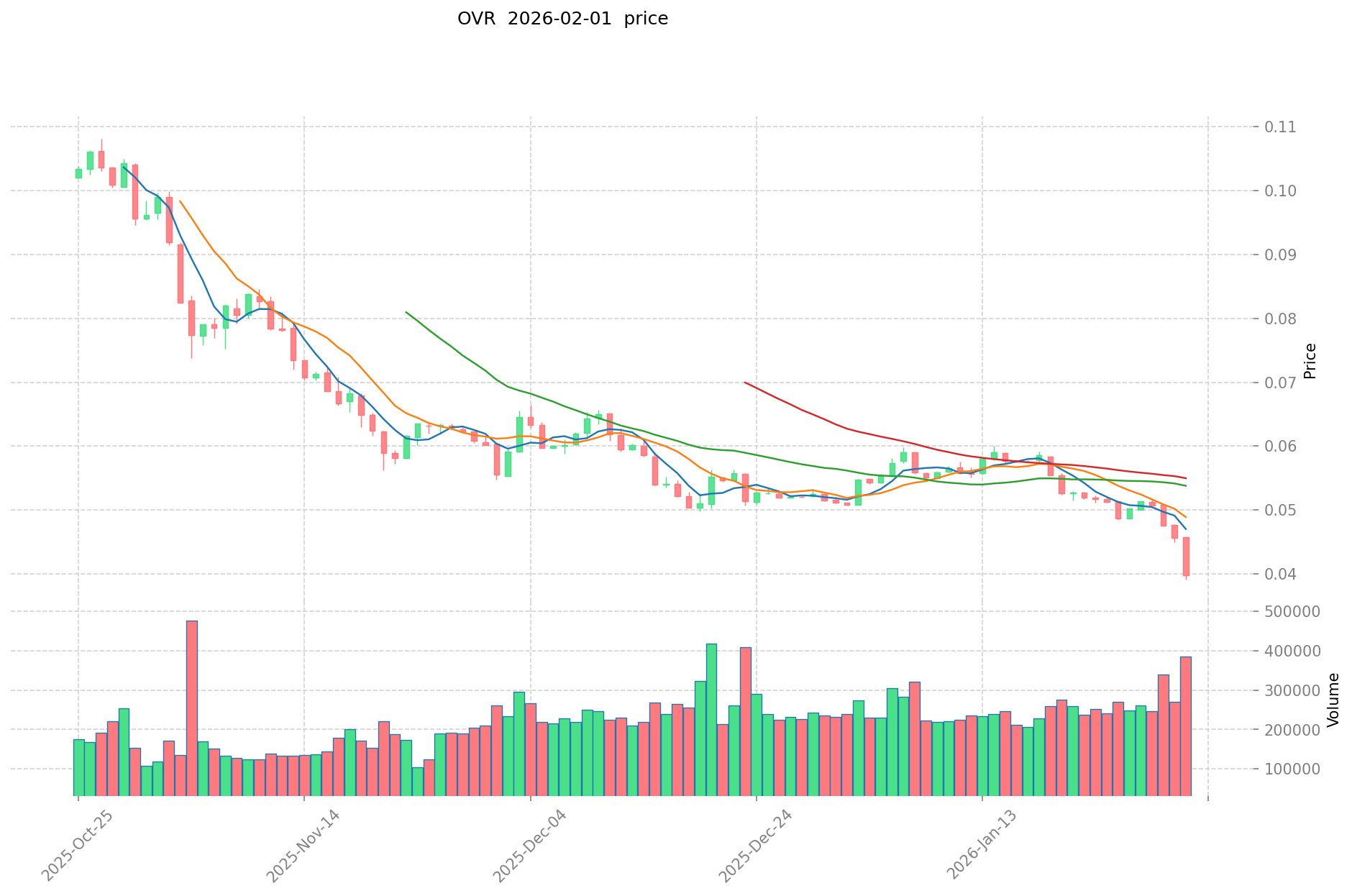
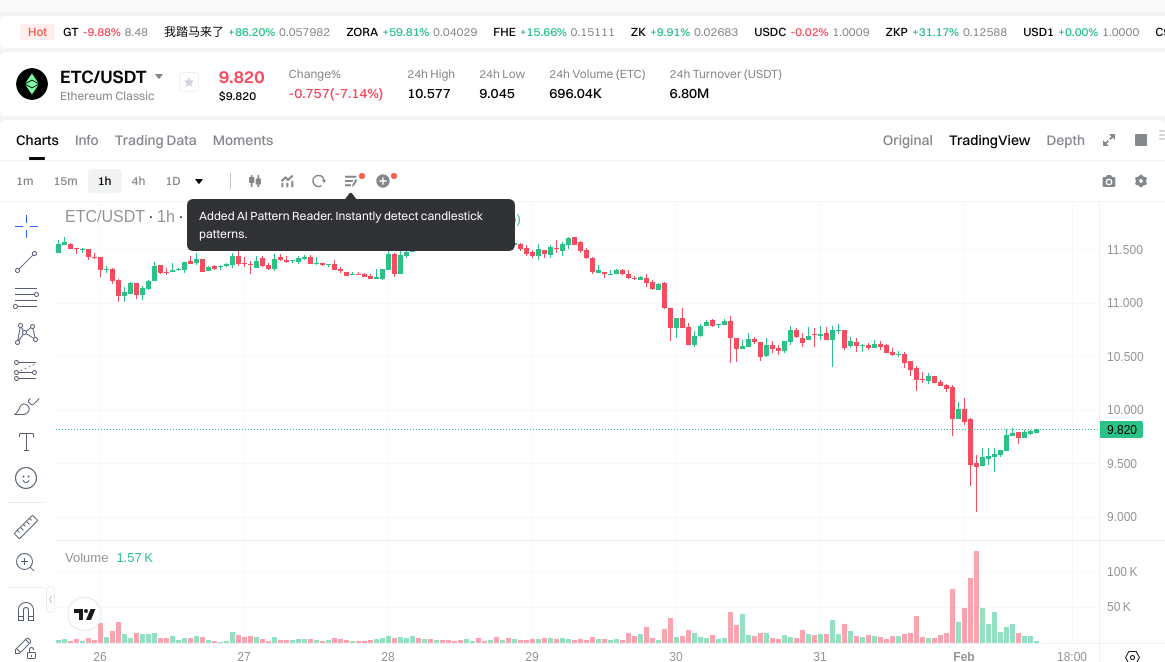
- Comparative Analysis: During the recent market cycle, OVR declined from its historical high of $3.33 to a current price of $0.03964, representing a substantial downward movement. Meanwhile, ETC decreased from its peak of $167.09 to $9.793, showing a similar pattern of decline but with different percentage drops relative to their respective highs.
Current Market Situation (2026-02-01)
- OVR Current Price: $0.03964
- ETC Current Price: $9.793
- 24-Hour Trading Volume: OVR recorded $17,202.40 while ETC showed significantly higher activity with $6,799,780.16
- Market Sentiment Index (Fear & Greed Index): 14 (Extreme Fear)
View Real-Time Prices:
II. Core Factors Influencing OVR vs ETC Investment Value
Supply Mechanism Comparison (Tokenomics)
- OVR: Information regarding OVR's supply mechanism is not available in the reference materials.
- ETC: Information regarding ETC's supply mechanism is not available in the reference materials.
- 📌 Historical Pattern: Supply mechanisms have historically influenced price cycles through scarcity dynamics and emission schedules, though specific data for these assets is not provided.
Institutional Adoption and Market Applications
- Institutional Holdings: Comparative data on institutional preference between OVR and ETC is not available in the reference materials.
- Enterprise Adoption: Information regarding OVR and ETC applications in cross-border payments, settlement, or investment portfolios is not provided in the reference materials.
- National Policies: Regulatory attitudes from different jurisdictions toward these assets are not documented in the available materials.
Technological Development and Ecosystem Building
- OVR Technical Upgrades: Specific technical upgrades and their potential impacts are not detailed in the reference materials.
- ETC Technical Development: Information regarding ETC's technological advancements is not available in the reference materials.
- Ecosystem Comparison: Comparative analysis of DeFi, NFT, payment systems, and smart contract implementations for both assets is not provided in the available materials.
Macroeconomic Environment and Market Cycles
- Performance Under Inflation: Comparative anti-inflation characteristics between OVR and ETC are not documented in the reference materials.
- Macroeconomic Monetary Policy: The specific impacts of interest rates and dollar index movements on these assets are not detailed in the available materials.
- Geopolitical Factors: Information regarding cross-border transaction demand and international circumstances affecting these assets is not provided in the reference materials.
III. 2026-2031 Price Prediction: OVR vs ETC
Short-term Prediction (2026)
- OVR: Conservative $0.0351-$0.0398 | Optimistic $0.0398-$0.0454
- ETC: Conservative $7.55-$9.80 | Optimistic $9.80-$11.37
Mid-term Prediction (2028-2029)
- OVR may enter a gradual growth phase, with estimated price range of $0.0384-$0.0693 in 2028, potentially reaching $0.0429-$0.0673 in 2029
- ETC may enter a moderate expansion phase, with estimated price range of $9.38-$15.53 in 2028, potentially reaching $10.68-$15.35 in 2029
- Key drivers: institutional capital inflows, ETF developments, ecosystem expansion
Long-term Prediction (2030-2031)
- OVR: Baseline scenario $0.0324-$0.0635 | Optimistic scenario $0.0635-$0.0755 (2030); Baseline scenario $0.0626-$0.0695 | Optimistic scenario $0.0695-$0.0855 (2031)
- ETC: Baseline scenario $11.91-$14.35 | Optimistic scenario $14.35-$16.36 (2030); Baseline scenario $12.74-$15.35 | Optimistic scenario $15.35-$21.34 (2031)
View detailed price predictions for OVR and ETC
Disclaimer: The above predictions are based on historical data analysis and market trend modeling. Cryptocurrency markets are highly volatile and subject to various unpredictable factors. These projections should not be considered as investment advice. Please conduct thorough research and consult professional financial advisors before making any investment decisions.
OVR:
| Year |
Predicted High Price |
Predicted Average Price |
Predicted Low Price |
Price Change |
| 2026 |
0.0454176 |
0.03984 |
0.0350592 |
0 |
| 2027 |
0.057122592 |
0.0426288 |
0.034529328 |
7 |
| 2028 |
0.06932721744 |
0.049875696 |
0.03840428592 |
25 |
| 2029 |
0.0673496460936 |
0.05960145672 |
0.0429130488384 |
50 |
| 2030 |
0.075535906174092 |
0.0634755514068 |
0.032372531217468 |
60 |
| 2031 |
0.085492046412248 |
0.069505728790446 |
0.062555155911401 |
75 |
ETC:
| Year |
Predicted High Price |
Predicted Average Price |
Predicted Low Price |
Price Change |
| 2026 |
11.37148 |
9.803 |
7.54831 |
0 |
| 2027 |
11.7518364 |
10.58724 |
8.3639196 |
8 |
| 2028 |
15.525658098 |
11.1695382 |
9.382412088 |
13 |
| 2029 |
15.34973787135 |
13.347598149 |
10.6780785192 |
36 |
| 2030 |
16.3574815315995 |
14.348668010175 |
11.90939444844525 |
46 |
| 2031 |
21.340773931533277 |
15.35307477088725 |
12.743052059836417 |
56 |
IV. Investment Strategy Comparison: OVR vs ETC
Long-term vs Short-term Investment Strategies
-
OVR: May appeal to investors interested in emerging technology applications, particularly those focusing on augmented reality (AR) integration and decentralized network platforms connecting physical and virtual environments. The asset shows higher volatility characteristics suitable for speculative positioning.
-
ETC: May suit investors seeking exposure to established smart contract platforms with historical market presence since 2015. The asset represents continuation of original Ethereum chain principles and demonstrates relatively higher liquidity based on trading volume data.
Risk Management and Asset Allocation
-
Conservative Investors: OVR 20-30% vs ETC 70-80% - Higher allocation toward ETC reflects its established market position and greater liquidity ($6.8M vs $17K daily trading volume)
-
Aggressive Investors: OVR 40-50% vs ETC 50-60% - Balanced exposure allowing participation in potential upside from both emerging AR-focused platforms and established smart contract ecosystems
-
Hedging Tools: Stablecoin allocation for liquidity management, options strategies for downside protection, cross-asset portfolio diversification across different cryptocurrency categories
V. Potential Risk Comparison
Market Risk
-
OVR: Exhibits substantial price decline from historical high of $3.33 to current $0.03964, indicating significant volatility exposure. Lower trading volume ($17,202.40 daily) suggests reduced liquidity and potential for increased price impact during transactions.
-
ETC: Demonstrates considerable price movement from peak of $167.09 to current $9.793. Higher trading volume ($6,799,780.16 daily) provides better liquidity conditions, though still subject to broader cryptocurrency market cycles and sentiment shifts.
Technical Risk
-
OVR: Scalability considerations and network stability factors require evaluation, though specific technical infrastructure details are not extensively documented in available materials.
-
ETC: Network security considerations and consensus mechanism characteristics warrant attention, particularly regarding mining concentration dynamics and potential vulnerability assessments.
Regulatory Risk
- Global regulatory developments may impact both assets differently based on their respective use cases. AR-focused platforms and smart contract platforms face distinct regulatory scrutiny frameworks across jurisdictions. Policy changes regarding cryptocurrency classification, taxation, and operational requirements could affect adoption trajectories and market accessibility.
VI. Conclusion: Which Is the Better Buy?
📌 Investment Value Summary:
-
OVR Advantages: Positioning in augmented reality and decentralized network space represents exposure to emerging technology sectors. Current price level shows significant distance from historical peaks, potentially offering entry points for risk-tolerant investors.
-
ETC Advantages: Established market presence since 2015 with substantially higher liquidity profile. Represents continuation of original Ethereum chain with "code is law" principles, providing exposure to smart contract platform category with historical track record.
✅ Investment Recommendations:
-
Novice Investors: Consider starting with smaller position sizes in ETC due to its higher liquidity and established market presence. Thorough research and understanding of cryptocurrency fundamentals recommended before allocation decisions.
-
Experienced Investors: May evaluate portfolio diversification strategies incorporating both assets based on risk tolerance and investment horizon. Technical analysis and fundamental assessment of ecosystem developments suggested for informed positioning.
-
Institutional Investors: Comprehensive due diligence on liquidity profiles, custody solutions, and regulatory compliance frameworks recommended. Portfolio allocation decisions should align with institutional risk management policies and investment mandates.
⚠️ Risk Warning: Cryptocurrency markets exhibit extreme volatility. Current market sentiment index indicates Extreme Fear (14), reflecting challenging conditions. This content does not constitute investment advice. Conduct independent research and consult qualified financial professionals before making investment decisions.
VII. FAQ
Q1: What are the main differences between OVR and ETC in terms of their core technology and use cases?
OVR focuses on augmented reality (AR) integration and decentralized network platforms connecting physical and virtual environments, while ETC serves as an established smart contract platform representing the continuation of the original Ethereum chain. OVR, launched in 2020, targets emerging applications in AR and virtual-physical world integration. ETC, operating since 2015, maintains the "code is law" principle and provides infrastructure for decentralized applications and smart contracts, making it a more mature platform with broader ecosystem development.
Q2: How do the liquidity profiles of OVR and ETC compare, and why does this matter for investors?
ETC demonstrates significantly higher liquidity with a 24-hour trading volume of $6,799,780.16 compared to OVR's $17,202.40 as of February 1, 2026. This substantial difference impacts investors through transaction execution efficiency, price stability, and market depth. Higher liquidity in ETC allows for larger position entries and exits with reduced price impact, making it more suitable for institutional investors and those requiring reliable trade execution. OVR's lower liquidity may result in wider bid-ask spreads and increased slippage during transactions.
Q3: What should investors consider when choosing between OVR and ETC based on their risk tolerance?
Conservative investors may prefer higher allocation toward ETC (70-80%) due to its established market position, greater liquidity, and longer operational history since 2015. Aggressive investors might consider balanced exposure (40-50% OVR, 50-60% ETC) to participate in both emerging AR-focused platforms and established smart contract ecosystems. Risk assessment should account for OVR's substantial price decline from $3.33 to $0.03964 and ETC's movement from $167.09 to $9.793, both indicating significant volatility exposure requiring appropriate position sizing and risk management strategies.
Q4: How have OVR and ETC performed relative to their historical peaks, and what does this indicate?
OVR reached its all-time high of $3.33 on December 2, 2021, and has declined to $0.03964, representing approximately 98.8% decrease from peak levels. ETC achieved its historical high of $167.09 on May 7, 2021, and currently trades at $9.793, showing approximately 94.1% decline from its peak. Both assets experienced substantial corrections following the 2021 cryptocurrency market peak, though OVR exhibits a more severe percentage decline. These movements reflect broader market cycle dynamics and suggest both assets remain significantly below previous valuation levels, though past performance does not guarantee future results.
Q5: What are the projected price ranges for OVR and ETC through 2031?
For 2026, OVR predictions range from $0.0351-$0.0454 (conservative to optimistic), while ETC ranges from $7.55-$11.37. By 2031, OVR projections extend to $0.0626-$0.0855 (baseline to optimistic), and ETC forecasts reach $12.74-$21.34 (baseline to optimistic). These predictions incorporate historical data analysis and market trend modeling, with ETC showing higher absolute price targets reflecting its larger market capitalization and established position. However, cryptocurrency markets remain highly volatile and subject to unpredictable factors including regulatory developments, technological changes, and macroeconomic conditions.
Q6: How does the current market sentiment affect investment decisions in OVR versus ETC?
The current Market Sentiment Index stands at 14, indicating Extreme Fear conditions as of February 1, 2026. This environment typically presents both challenges and potential opportunities: prices may face continued downward pressure from negative sentiment, but historically, extreme fear levels have sometimes preceded market reversals. Investors should recognize that both OVR and ETC operate within this challenging sentiment backdrop, requiring careful consideration of entry timing, position sizing, and risk management. Extreme fear conditions may offer accumulation opportunities for long-term investors with appropriate risk tolerance, though short-term volatility may persist.
Q7: What regulatory considerations should investors evaluate when comparing OVR and ETC?
Both assets face distinct regulatory frameworks based on their respective use cases. OVR's AR-focused platform and ETC's smart contract infrastructure encounter different scrutiny across jurisdictions. Regulatory developments regarding cryptocurrency classification, taxation policies, and operational requirements could significantly impact adoption trajectories and market accessibility for both assets. Investors should monitor evolving regulatory landscapes in major markets, assess compliance frameworks applicable to each asset, and consider how policy changes might affect their investment thesis. Global regulatory coordination efforts and jurisdiction-specific approaches may create varying operational environments for these distinct cryptocurrency categories.
Q8: What portfolio allocation strategies are recommended for different investor types considering OVR and ETC?
Novice investors should consider starting with smaller position sizes in ETC due to its higher liquidity ($6.8M daily volume) and established market presence, allowing for better trade execution and reduced complexity. Experienced investors may evaluate diversification strategies incorporating both assets, with technical analysis and ecosystem assessment informing allocation decisions based on individual risk tolerance and investment horizons. Institutional investors require comprehensive due diligence on liquidity profiles, custody solutions, and regulatory compliance frameworks, ensuring portfolio decisions align with institutional risk management policies and investment mandates. All investor categories should maintain appropriate diversification across cryptocurrency holdings and traditional assets to manage overall portfolio risk exposure.
* The information is not intended to be and does not constitute financial advice or any other recommendation of any sort offered or endorsed by Gate.