This comprehensive comparison analyzes OXT and LTC as distinct cryptocurrency investment opportunities. OXT, a decentralized VPN privacy token launched in 2019, currently trades at $0.02198 with lower liquidity, while LTC (Litecoin), the established digital silver since 2011, trades at $68.38 with significantly higher trading volume on Gate. The article examines historical price trends, market status, investment strategies, and risk profiles for both assets in the current extreme fear market sentiment. Long-term price forecasts through 2031 are provided alongside guidance for novice, experienced, and institutional investors with different risk tolerances. Key risk considerations include market volatility, liquidity disparities, and regulatory factors affecting both tokens. The analysis concludes that LTC suits conservative investors seeking stability, while OXT appeals to aggressive investors accepting higher risk for potential privacy-sector exposure.
Introduction: OXT vs LTC Investment Comparison
In the cryptocurrency market, the comparison between OXT and LTC continues to be a topic that investors cannot overlook. The two differ significantly in market cap ranking, application scenarios, and price performance, representing different cryptocurrency asset positioning.
OXT (Orchid): Launched in 2019, it has gained market recognition through its positioning in decentralized VPN services and privacy protection.
LTC (Litecoin): Since its launch in 2011, it has been regarded as digital silver and ranks among the cryptocurrencies with substantial global trading volume and market capitalization.
This article will comprehensively analyze the investment value comparison between OXT and LTC from multiple perspectives including historical price trends, supply mechanisms, institutional adoption, technical ecosystems, and future predictions, attempting to answer investors' most pressing question:
"Which is the better buy right now?"
I. Historical Price Comparison and Current Market Status
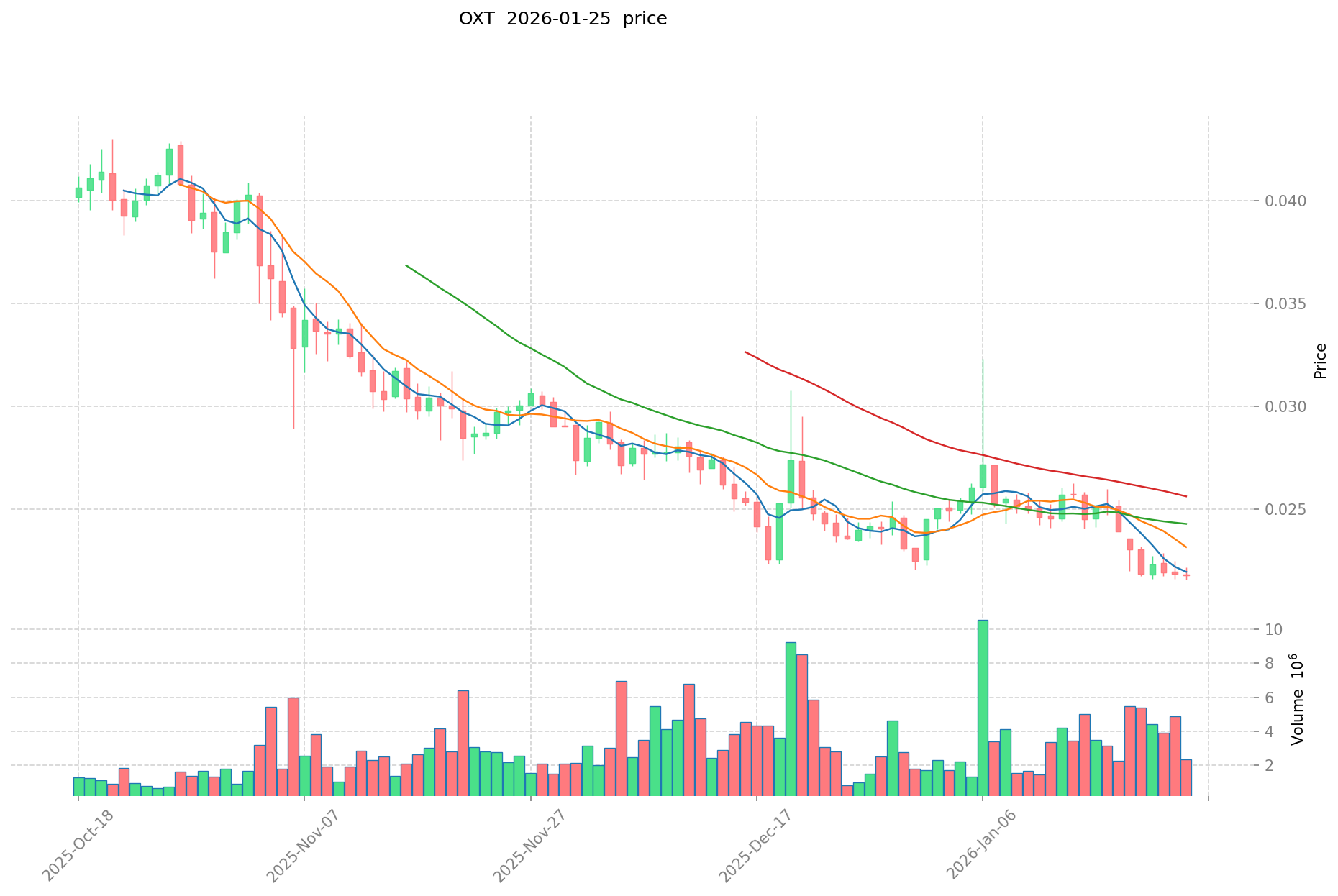
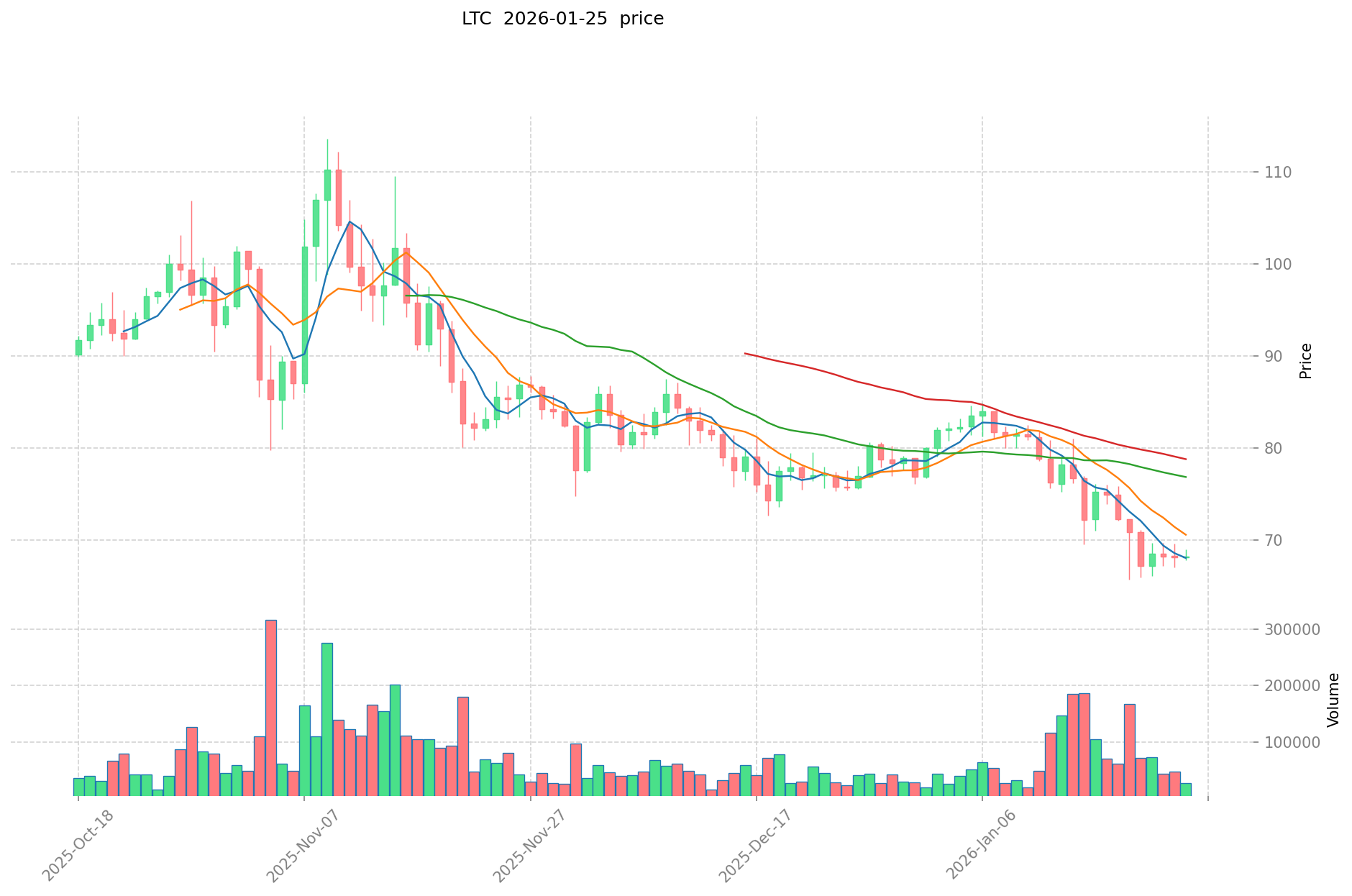
Price History of OXT (Coin A) and LTC (Coin B)
- 2021: OXT reached its all-time high of $1.026 on April 5, 2021, during the broader cryptocurrency market rally.
- 2021: LTC achieved its historical peak of $410.26 on May 10, 2021, reflecting strong market momentum during the same bull cycle.
- 2015: LTC recorded its all-time low of $1.15 on January 14, 2015, during a prolonged bear market phase.
- 2026: OXT touched its all-time low of $0.02161676 on January 25, 2026, marking a significant decline from its previous highs.
- Comparative Analysis: During the market cycle from 2021 to 2026, OXT declined from $1.026 to $0.02198, representing a substantial correction. In contrast, LTC decreased from $410.26 to $68.38, showing a similar downward trend but maintaining relatively stronger price levels.
Current Market Conditions (January 25, 2026)
- OXT current price: $0.02198
- LTC current price: $68.38
- 24-hour trading volume: OXT recorded $54,616.08 versus LTC's $1,869,269.71
- Market sentiment index (Fear & Greed Index): 25 (Extreme Fear)
- Price changes in the past 24 hours: OXT decreased by 0.5%, while LTC increased by 0.1%
- Weekly performance: OXT declined by 13.68%, and LTC fell by 8.49%
View real-time prices:
II. Core Factors Affecting OXT vs LTC Investment Value
Supply Mechanism Comparison (Tokenomics)
Due to insufficient reference materials regarding the supply mechanisms of OXT and LTC, this section cannot provide a detailed comparative analysis at this time.
Institutional Adoption and Market Application
The reference materials do not contain sufficient information about institutional holdings, enterprise adoption cases, or national policy attitudes toward OXT and LTC. A comprehensive comparison of their applications in cross-border payments, settlements, and investment portfolios cannot be established based on available data.
Technology Development and Ecosystem Construction
Without adequate information from the reference materials regarding technical upgrades for either OXT or LTC, and lacking details about their ecosystem developments in areas such as DeFi, NFT, payments, or smart contract implementations, this section cannot provide meaningful comparative insights.
Macroeconomic Conditions and Market Cycles
The reference materials do not provide sufficient data to analyze the performance of OXT versus LTC under various macroeconomic conditions, including inflationary environments, monetary policy changes, interest rate fluctuations, USD index movements, or geopolitical factors affecting cross-border transaction demands.
III. 2026-2031 Price Forecast: OXT vs LTC
Short-term Forecast (2026)
- OXT: Conservative range $0.013188 - $0.02198 | Optimistic range $0.02198 - $0.0325304
- LTC: Conservative range $54.0281 - $68.39 | Optimistic range $68.39 - $99.1655
Mid-term Forecast (2028-2029)
- OXT may enter a gradual growth phase, with projected price range of $0.02143894032 - $0.043540795242
- LTC may enter a moderate expansion phase, with projected price range of $76.1414080875 - $130.917353592375
- Key drivers: institutional capital flows, ETF developments, ecosystem expansion
Long-term Forecast (2030-2031)
- OXT: Baseline scenario $0.02264812476318 - $0.039048490971 | Optimistic scenario $0.039048490971 - $0.062590826177415
- LTC: Baseline scenario $109.73609817534 - $129.740074405219687 | Optimistic scenario $129.740074405219687 - $158.282890774368018
View detailed price predictions for OXT and LTC
Disclaimer
OXT:
| Year |
Predicted High Price |
Predicted Average Price |
Predicted Low Price |
Price Change |
| 2026 |
0.0325304 |
0.02198 |
0.013188 |
0 |
| 2027 |
0.029163064 |
0.0272552 |
0.014172704 |
24 |
| 2028 |
0.0409032414 |
0.028209132 |
0.02143894032 |
28 |
| 2029 |
0.043540795242 |
0.0345561867 |
0.02764494936 |
57 |
| 2030 |
0.05232497790114 |
0.039048490971 |
0.02264812476318 |
77 |
| 2031 |
0.062590826177415 |
0.04568673443607 |
0.035635652860134 |
107 |
LTC:
| Year |
Predicted High Price |
Predicted Average Price |
Predicted Low Price |
Price Change |
| 2026 |
99.1655 |
68.39 |
54.0281 |
0 |
| 2027 |
99.6955225 |
83.77775 |
67.0222 |
22 |
| 2028 |
103.6623989625 |
91.73663625 |
76.1414080875 |
34 |
| 2029 |
130.917353592375 |
97.69951760625 |
68.389662324375 |
43 |
| 2030 |
145.171713211126875 |
114.3084355993125 |
109.73609817534 |
67 |
| 2031 |
158.282890774368018 |
129.740074405219687 |
112.873864732541128 |
90 |
IV. Investment Strategy Comparison: OXT vs LTC
Long-term vs Short-term Investment Strategies
- OXT: May be suitable for investors with higher risk tolerance who are interested in emerging privacy-focused technologies and decentralized VPN services, though its substantial price decline from historical highs warrants careful consideration.
- LTC: May appeal to investors seeking exposure to more established cryptocurrency assets with longer market presence and relatively higher liquidity, as evidenced by its significantly larger 24-hour trading volume of $1,869,269.71 compared to OXT's $54,616.08.
Risk Management and Asset Allocation
- Conservative investors: Given the current market sentiment index of 25 (Extreme Fear) and recent weekly declines (OXT: -13.68%, LTC: -8.49%), a cautious approach with limited exposure to either asset may be considered, with emphasis on diversification across multiple cryptocurrencies and traditional assets.
- Aggressive investors: Those with higher risk appetite might consider a more balanced allocation between established assets like LTC and smaller-cap tokens like OXT, while maintaining awareness of the significantly different risk profiles between the two.
- Hedging tools: Stablecoin allocations, options strategies, and cross-asset portfolio combinations may help manage volatility exposure in current market conditions.
V. Potential Risk Comparison
Market Risk
- OXT: The token has experienced considerable price depreciation, declining from $1.026 in April 2021 to $0.02198 as of January 25, 2026, with its all-time low of $0.02161676 recorded on the same date. The relatively low 24-hour trading volume of $54,616.08 may present liquidity concerns.
- LTC: While LTC has also experienced significant decline from its May 2021 peak of $410.26 to the current price of $68.38, it maintains substantially higher trading volume at $1,869,269.71, suggesting better liquidity conditions compared to OXT.
Technical Risk
- OXT: Information regarding scalability developments and network stability metrics is not available in the reference materials.
- LTC: Data concerning mining power concentration and security vulnerabilities is not provided in the reference materials.
Regulatory Risk
The reference materials do not contain sufficient information regarding specific regulatory developments or policy impacts affecting either OXT or LTC in various jurisdictions.
VI. Conclusion: Which Is the Better Buy?
📌 Investment Value Summary:
- OXT highlights: Positioned in the decentralized VPN and privacy protection sector since 2019, though currently facing significant price challenges with substantial decline from historical peaks.
- LTC highlights: Established market presence since 2011 with recognition as digital silver, maintaining relatively higher liquidity with 24-hour trading volume exceeding $1.86 million, and demonstrating more moderate price decline compared to OXT in recent market conditions.
✅ Investment Recommendations:
- Novice investors: Given the current extreme fear sentiment (Fear & Greed Index: 25) and recent price weakness in both assets, newcomers should approach with caution, conduct thorough research, and consider starting with smaller position sizes while prioritizing education about cryptocurrency fundamentals.
- Experienced investors: May evaluate the different risk-return profiles of both assets, with OXT presenting higher risk given its substantial price decline and lower liquidity, while LTC offers relatively more established market positioning, though neither asset is immune to continued market volatility.
- Institutional investors: Should conduct comprehensive due diligence considering factors including liquidity requirements, regulatory compliance, custody solutions, and portfolio diversification objectives before making allocation decisions between these assets.
⚠️ Risk Warning: The cryptocurrency market exhibits substantial volatility. This content does not constitute investment advice. Investors should conduct independent research and consult qualified financial advisors before making investment decisions.
VII. FAQ
Q1: What is the current price difference between OXT and LTC, and how does it reflect their market positioning?
As of January 25, 2026, OXT trades at $0.02198 while LTC is priced at $68.38, representing a substantial price differential that reflects their distinct market positions. LTC, established in 2011 as "digital silver," commands significantly higher liquidity with 24-hour trading volume of $1,869,269.71 compared to OXT's $54,616.08. This price and volume disparity illustrates LTC's more mature market presence and broader institutional adoption, while OXT's lower price point and limited liquidity reflect its positioning as a specialized privacy-focused token in the decentralized VPN sector since 2019.
Q2: How have OXT and LTC performed from their all-time highs, and what does this indicate about their risk profiles?
OXT has declined approximately 97.9% from its all-time high of $1.026 (April 5, 2021) to its current price of $0.02198, while LTC has decreased approximately 83.3% from its peak of $410.26 (May 10, 2021) to $68.38. OXT's more severe drawdown, coupled with its all-time low of $0.02161676 recorded on January 25, 2026, indicates a higher-risk profile with greater volatility and price depreciation. LTC's relatively moderate decline demonstrates comparatively stronger price resilience, though both assets have experienced substantial corrections during the 2021-2026 market cycle.
Q3: What are the projected price ranges for OXT and LTC through 2031?
For OXT, short-term 2026 forecasts range from $0.013188 to $0.0325304, with long-term 2031 projections spanning $0.035635652860134 to $0.062590826177415 in the optimistic scenario. For LTC, 2026 estimates range from $54.0281 to $99.1655, with 2031 predictions reaching $112.873864732541128 to $158.282890774368018 in the optimistic case. These projections suggest potential growth trajectories for both assets, though investors should recognize that cryptocurrency price predictions carry substantial uncertainty and should not be considered guaranteed outcomes.
Q4: Which asset is more suitable for conservative versus aggressive investors?
Conservative investors may find LTC more appropriate given its established 13-year market history, significantly higher liquidity ($1.86 million vs. $54,616.08 daily volume), and relatively lower drawdown from historical peaks. LTC's market positioning as digital silver provides greater stability and institutional recognition. Aggressive investors with higher risk tolerance might consider OXT for its exposure to emerging privacy technology and decentralized VPN services, though they must accept substantially higher volatility, limited liquidity, and the significant price depreciation evidenced by its 97.9% decline from all-time highs.
Q5: How does the current market sentiment affect OXT and LTC investment decisions?
The current Fear & Greed Index stands at 25 (Extreme Fear), reflecting widespread market anxiety. In this environment, both assets have experienced recent weakness, with OXT declining 13.68% and LTC falling 8.49% over the past week. This extreme fear sentiment typically suggests investor caution is warranted, potentially indicating buying opportunities for contrarian investors or signaling further downside risk for risk-averse participants. The sentiment particularly impacts OXT's lower liquidity environment, where fear-driven selling can exacerbate price movements, while LTC's higher trading volume may provide somewhat better price stability during market stress.
Q6: What are the key liquidity considerations when comparing OXT and LTC investments?
Liquidity represents a critical differentiating factor between these assets. LTC's 24-hour trading volume of $1,869,269.71 substantially exceeds OXT's $54,616.08, providing LTC investors with greater ease of entry and exit, tighter bid-ask spreads, and reduced slippage on larger orders. OXT's limited liquidity presents challenges for investors seeking to execute significant positions without impacting market prices, potentially resulting in unfavorable execution prices during volatile conditions. For institutional investors or those managing larger portfolios, LTC's superior liquidity makes it a more practical choice, while OXT's thin trading volume may only suit smaller position sizes or investors with extended investment horizons.
Q7: What information gaps exist in evaluating OXT versus LTC, and how should investors address them?
The analysis reveals significant information gaps regarding both assets' supply mechanisms, institutional adoption specifics, technical development roadmaps, ecosystem growth metrics, and regulatory compliance status. Investors cannot fully assess tokenomics comparisons, enterprise use cases, DeFi ecosystem integration, or jurisdiction-specific regulatory treatments based on available reference materials. To address these gaps, investors should conduct independent research through official project documentation, developer community channels, regulatory filing databases, and on-chain analytics platforms. Consulting with qualified financial advisors and legal professionals familiar with cryptocurrency regulations is essential before making allocation decisions.
Q8: Considering the 2026-2031 forecasts, what annual growth rates do OXT and LTC projections suggest?
Based on average price predictions, OXT shows projected annual growth ranging from 24% (2027) to 107% (2031), with particularly strong growth anticipated in later years. LTC demonstrates more moderate projected annual growth from 22% (2027) to 90% (2031), reflecting expectations of steady expansion rather than explosive appreciation. However, investors must recognize that these forecasts assume favorable market conditions, continued technological development, and increasing adoption—none of which are guaranteed. The projections should be viewed as potential scenarios rather than reliable predictions, and actual results may vary substantially due to market volatility, regulatory changes, technological disruptions, or macroeconomic factors.
* The information is not intended to be and does not constitute financial advice or any other recommendation of any sort offered or endorsed by Gate.