This comprehensive investment guide compares PAX Gold (PAXG) and Ethereum (ETH) as long-term digital assets, analyzing their distinct positioning in crypto markets. PAXG, backed by physical gold reserves, offers inflation hedging and portfolio stability with approximately 12% annual volatility, while ETH delivers exposure to blockchain infrastructure with 47% volatility and staking yield opportunities. The article examines historical price trends, tokenomics differences, institutional adoption rates, and 2026-2031 price forecasts showing PAXG potentially reaching $12,751.90 and ETH reaching $8,393.15 by 2031. Key factors evaluated include regulatory landscapes, ecosystem development, macroeconomic sensitivity, and risk profiles. The guide provides tailored investment strategies for beginner, experienced, and institutional investors, emphasizing PAXG's suitability for capital preservation during economic uncertainty and ETH's potential for technology-focused growth portfolios. Trade both assets on Gate for opt
Introduction: PAXG and ETH Investment Comparison
In the cryptocurrency market, the comparison between PAXG and ETH remains a topic of ongoing interest among investors. These two assets differ significantly in market capitalization ranking, application scenarios, and price performance, while representing distinct positioning within the crypto asset landscape.
PAX Gold (PAXG): Launched in September 2019, it has gained market recognition through its positioning as a cost-effective digital representation of physical gold backed by London Bullion Market Association (LBMA) vault reserves.
Ethereum (ETH): Since its launch in July 2015, it has established itself as a decentralized blockchain platform supporting smart contracts and decentralized applications (DApps), becoming one of the cryptocurrencies with significant global trading volume and market capitalization.
This article will provide a comprehensive analysis of the PAXG vs ETH investment value comparison, covering historical price trends, supply mechanisms, institutional adoption, technical ecosystems, and future projections, while attempting to address the question most pressing to investors:
"Which option may align better with different investment strategies and risk profiles?"
I. Historical Price Comparison and Current Market Status
Historical Price Trends of PAXG (Coin A) and ETH (Coin B)
- 2025: PAXG experienced significant price movements, reaching a historical high of $4,854.86 on October 16, 2025, reflecting strong demand for gold-backed digital assets during this period.
- 2025: ETH faced notable volatility, achieving an all-time high of $4,946.05 on August 25, 2025, driven by developments in decentralized finance (DeFi) and institutional interest in blockchain technology.
- Comparative Analysis: During the 2025 market cycle, PAXG fluctuated between a low of $2,986.26 (April 7, 2025) and its peak of $4,854.86, demonstrating a price range tied to physical gold valuations. Meanwhile, ETH experienced broader volatility, moving from its lowest point of $0.432979 (historically recorded on October 20, 2015) to its 2025 peak of $4,946.05, reflecting its role as a foundational smart contract platform.
Current Market Status (January 14, 2026)
- PAXG Current Price: $4,605.35
- ETH Current Price: $3,214.55
- 24-Hour Trading Volume: PAXG recorded approximately $500.45 million, while ETH showed significantly higher activity with around $502.60 billion in trading volume.
- Market Sentiment Index (Fear & Greed Index): 26 (Fear)
View real-time prices:
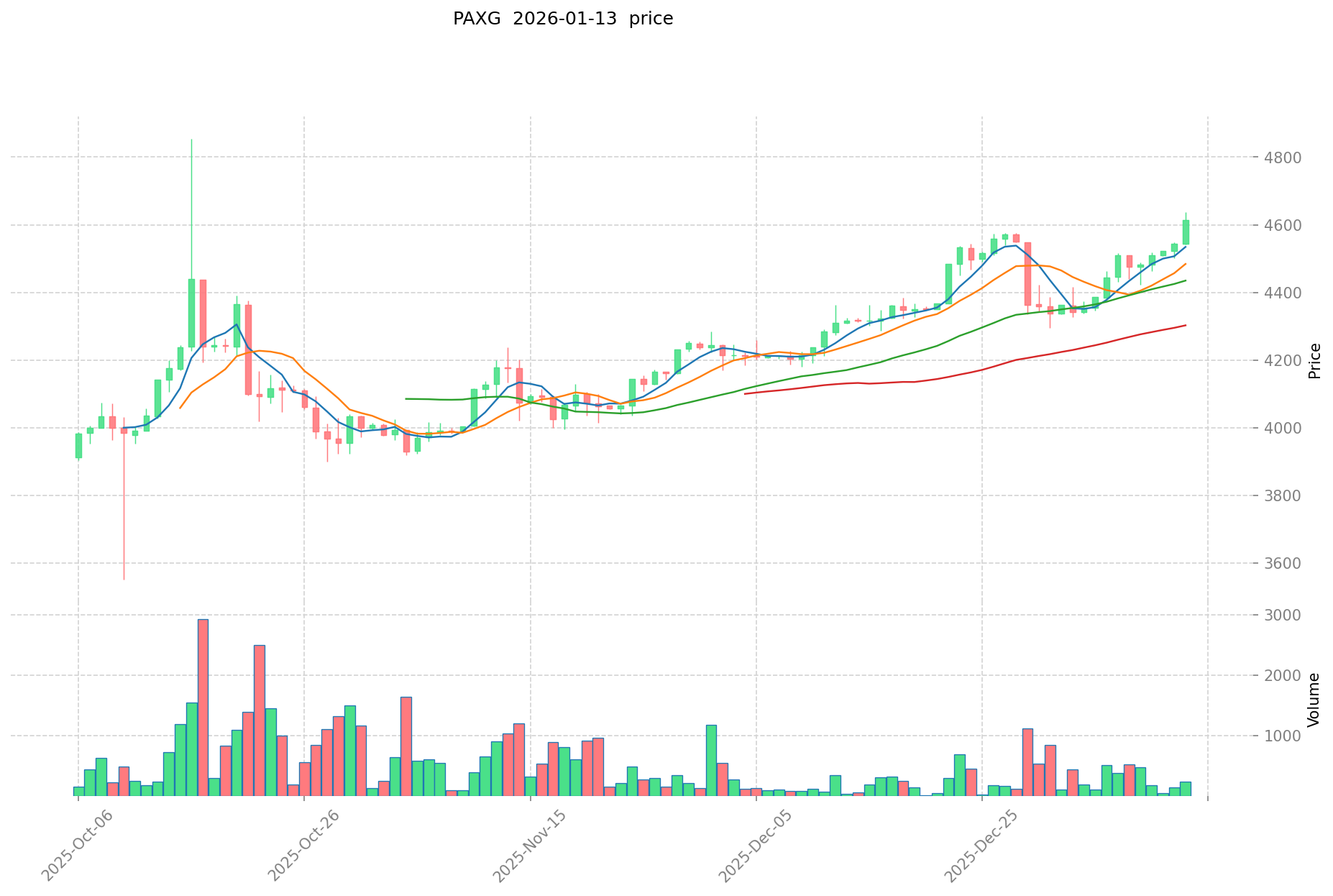
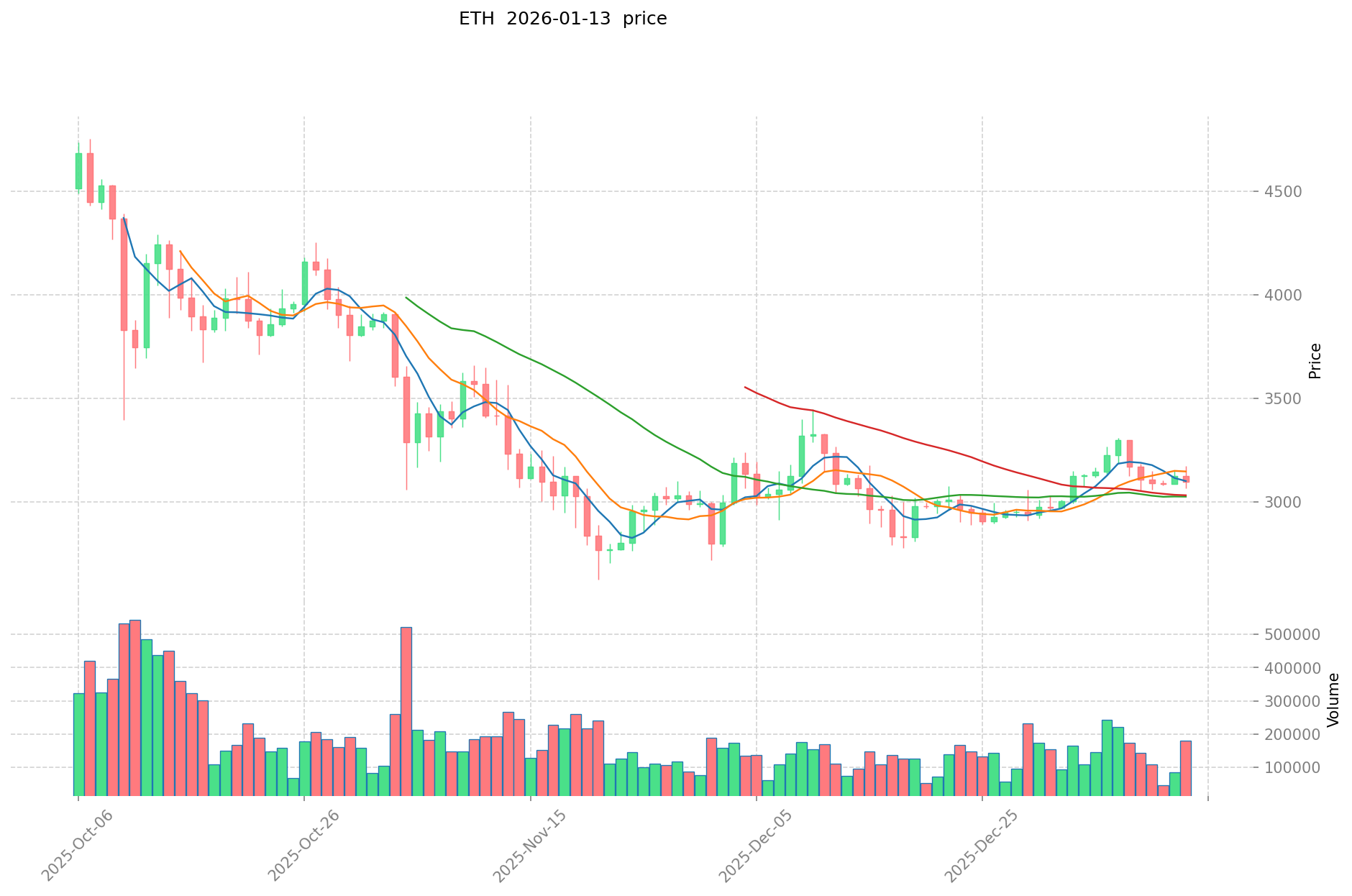
II. Core Factors Influencing PAXG vs ETH Investment Value
Tokenomics Comparison
-
PAXG: Asset-backed model where each token is pegged 1:1 to one troy ounce of physical gold stored in regulated vaults. The supply expands or contracts based on minting and redemption demand, with tokens created when users deposit collateral and burned upon redemption. This mechanism ties PAXG's supply directly to real-world gold reserves rather than following a predetermined issuance schedule.
-
ETH: Inflationary utility token model without a hard supply cap. ETH issuance occurs through staking rewards (PoS mechanism), currently yielding approximately 3-4% annually for validators. The network implements a burn mechanism via EIP-1559, where a portion of transaction fees is permanently removed from circulation, creating deflationary pressure during periods of high network activity.
-
📌 Historical Pattern: Supply mechanisms drive distinct price cycles - PAXG tracks gold market fundamentals and safe-haven demand during economic uncertainty, while ETH's value fluctuates with blockchain adoption, DeFi activity, and staking participation rates.
Institutional Adoption and Market Applications
-
Institutional Holdings: PAXG appeals to institutions seeking regulated exposure to gold without physical custody challenges, operating under NYDFS oversight through Paxos Trust Company. ETH attracts technology-focused institutions interested in blockchain infrastructure and DeFi ecosystem participation.
-
Enterprise Use Cases: PAXG serves as a digital gold settlement instrument and portfolio hedge, with applications in tokenized commodity trading. ETH functions as the foundation for decentralized applications, smart contracts, and serves as collateral in DeFi protocols. Major exchanges including Binance, Coinbase, and Kraken provide liquidity for PAXG, while ETH maintains broader integration across centralized and decentralized platforms.
-
Regulatory Landscape: PAXG operates within established commodities and securities frameworks, benefiting from clear regulatory status in jurisdictions like New York. ETH faces evolving classification debates globally, with regulatory approaches varying significantly across regions regarding its treatment as a commodity versus security.
Technology Development and Ecosystem Building
-
PAXG Technical Framework: Built as an ERC-20 token on Ethereum, enabling seamless integration with DeFi protocols. Each token links to specific serialized gold bars through Paxos verification tools, allowing transparent tracking of underlying assets. The architecture prioritizes regulatory compliance and audit transparency over technical innovation.
-
ETH Technical Evolution: Ongoing development includes scaling solutions and network upgrades to improve transaction throughput and reduce costs. The transition to Proof of Stake consensus has established staking as a core value proposition, with yields derived from network validation rather than mining.
-
Ecosystem Comparison: PAXG primarily functions within DeFi lending protocols (such as Aave and Morpho) where it serves as collateral or yield-generating asset, with annual returns typically ranging from 3% to 20% depending on market conditions. ETH underpins a comprehensive ecosystem spanning DeFi, NFTs, decentralized exchanges, and smart contract applications, with utility extending far beyond value storage to include network gas fees and staking participation.
Macroeconomic Conditions and Market Cycles
-
Inflation Hedge Characteristics: PAXG offers inflation protection through its direct linkage to physical gold, which historically serves as a store of value during currency devaluation periods. Gold-backed tokens have shown relative stability with lower volatility (approximately 12% annual volatility) compared to crypto-native assets. ETH exhibits higher price volatility (approximately 47% annual volatility as of 2024) and responds more directly to technological adoption trends than inflation metrics.
-
Monetary Policy Sensitivity: Interest rate changes and US dollar strength influence both assets differently - PAXG tends to move inversely with dollar strength and benefits from lower real interest rates, while ETH correlates more strongly with risk appetite in technology markets and crypto-specific liquidity conditions.
-
Geopolitical Considerations: PAXG gains appeal during geopolitical uncertainty as investors seek safe-haven assets, benefiting from gold's historical role in crisis scenarios. ETH's cross-border utility in decentralized finance and international settlements provides value in environments with capital controls or banking system restrictions, though it remains more sensitive to regulatory developments affecting blockchain technology adoption.
III. 2026-2031 Price Forecast: PAXG vs ETH
Short-term Forecast (2026)
- PAXG: Conservative $4,417.16 - $4,601.21 | Optimistic $4,601.21 - $5,475.44
- ETH: Conservative $3,018.17 - $3,210.82 | Optimistic $3,210.82 - $4,045.63
Mid-term Forecast (2028-2029)
- PAXG may enter a growth phase with estimated price range of $3,006.37 - $8,705.94
- ETH may enter an expansion phase with estimated price range of $2,358.35 - $6,048.45
- Key drivers: institutional capital inflows, ETF developments, ecosystem growth
Long-term Forecast (2031)
- PAXG: Base scenario $6,419.92 - $8,794.41 | Optimistic scenario $8,794.41 - $12,751.90
- ETH: Base scenario $4,104.68 - $6,126.39 | Optimistic scenario $6,126.39 - $8,393.15
View detailed price predictions for PAXG and ETH
Disclaimer
PAXG:
| Year |
Predicted High Price |
Predicted Average Price |
Predicted Low Price |
Price Change |
| 2026 |
5475.4399 |
4601.21 |
4417.1616 |
0 |
| 2027 |
6096.3731895 |
5038.32495 |
4332.959457 |
9 |
| 2028 |
6959.1863371875 |
5567.34906975 |
3006.368497665 |
20 |
| 2029 |
8705.9421078215625 |
6263.26770346875 |
3820.5932991159375 |
35 |
| 2030 |
10104.216622620960937 |
7484.60490564515625 |
4041.686649048384375 |
62 |
| 2031 |
12751.895607992934961 |
8794.410764133058593 |
6419.919857817132773 |
90 |
ETH:
| Year |
Predicted High Price |
Predicted Average Price |
Predicted Low Price |
Price Change |
| 2026 |
4045.6332 |
3210.82 |
3018.1708 |
0 |
| 2027 |
5406.057634 |
3628.2266 |
2358.34729 |
12 |
| 2028 |
4788.17064402 |
4517.142117 |
3433.02800892 |
40 |
| 2029 |
6048.453294663 |
4652.65638051 |
4326.9704338743 |
44 |
| 2030 |
6902.215740486585 |
5350.5548375865 |
4761.993805451985 |
66 |
| 2031 |
8393.147845980063225 |
6126.3852890365425 |
4104.678143654483475 |
90 |
IV. Investment Strategy Comparison: PAXG vs ETH
Long-term vs Short-term Investment Strategies
-
PAXG: Suitable for investors seeking portfolio diversification through gold exposure, those looking for inflation hedges during economic uncertainty, and participants interested in regulated digital commodities with lower volatility profiles. The asset's correlation with traditional gold markets makes it appropriate for wealth preservation strategies rather than growth-oriented approaches.
-
ETH: Suitable for investors focused on blockchain technology adoption, participants seeking exposure to decentralized finance ecosystems, and those willing to accept higher volatility for potential growth returns. The asset appeals to technology-forward investors interested in smart contract platforms and staking yield opportunities.
Risk Management and Asset Allocation
-
Conservative Investors: PAXG 60-70% vs ETH 30-40% - emphasizing capital preservation through gold-backed stability while maintaining limited exposure to blockchain technology growth potential.
-
Aggressive Investors: PAXG 20-30% vs ETH 70-80% - prioritizing growth opportunities in decentralized technology while using gold-backed assets as portfolio stabilizers during market corrections.
-
Hedging Tools: Stablecoin allocation for liquidity management (10-20% of portfolio), options strategies for downside protection, and cross-asset combinations pairing commodities with technology exposure to balance risk-reward profiles.
V. Potential Risk Comparison
Market Risks
-
PAXG: Price movements tied to physical gold market dynamics, including dollar strength fluctuations, interest rate policy changes, and commodity market liquidity conditions. Trading volume concentration on specific exchanges may create liquidity constraints during stress periods.
-
ETH: Higher volatility driven by technology adoption cycles, DeFi protocol developments, regulatory announcements, and broader cryptocurrency market sentiment. Network usage patterns and gas fee fluctuations can impact investor sentiment and transaction costs.
Technical Risks
-
PAXG: Dependency on Ethereum network performance for transaction processing, smart contract vulnerabilities in ERC-20 implementation, and custodial risks associated with physical gold storage despite regulatory oversight by Paxos Trust Company.
-
ETH: Network scalability challenges during high-demand periods, ongoing technical transitions affecting validator participation, and potential security vulnerabilities in smart contract code deployed across the ecosystem. Staking centralization among major validators presents governance considerations.
Regulatory Risks
- Global regulatory frameworks treat these assets differently - PAXG benefits from clearer commodity classification but faces oversight requirements for physical asset backing verification. ETH encounters varied regulatory interpretations across jurisdictions, with some regions treating it as a commodity while others consider securities frameworks. Staking rewards taxation and DeFi protocol regulations present evolving compliance landscapes affecting both institutional and retail participation.
VI. Conclusion: Which Is the Better Buy?
📌 Investment Value Summary:
-
PAXG Advantages: Provides regulated exposure to gold without physical custody requirements, offers relative price stability compared to crypto-native assets, functions effectively as portfolio diversification tool during market uncertainty, and maintains transparent asset backing through auditable reserves.
-
ETH Advantages: Delivers exposure to foundational blockchain infrastructure with extensive ecosystem applications, generates staking yields for network participation, benefits from deflationary tokenomics during high network activity, and maintains significantly higher trading liquidity across global markets.
✅ Investment Recommendations:
-
Beginner Investors: Consider starting with smaller allocations to both assets (such as 5-10% of crypto portfolio each) to understand their distinct risk-return characteristics. PAXG offers a familiar value proposition through gold backing, while ETH provides introduction to blockchain technology fundamentals.
-
Experienced Investors: Evaluate allocation based on macroeconomic outlook and risk tolerance - increase PAXG exposure during periods of currency devaluation concerns or rising inflation expectations, while emphasizing ETH during technology adoption cycles and favorable regulatory developments for blockchain infrastructure.
-
Institutional Investors: Assess compliance requirements and custody solutions for each asset class. PAXG fits traditional commodity allocation frameworks with established regulatory clarity, whereas ETH requires blockchain-native infrastructure but offers broader ecosystem participation opportunities through staking and DeFi protocols.
⚠️ Risk Warning: Cryptocurrency markets exhibit extreme volatility, and this content does not constitute investment advice. Conduct thorough due diligence and consider consulting financial professionals before making investment decisions.
VII. FAQ
Q1: What is the fundamental difference between PAXG and ETH as investment assets?
PAXG is a gold-backed stablecoin pegged 1:1 to physical gold, while ETH is a utility token powering a smart contract platform. PAXG derives its value from physical gold reserves stored in LBMA-certified vaults, with each token representing one troy ounce of gold. This makes it function similarly to traditional gold investments but in digital form. ETH, conversely, operates as the native currency of the Ethereum blockchain, enabling smart contracts, decentralized applications, and DeFi protocols. Its value stems from network utility, adoption rates, and technological development rather than commodity backing.
Q2: Which asset offers better protection during economic uncertainty?
PAXG typically provides superior downside protection during economic crises. As a gold-backed asset, PAXG exhibits significantly lower volatility (approximately 12% annually) compared to ETH's 47% volatility. During periods of inflation, currency devaluation, or geopolitical instability, PAXG benefits from gold's historical safe-haven status. However, ETH can offer value during specific crisis scenarios involving banking restrictions or capital controls due to its decentralized, borderless nature. For traditional economic downturns, PAXG's correlation with physical gold markets makes it the more conservative hedge.
Q3: How do the yield-generating mechanisms differ between PAXG and ETH?
PAXG generates yields primarily through DeFi lending protocols where it serves as collateral, with annual returns ranging from 3% to 20% depending on market conditions and platform selection. ETH offers staking yields of approximately 3-4% annually through network validation under its Proof of Stake consensus mechanism. Additionally, ETH benefits from deflationary tokenomics via EIP-1559's burn mechanism during high network activity periods. PAXG yields depend on third-party DeFi platforms, while ETH staking rewards come directly from protocol-level network operations, making ETH's yield mechanism more integrated into its core functionality.
Q4: What are the key regulatory considerations for each asset?
PAXG operates under clearer regulatory frameworks as a commodity-backed digital asset, regulated by the New York Department of Financial Services through Paxos Trust Company. This provides institutional investors with greater compliance certainty and established custody solutions. ETH faces more complex and evolving regulatory treatment globally, with jurisdictions disagreeing on its classification as a commodity versus security. Some regions impose securities regulations on ETH staking, while others treat it as a commodity. For conservative institutional investors prioritizing regulatory clarity, PAXG currently presents fewer compliance uncertainties.
Q5: How do liquidity profiles compare between PAXG and ETH?
ETH demonstrates significantly superior liquidity with approximately $502.60 billion in 24-hour trading volume compared to PAXG's $500.45 million. ETH maintains deep order books across numerous centralized and decentralized exchanges globally, enabling large position entries and exits with minimal price impact. PAXG liquidity concentrates on major exchanges like Binance, Coinbase, and Kraken, potentially creating execution challenges for larger institutional orders. For investors requiring quick position adjustments or trading substantial amounts, ETH's market depth provides considerable advantages over PAXG's more limited liquidity pools.
Q6: Which asset is more suitable for portfolio diversification purposes?
PAXG offers superior diversification benefits for crypto-heavy portfolios due to its correlation with traditional commodity markets rather than cryptocurrency cycles. Its gold backing provides exposure to an asset class with historical negative correlation to equities and crypto during market stress. ETH, while diversifying within blockchain technology categories, maintains high correlation with broader cryptocurrency market movements. For investors seeking to reduce overall portfolio volatility and add non-correlated assets, PAXG serves as a more effective diversification tool, particularly for those already holding significant crypto-native assets.
Q7: What are the primary technical risks associated with each asset?
PAXG faces custodial risks related to physical gold storage despite regulatory oversight, smart contract vulnerabilities in its ERC-20 implementation, and dependency on Ethereum network performance for transactions. ETH confronts network scalability challenges during congestion periods, ongoing technical transition risks affecting validator operations, and potential security vulnerabilities in its extensive smart contract ecosystem. Additionally, ETH's staking centralization among major validators presents governance concerns. For risk-averse investors, PAXG's simpler technical architecture and regulated custody structure generally present fewer technical uncertainties compared to ETH's complex, rapidly-evolving ecosystem.
Q8: How should investors approach allocation between PAXG and ETH based on market cycles?
Conservative investors should consider PAXG allocations of 60-70% during periods of economic uncertainty, rising inflation, or currency devaluation concerns, maintaining 30-40% ETH exposure for technology adoption potential. Aggressive investors might reverse this ratio to 20-30% PAXG and 70-80% ETH during favorable blockchain adoption cycles and stable macroeconomic conditions. Market timing considerations include increasing PAXG positions when real interest rates decline and dollar strength weakens, while emphasizing ETH during regulatory clarity improvements and DeFi ecosystem expansion phases. Rebalancing quarterly based on macroeconomic indicators and blockchain adoption metrics helps optimize risk-adjusted returns across different market environments.
* The information is not intended to be and does not constitute financial advice or any other recommendation of any sort offered or endorsed by Gate.