This comprehensive analysis compares PEAQ and UNI, two distinct blockchain assets serving different Web3 segments. PEAQ, launched in November 2024, operates as Layer-1 infrastructure for the Machine Economy (DePIN), serving 1.75 million devices across 21 industries. UNI, established since September 2020, functions as a pioneering decentralized exchange protocol on Ethereum. The article examines historical price performance, tokenomics, institutional adoption, technical ecosystems, and market dynamics through 2031. Current data shows PEAQ at $0.02211 with lower liquidity, while UNI trades at $4.276 with stronger trading volume. Price forecasts indicate PEAQ ranging $0.0146-$0.0329 by 2026, and UNI between $2.65-$4.70. The comparison provides risk-adjusted allocation strategies for conservative and aggressive investors, evaluating emerging infrastructure potential against established DeFi presence in the evolving cryptocurrency landscape.
Introduction: Investment Comparison Between PEAQ and UNI
In the cryptocurrency market, the comparison between PEAQ and UNI has become a topic of interest for investors. These two assets differ significantly in market cap ranking, application scenarios, and price performance, representing distinct positioning in the crypto asset landscape.
PEAQ: Launched in November 2024, it has positioned itself as a Layer-1 blockchain infrastructure for the Machine Economy (DePIN), serving over 1.75 million devices, vehicles, and machines across 21 industries.
UNI (Uniswap): Since its launch in September 2020, it has been recognized as a pioneering automated market-making protocol built on the Ethereum blockchain, establishing itself as one of the leading decentralized exchange platforms.
This article will provide a comprehensive analysis of the investment value comparison between PEAQ and UNI, examining aspects such as historical price trends, supply mechanisms, institutional adoption, technological ecosystems, and future projections, while attempting to address investors' primary concern:
"Which is the better buy right now?"
I. Historical Price Comparison and Current Market Status
PEAQ and UNI Historical Price Trends
- 2024: PEAQ reached a peak price of $0.75655 in December 2024, marking a notable initial valuation period for the token.
- 2021: UNI experienced a significant milestone when its price reached $44.92 in May 2021, reflecting strong market interest during the DeFi boom.
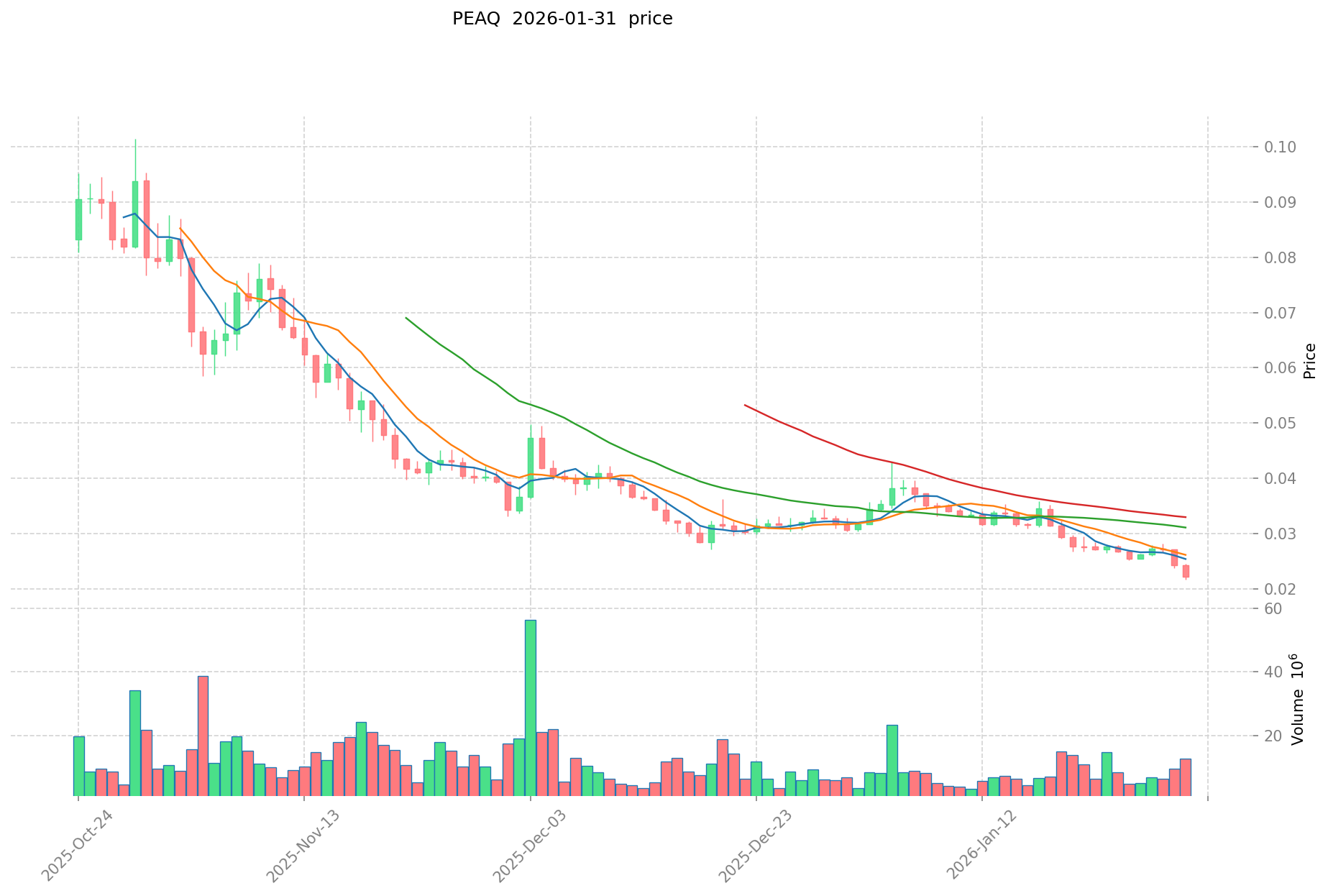
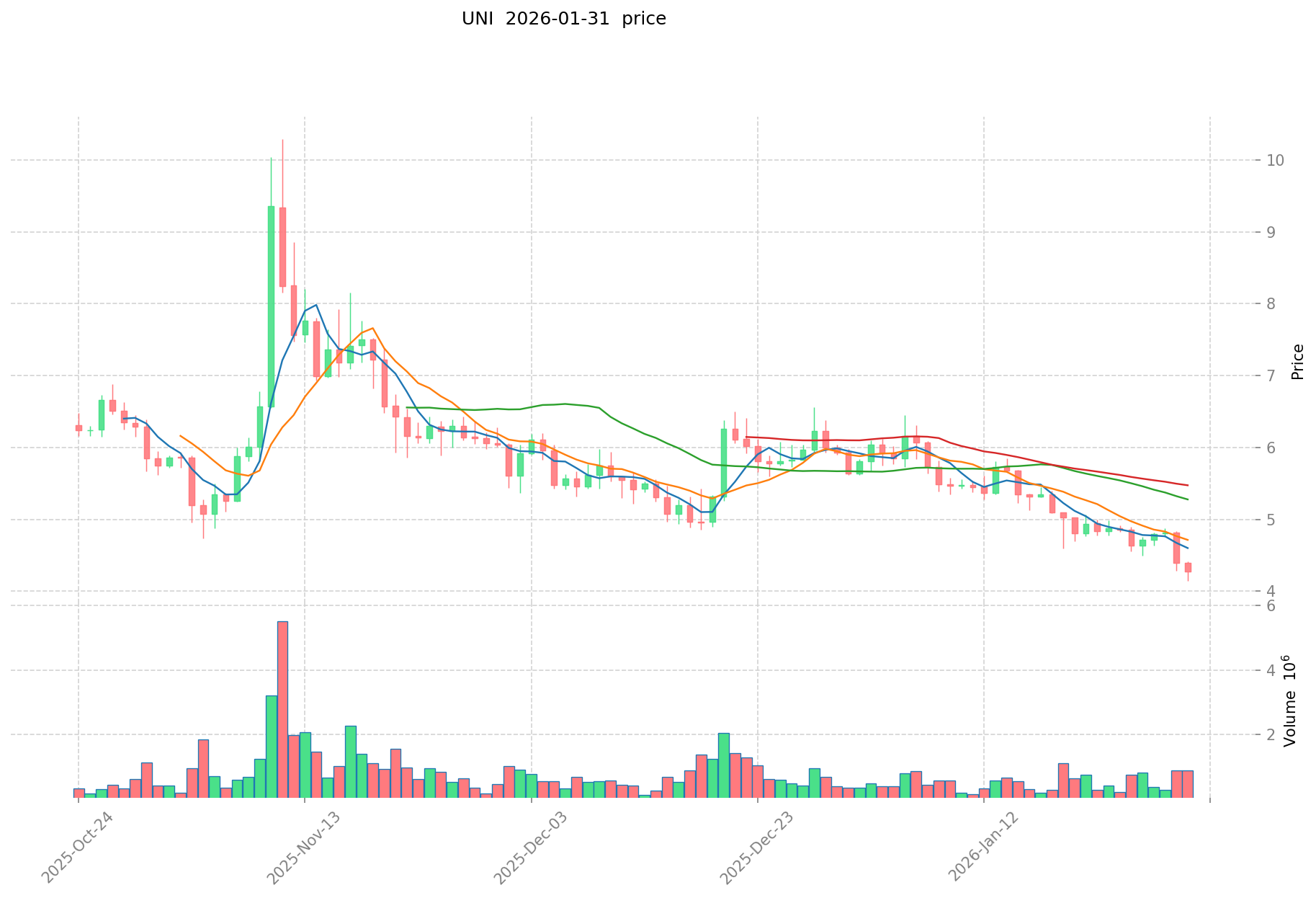
- Comparative Analysis: During the 2024-2026 market cycle, PEAQ declined from its peak of $0.75655 to a low of $0.02163, representing a substantial correction. Meanwhile, UNI decreased from its historical high of $44.92 to approximately $4.276, demonstrating a different volatility pattern across distinct market phases.
Current Market Status (2026-01-31)
- PEAQ current price: $0.02211
- UNI current price: $4.276
- 24-hour trading volume: PEAQ $286,607.36 vs UNI $3,819,348.32
- Market Sentiment Index (Fear & Greed Index): 16 (Extreme Fear)
View real-time prices:
- Check PEAQ current price Market Price
- Check UNI current price Market Price
II. Core Factors Affecting PEAQ vs UNI Investment Value
Supply Mechanism Comparison (Tokenomics)
- PEAQ: Total supply of 4,200,000,000 tokens with a circulating supply of 132,300,000 tokens. The supply mechanism and scarcity directly influence price dynamics and investment considerations.
- UNI: The reference materials do not provide specific information about UNI's supply mechanism or tokenomics structure.
- 📌 Historical Pattern: Supply mechanisms play a role in shaping price cycles, though specific historical data for these tokens is not available in the provided materials.
Institutional Adoption and Market Application
- Institutional Holdings: The provided materials do not contain comparative data on institutional preference between PEAQ and UNI.
- Enterprise Adoption: Information regarding the application of PEAQ or UNI in cross-border payments, settlements, or investment portfolios is not available in the reference materials.
- National Policies: The materials do not address regulatory attitudes of different countries toward either token.
Technical Development and Ecosystem Building
- PEAQ Technical Development: PEAQ is associated with blockchain-driven IoT applications and machine economy networks, focusing on data collection through robotics, cross-device machine coordination networks, and machine-autonomous market participation.
- UNI Technical Development: Specific technical upgrades or developments for UNI are not mentioned in the provided materials.
- Ecosystem Comparison: The reference materials note that DeFi market share expanded significantly in 2024, with total value locked (TVL) more than doubling since the beginning of the year. DEX/CEX trading volume ratios increased from 9.37% at the start of the year to 11.05% by year-end, with annualized trading volume reaching $2.67 trillion. However, specific ecosystem comparisons between PEAQ and UNI regarding DeFi, NFT, payment, and smart contract implementations are not provided.
Macroeconomic Environment and Market Cycles
- Performance in Inflationary Environments: The materials do not provide comparative analysis of PEAQ versus UNI performance under inflationary conditions.
- Macroeconomic Monetary Policy: The reference materials indicate that macroeconomic tightening and uncertainty, including reduced expectations for Federal Reserve rate cuts in December and stock market pressure, led investors to sell high-risk assets including cryptocurrencies. However, specific impacts on PEAQ or UNI are not detailed.
- Geopolitical Factors: The materials mention geopolitical situations affecting gold prices through increased safe-haven demand, weakening dollar credit, and accelerated de-globalization trends. However, direct impacts on PEAQ or UNI from cross-border transaction demands or international situations are not addressed in the reference materials.
III. 2026-2031 Price Forecast: PEAQ vs UNI
Short-term Forecast (2026)
- PEAQ: Conservative $0.0146-$0.0221 | Optimistic $0.0221-$0.0329
- UNI: Conservative $2.65-$4.27 | Optimistic $4.27-$4.70
Medium-term Forecast (2028-2029)
- PEAQ may enter a consolidation phase with potential ranging between $0.0228-$0.0524, showing gradual growth momentum
- UNI may experience moderate expansion phase, with price range anticipated at $3.46-$7.75
- Key drivers: institutional capital flows, ETF developments, ecosystem expansion
Long-term Forecast (2031)
- PEAQ: Base scenario $0.0357-$0.0489 | Optimistic scenario $0.0489-$0.0597
- UNI: Base scenario $7.16-$8.32 | Optimistic scenario $8.32-$12.24
View detailed price predictions for PEAQ and UNI
Disclaimer
PEAQ:
| Year |
Predicted High Price |
Predicted Average Price |
Predicted Low Price |
Price Change |
| 2026 |
0.0329141 |
0.02209 |
0.0145794 |
0 |
| 2027 |
0.0327274395 |
0.02750205 |
0.0162262095 |
24 |
| 2028 |
0.04216064265 |
0.03011474475 |
0.02770556517 |
36 |
| 2029 |
0.052399655865 |
0.0361376937 |
0.022766747031 |
63 |
| 2030 |
0.053565096486825 |
0.0442686747825 |
0.04161255429555 |
100 |
| 2031 |
0.059678600474288 |
0.048916885634662 |
0.035709326513303 |
121 |
UNI:
| Year |
Predicted High Price |
Predicted Average Price |
Predicted Low Price |
Price Change |
| 2026 |
4.6981 |
4.271 |
2.64802 |
0 |
| 2027 |
6.5025975 |
4.48455 |
3.497949 |
4 |
| 2028 |
7.7459389875 |
5.49357375 |
3.4609514625 |
28 |
| 2029 |
7.0831393145625 |
6.61975636875 |
4.369039203375 |
54 |
| 2030 |
9.797570413568437 |
6.85144784165625 |
5.823730665407812 |
60 |
| 2031 |
12.237028417590145 |
8.324509127612343 |
7.159077849746615 |
94 |
IV. Investment Strategy Comparison: PEAQ vs UNI
Long-term vs Short-term Investment Strategies
- PEAQ: May appeal to investors interested in emerging infrastructure for the Machine Economy and DePIN applications, with focus on IoT and robotics ecosystems. The token shows characteristics of early-stage blockchain projects with notable price volatility.
- UNI: May suit investors seeking exposure to established decentralized exchange protocols with demonstrated market presence since 2020. The token represents participation in the DeFi trading infrastructure landscape.
Risk Management and Asset Allocation
- Conservative Investors: PEAQ 20-30% vs UNI 70-80% - Higher allocation toward more established protocol with longer operational history
- Aggressive Investors: PEAQ 50-60% vs UNI 40-50% - Balanced exposure accounting for emerging technology potential and established market position
- Hedging Tools: Stablecoin allocation for liquidity management, options strategies for downside protection, cross-asset portfolio diversification
V. Potential Risk Comparison
Market Risks
- PEAQ: Exposure to extreme volatility patterns as evidenced by the decline from $0.75655 to $0.02163. Limited trading volume of $286,607.36 may indicate liquidity constraints and susceptibility to price impact from larger transactions.
- UNI: Subject to broader DeFi sector dynamics and DEX market competition. Current 24-hour trading volume of $3,819,348.32 suggests relatively higher liquidity compared to PEAQ, though still exposed to market-wide sentiment shifts as indicated by the Fear & Greed Index of 16.
Technical Risks
- PEAQ: Network scalability considerations for supporting 1.75 million devices across multiple industries. Operational stability requirements for machine economy applications spanning robotics and cross-device coordination networks.
- UNI: Protocol upgrade dependencies and smart contract security considerations inherent to decentralized exchange operations. Competition from alternative DEX platforms may impact market share and token utility.
Regulatory Risks
- Global regulatory approaches toward DeFi protocols and blockchain infrastructure may affect both assets differently. PEAQ's focus on machine economy and IoT applications may face distinct regulatory considerations compared to UNI's decentralized exchange framework. Evolving compliance requirements across jurisdictions could impact operational parameters and market accessibility for both tokens.
VI. Conclusion: Which Is the Better Buy?
📌 Investment Value Summary:
- PEAQ Characteristics: Represents early-stage positioning in Machine Economy infrastructure with focus on DePIN applications. Current circulating supply of 132,300,000 tokens against total supply of 4,200,000,000 suggests ongoing distribution dynamics. Price forecasts indicate potential ranging from $0.0146-$0.0329 in 2026 under various scenarios.
- UNI Characteristics: Established presence in decentralized exchange infrastructure since 2020. Benefits from broader DeFi sector expansion, with DEX/CEX volume ratios showing growth trends. Price forecasts suggest potential ranging from $2.65-$4.70 in 2026 under different market conditions.
✅ Investment Considerations:
- New Investors: May consider starting with established protocols showing longer operational history and higher liquidity levels. Gradual portfolio building with emphasis on understanding tokenomics and use case fundamentals before allocation decisions.
- Experienced Investors: Could evaluate portfolio diversification across different blockchain infrastructure segments. Assessment of risk-adjusted return potential considering volatility patterns, trading volumes, and ecosystem development trajectories.
- Institutional Investors: May focus on due diligence regarding regulatory compliance frameworks, liquidity depth for position sizing, and alignment with broader digital asset allocation strategies. Consideration of correlation patterns with broader crypto market movements.
⚠️ Risk Notice: Cryptocurrency markets exhibit substantial volatility. This content does not constitute investment advice. Investors should conduct independent research and consider personal risk tolerance before making allocation decisions.
VII. FAQ
Q1: What are the main differences between PEAQ and UNI in terms of their core applications?
PEAQ focuses on Layer-1 blockchain infrastructure for the Machine Economy (DePIN), while UNI operates as a decentralized exchange protocol on Ethereum. PEAQ serves over 1.75 million devices across 21 industries, emphasizing IoT applications, robotics, and cross-device machine coordination networks. UNI, launched in September 2020, functions as an automated market-making protocol that facilitates decentralized token trading. The fundamental distinction lies in PEAQ's infrastructure-oriented approach to machine-to-machine transactions versus UNI's role in enabling peer-to-peer asset exchanges within the DeFi ecosystem.
Q2: How do the supply mechanisms of PEAQ and UNI affect their investment characteristics?
PEAQ has a total supply of 4,200,000,000 tokens with only 132,300,000 tokens currently in circulation, representing approximately 3.15% of the total supply. This limited circulating supply against the total supply indicates ongoing distribution dynamics that may influence price behavior as more tokens enter circulation. The reference materials do not provide specific tokenomics details for UNI, making direct comparison of supply mechanisms challenging. Investors should consider how PEAQ's gradual token release schedule may impact long-term price discovery and market dynamics.
Q3: What explains the significant difference in trading volumes between PEAQ and UNI?
As of January 31, 2026, UNI's 24-hour trading volume stands at $3,819,348.32 compared to PEAQ's $286,607.36, representing approximately 13 times higher liquidity. This disparity reflects UNI's longer market presence since 2020 and its established position within the DeFi infrastructure. Higher trading volume typically indicates better liquidity, reduced slippage for larger transactions, and stronger market depth. PEAQ's lower volume may present liquidity constraints and higher price impact risk, particularly for investors planning substantial position sizes.
Q4: How have PEAQ and UNI performed during recent market cycles?
PEAQ experienced significant volatility since its November 2024 launch, declining from a peak of $0.75655 in December 2024 to $0.02211 by January 2026, representing approximately 97% correction. UNI decreased from its historical high of $44.92 in May 2021 to approximately $4.276, showing an approximate 90% decline from peak levels. Both assets demonstrated substantial corrections, though occurring across different timeframes and market phases. The current Fear & Greed Index reading of 16 (Extreme Fear) reflects broader market sentiment affecting both tokens.
Q5: What are the projected price ranges for PEAQ and UNI through 2031?
For 2026, PEAQ projections range from $0.0146-$0.0329, while UNI forecasts span $2.65-$4.70 under various scenarios. By 2031, PEAQ base scenario suggests $0.0357-$0.0489 with optimistic potential reaching $0.0597, while UNI base scenario indicates $7.16-$8.32 with optimistic projections up to $12.24. These forecasts incorporate factors including institutional capital flows, ETF developments, and ecosystem expansion. However, investors should recognize that cryptocurrency price predictions involve substantial uncertainty and actual outcomes may differ significantly from projected ranges.
Q6: What risk factors should investors consider when comparing PEAQ and UNI?
Market risks differ significantly between the two assets. PEAQ faces extreme volatility patterns and limited liquidity as evidenced by lower trading volumes, which may result in higher price impact from transactions. UNI encounters risks related to DeFi sector dynamics and DEX market competition. Technical risks for PEAQ include network scalability requirements for supporting millions of devices and operational stability for machine economy applications. UNI faces protocol upgrade dependencies and smart contract security considerations. Regulatory risks affect both tokens differently, with PEAQ's machine economy focus potentially facing distinct compliance requirements compared to UNI's decentralized exchange framework.
Q7: How should different investor profiles approach allocation between PEAQ and UNI?
Conservative investors might consider 20-30% PEAQ versus 70-80% UNI allocation, favoring the more established protocol with longer operational history and higher liquidity. Aggressive investors could balance exposure at 50-60% PEAQ versus 40-50% UNI, accounting for emerging technology potential alongside established market position. New investors may benefit from starting with established protocols showing longer operational history before gradually diversifying into emerging infrastructure projects. Experienced and institutional investors should conduct comprehensive due diligence regarding regulatory compliance frameworks, liquidity depth for position sizing, and correlation patterns with broader crypto market movements before making allocation decisions.
Q8: What role does the DeFi ecosystem expansion play in evaluating these investments?
The DeFi sector experienced significant growth in 2024, with total value locked (TVL) more than doubling and DEX/CEX trading volume ratios increasing from 9.37% to 11.05%, reaching annualized trading volume of $2.67 trillion. This expansion directly benefits UNI as a core decentralized exchange infrastructure provider, potentially supporting increased protocol usage and token utility. While PEAQ operates in a different segment focusing on machine economy infrastructure, broader blockchain adoption trends may create positive spillover effects. Investors should evaluate how each token's specific use case aligns with larger ecosystem trends when assessing long-term value proposition and growth potential within the evolving cryptocurrency landscape.
* The information is not intended to be and does not constitute financial advice or any other recommendation of any sort offered or endorsed by Gate.