This comprehensive guide compares PI Network and Litecoin across critical investment dimensions. PI Network, launched in 2019, represents a mobile-first cryptocurrency with KYC-based token distribution currently trading at $0.20773 on Gate with $1.74 billion market cap. Litecoin, established since 2011, functions as proven payment infrastructure trading at $77.38 with $5.94 billion market cap. Key differences include supply mechanisms—PI uses verification-based unlocking versus LTC's traditional halving schedule—and liquidity depth where LTC's $9.3M daily volume significantly exceeds PI's $868K. LTC demonstrates institutional adoption through Grayscale products and exchange infrastructure, while PI remains in ecosystem development stages. The article analyzes price history, tokenomics, technological progress, risk factors, and investment strategies to help readers evaluate which asset aligns with their investment profile and risk tolerance.
Introduction: PI vs LTC Investment Comparison
In the cryptocurrency market, the comparison between PI vs LTC has consistently been a topic investors cannot overlook. These two assets exhibit distinct differences in market cap ranking, application scenarios, and price performance, representing different positioning within the crypto asset landscape.
PI Network (PI): Launched in 2019, it has attracted attention as the first digital currency mineable via mobile phones, introducing an innovative approach to cryptocurrency accessibility.
Litecoin (LTC): Since its inception in 2011, it has been recognized for its faster transaction confirmation speed and efficiency compared to Bitcoin, establishing itself as one of the mature and stable commercial financial systems in the crypto space.
This article will comprehensively analyze the investment value comparison of PI vs LTC through historical price trends, supply mechanisms, institutional adoption, technological ecosystems, and future predictions, attempting to address the question investors care about most:
"Which is the better buy right now?"
I. Price History Comparison and Market Status
PI Network (PI) and Litecoin (LTC) Historical Price Trends
- 2021: PI Network initiated its enclosed mainnet in December 2021, establishing the foundation for controlled testing and user migration through KYC processes before any formal market pricing was established.
- 2021: Litecoin (LTC) reached its all-time high of $410.26 in May 2021, reflecting the broader cryptocurrency market rally during that period.
- 2025: PI Network experienced notable volatility following its initial market listing, with prices fluctuating between $0.049 (historical low on February 20, 2025) and $3.00 (all-time high on February 26, 2025), demonstrating significant price discovery dynamics in its early trading phase.
- Comparative Analysis: During recent market cycles, PI has shown substantial volatility with an 87.78% decline over the past year from higher levels, while LTC has demonstrated relatively more stability with a 24.44% decrease over the same period, reflecting its more mature market position.
Current Market Status (January 14, 2026)
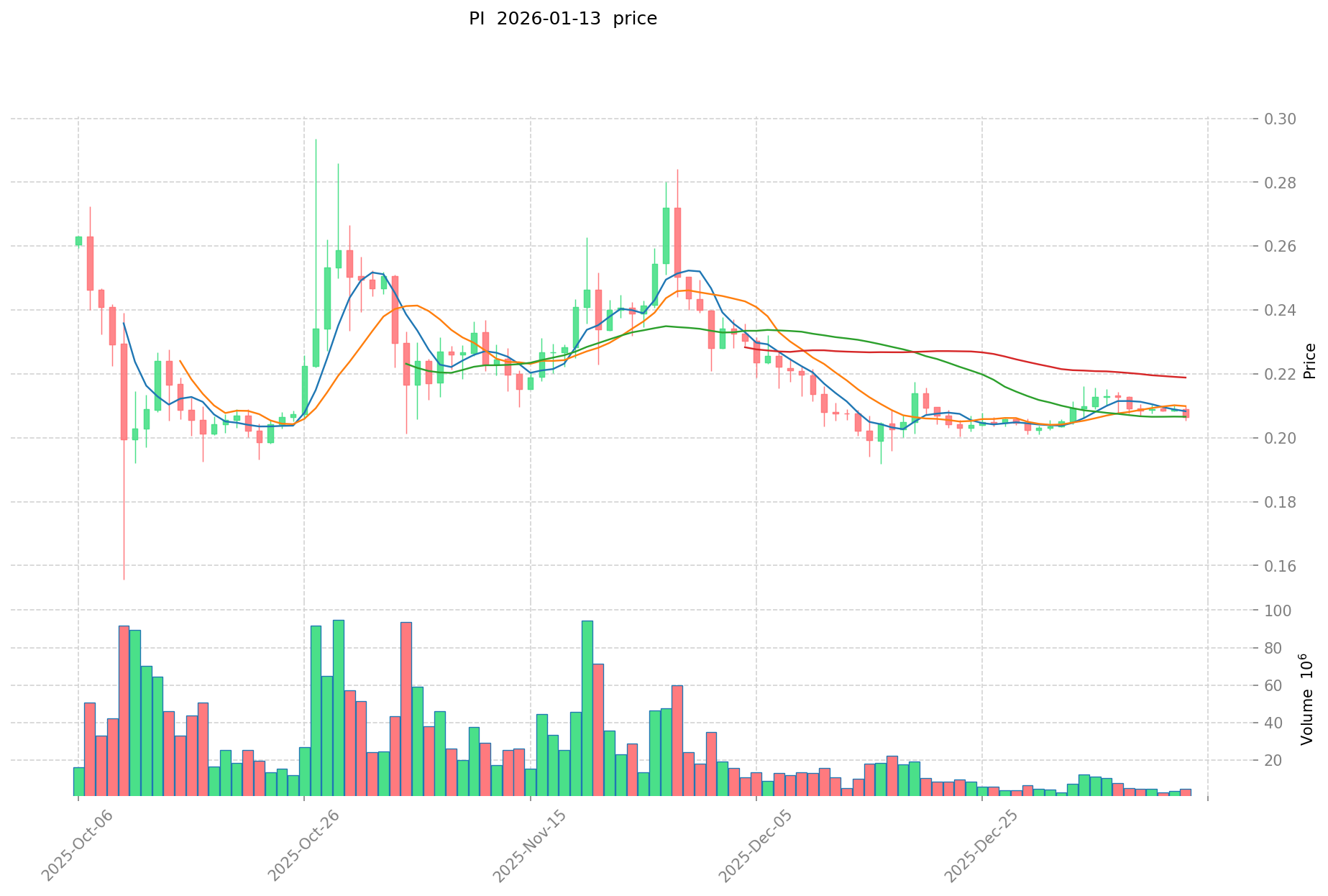
- PI Current Price: $0.20773
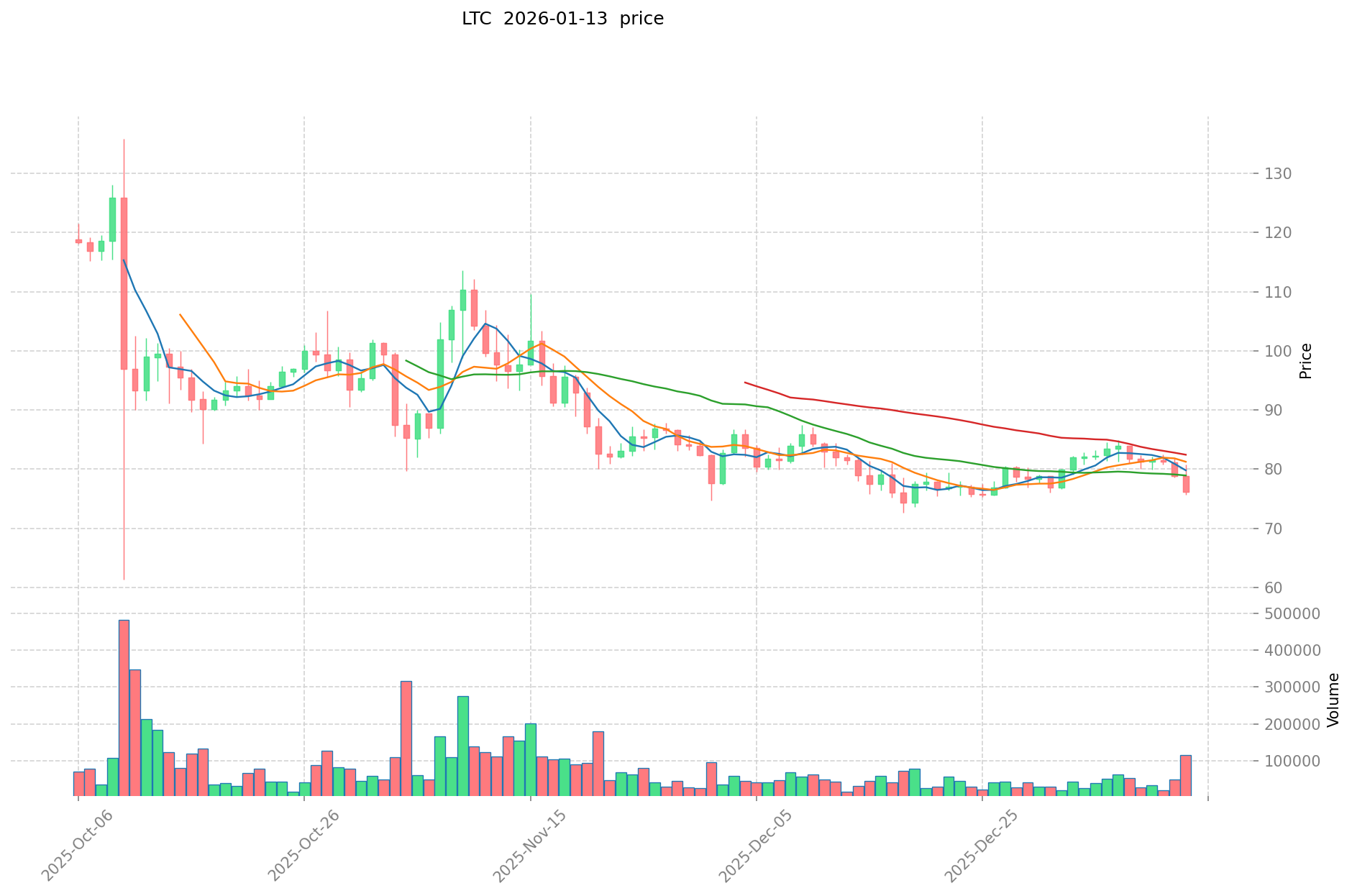
- LTC Current Price: $77.38
- 24-Hour Trading Volume: PI recorded $868,475.98 compared to LTC's $9,311,711.68
- Market Capitalization: PI stands at $1.74 billion with 8.38% of maximum supply in circulation, while LTC maintains $5.94 billion with 91.35% circulation ratio
- Market Sentiment Index (Fear & Greed Index): 26 (Fear)
- Recent Performance: PI shows +0.91% change in 24 hours, while LTC demonstrates +1.44% over the same period
View real-time prices:
II. Core Factors Influencing PI vs LTC Investment Value
Supply Mechanism Comparison (Tokenomics)
-
PI: Utilizes a KYC-based unlocking mechanism rather than traditional mining supply controls. Token distribution depends on user verification completion and mainnet migration progress, with supply dynamics tied to community growth rather than algorithmic issuance schedules.
-
LTC: Employs a halving mechanism with a maximum supply of 21 million coins. Block rewards reduce approximately every four years, creating predictable supply constraints. Current block time averages 2.5 minutes, significantly faster than Bitcoin's 10-minute intervals.
-
📌 Historical Pattern: LTC's halving cycles have historically influenced price volatility patterns, while PI's supply dynamics remain dependent on KYC completion rates and mainnet opening schedules rather than predetermined algorithmic events.
Institutional Adoption and Market Application
-
Institutional Holdings: LTC demonstrates measurable institutional interest, with Grayscale's LTC Trust Fund showing consistent data growth. According to founder Charlie Lee's statements, institutional demand persists, reflected in trust fund pricing trading at multiples above net asset value.
-
Enterprise Adoption: LTC functions in fast transaction settlements and cross-border payment scenarios, supported by established exchange infrastructure across major platforms including Binance, Coinbase, and specialized payment processors. PI's enterprise application remains limited to testing phases within its developing ecosystem.
-
Regulatory Environment: LTC benefits from clearer regulatory frameworks in multiple jurisdictions due to its established presence since 2011. PI's regulatory status varies significantly across regions, with ongoing developments around KYC compliance and mainnet classification.
Technology Development and Ecosystem Construction
-
PI Technical Progress: Announced mainnet full opening scheduled for February 20, 2025, with over 3.36 million additional KYC approvals cleared. Launched DeFi testnet within Pi Wallet featuring AMM and DEX tools, enabling users to simulate swaps and liquidity pools. Alignment with ISO 20022 standards positions the network within global banking system frameworks.
-
LTC Technical Evolution: Continues refinement of Proof-of-Work consensus using Scrypt algorithm, maintaining focus on transaction speed and cost efficiency. Established infrastructure supports integration with payment systems and wallet providers across multiple platforms.
-
Ecosystem Comparison: LTC operates with mature blockchain settlement, transparent issuance mechanisms, and established presence across DeFi protocols and payment networks. PI's ecosystem centers on mobile-first accessibility with developing DeFi infrastructure currently in testing phases, lacking the breadth of established financial integrations present in LTC's network.
Macroeconomic Context and Market Cycles
-
Performance in Inflationary Environments: LTC's established market presence and liquidity provide relative stability during inflation periods, functioning as an alternative to traditional payment systems. PI's performance metrics remain limited due to restricted transferability and exchange availability.
-
Monetary Policy Influence: Interest rate adjustments and USD index fluctuations directly impact LTC pricing through established market mechanisms and institutional trading patterns. PI's sensitivity to these factors remains unclear given limited price discovery mechanisms.
-
Geopolitical Factors: Cross-border transaction demand benefits established cryptocurrencies with proven settlement capabilities. LTC's integration into payment infrastructure positions it to capture international transfer use cases, while PI's cross-border utility depends on future mainnet development and exchange listing outcomes.
III. 2026-2031 Price Prediction: PI vs LTC
Short-term Prediction (2026)
- PI: Conservative $0.1601-$0.2079 | Optimistic $0.2079-$0.2224
- LTC: Conservative $59.64-$77.46 | Optimistic $77.46-$81.33
Mid-term Prediction (2028-2029)
- PI may enter a consolidation phase, with projected price range of $0.1810-$0.3071
- LTC may enter an expansion phase, with projected price range of $77.81-$139.83
- Key drivers: institutional capital inflows, ETF developments, ecosystem growth
Long-term Prediction (2031)
- PI: Baseline scenario $0.1570-$0.3079 | Optimistic scenario $0.3079-$0.3356
- LTC: Baseline scenario $76.65-$150.29 | Optimistic scenario $150.29-$156.30
View detailed price predictions for PI and LTC
Disclaimer
PI:
| Year |
Predicted High Price |
Predicted Average Price |
Predicted Low Price |
Price Change |
| 2026 |
0.2224423 |
0.20789 |
0.1600753 |
0 |
| 2027 |
0.2947776255 |
0.21516615 |
0.206559504 |
3 |
| 2028 |
0.2983171086675 |
0.25497188775 |
0.1810300403025 |
22 |
| 2029 |
0.307075393011712 |
0.27664449820875 |
0.235147823477437 |
33 |
| 2030 |
0.323964539627356 |
0.291859945610231 |
0.210139160839366 |
40 |
| 2031 |
0.335624344454485 |
0.307912242618794 |
0.157035243735584 |
48 |
LTC:
| Year |
Predicted High Price |
Predicted Average Price |
Predicted Low Price |
Price Change |
| 2026 |
81.333 |
77.46 |
59.6442 |
0 |
| 2027 |
116.712855 |
79.3965 |
53.98962 |
2 |
| 2028 |
127.47108075 |
98.0546775 |
94.1324904 |
26 |
| 2029 |
139.825970115 |
112.762879125 |
77.80638659625 |
45 |
| 2030 |
174.2863059756 |
126.29442462 |
83.3543202492 |
63 |
| 2031 |
156.301979909712 |
150.2903652978 |
76.648086301878 |
94 |
IV. Investment Strategy Comparison: PI vs LTC
Long-term vs Short-term Investment Strategies
-
PI: May appeal to investors interested in emerging mobile-first cryptocurrency models and early-stage ecosystem development. The asset's limited circulation ratio (8.38%) and dependency on KYC completion create unique supply dynamics distinct from traditional mining-based cryptocurrencies.
-
LTC: May suit investors seeking exposure to established payment infrastructure with proven transaction settlement capabilities. The asset's high circulation ratio (91.35%) and mature market presence provide characteristics associated with longer operational history in the cryptocurrency space.
Risk Management and Asset Allocation
-
Conservative Investors: Consider allocation frameworks that prioritize established market presence and liquidity depth. LTC's integration into institutional products and exchange infrastructure provides measurable trading volumes, while PI's developing ecosystem presents limited historical performance data for assessment.
-
Aggressive Investors: May evaluate higher allocation to emerging assets with potential for ecosystem expansion, balanced against established cryptocurrencies with proven settlement capabilities. Portfolio construction should account for differing liquidity profiles and market maturity levels between PI and LTC.
-
Hedging Instruments: Stablecoin allocation can provide liquidity buffers during volatility periods. Cross-asset combinations may help balance exposure between developing and mature cryptocurrency segments, though effectiveness varies based on market conditions and correlation patterns.
V. Potential Risk Comparison
Market Risks
-
PI: Trading volume of $868,475.98 (as of January 14, 2026) reflects limited liquidity compared to established cryptocurrencies. Price volatility demonstrated by 87.78% decline over the past year indicates substantial price discovery dynamics. Limited exchange availability may impact accessibility and execution during market stress periods.
-
LTC: Trading volume of $9,311,711.68 provides greater liquidity depth, though remains subject to broader cryptocurrency market cycles. Price movements show correlation with Bitcoin and general crypto market sentiment. Historical volatility patterns around halving events create predictable but notable price fluctuation periods.
Technical Risks
-
PI: Network scalability remains under evaluation as mainnet transitions from testing to full operation. KYC-dependent supply mechanisms create uncertainty around actual circulating supply expansion timelines. Mobile-first infrastructure requires continued development to support growing user base and transaction volumes.
-
LTC: Proof-of-Work consensus using Scrypt algorithm faces ongoing considerations around mining concentration. Network security depends on sustained miner participation and hash rate distribution. Infrastructure maturity provides stability but limits flexibility for protocol modifications compared to newer blockchain architectures.
Regulatory Risks
- Regulatory frameworks continue evolving across jurisdictions, with differing approaches to established versus emerging cryptocurrencies. LTC benefits from longer operational history under existing regulatory structures, while PI faces ongoing classification questions related to its distribution model and mainnet status. Compliance requirements, particularly KYC processes, create operational considerations that vary by geographic region and may impact accessibility and adoption patterns.
VI. Conclusion: Which Is the Better Buy?
📌 Investment Value Summary
-
PI Characteristics: Mobile-first accessibility model with developing DeFi infrastructure. Limited circulation creates supply dynamics tied to KYC completion rather than algorithmic issuance. ISO 20022 alignment positions network within evolving banking standards frameworks.
-
LTC Characteristics: Established payment infrastructure with proven transaction settlement capabilities. High circulation ratio and mature market presence provide liquidity depth. Integration into institutional products and exchange networks demonstrates sustained market acceptance since 2011.
✅ Investment Considerations
-
New Investors: May prioritize established cryptocurrencies with proven infrastructure, transparent supply mechanisms, and broader exchange availability. Understanding fundamental differences in supply dynamics, market maturity, and liquidity profiles remains important for informed decision-making.
-
Experienced Investors: Can evaluate allocation strategies accounting for differing risk-return profiles, liquidity characteristics, and ecosystem development stages. Portfolio construction may incorporate both emerging and established assets based on individual risk tolerance and investment timeframes.
-
Institutional Participants: May focus on assets with established regulatory clarity, institutional product availability, and proven settlement infrastructure. Due diligence should address liquidity requirements, custody solutions, and compliance frameworks applicable to specific jurisdictions.
⚠️ Risk Disclosure: Cryptocurrency markets exhibit substantial volatility. This content does not constitute investment advice. Individuals should conduct independent research and consult qualified professionals before making investment decisions.
VII. FAQ
Q1: What is the main difference between PI and LTC's supply mechanism?
PI uses a KYC-based unlocking mechanism where token distribution depends on user verification completion and mainnet migration progress, while LTC employs a traditional halving mechanism with a fixed maximum supply of 21 million coins and predictable block rewards that reduce approximately every four years. This fundamental difference means PI's supply dynamics are tied to community growth and verification rates rather than algorithmic issuance schedules, creating distinct tokenomics models between the two assets.
Q2: Which cryptocurrency has better liquidity for trading purposes?
LTC demonstrates significantly better liquidity with a 24-hour trading volume of $9,311,711.68 compared to PI's $868,475.98 as of January 14, 2026. Additionally, LTC has 91.35% of its maximum supply in circulation versus PI's 8.38%, providing greater market depth and established presence across major exchanges including Binance and Coinbase. This liquidity advantage makes LTC more suitable for investors requiring efficient order execution and lower slippage during trading activities.
Q3: What are the key technological differences between PI Network and Litecoin?
PI Network focuses on mobile-first accessibility with developing DeFi infrastructure currently in testing phases, including AMM and DEX tools within Pi Wallet, and alignment with ISO 20022 banking standards. LTC operates on mature Proof-of-Work consensus using Scrypt algorithm, with established infrastructure supporting payment systems integration and 2.5-minute block times for faster transaction confirmation. While LTC provides proven blockchain settlement capabilities since 2011, PI's ecosystem remains in early development stages with its mainnet scheduled for full opening in February 2025.
Q4: How do institutional adoption levels compare between PI and LTC?
LTC demonstrates measurable institutional interest through products like Grayscale's LTC Trust Fund and integration into established payment infrastructure across major platforms. The cryptocurrency functions in fast transaction settlements and cross-border payment scenarios with clear regulatory frameworks in multiple jurisdictions due to its operational history since 2011. In contrast, PI's institutional adoption remains limited to testing phases within its developing ecosystem, with regulatory status varying significantly across regions and enterprise applications not yet fully established.
Q5: What is the price volatility difference between these two assets?
PI has shown substantial volatility with an 87.78% decline over the past year from higher levels, with prices fluctuating between $0.049 (historical low on February 20, 2025) and $3.00 (all-time high on February 26, 2025), demonstrating significant price discovery dynamics in its early trading phase. LTC has demonstrated relatively more stability with a 24.44% decrease over the same period, reflecting its more mature market position. Current prices as of January 14, 2026 stand at $0.20773 for PI and $77.38 for LTC.
Q6: Which cryptocurrency is more suitable for conservative investors?
LTC may be more suitable for conservative investors seeking exposure to established payment infrastructure with proven transaction settlement capabilities. The asset's high circulation ratio (91.35%), mature market presence since 2011, integration into institutional products, and broader exchange availability provide characteristics associated with longer operational history and greater liquidity depth. PI's limited circulation ratio (8.38%), developing ecosystem, and dependency on KYC completion create unique supply dynamics that may present higher uncertainty for risk-averse investment strategies.
Q7: What are the long-term price predictions for PI and LTC by 2031?
According to baseline scenarios, PI is predicted to range between $0.1570-$0.3079 by 2031 (optimistic scenario: $0.3079-$0.3356), representing a 48% price change from 2026 levels. LTC is projected to range between $76.65-$150.29 by 2031 (optimistic scenario: $150.29-$156.30), representing a 94% price change from 2026 levels. These predictions account for factors including institutional capital inflows, ETF developments, ecosystem growth, and broader cryptocurrency market cycles, though actual outcomes may vary significantly based on numerous variables including regulatory developments and market conditions.
Q8: What are the primary risks investors should consider for each cryptocurrency?
For PI, primary risks include limited liquidity ($868,475.98 trading volume), substantial price volatility (87.78% decline over past year), limited exchange availability, network scalability uncertainties during mainnet transition, and varying regulatory status across jurisdictions. For LTC, key risks involve cryptocurrency market cycle correlations, historical volatility around halving events, mining concentration considerations, and protocol modification limitations due to mature infrastructure. Both assets face evolving regulatory frameworks, though LTC benefits from longer operational history under existing regulatory structures while PI faces ongoing classification questions related to its distribution model.
* The information is not intended to be and does not constitute financial advice or any other recommendation of any sort offered or endorsed by Gate.