This comprehensive analysis compares PIPPIN and QNT, two distinct blockchain assets representing different investment categories within the Web3 ecosystem. PIPPIN, a recently launched meme token on Solana with AI associations, exhibits high volatility and retail-focused dynamics, while QNT represents established enterprise blockchain interoperability infrastructure operating since 2018 with documented institutional interest. The article examines historical price trends—PIPPIN ranging from $0.78 to current $0.31839, QNT declining from $427.42 to $73.56—alongside 2026-2031 price predictions showing potential growth trajectories for both assets. Risk analysis, tokenomics, technology ecosystems, and institutional adoption patterns are evaluated to guide investment decisions. Portfolio allocation strategies differentiate between conservative (10-15% PIPPIN, 20-30% QNT) and aggressive investors (25-35% PIPPIN, 30-40% QNT), emphasizing diversification and risk management. This guide assists cryptocurrency investors
Introduction: Investment Comparison Between PIPPIN and QNT
In the cryptocurrency market, the comparison between PIPPIN and QNT represents a discussion of two distinct asset categories. These tokens differ significantly in market capitalization ranking, application scenarios, and price performance, representing different positioning within the crypto asset landscape.
PIPPIN: A meme token launched on the Solana blockchain via Pumpfun, created by Yohei Nakajima, known for his work in AI and venture capital innovation. The project gained attention through its association with AI development and the creator's public building approach.
QNT (Quant): Operating since 2018, Quant Network positions itself as a technology provider enabling trusted digital interaction through its Overledger operating system, which addresses blockchain interoperability challenges for enterprises, regulators, governments, and individuals.
This article examines historical price trends, supply mechanisms, market adoption, technological ecosystems, and future outlook to provide a comprehensive analysis comparing PIPPIN and QNT. The analysis addresses key considerations for investors evaluating these two different crypto assets:
"What are the fundamental differences in investment characteristics between these tokens?"
I. Historical Price Comparison and Current Market Status
PIPPIN and QNT Historical Price Trends
-
2025: PIPPIN experienced significant volatility during its initial launch phase on the Solana blockchain. The token reached an all-time high of $0.78 on December 24, 2025, reflecting strong initial market interest in this AI-powered meme token.
-
2021: QNT was influenced by the broader blockchain interoperability narrative, with its price reaching an all-time high of $427.42 on September 11, 2021, driven by growing enterprise adoption of the Overledger platform.
-
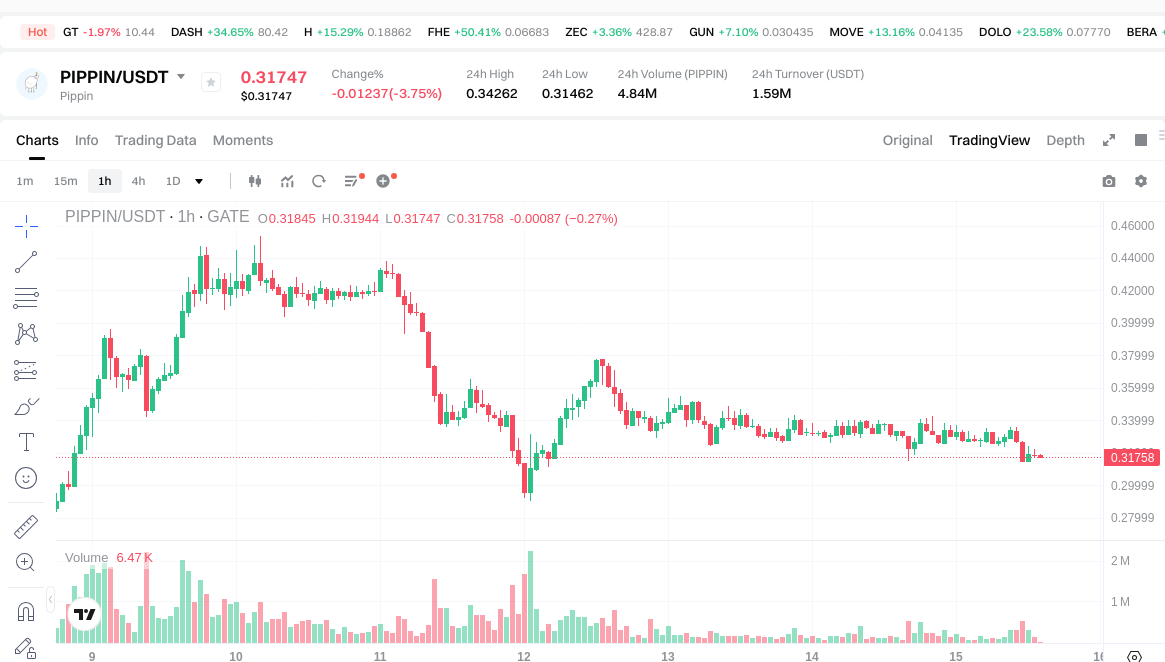
Comparative Analysis: During recent market cycles, PIPPIN declined from its peak of $0.78 to a low of $0.00165 on October 10, 2025, demonstrating the high volatility characteristic of meme tokens. In contrast, QNT has shown more stable price action, declining from its 2021 high of $427.42 to a current trading range around $73.56, reflecting a mature project with established use cases.
Current Market Status (2026-01-15)
- PIPPIN Current Price: $0.31839
- QNT Current Price: $73.56
- 24-Hour Trading Volume: PIPPIN recorded $1,597,418.17 compared to QNT's $456,774.31
- Market Sentiment Index (Fear & Greed Index): 61 (Greed)
Click to view real-time prices:

II. Core Factors Influencing PIPPIN vs QNT Investment Value
Supply Mechanism Comparison (Tokenomics)
- PIPPIN: Supply mechanism information not available in provided materials.
- QNT: Supply mechanism details not available in provided materials.
- 📌 Historical Pattern: Supply mechanisms can influence price cycles through scarcity dynamics and emission schedules, though specific patterns for these tokens require additional data.
Institutional Adoption and Market Application
- Institutional Holdings: QNT has demonstrated notable institutional interest, as evidenced by price movements suggesting strong investor participation. On November 29, QNT showed positive momentum with price increases, reflecting institutional and retail demand.
- Enterprise Adoption: Specific enterprise use cases for PIPPIN and QNT in cross-border payments, settlements, or investment portfolios are not detailed in available materials.
- National Policies: Regulatory attitudes from different jurisdictions toward PIPPIN and QNT are not documented in current materials.
Technology Development and Ecosystem Building
- PIPPIN Technology Upgrades: Technical development information not available in provided materials.
- QNT Technology Development: Specific technical upgrades and their potential impacts are not detailed in available materials.
- Ecosystem Comparison: Concrete implementation data regarding DeFi, NFT, payment systems, and smart contract deployments for both tokens is not available in current materials.
Macroeconomic Conditions and Market Cycles
- Performance in Inflationary Environments: QNT has shown price volatility influenced by broader cryptocurrency market dynamics, with significant single-day movements observed in November. The token experienced both gains and declines, with a 13.52% increase on November 29 and a 2.91% decrease on November 26, indicating sensitivity to market conditions.
- Macroeconomic Monetary Policy: The influence of interest rates and dollar index movements on PIPPIN and QNT is not specifically documented in available materials.
- Geopolitical Factors: Cross-border transaction demand and international developments' specific impacts on these tokens are not detailed in current materials.
III. 2026-2031 Price Prediction: PIPPIN vs QNT
Short-term Forecast (2026)
- PIPPIN: Conservative $0.22-$0.32 | Optimistic $0.32-$0.42
- QNT: Conservative $63.24-$73.54 | Optimistic $73.54-$91.93
Mid-term Forecast (2028-2029)
- PIPPIN may enter a consolidation phase with potential ranging between $0.26-$0.58, showing gradual upward momentum
- QNT may experience broader volatility with estimates spanning $44.68-$147.69, reflecting market maturation dynamics
- Key drivers: institutional capital flows, ETF developments, ecosystem expansion
Long-term Forecast (2030-2031)
- PIPPIN: Base scenario $0.47-$0.61 | Optimistic scenario $0.61-$0.85
- QNT: Base scenario $85.94-$154.96 | Optimistic scenario $154.96-$210.75
View detailed price predictions for PIPPIN and QNT
Disclaimer: Price predictions are speculative and based on historical data patterns. Cryptocurrency markets involve substantial risk. This content does not constitute investment advice.
PIPPIN:
| Year |
Predicted High Price |
Predicted Average Price |
Predicted Low Price |
Price Change |
| 2026 |
0.416187 |
0.3177 |
0.22239 |
0 |
| 2027 |
0.451340505 |
0.3669435 |
0.260529885 |
15 |
| 2028 |
0.535976023275 |
0.4091420025 |
0.323222181975 |
28 |
| 2029 |
0.581247585851625 |
0.4725590128875 |
0.25518186695925 |
48 |
| 2030 |
0.684974289180431 |
0.526903299369562 |
0.474212969432606 |
65 |
| 2031 |
0.854373699927745 |
0.605938794274996 |
0.533226138961997 |
90 |
QNT:
| Year |
Predicted High Price |
Predicted Average Price |
Predicted Low Price |
Price Change |
| 2026 |
91.925 |
73.54 |
63.2444 |
0 |
| 2027 |
113.343525 |
82.7325 |
44.67555 |
12 |
| 2028 |
127.44941625 |
98.0380125 |
86.273451 |
33 |
| 2029 |
147.69426583125 |
112.743714375 |
71.02854005625 |
53 |
| 2030 |
179.7022063423125 |
130.218990103125 |
85.9445334680625 |
77 |
| 2031 |
210.7464135828975 |
154.96059822271875 |
131.716508489310937 |
110 |
IV. Investment Strategy Comparison: PIPPIN vs QNT
Long-term vs Short-term Investment Strategies
-
PIPPIN: May suit investors attracted to emerging meme token narratives and AI-associated projects, with awareness of elevated volatility. The token's price movements from $0.78 to $0.00165 within months illustrate the rapid cycle characteristic of newer meme assets.
-
QNT: May appeal to investors focused on blockchain interoperability infrastructure and enterprise adoption potential. The token's established presence since 2018 and its price performance from $427.42 to current levels suggest a more mature asset with longer development cycles.
Risk Management and Asset Allocation
-
Conservative Investors: PIPPIN 10-15% vs QNT 20-30% within a diversified crypto portfolio, prioritizing established projects with documented use cases.
-
Aggressive Investors: PIPPIN 25-35% vs QNT 30-40%, accepting higher volatility in exchange for potential upside, while maintaining awareness of drawdown risks.
-
Hedging Tools: Stablecoin allocation for liquidity management, options strategies for downside protection, cross-asset diversification to reduce correlation risk.
V. Potential Risk Comparison
Market Risks
-
PIPPIN: Faces elevated volatility inherent to meme tokens, with price movements demonstrating rapid fluctuations. The token recorded a decline from $0.78 to $0.00165 before recovering to $0.31839, indicating susceptibility to sentiment shifts and reduced liquidity during market stress.
-
QNT: Experiences market cycle sensitivity, with price movements from $427.42 to current levels reflecting broader crypto market dynamics. Recent volatility includes a 13.52% single-day increase and a 2.91% decrease in November, suggesting ongoing price discovery despite longer market presence.
Technical Risks
-
PIPPIN: Scalability considerations and network stability factors related to the Solana blockchain infrastructure on which it operates. Specific technical development roadmap details are not documented in available materials.
-
QNT: Technical infrastructure risks associated with interoperability technology deployment and enterprise integration complexity. Specific security audit results and network stability metrics are not detailed in current materials.
Regulatory Risks
- Global regulatory frameworks continue evolving, with potential differential impacts on meme tokens versus enterprise-focused blockchain infrastructure projects. Jurisdictional approaches to token classification, securities regulation, and cross-border transaction oversight may affect both assets differently based on their use cases and market positioning.
VI. Conclusion: Which Is the Better Buy?
📌 Investment Value Summary:
-
PIPPIN Characteristics: Association with AI development narrative through creator background, Solana blockchain deployment enabling transaction speed, meme token positioning with community-driven dynamics, demonstrated high volatility with recovery potential.
-
QNT Characteristics: Established market presence since 2018, enterprise blockchain interoperability focus, documented institutional interest reflected in price movements, longer development cycle with infrastructure positioning.
✅ Investment Considerations:
-
Newer Investors: May consider starting with smaller allocations to more established projects with documented use cases, maintaining substantial stablecoin reserves for learning and risk management.
-
Experienced Investors: Could evaluate portfolio positioning based on risk tolerance, market cycle assessment, and conviction in specific narratives, utilizing risk management tools and diversification strategies.
-
Institutional Participants: May assess alignment with investment mandates, regulatory compliance requirements, liquidity needs, and infrastructure due diligence standards when evaluating either asset class.
⚠️ Risk Disclosure: Cryptocurrency markets demonstrate substantial volatility and carry significant risk. This content does not constitute investment advice.
VII. FAQ
Q1: What is the fundamental difference between PIPPIN and QNT as crypto assets?
PIPPIN is a meme token launched on Solana in 2025 with AI development associations, while QNT is an established enterprise blockchain interoperability infrastructure project operating since 2018. PIPPIN represents a community-driven, narrative-focused asset with high volatility (ranging from $0.00165 to $0.78 within months), targeting retail investors attracted to emerging trends. QNT positions itself as an enterprise technology provider through its Overledger platform, demonstrating longer development cycles and institutional interest, with price movements from $427.42 in 2021 to $73.56 currently, reflecting a more mature market profile.
Q2: Which token demonstrates higher volatility and what does this mean for investors?
PIPPIN exhibits significantly higher volatility compared to QNT. PIPPIN experienced a 99.8% decline from its peak of $0.78 to $0.00165 before recovering to $0.31839, demonstrating the rapid sentiment-driven price cycles characteristic of meme tokens. QNT, while still volatile, shows more measured movements with recent single-day fluctuations of +13.52% and -2.91% in November. This volatility differential means PIPPIN may offer higher potential returns but carries substantially greater drawdown risk, while QNT presents relatively more stable price action suitable for investors with lower risk tolerance.
Q3: How do the 2026-2031 price predictions compare for these two tokens?
QNT shows higher absolute price targets but PIPPIN demonstrates stronger percentage growth projections. For 2026, PIPPIN predictions range from $0.22-$0.42 (conservative to optimistic), while QNT ranges from $63.24-$91.93. By 2031, PIPPIN's optimistic scenario reaches $0.85 (168% increase from 2026 average), while QNT projects $210.75 (186% increase from 2026 average). These predictions suggest both tokens may experience substantial growth, though QNT maintains higher absolute values reflecting its established market position, while PIPPIN's percentage gains reflect typical early-stage asset growth patterns.
Q4: What portfolio allocation strategies are recommended for conservative versus aggressive investors?
Conservative investors should consider allocating 10-15% to PIPPIN versus 20-30% to QNT within their crypto portfolios, prioritizing established projects with documented use cases like QNT's enterprise interoperability focus. Aggressive investors may allocate 25-35% to PIPPIN and 30-40% to QNT, accepting higher volatility for potential upside while maintaining awareness of drawdown risks. Both strategies should incorporate hedging tools including stablecoin reserves for liquidity management, options strategies for downside protection, and cross-asset diversification to reduce correlation risk. These allocations assume crypto holdings represent only a portion of overall investment portfolios.
Q5: What are the primary risk factors distinguishing PIPPIN from QNT investments?
PIPPIN faces elevated meme token-specific risks including sentiment-driven volatility, reduced liquidity during market stress, and dependence on community engagement and narrative maintenance. QNT encounters enterprise adoption risks, including technology implementation complexity, longer sales cycles for institutional clients, and competition in the blockchain interoperability space. Regulatory risks differ as well: PIPPIN may face scrutiny related to meme token classification and retail investor protection, while QNT confronts enterprise-focused regulations concerning cross-border transactions, securities classification, and institutional compliance requirements. Both face broader cryptocurrency market risks including macroeconomic sensitivity and evolving global regulatory frameworks.
Q6: How does institutional adoption differ between PIPPIN and QNT?
QNT demonstrates documented institutional interest through its enterprise blockchain interoperability positioning and price movements suggesting professional investor participation, with notable momentum observed through price increases indicating institutional and retail demand. The project's focus on serving enterprises, regulators, and governments through its Overledger operating system positions it for institutional engagement. PIPPIN, as a recently launched meme token, lacks documented institutional adoption patterns and primarily attracts retail investors drawn to its AI development associations and community-driven dynamics. This fundamental difference means QNT may experience support from institutional capital flows, while PIPPIN's performance depends more heavily on retail sentiment and social media engagement.
Q7: What technological infrastructure considerations should investors evaluate for each token?
PIPPIN operates on the Solana blockchain, inheriting its scalability characteristics and network stability factors, including fast transaction speeds and lower fees, but also exposure to Solana network outages or technical issues. The token's association with AI development through its creator provides narrative value but specific technical development roadmaps are not extensively documented. QNT's Overledger technology addresses blockchain interoperability challenges, representing more complex infrastructure with enterprise integration requirements. Investors should consider QNT's technology deployment risks, including security audit results, network stability metrics, and successful enterprise implementation examples. Both tokens require evaluation of smart contract security, development team capabilities, and ongoing technical maintenance commitments.
Q8: How should investors approach entry and exit strategies for these two assets?
For PIPPIN, investors should consider dollar-cost averaging during consolidation phases given high volatility, setting strict stop-loss levels (typically 15-25% below entry) to manage meme token drawdown risks, and taking partial profits during sentiment-driven rallies. Exit strategies should account for liquidity conditions and avoid large position liquidations during low-volume periods. For QNT, longer-term accumulation strategies may suit its enterprise adoption cycle, with position building during broader market corrections and partial profit-taking near resistance levels identified through technical analysis. Both assets benefit from stablecoin reserve maintenance for reentry opportunities and hedging through diversification across uncorrelated assets. Investors should establish clear investment theses and predetermined price targets before entry to avoid emotion-driven decision-making.
* The information is not intended to be and does not constitute financial advice or any other recommendation of any sort offered or endorsed by Gate.