This comprehensive analysis compares POLYX and XRP investment potential, examining two distinct cryptocurrency sectors: regulated asset tokenization versus cross-border payment infrastructure. POLYX, launched in 2021, focuses on institutional-grade security token infrastructure, while XRP since 2013 specializes in payment efficiency with superior liquidity ($32.2M daily volume vs $26K). The article evaluates historical price performance, tokenomics, institutional adoption, technical ecosystems, and provides price forecasts through 2031. XRP demonstrates stronger market resilience and liquidity for conservative investors, while POLYX offers specialized infrastructure growth potential for risk-tolerant portfolios. Detailed investment strategies, regulatory considerations, and risk assessments help investors determine optimal allocation based on individual mandates and market exposure preferences.
Introduction: POLYX vs XRP Investment Comparison
In the cryptocurrency market, the comparison between POLYX and XRP has been a topic of interest for investors. Both show notable differences in market cap ranking, application scenarios, and price performance, representing distinct positioning within the crypto asset landscape.
POLYX (Polymesh): Launched in October 2021, it has gained recognition for its focus on regulated asset tokenization through an institutional-grade blockchain infrastructure.
XRP (Ripple): Since its launch in April 2013, it has been positioned as a solution for cross-border payment efficiency and remains one of the cryptocurrencies with substantial trading volume and market capitalization globally.
This article will provide a comprehensive analysis of the POLYX vs XRP investment value comparison, focusing on historical price trends, supply mechanisms, institutional adoption, technical ecosystems, and future outlook, attempting to address the question that concerns investors most:
"Which is the better buy right now?"
I. Historical Price Comparison and Current Market Status
POLYX (Coin A) and XRP (Coin B) Historical Price Trends
- 2024: POLYX reached its all-time high of $0.748771 on April 1, 2024, reflecting strong market interest during that period.
- 2025: XRP achieved its all-time high of $3.65 on July 18, 2025, driven by increased institutional adoption and favorable market conditions.
- Comparative Analysis: During the recent market cycle, POLYX declined from its peak of $0.748771 to a low of $0.04574115 recorded on December 19, 2025, representing a substantial correction. Meanwhile, XRP experienced a decline from its high of $3.65 to approximately $2.067, showing relatively stronger price retention during market volatility.
Current Market Status (2026-01-18)
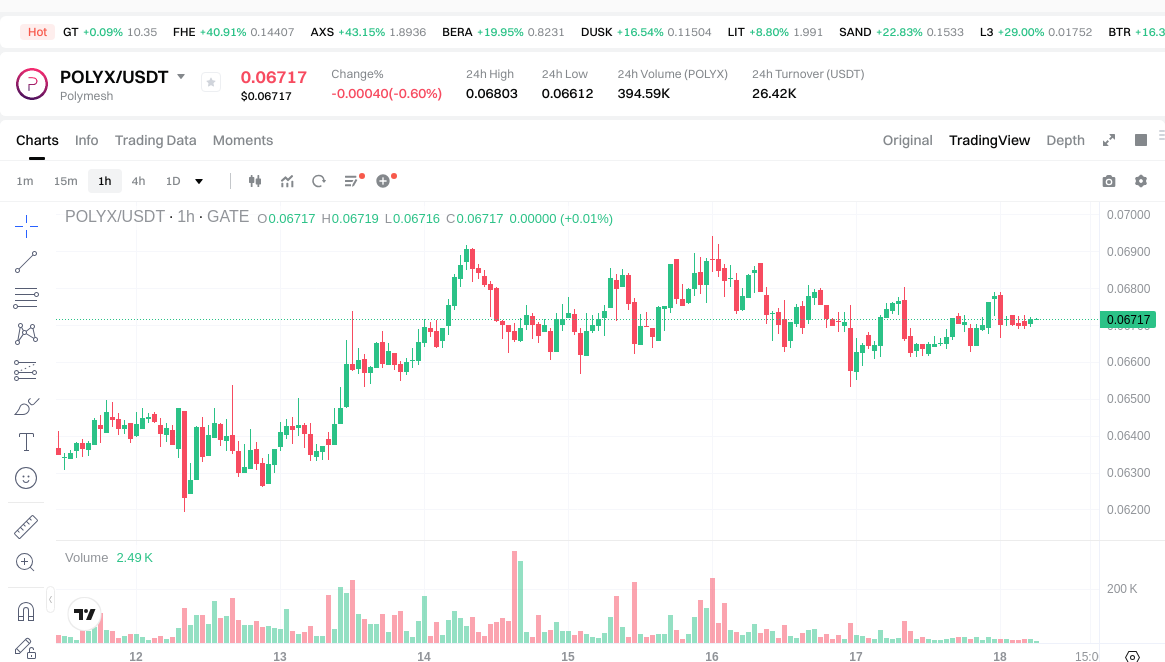
- POLYX Current Price: $0.06718
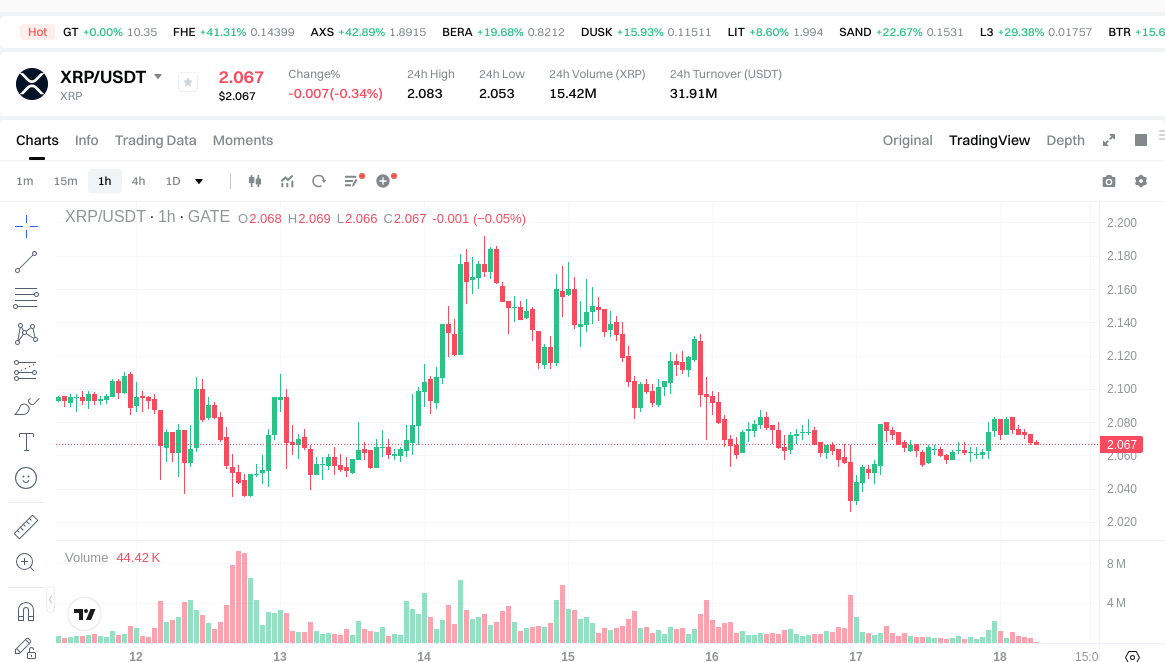
- XRP Current Price: $2.067
- 24-Hour Trading Volume: POLYX $26,370.44 vs XRP $32,212,635.80
- Market Sentiment Index (Fear & Greed Index): 50 (Neutral)
View Real-Time Prices:
II. Core Factors Influencing POLYX vs XRP Investment Value
Supply Mechanism Comparison (Tokenomics)
-
POLYX: Polymesh utilizes a supply mechanism designed to support its specialized blockchain infrastructure for security tokens. The tokenomics structure aims to incentivize network participants while maintaining operational efficiency for institutional-grade asset tokenization.
-
XRP: XRP operates with a pre-mined supply model where tokens were created at network genesis. The circulating supply dynamics are influenced by escrow releases and network usage patterns, particularly in cross-border payment settlements.
-
📌 Historical Pattern: Supply mechanisms have historically influenced price cycles through predictable release schedules and network demand dynamics, with scarcity models potentially supporting value during expansion phases.
Institutional Adoption and Market Application
-
Institutional Holdings: Both assets have attracted institutional interest, though in different capacities. POLYX benefits from connections to security token offerings (STOs) and real-world asset (RWA) tokenization initiatives, particularly following developments in institutional STO fund launches. XRP maintains established presence in financial institution payment networks.
-
Enterprise Adoption: POLYX focuses on regulated security token infrastructure and institutional asset tokenization frameworks. XRP demonstrates application in cross-border payment corridors and remittance services, with ongoing adoption in financial settlement systems.
-
Regulatory Landscape: Different jurisdictions have taken varied approaches to both assets. XRP's regulatory developments have significantly influenced market sentiment, while POLYX operates within the regulatory-focused security token framework.
Technology Development and Ecosystem Building
-
POLYX Technical Evolution: Polymesh continues developing blockchain infrastructure specifically optimized for regulated securities, with technical specifications addressing compliance, identity verification, and asset settlement requirements in tokenized security markets.
-
XRP Technical Progress: XRP's underlying technology focuses on transaction speed and settlement efficiency, with ongoing network enhancements aimed at maintaining competitive advantages in payment processing and liquidity provision.
-
Ecosystem Comparison: POLYX concentrates on security token issuance, trading infrastructure, and institutional-grade asset management tools. XRP maintains broader presence across payment networks, exchange integrations, and cross-border transaction corridors, though with different application focus than DeFi or NFT sectors.
Macroeconomic Factors and Market Cycles
-
Performance in Inflationary Environments: Both assets respond to macroeconomic conditions through different mechanisms. Digital assets generally reflect broader risk sentiment during inflationary periods, though specific utility cases may provide differentiated demand drivers.
-
Monetary Policy Impact: Interest rate decisions and dollar index movements influence digital asset markets broadly. Higher rate environments typically increase opportunity costs for non-yielding assets, affecting both tokens through capital allocation shifts and risk appetite changes.
-
Geopolitical Considerations: Cross-border transaction demand and international regulatory developments create varying impact scenarios. XRP benefits from increased cross-border payment needs, while POLYX gains from institutional interest in compliant asset tokenization during periods of regulatory clarity.
III. 2026-2031 Price Forecast: POLYX vs XRP
Short-term Forecast (2026)
- POLYX: Conservative $0.040314 - $0.06719 | Optimistic $0.06719 - $0.0772685
- XRP: Conservative $1.7578 - $2.068 | Optimistic $2.068 - $3.03996
Mid-term Forecast (2028-2029)
- POLYX may enter a gradual growth phase, with estimated price range of $0.065 - $0.115
- XRP may enter a consolidation phase, with estimated price range of $2.21 - $3.33
- Key drivers: institutional capital inflows, ETF developments, ecosystem expansion
Long-term Forecast (2031)
- POLYX: Baseline scenario $0.095 - $0.121 | Optimistic scenario $0.121 - $0.124
- XRP: Baseline scenario $1.83 - $3.52 | Optimistic scenario $3.52 - $3.80
View detailed price predictions for POLYX and XRP
Disclaimer
POLYX:
| Year |
Predicted High Price |
Predicted Average Price |
Predicted Low Price |
Price Change |
| 2026 |
0.0772685 |
0.06719 |
0.040314 |
0 |
| 2027 |
0.0859528075 |
0.07222925 |
0.067895495 |
7 |
| 2028 |
0.115472901975 |
0.07909102875 |
0.0672273744375 |
17 |
| 2029 |
0.10311888328425 |
0.0972819653625 |
0.065178916792875 |
44 |
| 2030 |
0.142284602539192 |
0.100200424323375 |
0.071142301269596 |
49 |
| 2031 |
0.124879788834222 |
0.121242513431283 |
0.095781585610714 |
80 |
XRP:
| Year |
Predicted High Price |
Predicted Average Price |
Predicted Low Price |
Price Change |
| 2026 |
3.03996 |
2.068 |
1.7578 |
0 |
| 2027 |
2.9115372 |
2.55398 |
2.1453432 |
23 |
| 2028 |
3.333965492 |
2.7327586 |
2.213534466 |
32 |
| 2029 |
3.12436290738 |
3.033362046 |
2.76035946186 |
46 |
| 2030 |
3.9717325949301 |
3.07886247669 |
2.6478217299534 |
48 |
| 2031 |
3.807321338674854 |
3.52529753581005 |
1.833154718621226 |
70 |
IV. Investment Strategy Comparison: POLYX vs XRP
Long-term vs Short-term Investment Strategies
-
POLYX: May be suitable for investors focusing on regulated asset tokenization, institutional-grade security token infrastructure, and real-world asset (RWA) tokenization trends. The investment approach could emphasize longer-term ecosystem development in the security token sector.
-
XRP: May be suitable for investors interested in cross-border payment applications, established financial institution networks, and transaction settlement infrastructure. The strategy could incorporate both medium-term positioning around institutional adoption and short-term responsiveness to regulatory developments.
Risk Management and Asset Allocation
-
Conservative Investors: A balanced approach might consider POLYX: 30-40% vs XRP: 60-70%, reflecting XRP's relatively established market presence and higher liquidity profile.
-
Aggressive Investors: A more dynamic allocation could explore POLYX: 50-60% vs XRP: 40-50%, accounting for potential growth scenarios in specialized security token infrastructure while maintaining exposure to payment network developments.
-
Hedging Tools: Portfolio construction may incorporate stablecoin allocations for liquidity management, options strategies for downside protection, and cross-asset diversification to balance sector-specific exposures.
V. Potential Risk Comparison
Market Risk
-
POLYX: Faces market risks associated with relatively lower trading volume ($26,370.44 as of current data), which may contribute to higher volatility and liquidity constraints during market stress periods. Price movements have shown substantial correction patterns from peak levels.
-
XRP: Experiences market risks related to broader digital asset market cycles and sentiment shifts. Despite higher trading volume ($32,212,635.80), price movements remain subject to macroeconomic factors, institutional flow patterns, and general cryptocurrency market dynamics.
Technical Risk
-
POLYX: Technical considerations include network scalability requirements for institutional-grade asset tokenization, infrastructure stability for regulated security token operations, and ongoing development needs for specialized compliance features.
-
XRP: Technical aspects involve maintaining transaction processing efficiency, network reliability for cross-border payment applications, and infrastructure adaptation to evolving payment industry requirements.
Regulatory Risk
-
Jurisdictional Variations: Different regulatory frameworks across jurisdictions create varying impact scenarios for both assets. XRP has experienced significant regulatory developments that influenced market sentiment, while POLYX operates within regulatory-focused security token frameworks that may evolve with changing compliance requirements.
-
Policy Evolution: Ongoing regulatory clarification processes in major markets may affect both assets differently, with XRP potentially influenced by payment and securities classification discussions, and POLYX subject to security token regulation developments.
VI. Conclusion: Which Is the Better Buy?
📌 Investment Value Summary
-
POLYX Characteristics: Focuses on specialized infrastructure for regulated asset tokenization, institutional-grade security token applications, and compliance-oriented blockchain solutions. Benefits from growing interest in real-world asset tokenization, though operates with lower trading volume and market capitalization relative to established cryptocurrencies.
-
XRP Characteristics: Maintains established presence in cross-border payment networks, demonstrates higher liquidity and trading volume, and benefits from institutional adoption in financial settlement systems. Price performance shows relatively stronger retention during recent market volatility compared to POLYX.
✅ Investment Considerations
-
New Investors: May consider starting with assets demonstrating higher liquidity and established market presence while maintaining strict risk management protocols. Understanding fundamental differences between security token infrastructure and payment network applications is essential before allocation decisions.
-
Experienced Investors: Could evaluate portfolio diversification across different cryptocurrency sectors, balancing exposure between established payment networks and specialized institutional infrastructure. Risk-adjusted positioning should account for volatility patterns, liquidity profiles, and sector-specific development trajectories.
-
Institutional Investors: May assess both assets based on specific mandate requirements, whether focused on payment infrastructure solutions or regulated security token applications. Due diligence should incorporate regulatory landscape analysis, counterparty considerations, and operational infrastructure requirements.
⚠️ Risk Disclosure: Cryptocurrency markets exhibit significant volatility. This analysis does not constitute investment advice. Market conditions, regulatory developments, and technological factors may materially affect asset performance. Investors should conduct independent research and consider risk tolerance before making investment decisions.
VII. FAQ
Q1: What are the main differences between POLYX and XRP in terms of use cases?
POLYX focuses on regulated asset tokenization and institutional-grade security token infrastructure, while XRP specializes in cross-border payment efficiency and financial settlement systems. POLYX operates within the security token framework, providing blockchain solutions for compliance-oriented asset management, identity verification, and regulated securities trading. XRP, launched in 2013, targets payment networks and remittance services, offering fast transaction processing for international money transfers and liquidity provision across financial institutions.
Q2: Which cryptocurrency has better liquidity - POLYX or XRP?
XRP demonstrates significantly superior liquidity compared to POLYX. As of January 18, 2026, XRP's 24-hour trading volume stands at $32,212,635.80, whereas POLYX records only $26,370.44 in trading volume. This substantial difference reflects XRP's established market presence since 2013 and broader adoption across cryptocurrency exchanges. Higher liquidity generally translates to easier entry and exit positions, tighter bid-ask spreads, and reduced price slippage during transactions, making XRP more suitable for investors prioritizing trading flexibility.
Q3: How have POLYX and XRP performed during recent market corrections?
Both assets experienced significant corrections from their respective all-time highs, though with different magnitudes. POLYX declined from its peak of $0.748771 (April 1, 2024) to $0.04574115 (December 19, 2025), representing a substantial drawdown. XRP decreased from $3.65 (July 18, 2025) to approximately $2.067, showing relatively stronger price retention during market volatility. As of January 18, 2026, POLYX trades at $0.06718 while XRP maintains $2.067, indicating XRP's comparatively more resilient performance through recent market cycles.
Q4: What regulatory risks should investors consider for POLYX vs XRP?
Regulatory risks differ significantly between the two assets. XRP has experienced notable regulatory developments, particularly regarding securities classification discussions in major jurisdictions, which have materially influenced market sentiment and price movements. POLYX operates within regulatory-focused security token frameworks, facing risks related to evolving compliance requirements and jurisdictional variations in security token regulation. Both assets remain subject to policy evolution across different markets, though their regulatory exposure stems from distinct application areas - payment networks for XRP and regulated securities infrastructure for POLYX.
Q5: What are the long-term price forecasts for POLYX and XRP through 2031?
Price forecasts suggest divergent trajectories for both assets. For 2031, POLYX baseline scenario estimates range from $0.095 to $0.121, with optimistic scenarios reaching $0.121 to $0.124. XRP's 2031 baseline scenario projects $1.83 to $3.52, with optimistic estimates between $3.52 and $3.80. Key factors influencing these projections include institutional capital inflows, ecosystem expansion, ETF developments, and sector-specific adoption trends. However, cryptocurrency markets exhibit significant volatility, and actual performance may materially differ from forecasts due to regulatory developments, technological changes, and macroeconomic conditions.
Q6: How do supply mechanisms differ between POLYX and XRP?
The supply mechanisms reflect each asset's distinct design philosophy. XRP operates with a pre-mined supply model where all tokens were created at network genesis, with circulating supply dynamics influenced by escrow releases and network usage patterns. POLYX utilizes a supply mechanism designed specifically to support its specialized blockchain infrastructure for security tokens, aiming to incentivize network participants while maintaining operational efficiency for institutional-grade asset tokenization. These fundamental differences in tokenomics affect long-term value dynamics, scarcity models, and network incentive structures for each asset.
Q7: Which asset is more suitable for institutional investors?
Suitability depends on specific institutional mandates and investment objectives. XRP appeals to institutions focusing on payment infrastructure solutions, cross-border transaction capabilities, and established financial settlement systems, offering higher liquidity and broader market recognition. POLYX attracts institutions interested in regulated security token applications, real-world asset tokenization, and compliance-oriented blockchain infrastructure. Institutional investors should evaluate both assets based on mandate requirements, conducting thorough due diligence on regulatory landscape, counterparty considerations, operational infrastructure, and alignment with portfolio objectives before allocation decisions.
Q8: What are the primary technical risks for POLYX and XRP?
Technical risks vary according to each asset's operational focus. POLYX faces challenges related to network scalability requirements for institutional-grade asset tokenization, infrastructure stability for regulated security token operations, and ongoing development needs for specialized compliance features. XRP's technical considerations involve maintaining transaction processing efficiency, ensuring network reliability for cross-border payment applications, and adapting infrastructure to evolving payment industry requirements. Both assets require continuous technical development to address emerging security threats, scalability demands, and competitive pressures within their respective market segments.
* The information is not intended to be and does not constitute financial advice or any other recommendation of any sort offered or endorsed by Gate.