This comprehensive analysis compares POWER, a 2025-launched Web3 incentive layer protocol, against AAVE, an established 2020-founded DeFi lending platform. The article examines historical price trends, current market status (POWER at $0.1519 vs AAVE at $153.28), supply mechanisms, institutional adoption, and technical ecosystems. It provides price forecasts through 2031, investment strategies tailored to different investor profiles, and detailed risk assessments. The comparison reveals AAVE's 73x larger market capitalization ($2.33B versus $31.89M) and superior liquidity on Gate exchange, while positioning POWER as an early-stage growth opportunity. Suitable for investors evaluating diversification between emerging Web3 infrastructure and established DeFi protocols.
Introduction: POWER vs AAVE Investment Comparison
In the cryptocurrency market, the comparison between POWER vs AAVE has been a topic that investors cannot avoid. The two not only show significant differences in market cap ranking, application scenarios, and price performance, but also represent different crypto asset positioning.
POWER (POWER): Launched in 2025, it has gained market recognition through its positioning as an incentive layer that connects mainstream applications to Web3 by transforming user behavior and app revenue into on-chain rewards.
AAVE (AAVE): Since its launch in 2020, it has been recognized as a decentralized lending protocol, serving as one of the cryptocurrencies with high global trading volume and market capitalization.
This article will comprehensively analyze the investment value comparison between POWER vs AAVE around historical price trends, supply mechanisms, institutional adoption, technical ecosystem, and future predictions, attempting to answer the question investors care most about:
"Which is the better buy right now?"
I. Historical Price Comparison and Current Market Status
POWER (Coin A) vs AAVE (Coin B) Historical Price Trends
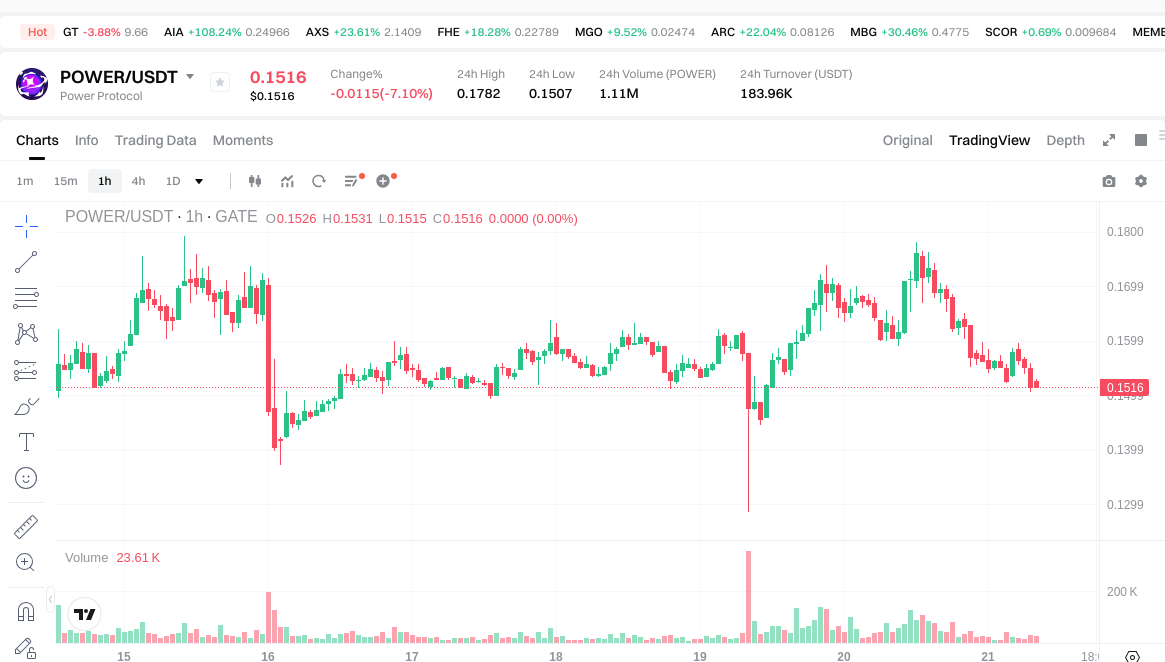
- 2025: POWER launched on January 4, 2025, with an initial price trajectory that reached $0.4595 on December 17, 2025.
- 2026: POWER experienced a significant price decline, dropping to a low of $0.1263 on January 11, 2026.
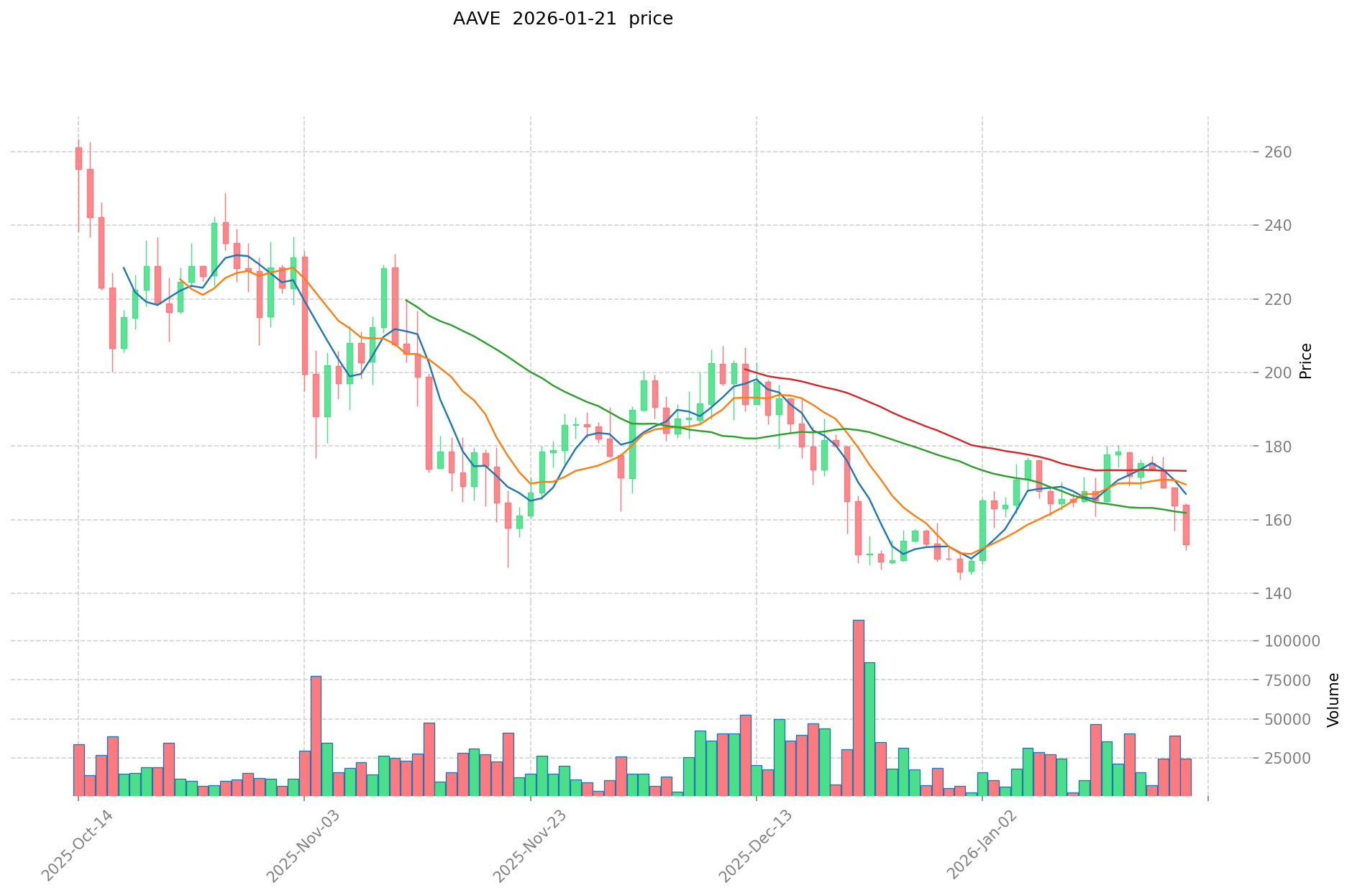
- 2021: AAVE reached a peak price of $661.69 on May 19, 2021, during a bullish market cycle.
- 2020: AAVE recorded its lowest price point of $26.02 on November 5, 2020, following its launch in October 2020.
- Comparative Analysis: During recent market cycles, POWER declined from its high of $0.4595 to $0.1263, representing a substantial decrease over a brief period. In contrast, AAVE has experienced a longer-term decline from its 2021 peak of $661.69, with current trading levels reflecting a 76.8% decrease from that high.
Current Market Status (January 21, 2026)
- POWER Current Price: $0.1519
- AAVE Current Price: $153.28
- 24-Hour Trading Volume: $181,927.59 (POWER) vs $3,883,246.77 (AAVE)
- 24-Hour Price Change: -6.01% (POWER) vs -6.11% (AAVE)
- Market Capitalization: $31,899,000 (POWER) vs $2,327,358,950.14 (AAVE)
- Market Sentiment Index (Fear & Greed Index): 32 (Fear)
View real-time prices:
II. Core Factors Affecting POWER vs AAVE Investment Value
Supply Mechanism Comparison (Tokenomics)
Due to insufficient reference materials and knowledge base limitations regarding the specific supply mechanisms of POWER and AAVE, this section cannot be elaborated upon at this time.
Institutional Adoption and Market Application
Institutional Holdings
Based on available information, both assets show varying degrees of institutional interest, though specific comparative data on institutional holdings is not currently accessible.
Enterprise Adoption
The concrete applications of POWER and AAVE in cross-border payments, settlements, and investment portfolios require further data collection for accurate comparison.
National Policies
Regulatory attitudes toward these assets vary across jurisdictions, though specific policy frameworks for POWER and AAVE in different countries are not detailed in the current materials.
Technology Development and Ecosystem Building
Technology Upgrades
Specific information regarding recent or planned technology upgrades for both POWER and AAVE is not available in the reference materials.
Ecosystem Comparison
A comprehensive comparison of DeFi integration, NFT involvement, payment solutions, and smart contract implementations for both assets cannot be provided due to limited data availability.
Macroeconomic Factors and Market Cycles
The comparative anti-inflation properties of POWER versus AAVE would require historical performance data that is not present in the current reference materials.
Macroeconomic Monetary Policy
The specific impacts of interest rates and the US Dollar Index on both assets' performance patterns are not documented in the available sources.
Geopolitical Factors
While geopolitical developments can influence crypto assets through cross-border transaction demand and international developments, specific comparative impacts on POWER and AAVE are not detailed in the reference materials.
III. 2026-2031 Price Forecast: POWER vs AAVE
Short-term Forecast (2026)
- POWER: Conservative $0.127-$0.153 | Optimistic $0.153-$0.170
- AAVE: Conservative $99.90-$153.69 | Optimistic $153.69-$229.00
Mid-term Forecast (2028-2029)
- POWER may enter a gradual growth phase, with projected price range of $0.176-$0.273 in 2028 and $0.176-$0.318 in 2029
- AAVE may enter a moderate expansion phase, with projected price range of $119.86-$264.13 in 2028 and $179.85-$308.67 in 2029
- Key drivers: institutional capital flows, ETF developments, ecosystem expansion
Long-term Forecast (2030-2031)
- POWER: Baseline scenario $0.177-$0.276 (2030) | Optimistic scenario $0.244-$0.350 (2031)
- AAVE: Baseline scenario $217.93-$275.86 (2030) | Optimistic scenario $232.09-$389.00 (2031)
View detailed price predictions for POWER and AAVE
Disclaimer
POWER:
| Year |
Predicted High Price |
Predicted Average Price |
Predicted Low Price |
Price Change |
| 2026 |
0.169608 |
0.1528 |
0.126824 |
0 |
| 2027 |
0.22890968 |
0.161204 |
0.15636788 |
5 |
| 2028 |
0.273079576 |
0.19505684 |
0.1775017244 |
27 |
| 2029 |
0.31833276288 |
0.234068208 |
0.175551156 |
53 |
| 2030 |
0.3424886019456 |
0.27620048544 |
0.1767683106816 |
81 |
| 2031 |
0.349559334372864 |
0.3093445436928 |
0.244382189517312 |
102 |
AAVE:
| Year |
Predicted High Price |
Predicted Average Price |
Predicted Low Price |
Price Change |
| 2026 |
228.9981 |
153.69 |
99.8985 |
0 |
| 2027 |
252.574146 |
191.34405 |
126.287073 |
24 |
| 2028 |
264.13132662 |
221.959098 |
119.85791292 |
44 |
| 2029 |
308.6674196337 |
243.04521231 |
179.8534571094 |
58 |
| 2030 |
377.9231528814345 |
275.85631597185 |
217.9264896177615 |
79 |
| 2031 |
388.998783967704277 |
326.88973442664225 |
232.091711442915997 |
113 |
IV. Investment Strategy Comparison: POWER vs AAVE
Long-term vs Short-term Investment Strategies
- POWER: May appeal to investors focused on emerging Web3 incentive models and early-stage ecosystem participation, given its recent launch in 2025 and positioning as an application-to-Web3 bridge.
- AAVE: May appeal to investors seeking exposure to established DeFi lending protocols with longer market history and relatively larger market capitalization.
Risk Management and Asset Allocation
- Conservative Investors: POWER 10-20% vs AAVE 80-90%
- Aggressive Investors: POWER 40-50% vs AAVE 50-60%
- Hedging Tools: stablecoin allocation, options instruments, cross-asset portfolio diversification
V. Potential Risk Comparison
Market Risk
- POWER: As a newer asset launched in 2025, POWER exhibits limited price history and experienced a decline from $0.4595 to $0.1263 between December 2025 and January 2026. The relatively smaller market capitalization of $31.89 million may indicate higher volatility sensitivity.
- AAVE: Despite a longer market presence since 2020, AAVE has experienced a substantial decline from its 2021 peak of $661.69. The current market capitalization of approximately $2.33 billion reflects a more established but still volatile asset class.
Technical Risk
- POWER: Scalability considerations and network stability factors require monitoring as the ecosystem develops.
- AAVE: Protocol security considerations and smart contract vulnerabilities remain ongoing technical considerations in the DeFi lending space.
Regulatory Risk
- Global regulatory frameworks continue to evolve for both assets, with potential differential impacts based on their respective use cases—incentive mechanisms for POWER and decentralized lending protocols for AAVE.
VI. Conclusion: Which Is the Better Buy?
📌 Investment Value Summary:
- POWER Strengths: Early-stage positioning in Web3 application incentive layer, potential for ecosystem growth, entry point following recent price decline.
- AAVE Strengths: Established DeFi protocol with longer operational history, larger market capitalization, demonstrated utility in decentralized lending markets.
✅ Investment Recommendations:
- Novice Investors: Consider starting with smaller allocations to both assets, prioritizing understanding of fundamental differences between incentive protocols and lending platforms. Dollar-cost averaging may help manage entry-point risk.
- Experienced Investors: Evaluate portfolio allocation based on risk tolerance, with potential for tactical positioning considering current Fear market sentiment (Index: 32). Monitor ecosystem developments and adoption metrics.
- Institutional Investors: Assess liquidity requirements given the substantial difference in 24-hour trading volumes ($181,927.59 for POWER vs $3,883,246.77 for AAVE). Consider regulatory compliance frameworks for both asset categories.
⚠️ Risk Disclaimer: The cryptocurrency market exhibits high volatility. This content does not constitute investment advice.
VII. FAQ
Q1: What is the main difference between POWER and AAVE in terms of their core functionality?
POWER serves as an incentive layer connecting mainstream applications to Web3 by transforming user behavior and app revenue into on-chain rewards, while AAVE operates as a decentralized lending protocol. POWER, launched in January 2025, focuses on bridging traditional applications with blockchain technology through reward mechanisms. In contrast, AAVE, established in 2020, provides a peer-to-peer lending platform where users can borrow and lend cryptocurrencies without intermediaries. The fundamental distinction lies in their use cases: POWER targets user engagement and application integration, whereas AAVE addresses decentralized financial services in the lending sector.
Q2: How do the market capitalizations of POWER and AAVE compare as of January 21, 2026?
As of January 21, 2026, AAVE has a significantly larger market capitalization of approximately $2.33 billion compared to POWER's market cap of $31.89 million. This represents roughly a 73x difference in market size. AAVE's substantially higher market capitalization reflects its longer operational history (launched in 2020 versus POWER's 2025 launch), established position in the DeFi ecosystem, and broader institutional recognition. The market cap disparity also indicates different liquidity profiles, with AAVE showing 24-hour trading volume of $3.88 million compared to POWER's $181,927.59.
Q3: What is the current market sentiment for cryptocurrency investments, and how might it affect POWER and AAVE?
The current market sentiment as of January 21, 2026, shows a Fear & Greed Index reading of 32, indicating "Fear" conditions in the cryptocurrency market. This bearish sentiment typically results in risk-averse investor behavior, potentially affecting newer assets like POWER more severely due to its smaller market cap and limited price history. Both POWER and AAVE experienced similar negative 24-hour price changes (-6.01% and -6.11% respectively), reflecting the broader market downturn. In fear-driven markets, investors often gravitate toward more established assets with larger market capitalizations and longer track records, which may favor AAVE over POWER in the short term.
Q4: What are the price predictions for POWER and AAVE through 2031?
For 2026, POWER is projected to trade between $0.127-$0.170 (conservative to optimistic scenarios), while AAVE is forecast at $99.90-$229.00. By 2031, POWER's predicted range extends to $0.244-$0.350, representing potential growth of approximately 102% from current levels, while AAVE is projected at $232.09-$389.00, indicating potential growth of around 113%. Mid-term forecasts for 2028-2029 suggest POWER may range from $0.176-$0.318, while AAVE could reach $119.86-$308.67. These projections assume various factors including institutional capital flows, ETF developments, and ecosystem expansion, though actual performance may vary significantly based on market conditions and adoption rates.
Q5: What investment allocation strategy is recommended for different investor profiles when considering POWER versus AAVE?
Conservative investors are recommended to allocate 10-20% to POWER and 80-90% to AAVE, reflecting AAVE's established market position and lower relative risk. Aggressive investors may consider a more balanced approach with 40-50% in POWER and 50-60% in AAVE to capture potential upside from POWER's early-stage growth while maintaining exposure to AAVE's established protocol. Novice investors should start with smaller allocations to both assets and employ dollar-cost averaging to manage entry-point risk. Institutional investors should particularly consider the substantial liquidity difference between the two assets, with AAVE offering approximately 21x higher 24-hour trading volume, making it more suitable for larger position sizes.
Q6: What are the primary risk factors distinguishing POWER from AAVE?
POWER's primary risks stem from its recent launch in 2025, including limited price history, smaller market capitalization of $31.89 million that may amplify volatility, and unproven scalability as its ecosystem develops. The asset experienced a sharp decline from $0.4595 to $0.1263 between December 2025 and January 2026, demonstrating high price sensitivity. AAVE's risks, while different, include exposure to DeFi-specific vulnerabilities such as smart contract security concerns, protocol risks inherent to lending platforms, and sensitivity to regulatory developments affecting decentralized finance. Despite its longer operational history since 2020 and larger $2.33 billion market cap, AAVE has also experienced substantial volatility, declining 76.8% from its 2021 peak of $661.69.
Q7: How do the 24-hour trading volumes of POWER and AAVE reflect their liquidity profiles?
As of January 21, 2026, AAVE demonstrates significantly higher liquidity with 24-hour trading volume of $3,883,246.77 compared to POWER's $181,927.59—approximately 21 times greater. This substantial difference indicates that AAVE offers better order execution, tighter bid-ask spreads, and reduced slippage for larger transactions. For institutional investors or traders requiring significant position sizes, AAVE's higher liquidity provides more practical entry and exit options. POWER's lower trading volume reflects its newer market presence and smaller market capitalization, which may result in higher transaction costs and greater price impact for substantial trades, making it more suitable for smaller, strategic allocations rather than core portfolio positions.
Q8: What role does each asset play in a diversified cryptocurrency portfolio?
POWER and AAVE serve complementary functions in portfolio diversification due to their distinct positioning within the crypto ecosystem. POWER represents exposure to emerging Web3 infrastructure and application incentive mechanisms, offering potential early-stage growth opportunities similar to venture-style investments. Its positioning as a bridge between traditional applications and blockchain technology provides differentiated exposure from standard DeFi protocols. AAVE, conversely, offers exposure to established decentralized finance lending markets with demonstrated utility and longer operational history. Together, they provide diversification across both maturity stages (early-stage versus established) and functional categories (incentive mechanisms versus lending protocols), allowing investors to balance speculative growth potential with relatively more proven DeFi infrastructure exposure.
* The information is not intended to be and does not constitute financial advice or any other recommendation of any sort offered or endorsed by Gate.