This comprehensive guide compares PROM and QNT, two distinct blockchain infrastructure tokens serving different market segments. PROM positions itself as a unified NFT gaming and metaverse platform launched in 2019, while QNT functions as an enterprise blockchain interoperability solution since 2018. The article analyzes historical price trends, tokenomics, institutional adoption, and technological ecosystems, revealing QNT's stronger price resilience and market capitalization of $1.09 billion compared to PROM's $165.33 million. Through detailed price forecasts extending to 2031 and tailored investment strategies for different investor profiles, this analysis equips readers to evaluate which token aligns better with their portfolio objectives and risk tolerance on Gate and other major exchanges.
Introduction: Investment Comparison Between PROM and QNT
In the cryptocurrency market, the comparison between PROM vs QNT has consistently been a topic investors cannot avoid. The two demonstrate notable differences in market capitalization ranking, application scenarios, and price performance, representing distinct crypto asset positioning.
Prometeus (PROM): Launched in 2019, it has positioned itself as a unified access point for NFT gaming and the metaverse industry, including NFT marketplace and aggregator, uncollateralized NFT lending and staking, educational portal and analytics tools, NFT launchpad, and DEX for GameFi assets.
Quant (QNT): Since its inception in 2018, it has been recognized as a technology provider enabling trusted digital interactions through its global blockchain operating system Overledger, addressing blockchain interoperability challenges for enterprises, regulators, governments, and individuals.
This article will provide a comprehensive analysis of PROM vs QNT investment value comparison through historical price trends, supply mechanisms, institutional adoption, technological ecosystems, and future forecasts, attempting to answer investors' most pressing question:
"Which is the better buy right now?"
I. Historical Price Comparison and Current Market Status
PROM (Coin A) and QNT (Coin B) Historical Price Trends
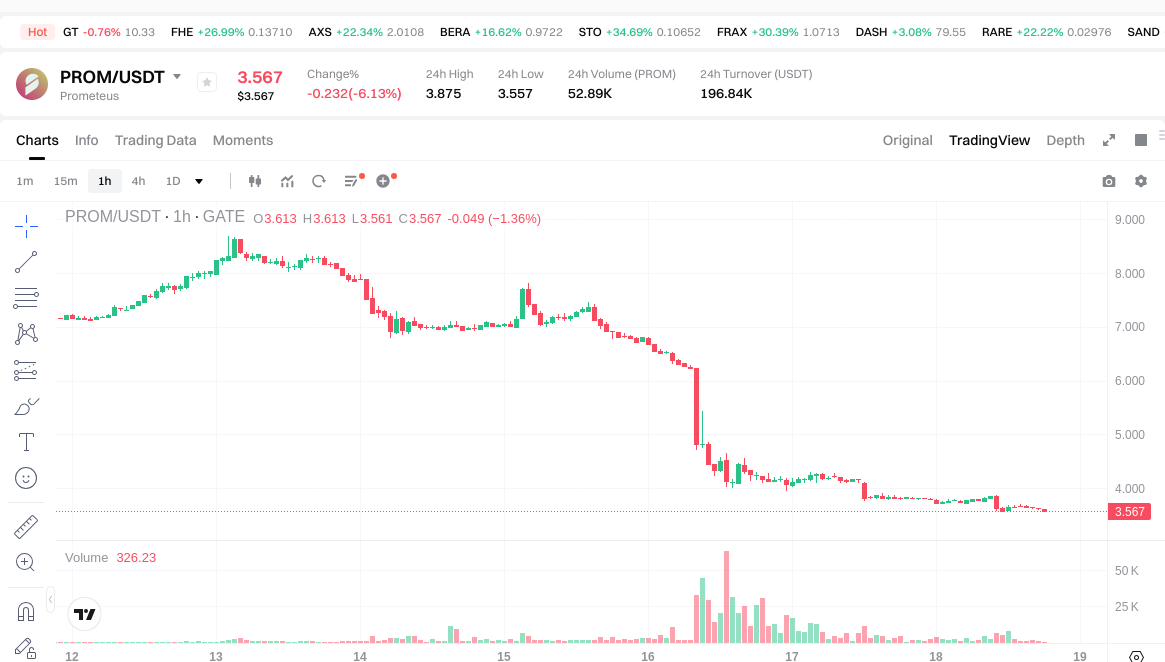
- 2021: PROM experienced significant volatility, with its price reaching an all-time high of $105.94 in April 2021 during the broader crypto market rally.
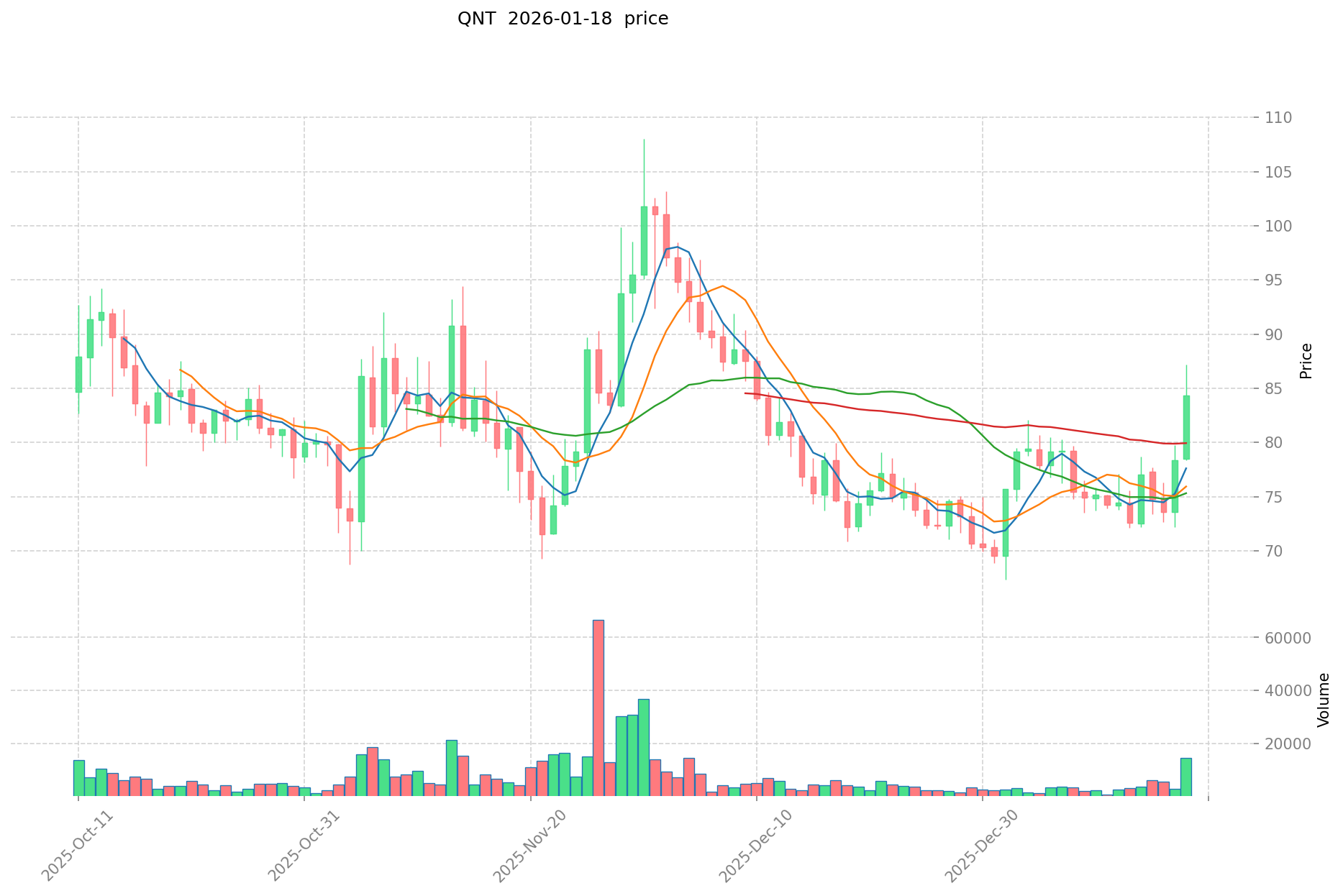
- 2021: QNT recorded its all-time high of $427.42 in September 2021, driven by growing institutional interest in blockchain interoperability solutions.
- Comparative Analysis: During the 2021-2022 market cycle, PROM declined from its peak of $105.94 to its current level of $3.588, representing a decline of approximately 96.6%. In contrast, QNT decreased from $427.42 to $80.61, showing a decline of approximately 81.1%, indicating relatively stronger price resilience during market corrections.
Current Market Status (2026-01-18)
- PROM Current Price: $3.588
- QNT Current Price: $80.61
- 24-Hour Trading Volume: PROM $207,204.84 vs QNT $988,295.54
- Market Sentiment Index (Fear & Greed Index): 49 (Neutral)
View Real-Time Prices:
II. Core Factors Influencing PROM vs QNT Investment Value
Supply Mechanism Comparison (Tokenomics)
- PROM: Market capitalization stands at $165.33 million with a circulating supply of 18.25 million tokens, trading in the price range of $8.09 to $8.91
- QNT: Current market valuation reaches $1.09 billion at a price of $79.23, with daily trading volume of approximately $169,928
- 📌 Historical Pattern: Supply dynamics and token distribution mechanisms significantly influence price cycles and market valuations
Institutional Adoption and Market Application
- Institutional Holdings: QNT demonstrates stronger institutional preference with its higher market capitalization positioning
- Enterprise Adoption: PROM is accessible through Gate, KuCoin, and CoinEx platforms, while QNT trades on Gate, Binance, KuCoin, and Coinbase, indicating broader institutional integration
- Regulatory Landscape: Both assets operate within evolving regulatory frameworks that influence institutional participation patterns
Technology Development and Ecosystem Building
- PROM Technical Progress: The project maintains active development with market ranking at position 190 globally
- QNT Technical Evolution: Positioned as an established infrastructure solution with presence across major trading platforms
- Ecosystem Comparison: Both projects demonstrate distinct approaches to blockchain infrastructure, with varying degrees of DeFi integration, payment solutions, and smart contract implementation
Macroeconomic Environment and Market Cycles
- Inflation Dynamics: Asset performance correlates with broader cryptocurrency market trends, which showed a 2.2% increase during recent periods
- Monetary Policy Impact: Interest rate fluctuations, dollar index movements, and central bank policies affect both assets through market sentiment and capital flows
- Geopolitical Considerations: Cross-border transaction demand and international developments influence adoption rates and trading volumes for both tokens
III. 2026-2031 Price Forecast: PROM vs QNT
Short-term Forecast (2026)
- PROM: Conservative $2.50-$3.57 | Optimistic $3.57-$4.32
- QNT: Conservative $54.02-$80.62 | Optimistic $80.62-$95.94
Mid-term Forecast (2028-2029)
- PROM may enter a gradual growth phase, with estimated price range of $3.81-$6.00 in 2028 and $3.46-$5.64 in 2029
- QNT may enter an expansion phase, with estimated price range of $88.19-$120.53 in 2028 and $88.50-$155.15 in 2029
- Key drivers: institutional capital inflows, ETF developments, ecosystem expansion
Long-term Forecast (2030-2031)
- PROM: Base scenario $3.18-$5.49 (2030), $4.05-$6.34 (2031) | Optimistic scenario $5.49-$7.19 (2030), $6.34-$7.03 (2031)
- QNT: Base scenario $96.51-$132.20 (2030), $123.68-$152.69 (2031) | Optimistic scenario $132.20-$173.19 (2030), $152.69-$212.24 (2031)
View detailed price predictions for PROM and QNT
Disclaimer: Price predictions are based on historical data analysis and market trends. Actual prices may vary significantly due to market volatility, regulatory changes, technological developments, and other unforeseen factors. This information is for reference purposes only and does not constitute investment advice.
PROM:
| Year |
Predicted High Price |
Predicted Average Price |
Predicted Low Price |
Price Change |
| 2026 |
4.31607 |
3.567 |
2.4969 |
0 |
| 2027 |
5.3604876 |
3.941535 |
2.6802438 |
9 |
| 2028 |
5.999804577 |
4.6510113 |
3.813829266 |
29 |
| 2029 |
5.64493241481 |
5.3254079385 |
3.461515160025 |
48 |
| 2030 |
7.18557293141805 |
5.485170176655 |
3.1813987024599 |
52 |
| 2031 |
7.032262424980542 |
6.335371554036525 |
4.054637794583376 |
76 |
QNT:
| Year |
Predicted High Price |
Predicted Average Price |
Predicted Low Price |
Price Change |
| 2026 |
95.9378 |
80.62 |
54.0154 |
0 |
| 2027 |
107.700258 |
88.2789 |
75.037065 |
9 |
| 2028 |
120.52718217 |
97.989579 |
88.1906211 |
21 |
| 2029 |
155.1469004307 |
109.258380585 |
88.49928827385 |
35 |
| 2030 |
173.1854590652835 |
132.20264050785 |
96.5079275707305 |
64 |
| 2031 |
212.244729203327782 |
152.69404978656675 |
123.682180327119067 |
89 |
IV. Investment Strategy Comparison: PROM vs QNT
Long-term vs Short-term Investment Strategies
- PROM: Suitable for investors focusing on NFT gaming and metaverse ecosystem potential, particularly those interested in emerging GameFi infrastructure with higher risk tolerance
- QNT: Suitable for investors seeking enterprise blockchain interoperability solutions with established institutional presence and relatively stronger price resilience during market corrections
Risk Management and Asset Allocation
- Conservative Investors: PROM 30% vs QNT 70%
- Aggressive Investors: PROM 55% vs QNT 45%
- Hedging Tools: Stablecoin allocation, options strategies, cross-asset portfolio diversification
V. Potential Risk Comparison
Market Risk
- PROM: Higher price volatility with approximately 96.6% decline from peak levels, lower trading volume of $207,204.84 indicating reduced liquidity, market capitalization ranking at position 190
- QNT: Moderate volatility with approximately 81.1% decline from peak levels, higher trading volume of $988,295.54 providing better liquidity support, market capitalization of $1.09 billion suggesting more established market position
Technical Risk
- PROM: Scalability challenges in NFT marketplace infrastructure, network stability concerns in GameFi ecosystem integration
- QNT: Interoperability protocol complexity, potential security vulnerabilities in cross-chain operations
Regulatory Risk
- Global regulatory frameworks surrounding NFT gaming platforms and metaverse applications may impact PROM's operational scope differently than enterprise blockchain solutions, while QNT faces evolving compliance requirements for institutional blockchain infrastructure across multiple jurisdictions
VI. Conclusion: Which Is the Better Buy?
📌 Investment Value Summary:
- PROM Advantages: Positioned in growing NFT gaming and metaverse sectors, lower entry price point at $3.588, potential for ecosystem expansion in GameFi infrastructure
- QNT Advantages: Established enterprise blockchain interoperability solution, broader institutional adoption across major exchanges including Binance and Coinbase, stronger price resilience with 81.1% decline versus 96.6% for PROM, higher market capitalization at $1.09 billion indicating more mature market positioning
✅ Investment Recommendations:
- Beginner Investors: Consider QNT for its established market position and broader institutional support, with allocation not exceeding risk tolerance levels
- Experienced Investors: Evaluate portfolio diversification between PROM's emerging GameFi potential and QNT's enterprise infrastructure positioning based on individual risk profiles
- Institutional Investors: QNT may align better with established blockchain infrastructure requirements, while PROM presents opportunities in nascent NFT gaming sectors
⚠️ Risk Disclosure: Cryptocurrency markets demonstrate high volatility. This content does not constitute investment advice.
VII. FAQ
Q1: What are the main differences between PROM and QNT in terms of market positioning?
PROM focuses on NFT gaming and metaverse infrastructure, while QNT provides enterprise blockchain interoperability solutions. PROM serves as a unified access point for GameFi assets, NFT marketplaces, and metaverse applications, targeting the gaming and digital collectibles sector. In contrast, QNT's Overledger platform addresses cross-chain connectivity challenges for enterprises, regulators, and governments, positioning it as an institutional-grade blockchain infrastructure provider with broader enterprise adoption across major exchanges including Binance and Coinbase.
Q2: Which asset demonstrates better price resilience during market corrections?
QNT shows stronger price resilience compared to PROM. During the 2021-2022 market cycle, QNT declined approximately 81.1% from its all-time high of $427.42 to $80.61, while PROM experienced a more significant decline of approximately 96.6% from $105.94 to $3.588. This difference suggests QNT maintains relatively better value stability during bearish market conditions, supported by its higher market capitalization of $1.09 billion and daily trading volume of $988,295.54 compared to PROM's $207,204.84.
Q3: What are the projected price ranges for PROM and QNT through 2031?
For 2026, PROM's conservative forecast ranges from $2.50-$3.57 with an optimistic scenario of $3.57-$4.32, while QNT projects $54.02-$80.62 conservatively and $80.62-$95.94 optimistically. By 2031, PROM's base scenario estimates $4.05-$6.34 with an optimistic range of $6.34-$7.03, whereas QNT forecasts $123.68-$152.69 in the base case and $152.69-$212.24 optimistically. These projections reflect both assets' growth potential, though actual prices may vary significantly due to market volatility, regulatory changes, and technological developments.
Q4: How should different investor types allocate between PROM and QNT?
Conservative investors should consider a 30% PROM to 70% QNT allocation, prioritizing QNT's established market position and institutional support. Aggressive investors may adopt a 55% PROM to 45% QNT ratio, capitalizing on PROM's higher growth potential in emerging GameFi sectors. Beginner investors should focus primarily on QNT due to its broader exchange presence and mature market positioning, while experienced investors can evaluate diversification based on individual risk profiles. Institutional investors typically find QNT more aligned with established blockchain infrastructure requirements.
Q5: What are the primary risks associated with investing in PROM versus QNT?
PROM carries higher market risk with greater price volatility, lower liquidity evidenced by $207,204.84 daily trading volume, and market ranking at position 190. Technical risks include scalability challenges in NFT marketplace infrastructure and network stability concerns in GameFi integration. QNT faces moderate volatility risks, interoperability protocol complexity, and potential security vulnerabilities in cross-chain operations. Both assets encounter regulatory uncertainties, with PROM subject to evolving NFT gaming regulations and QNT facing compliance requirements for institutional blockchain infrastructure across multiple jurisdictions.
Q6: Which exchanges support PROM and QNT trading?
PROM is accessible through Gate, KuCoin, and CoinEx platforms, providing multiple trading venues for investors. QNT demonstrates broader institutional integration with availability on Gate, Binance, KuCoin, and Coinbase, indicating stronger exchange partnerships and greater accessibility for both retail and institutional investors. This wider exchange support for QNT correlates with its higher market capitalization and suggests better liquidity conditions for traders seeking entry and exit points.
Q7: What factors drive the long-term value proposition for each asset?
PROM's value derives from growth in NFT gaming and metaverse sectors, GameFi infrastructure expansion, and development of its unified marketplace ecosystem. The project's focus on uncollateralized NFT lending, staking mechanisms, and educational tools positions it within emerging digital entertainment markets. QNT's value proposition centers on enterprise blockchain adoption, cross-chain interoperability demand, institutional integration requirements, and regulatory compliance solutions. Key drivers for both include technological developments, ecosystem expansion, institutional capital inflows, and potential ETF developments affecting broader cryptocurrency market sentiment.
Q8: How do supply mechanisms differ between PROM and QNT?
PROM maintains a market capitalization of $165.33 million with 18.25 million tokens in circulation, trading in the range of $8.09 to $8.91 based on recent data. QNT's current market valuation reaches $1.09 billion at approximately $79.23 per token, with daily trading volume around $169,928. These supply dynamics and token distribution mechanisms significantly influence price cycles and market valuations, with QNT's larger circulating supply and higher valuation reflecting its more established market position and institutional preference compared to PROM's emerging ecosystem status.
* The information is not intended to be and does not constitute financial advice or any other recommendation of any sort offered or endorsed by Gate.