This comprehensive analysis compares Portal To Bitcoin (PTB) and Synthetix (SNX), two distinct cryptocurrency platforms with different market positioning. PTB, launched in 2024, serves as a custodyless Bitcoin scaling solution enabling cross-chain trading with centralized exchange efficiency. SNX, operational since 2018, functions as a decentralized synthetic asset protocol supporting fiat, commodities, and crypto derivatives. The article examines historical price trends, tokenomics, institutional adoption, technical ecosystems, and market risks. As of January 2026, PTB trades at $0.002074 with extreme volatility, while SNX maintains $0.3832 with extended downtrend exposure. Through detailed investment strategy analysis, risk assessment, and price forecasts through 2031, this guide helps investors evaluate which platform aligns better with their investment thesis, risk tolerance, and portfolio objectives in the current crypto market environment.
Introduction: PTB vs SNX Investment Comparison
In the cryptocurrency market, the comparison between PTB and SNX has become a topic that investors cannot avoid. Both show significant differences in market cap ranking, application scenarios, and price performance, representing distinct positioning within the crypto asset landscape.
Portal To Bitcoin (PTB): Launched in 2024, it positions itself as the only custodyless solution to scale Bitcoin to millions of markets, starting with cross-chain trading that offers the scale, speed, and low transaction fees comparable to centralized exchanges.
Synthetix (SNX): Since its launch in 2018 (formerly known as Havven), it has been designed as a decentralized network supporting synthetic assets including fiat currencies pegged to USD, precious metals, indices, and other cryptocurrencies.
This article will comprehensively analyze the investment value comparison between PTB and SNX around historical price trends, supply mechanisms, institutional adoption, technological ecosystem, and future predictions, attempting to answer the question that investors care about most:
"Which is the better buy right now?"
I. Historical Price Comparison and Current Market Status
Portal To Bitcoin (PTB) and Synthetix (SNX) Historical Price Trends
-
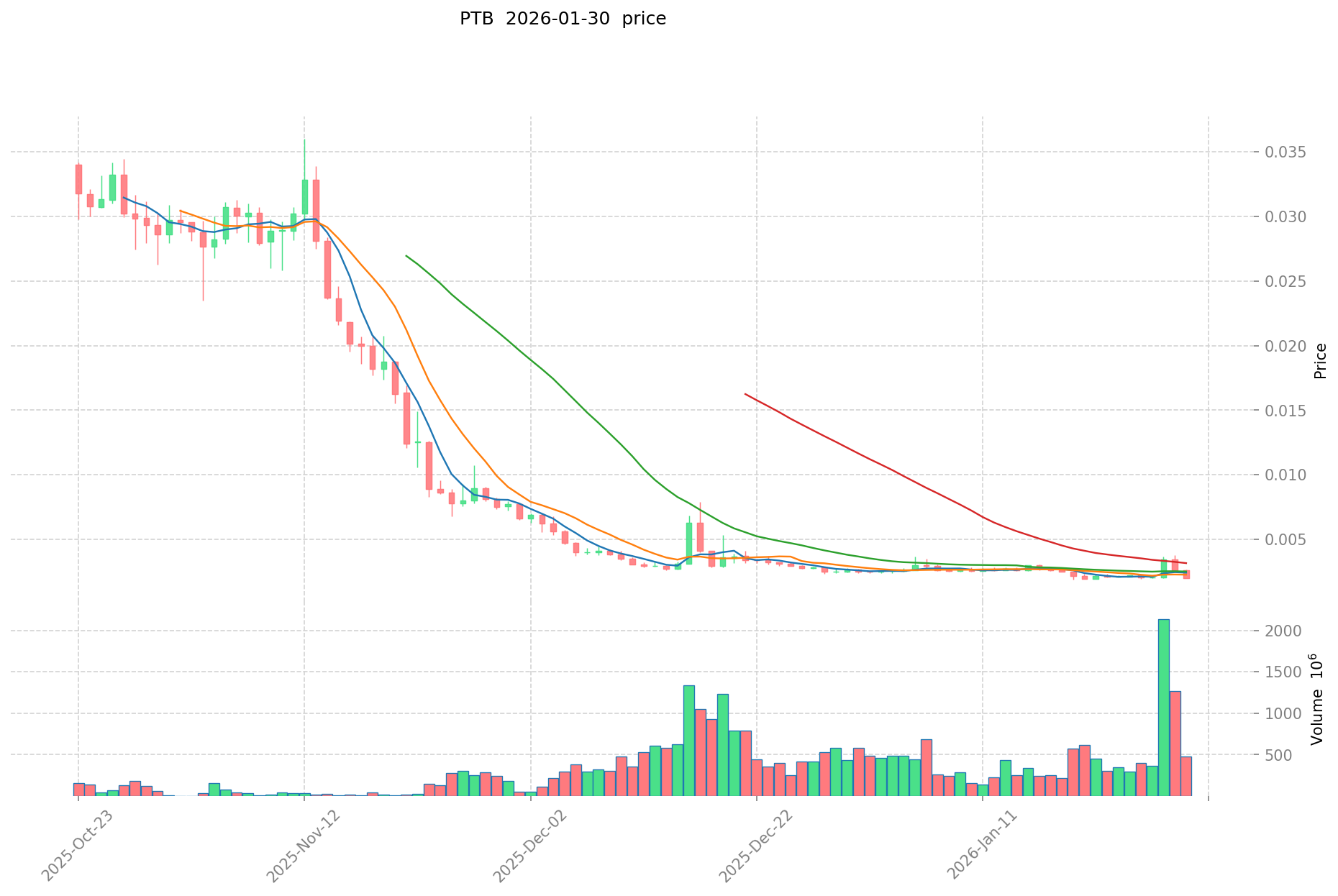
2025: Portal To Bitcoin (PTB) reached its all-time high of $0.08705 on September 8, 2025, driven by initial market enthusiasm following its launch in January 2025. The token subsequently experienced significant volatility.
-
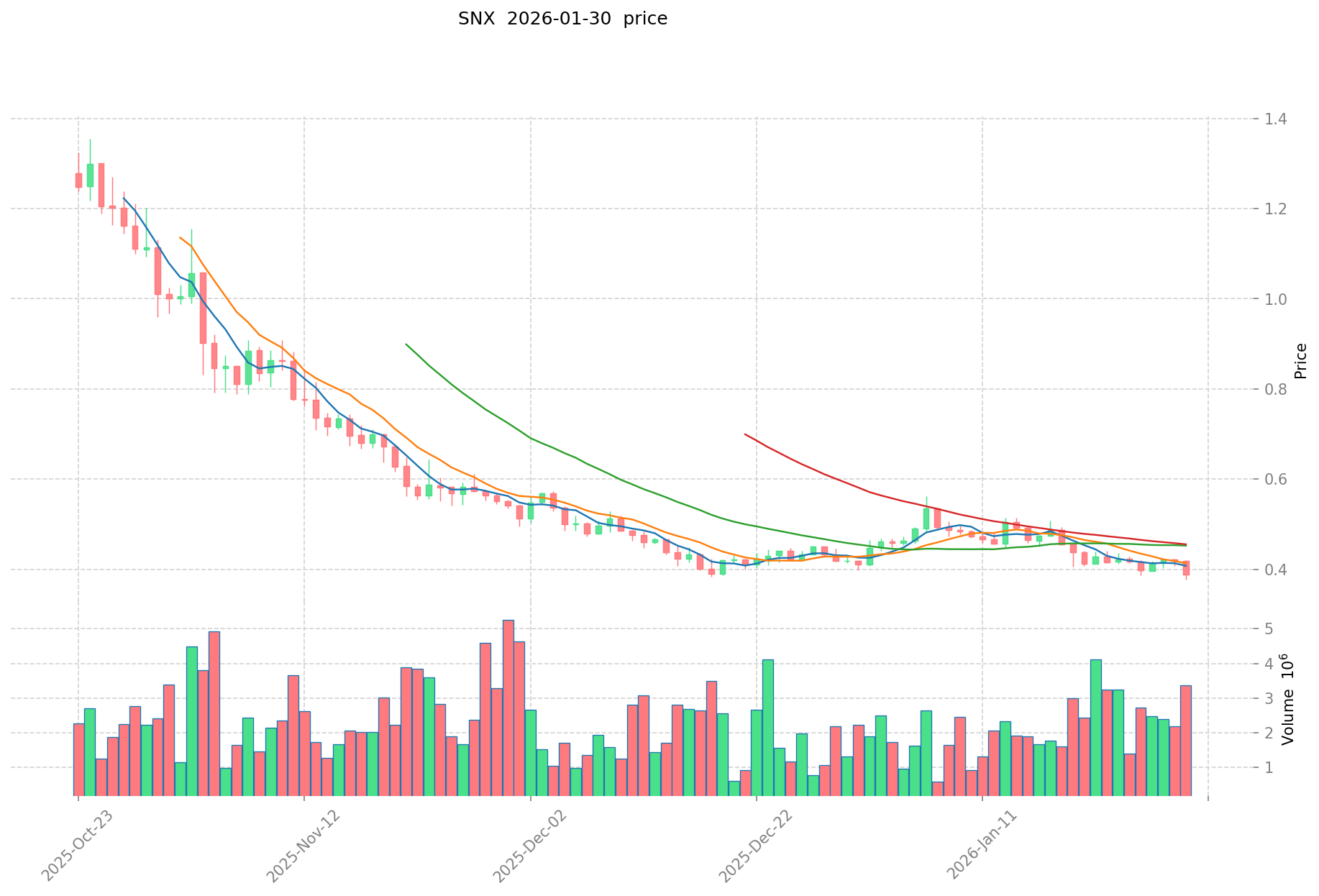
2021: Synthetix (SNX) reached its all-time high of $28.53 on February 14, 2021, during the broader DeFi market expansion. The protocol benefited from growing interest in decentralized synthetic assets trading.
-
Comparative Analysis: During the 2025-2026 market cycle, PTB declined from its peak of $0.08705 to a low of $0.001871 recorded on January 19, 2026, representing a decline of approximately 97.9%. In contrast, SNX has experienced a more extended downtrend from its 2021 peak, declining from $28.53 to its current levels, with a historical low of $0.0347864 recorded on January 6, 2019.
Current Market Status (January 30, 2026)
- PTB Current Price: $0.002074
- SNX Current Price: $0.3832
- 24-Hour Trading Volume: PTB recorded $1,033,258.34 compared to SNX's $1,563,904.13
- Market Sentiment Index (Fear & Greed Index): 16 (Extreme Fear)
View real-time prices:
II. Core Factors Influencing PTB vs SNX Investment Value
Supply Mechanism Comparison (Tokenomics)
- PTB: Supply mechanism details were not available in the reference materials.
- SNX: Supply mechanism details were not available in the reference materials.
- 📌 Historical Pattern: Supply mechanisms can influence price cycles through controlled token release schedules and circulation dynamics.
Institutional Adoption and Market Application
- Institutional Holdings: Information regarding institutional preference between PTB and SNX was not available in the reference materials.
- Enterprise Adoption: Comparative data on PTB and SNX adoption in cross-border payments, settlements, or investment portfolios was not available in the reference materials.
- National Policies: Regulatory attitudes toward PTB and SNX across different jurisdictions were not documented in the reference materials.
Technical Development and Ecosystem Building
- PTB Technical Upgrades: Specific technical upgrade details and potential impacts were not available in the reference materials.
- SNX Technical Development: Specific technical development details and potential impacts were not available in the reference materials.
- Ecosystem Comparison: Comparative implementation data regarding DeFi, NFT, payments, and smart contract deployments for PTB and SNX were not available in the reference materials.
Macroeconomic Factors and Market Cycles
- Performance in Inflationary Environments: Comparative analysis of anti-inflation properties between PTB and SNX was not available in the reference materials.
- Macroeconomic Monetary Policy: Specific impacts of interest rates and US Dollar Index movements on PTB and SNX were not documented in the reference materials.
- Geopolitical Factors: Information regarding cross-border transaction demand and international developments affecting PTB and SNX was not available in the reference materials.
III. 2026-2031 Price Forecast: PTB vs SNX
Short-term Forecast (2026)
- PTB: Conservative $0.00149328 - $0.002074 | Optimistic $0.002074 - $0.00230214
- SNX: Conservative $0.360208 - $0.3832 | Optimistic $0.3832 - $0.559472
Medium-term Forecast (2028-2029)
- PTB may enter a gradual accumulation phase, with projected price range of $0.0014441262 - $0.003615451994325
- SNX may enter an expansion phase, with projected price range of $0.29222832 - $1.004947151166
- Key drivers: institutional capital flows, ETF developments, ecosystem growth
Long-term Forecast (2030-2031)
- PTB: Base scenario $0.001710482805591 - $0.003054433581412 | Optimistic scenario $0.002880330867271 - $0.004257880412489
- SNX: Base scenario $0.5065754006898 - $0.844292334483 | Optimistic scenario $0.832134524866444 - $1.40895504778523
View detailed price predictions for PTB and SNX
Disclaimer
PTB:
| Year |
Predicted High Price |
Predicted Average Price |
Predicted Low Price |
Price Change |
| 2026 |
0.00230214 |
0.002074 |
0.00149328 |
0 |
| 2027 |
0.0024725191 |
0.00218807 |
0.0014441262 |
5 |
| 2028 |
0.002656535787 |
0.00233029455 |
0.0021205680405 |
12 |
| 2029 |
0.003615451994325 |
0.0024934151685 |
0.00159578570784 |
20 |
| 2030 |
0.003207155260483 |
0.003054433581412 |
0.001710482805591 |
47 |
| 2031 |
0.004257880412489 |
0.003130794420947 |
0.002880330867271 |
50 |
SNX:
| Year |
Predicted High Price |
Predicted Average Price |
Predicted Low Price |
Price Change |
| 2026 |
0.559472 |
0.3832 |
0.360208 |
0 |
| 2027 |
0.70229064 |
0.471336 |
0.29222832 |
23 |
| 2028 |
0.7804617156 |
0.58681332 |
0.4342418568 |
53 |
| 2029 |
1.004947151166 |
0.6836375178 |
0.663128392266 |
79 |
| 2030 |
1.04692249475892 |
0.844292334483 |
0.5065754006898 |
121 |
| 2031 |
1.40895504778523 |
0.94560741462096 |
0.832134524866444 |
147 |
IV. Investment Strategy Comparison: PTB vs SNX
Long-term vs Short-term Investment Strategies
-
PTB: May be suitable for investors interested in emerging cross-chain Bitcoin scaling solutions and those with higher risk tolerance for early-stage projects. The token's positioning in custodyless Bitcoin market access represents a specific use case within the cryptocurrency ecosystem.
-
SNX: May appeal to investors focused on decentralized synthetic asset protocols and DeFi ecosystem participation. The longer operational history since 2018 provides a more established track record compared to newer projects.
Risk Management and Asset Allocation
-
Conservative Investors: Considering the volatility profiles, conservative portfolios might consider limited exposure to either asset, with potential allocation considerations favoring more established projects like SNX over newer entrants like PTB.
-
Aggressive Investors: Those seeking higher risk-reward profiles might explore varied allocations based on their conviction in specific technological approaches and market positioning.
-
Hedging Tools: Portfolio diversification through stablecoin allocations, derivatives instruments where available, and cross-asset combinations may help manage exposure volatility.
V. Potential Risk Comparison
Market Risk
-
PTB: As a token launched in 2024, PTB faces liquidity considerations with 24-hour trading volume of approximately $1.03 million as of January 30, 2026. The token has experienced substantial price decline from its September 2025 peak, reflecting market volatility common to newer projects.
-
SNX: Despite longer market presence since 2018, SNX has experienced extended downtrend from its February 2021 peak. Current 24-hour trading volume stands at approximately $1.56 million, with price movements influenced by broader DeFi market conditions and synthetic asset demand.
Technical Risk
-
PTB: As a cross-chain scaling solution, technical considerations include implementation complexity, bridge security, and adoption challenges inherent in custodyless architectures.
-
SNX: Protocol risks associated with synthetic asset collateralization, oracle dependencies, and smart contract vulnerabilities represent ongoing considerations for the decentralized synthetic asset network.
Regulatory Risk
- Global regulatory developments may impact both projects differently based on their respective functionalities. Cross-chain solutions and synthetic asset protocols each face distinct regulatory considerations across various jurisdictions, though specific policy impacts were not detailed in available materials.
VI. Conclusion: Which Is the Better Buy?
📌 Investment Value Summary:
-
PTB Characteristics: Represents an early-stage approach to Bitcoin scaling through custodyless cross-chain solutions, launched in 2024 with focus on transaction efficiency and decentralized market access.
-
SNX Characteristics: Established decentralized synthetic asset protocol operational since 2018, providing exposure to the DeFi synthetic asset sector with longer operational history.
✅ Investment Considerations:
-
New Investors: May benefit from thorough research into both projects' underlying technologies, use cases, and risk profiles before considering any allocation. Understanding the fundamental differences between cross-chain Bitcoin solutions and synthetic asset protocols is essential.
-
Experienced Investors: Should evaluate each project based on their specific investment thesis, risk tolerance, and portfolio objectives. Consideration of liquidity profiles, technological differentiation, and market positioning within their respective niches may inform decision-making.
-
Institutional Investors: May require comprehensive due diligence on operational history, technical architecture, regulatory positioning, and liquidity characteristics before considering exposure to either asset class.
⚠️ Risk Disclosure: Cryptocurrency markets exhibit high volatility. This analysis does not constitute investment advice. Market conditions as of January 30, 2026 show an Extreme Fear sentiment index of 16, reflecting challenging market environment. Both PTB and SNX have experienced substantial declines from their respective peak prices. Investors should conduct independent research and consider their financial situation before making investment decisions.
VII. FAQ
Q1: What are the fundamental differences between PTB and SNX as cryptocurrency investments?
PTB (Portal To Bitcoin) and SNX (Synthetix) serve distinctly different purposes in the cryptocurrency ecosystem. PTB is a custodyless cross-chain scaling solution for Bitcoin launched in 2024, designed to enable Bitcoin trading across millions of markets with centralized exchange-like speed and low fees. SNX, operational since 2018, is a decentralized protocol for creating and trading synthetic assets including fiat currencies, commodities, and cryptocurrencies. The key distinction lies in their core functionalities: PTB focuses on Bitcoin interoperability and scaling, while SNX enables exposure to various asset classes through synthetic instruments within the DeFi ecosystem.
Q2: Which token has shown better price stability during market downturns?
Based on historical data, both tokens have experienced significant volatility, though at different timeframes. PTB declined approximately 97.9% from its September 2025 peak of $0.08705 to its January 2026 low of $0.001871 within roughly four months. SNX experienced an extended multi-year decline from its February 2021 peak of $28.53, representing a longer-term downtrend influenced by broader DeFi market cycles. Neither token demonstrates particular price stability during downturns, with PTB showing more acute short-term volatility as a newer project, while SNX reflects sustained pressure over an extended period.
Q3: What is the current liquidity situation for trading PTB versus SNX?
As of January 30, 2026, SNX demonstrates slightly higher liquidity with 24-hour trading volume of $1,563,904.13 compared to PTB's $1,033,258.34. However, both tokens exhibit relatively modest trading volumes, which may impact execution for larger orders and contribute to price slippage. The liquidity difference of approximately 51% in SNX's favor likely reflects its longer market presence and broader DeFi ecosystem integration. Investors should consider these liquidity profiles when planning entry and exit strategies, particularly for position sizes that represent meaningful percentages of daily volume.
Q4: How do the price predictions for 2026-2031 compare between PTB and SNX?
The price forecasts show markedly different trajectories reflecting each token's market positioning. For 2026, PTB's conservative range is $0.00149328 - $0.002074, while SNX ranges from $0.360208 - $0.3832. By 2031, PTB's optimistic scenario projects $0.002880 - $0.004257, representing potential appreciation of approximately 105-138% from current levels. SNX's 2031 optimistic scenario of $0.832134 - $1.408955 suggests potential gains of 117-268% from current prices. These projections indicate SNX may offer higher absolute growth potential in terms of percentage gains, though both forecasts remain speculative and subject to significant uncertainty given market volatility.
Q5: What are the primary risk factors specific to each token?
PTB's primary risks include its early-stage status as a 2024 launch, technical implementation challenges inherent in custodyless cross-chain architecture, bridge security vulnerabilities, and adoption uncertainty for its Bitcoin scaling approach. The token's severe price decline and limited liquidity also present market risk. SNX faces different challenges including smart contract vulnerabilities in its synthetic asset protocol, collateralization risks, oracle dependencies for price feeds, and regulatory uncertainty surrounding synthetic asset offerings. Additionally, SNX's prolonged downtrend since 2021 reflects sustained DeFi sector headwinds that may continue affecting its performance.
Q6: Which token is more suitable for conservative versus aggressive investors?
Conservative investors seeking cryptocurrency exposure might find neither token particularly suitable given their high volatility profiles and substantial declines from peak prices. If considering either, SNX's longer operational history since 2018 and slightly higher liquidity may offer marginally more established track record compared to PTB's recent launch. Aggressive investors with higher risk tolerance might explore PTB for its early-stage potential in Bitcoin scaling solutions, though this comes with heightened uncertainty and liquidity constraints. Both tokens require thorough due diligence and should represent only a small portion of diversified portfolios, with position sizing reflecting each investor's specific risk capacity and investment thesis.
Q7: How does the current market sentiment affect investment decisions between PTB and SNX?
The current Fear & Greed Index reading of 16 (Extreme Fear) as of January 30, 2026, indicates widespread market pessimism that affects all cryptocurrency assets including both PTB and SNX. This extreme fear environment historically precedes either capitulation lows or extended consolidation periods. For contrarian investors, such conditions might represent potential accumulation opportunities, though timing remains uncertain. However, extreme fear also suggests continued downside risk and the possibility of further liquidity deterioration. Investors should recognize that both tokens operate within this challenging macro environment, and any investment decision should account for potential continued market weakness rather than assuming immediate sentiment reversal.
Q8: What factors should investors prioritize when choosing between PTB and SNX?
Investors should prioritize several key factors when evaluating these tokens: (I) Investment thesis alignment - whether they believe in Bitcoin scaling solutions (PTB) or synthetic asset protocols (SNX); (II) Risk tolerance - PTB's early-stage nature versus SNX's established but declining trajectory; (III) Liquidity requirements - both show modest volumes that may constrain larger positions; (IV) Time horizon - longer-term holders may weather volatility better than short-term traders; (V) Technical understanding - comprehension of each protocol's architecture and value proposition; (VI) Portfolio context - how either token fits within broader cryptocurrency and traditional asset allocations; (VII) Regulatory considerations - potential jurisdictional impacts on cross-chain and synthetic asset protocols. No single factor should dominate decision-making; rather, a holistic assessment of these elements should inform investment choices.
* The information is not intended to be and does not constitute financial advice or any other recommendation of any sort offered or endorsed by Gate.