This comprehensive guide compares PYR and OP, two distinct blockchain assets within gaming and Layer-2 infrastructure sectors. PYR operates as a utility token in the Vulcan Forged gaming ecosystem across Ethereum, Polygon, and BSC networks, currently trading at $0.43 with limited liquidity. OP serves Optimism's Layer-2 scaling solution with significantly higher trading volume at $2.1M daily. The analysis examines historical price trajectories, tokenomics, investment strategies tailored to different investor profiles, and comparative risk assessments. Price forecasts through 2031 suggest PYR potential upside during gaming sector growth, while OP offers infrastructure-anchored stability. Risk-averse investors should favor OP for liquidity, while gaming-focused investors may allocate 30-40% to PYR. Current Extreme Fear sentiment requires careful due diligence before allocation decisions.
Introduction: PYR Investment Value, Price Prediction and Risk Analysis
In the cryptocurrency market, Vulcan Forged (PYR) represents a unique intersection of blockchain gaming and NFT infrastructure. Since its launch in April 2021, PYR has established itself as a functional token within the Vulcan Forged ecosystem, enabling NFT marketplace transactions, staking mechanisms, and liquidity provision across gaming applications.
PYR operates as a utility token within a multi-game platform built on Ethereum, Polygon, and BSC networks. Key games in the ecosystem include VulcanVerse and Berserk, where PYR facilitates in-game asset purchases, land NFT upgrades through staking, and scholar registration fees. The ecosystem employs a dual-token model with LAVA serving as the secondary reward token.
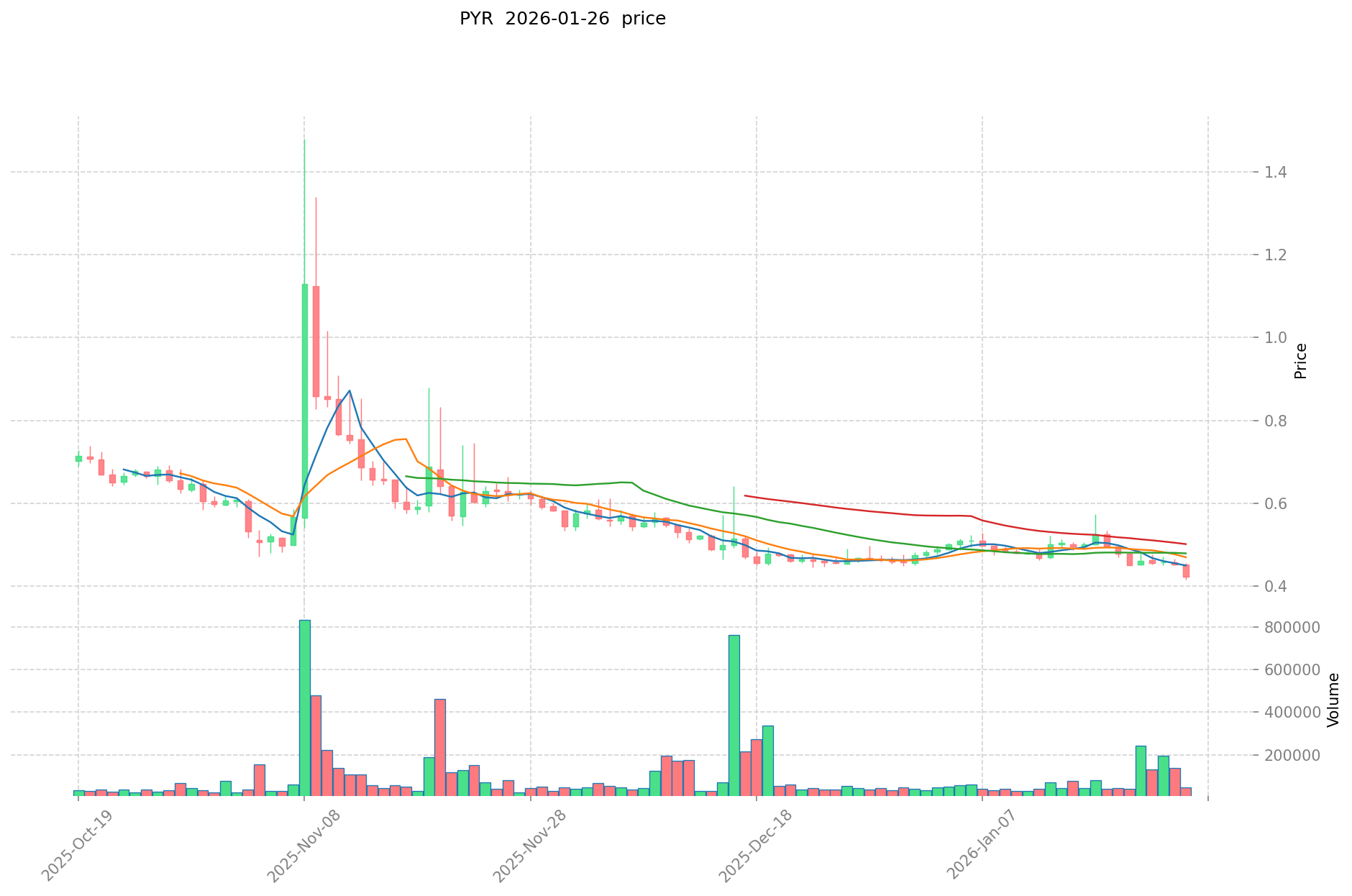
As of January 26, 2026, PYR is trading at approximately $0.43, ranking #1,189 by market capitalization with a circulating supply of 23.9 million tokens out of a maximum supply of 50 million. The token has experienced notable volatility, with recent performance showing declines across multiple timeframes: -5.46% (24H), -10.89% (7D), and -84.73% (1Y).
This analysis examines PYR's investment characteristics across several dimensions:
What fundamental factors influence PYR's market performance?
How do supply dynamics and tokenomics affect long-term value?
What are the key risks associated with gaming-focused crypto assets?
Given the evolving nature of blockchain gaming and NFT markets, understanding PYR's position within this sector requires careful evaluation of both ecosystem development and broader market conditions that impact gaming tokens.
I. Historical Price Comparison and Current Market Status
PYR (Coin A) and OP (Coin B) Historical Price Trends
- 2021: PYR reached a peak price of $49.24 on December 1, 2021, driven by the expansion of its NFT gaming ecosystem and increased adoption of its VulcanVerse and Berserk games.
- 2024: OP achieved a peak price of $4.84 on March 6, 2024, supported by growing adoption of Ethereum Layer-2 scaling solutions and ecosystem development.
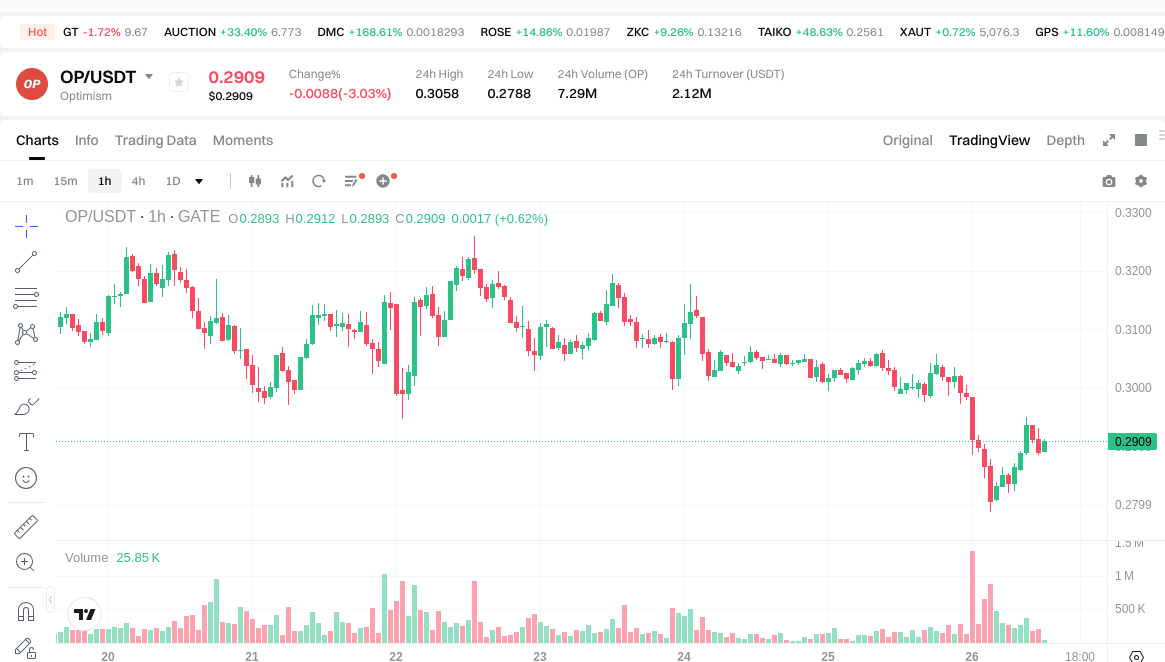
- Comparative Analysis: During the market cycle from 2021 to 2026, PYR declined from its peak of $49.24 to a historical low of $0.418274 on January 26, 2026, representing a decline of approximately 99.15%. Meanwhile, OP declined from its peak of $4.84 to a low of $0.251922 on December 26, 2025, reflecting a decline of approximately 94.79%.
Current Market Status (2026-01-26)
- PYR Current Price: $0.4252
- OP Current Price: $0.2902
- 24-Hour Trading Volume: PYR recorded $19,657.60 vs OP recorded $2,122,560.62
- Market Sentiment Index (Fear & Greed Index): 20 (Extreme Fear)
View real-time prices:
II. Core Factors Influencing PYR vs OP Investment Value
Supply Mechanism Comparison (Tokenomics)
Due to the absence of specific tokenomics data in the provided materials, a detailed comparison of supply mechanisms cannot be presented at this time.
Institutional Adoption and Market Application
Without available data on institutional holdings, enterprise adoption cases, or specific national policy positions regarding PYR and OP, a comprehensive analysis of their respective market applications and regulatory environments cannot be provided.
Technical Development and Ecosystem Construction
The provided materials do not contain information about recent technical upgrades, development roadmaps, or ecosystem metrics for either PYR or OP. Therefore, a comparative assessment of their technical evolution and ecosystem building efforts is not feasible.
Macroeconomic Factors and Market Cycles
In the absence of historical performance data under various macroeconomic conditions, comparative analysis of inflation resistance properties, sensitivity to monetary policy changes, or geopolitical factors cannot be conducted for these assets.
III. 2026-2031 Price Forecast: PYR vs OP
Short-term Forecast (2026)
- PYR: Conservative $0.276-$0.425 | Optimistic $0.425-$0.561
- OP: Conservative $0.151-$0.291 | Optimistic $0.291-$0.367
Medium-term Forecast (2028-2029)
- PYR may enter a consolidation phase, with estimated price range of $0.281-$0.821
- OP may enter a growth phase, with estimated price range of $0.297-$0.477
- Key drivers: institutional capital inflows, ETF developments, ecosystem expansion
Long-term Forecast (2030-2031)
- PYR: Baseline scenario $0.481-$0.729 | Optimistic scenario $0.729-$0.996
- OP: Baseline scenario $0.264-$0.447 | Optimistic scenario $0.447-$0.630
View detailed price predictions for PYR and OP
Disclaimer
PYR:
| Year |
Predicted High Price |
Predicted Average Price |
Predicted Low Price |
Price Change |
| 2026 |
0.561264 |
0.4252 |
0.27638 |
0 |
| 2027 |
0.5672168 |
0.493232 |
0.42911184 |
16 |
| 2028 |
0.74231416 |
0.5302244 |
0.281018932 |
24 |
| 2029 |
0.8207873712 |
0.63626928 |
0.5535542736 |
49 |
| 2030 |
0.852378140952 |
0.7285283256 |
0.480828694896 |
71 |
| 2031 |
0.99597107392776 |
0.790453233276 |
0.62445805428804 |
85 |
OP:
| Year |
Predicted High Price |
Predicted Average Price |
Predicted Low Price |
Price Change |
| 2026 |
0.36666 |
0.291 |
0.15132 |
0 |
| 2027 |
0.4044609 |
0.32883 |
0.2038746 |
13 |
| 2028 |
0.476639085 |
0.36664545 |
0.2969828145 |
26 |
| 2029 |
0.4722393396 |
0.4216422675 |
0.349963082025 |
45 |
| 2030 |
0.6301865330055 |
0.44694080355 |
0.2636950740945 |
54 |
| 2031 |
0.613962581836635 |
0.53856366827775 |
0.376994567794425 |
85 |
IV. Investment Strategy Comparison: PYR vs OP
Long-term vs Short-term Investment Strategies
- PYR: Suited for investors focused on blockchain gaming ecosystem development and NFT marketplace growth. The token's utility within the Vulcan Forged platform provides exposure to the gaming sector, though its limited trading volume of $19,657.60 suggests lower liquidity for short-term trading strategies.
- OP: Suited for investors seeking exposure to Ethereum Layer-2 scaling solutions with comparatively higher liquidity, as evidenced by its 24-hour trading volume of $2,122,560.62. The token may appeal to those interested in infrastructure-level blockchain development.
Risk Management and Asset Allocation
- Conservative Investors: PYR 20-30% vs OP 70-80% - Given OP's higher liquidity and infrastructure-focused positioning, conservative portfolios may favor greater OP allocation.
- Aggressive Investors: PYR 40-50% vs OP 50-60% - Higher risk tolerance may accommodate increased PYR exposure for potential gaming sector upside, while maintaining OP as a core Layer-2 holding.
- Hedging Tools: Stablecoin allocation for portfolio stability, derivatives for downside protection, cross-asset diversification across gaming and infrastructure sectors.
V. Comparative Risk Analysis
Market Risk
- PYR: Gaming-focused tokens face sector-specific volatility tied to NFT market cycles and player adoption rates. Historical decline of approximately 99.15% from peak demonstrates substantial drawdown risk. Limited trading volume may amplify price volatility during market stress.
- OP: Layer-2 infrastructure tokens carry systematic risk linked to Ethereum ecosystem performance and competitive dynamics among scaling solutions. Historical decline of approximately 94.79% from peak reflects broader market sensitivity, though higher liquidity may provide better price discovery.
Technical Risk
- PYR: Multi-chain deployment across Ethereum, Polygon, and BSC networks introduces cross-chain security considerations. Gaming platform dependencies may affect token utility if ecosystem adoption slows.
- OP: Layer-2 scaling technology faces ongoing development challenges related to network stability and transaction throughput. Infrastructure-level security vulnerabilities could impact ecosystem confidence.
Regulatory Risk
- Global regulatory frameworks for gaming tokens and NFT platforms remain uncertain across jurisdictions. Layer-2 solutions face evolving compliance requirements related to decentralization standards and securities classification. Both assets operate in regulatory environments that continue to develop, with potential for material policy changes affecting market access and operational parameters.
VI. Conclusion: Which Is the Better Buy?
📌 Investment Value Summary:
- PYR Strengths: Established presence within blockchain gaming sector with functional utility across NFT marketplace, staking mechanisms, and multi-game ecosystem. Dual-token model with LAVA provides diversified reward structure.
- OP Strengths: Positioned within Ethereum Layer-2 infrastructure with significantly higher trading liquidity. Exposure to scaling solution adoption trends and broader blockchain infrastructure development.
✅ Investment Recommendations:
- Beginner Investors: Consider OP for higher liquidity and infrastructure-level exposure, with limited PYR allocation (10-20%) for gaming sector diversification. Prioritize understanding tokenomics and ecosystem fundamentals before allocation.
- Experienced Investors: Evaluate sector-specific thesis for gaming vs infrastructure positioning. Balanced allocation may incorporate 30-40% PYR for gaming exposure and 60-70% OP for Layer-2 infrastructure play, adjusted for risk tolerance and market outlook.
- Institutional Investors: Conduct comprehensive due diligence on ecosystem development metrics, liquidity profiles, and regulatory positioning. Consider structured allocation strategies that account for sector correlations and portfolio-level risk management.
⚠️ Risk Disclosure: Cryptocurrency markets exhibit substantial volatility. This analysis does not constitute investment advice. Market participants should conduct independent research and consider risk tolerance, investment objectives, and financial circumstances before making allocation decisions. Historical performance does not guarantee future results. Current market sentiment index of 20 (Extreme Fear) reflects heightened risk conditions as of January 26, 2026.
VII. FAQ
Q1: What are the main differences between PYR and OP's use cases?
PYR serves as a utility token within the Vulcan Forged gaming ecosystem, facilitating NFT marketplace transactions, in-game asset purchases, land NFT upgrades through staking, and scholar registration fees across games like VulcanVerse and Berserk. OP, in contrast, functions as the native token for Optimism's Layer-2 scaling solution, supporting Ethereum network infrastructure development and transaction fee mechanisms. The fundamental distinction lies in PYR's gaming-sector focus versus OP's blockchain infrastructure positioning, which influences their respective adoption drivers and risk profiles.
Q2: Why does OP have significantly higher trading volume than PYR?
OP's 24-hour trading volume of $2,122,560.62 vastly exceeds PYR's $19,657.60 due to its positioning within Ethereum's Layer-2 infrastructure ecosystem, which attracts broader market participation from institutional investors, DeFi protocols, and infrastructure-focused traders. PYR's lower liquidity reflects its niche positioning within the blockchain gaming sector, which has a more specialized investor base and less institutional adoption. This liquidity differential directly impacts execution quality, price discovery efficiency, and suitability for different trading strategies.
Q3: How have PYR and OP performed relative to their historical peaks?
PYR experienced a decline of approximately 99.15% from its peak price of $49.24 on December 1, 2021, to $0.418274 on January 26, 2026, while OP declined approximately 94.79% from its peak of $4.84 on March 6, 2024, to $0.251922 on December 26, 2025. Both tokens demonstrate substantial drawdown risk characteristic of cryptocurrency markets, though PYR's more severe decline may reflect additional pressures from NFT market cycles and gaming sector volatility beyond general market conditions affecting infrastructure tokens like OP.
Q4: What factors should influence allocation between PYR and OP?
Allocation decisions should consider liquidity requirements (OP offers superior trading volume), sector exposure preferences (gaming ecosystem vs Layer-2 infrastructure), risk tolerance (PYR carries gaming-specific volatility while OP faces infrastructure competition risks), and investment timeframe. Conservative investors may favor 70-80% OP allocation for higher liquidity and infrastructure exposure, while aggressive investors with gaming sector conviction might increase PYR to 40-50%. Current market sentiment of 20 (Extreme Fear) suggests heightened caution regardless of allocation strategy.
Q5: What are the primary risks specific to PYR as a gaming token?
PYR faces sector-specific risks including NFT market cycle volatility, player adoption rate fluctuations within the Vulcan Forged ecosystem, multi-chain deployment complexities across Ethereum, Polygon, and BSC networks, and gaming platform dependencies that could affect token utility if ecosystem growth slows. The token's limited trading volume of $19,657.60 amplifies price volatility during market stress and may restrict exit liquidity during downturns. Additionally, regulatory uncertainty surrounding gaming tokens and NFT platforms presents jurisdictional compliance considerations that could impact market access and operational parameters.
Q6: How do the 2026-2031 price forecasts compare between PYR and OP?
PYR's conservative 2026 forecast ranges from $0.276-$0.425, expanding to $0.481-$0.729 by 2030-2031 baseline scenario, representing potential growth of 74-113% from current levels. OP's conservative 2026 forecast spans $0.151-$0.291, growing to $0.264-$0.447 by 2030-2031 baseline scenario, indicating potential decline to modest growth of -9% to 54% from current levels. These projections suggest PYR may offer higher upside potential if gaming sector adoption materializes, while OP presents a more infrastructure-anchored trajectory tied to Ethereum Layer-2 adoption trends.
Q7: What market conditions would favor PYR over OP, and vice versa?
PYR would likely outperform during periods of NFT market resurgence, blockchain gaming adoption acceleration, and increased player engagement within the Vulcan Forged ecosystem. OP would typically benefit from Ethereum network congestion driving Layer-2 demand, institutional adoption of scaling solutions, and infrastructure-level capital inflows during risk-on market phases. Currently, with the Fear & Greed Index at 20 (Extreme Fear), infrastructure tokens like OP may demonstrate greater resilience due to higher liquidity, while gaming tokens like PYR could face amplified downside pressure from sector-specific headwinds.
Q8: Is either PYR or OP suitable for beginner cryptocurrency investors?
OP presents a more suitable entry point for beginners due to its significantly higher trading liquidity ($2.1M+ vs $19.6K daily volume), broader market participation, and infrastructure-level positioning that may be easier to understand than gaming ecosystem mechanics. Beginners considering PYR should limit allocation to 10-20% of crypto portfolio and prioritize understanding the Vulcan Forged ecosystem, dual-token model with LAVA, and gaming sector dynamics before investment. Both assets require comprehensive research into tokenomics, risk factors, and market conditions, with particular attention to the current Extreme Fear market sentiment environment as of January 26, 2026.
* The information is not intended to be and does not constitute financial advice or any other recommendation of any sort offered or endorsed by Gate.