This comprehensive analysis compares PYTH Network and Enjin Coin across investment dimensions within the crypto market. PYTH operates as a decentralized oracle providing financial market data to DeFi protocols, ranking #158 by market cap with 10 billion fixed supply. ENJ serves the gaming and metaverse sector, established since 2017, ranking #492 with 1.92 billion tokens. The article examines historical price trends, tokenomics, institutional adoption, and technological ecosystems to address investor concerns about suitable opportunities. Key differences include PYTH's cross-chain oracle infrastructure attracting DeFi protocols requiring real-time price feeds, while ENJ focuses on gaming platform integration and NFT infrastructure. Current market status shows PYTH at $0.06935 and ENJ at $0.03145, reflecting distinct sector positioning. Investment strategies vary based on risk tolerance, with allocation recommendations ranging from conservative to aggressive approaches across both tokens available on Gate exch
Introduction: Investment Comparison Between PYTH and ENJ
In the cryptocurrency market, the comparison between PYTH vs ENJ continues to be a topic of interest among investors. Both tokens demonstrate notable differences in market capitalization ranking, application scenarios, and price performance, representing distinct positioning within the crypto asset landscape.
PYTH Network (PYTH): Launched in November 2023, it operates as an oracle publishing financial market data to multiple blockchains. Currently ranked #158 by market capitalization with approximately 5.75 billion tokens in circulation.
Enjin Coin (ENJ): Introduced in November 2017, it serves as a platform token for online gaming communities and virtual goods. Currently ranked #492 by market capitalization with approximately 1.92 billion tokens in circulation.
This article provides a comprehensive analysis of PYTH vs ENJ investment value comparison, examining historical price trends, supply mechanisms, adoption patterns, technical ecosystems, and future outlook. The analysis aims to address the fundamental question investors frequently consider:
"Which presents a more suitable investment opportunity under current market conditions?"
Key comparison dimensions include price volatility patterns, token distribution models, holder base size, exchange accessibility, and respective technological frameworks. Both assets operate within different sectors of the blockchain ecosystem, with PYTH focusing on oracle services and data provision, while ENJ concentrates on gaming and digital asset integration.
I. Historical Price Comparison and Current Market Status
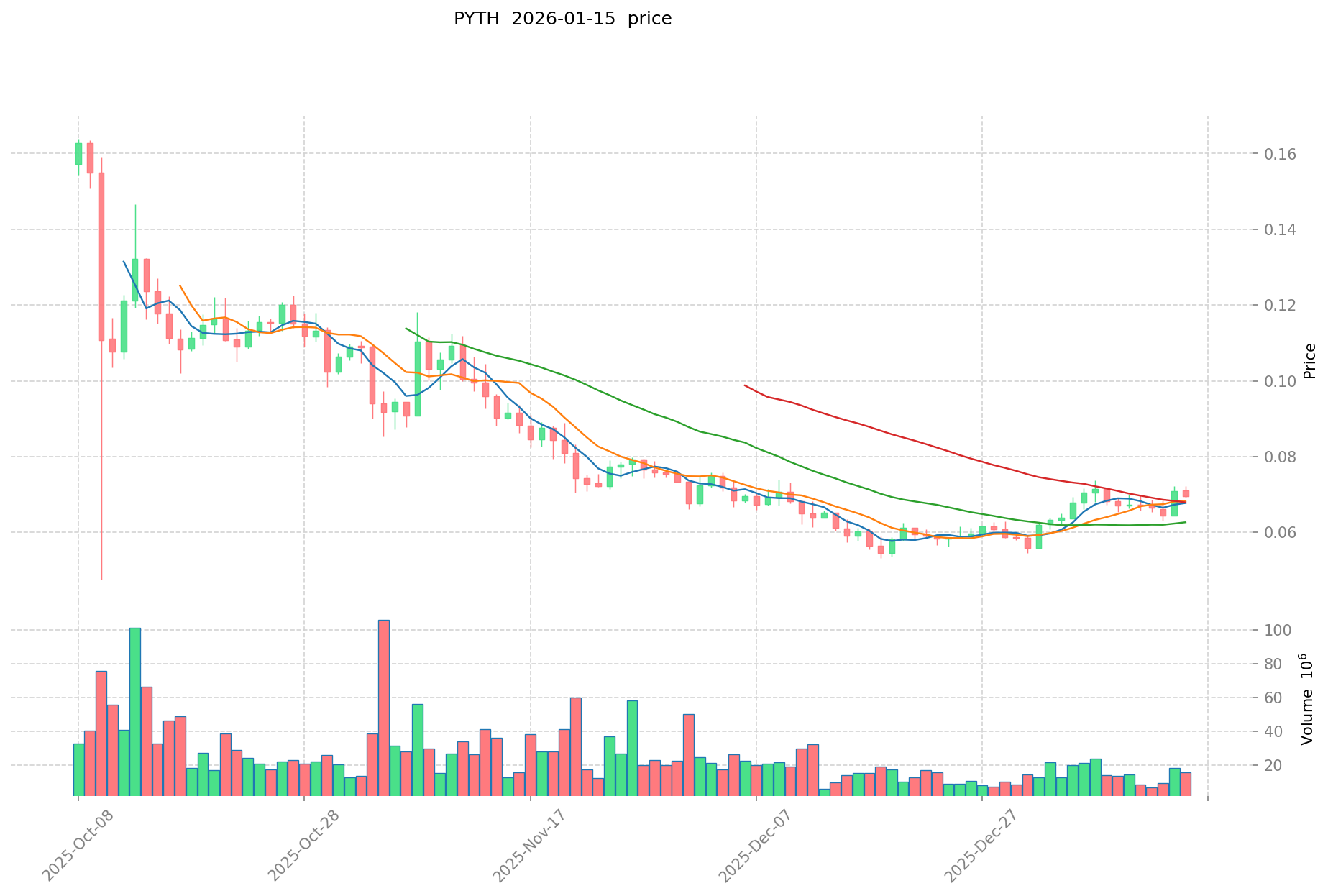
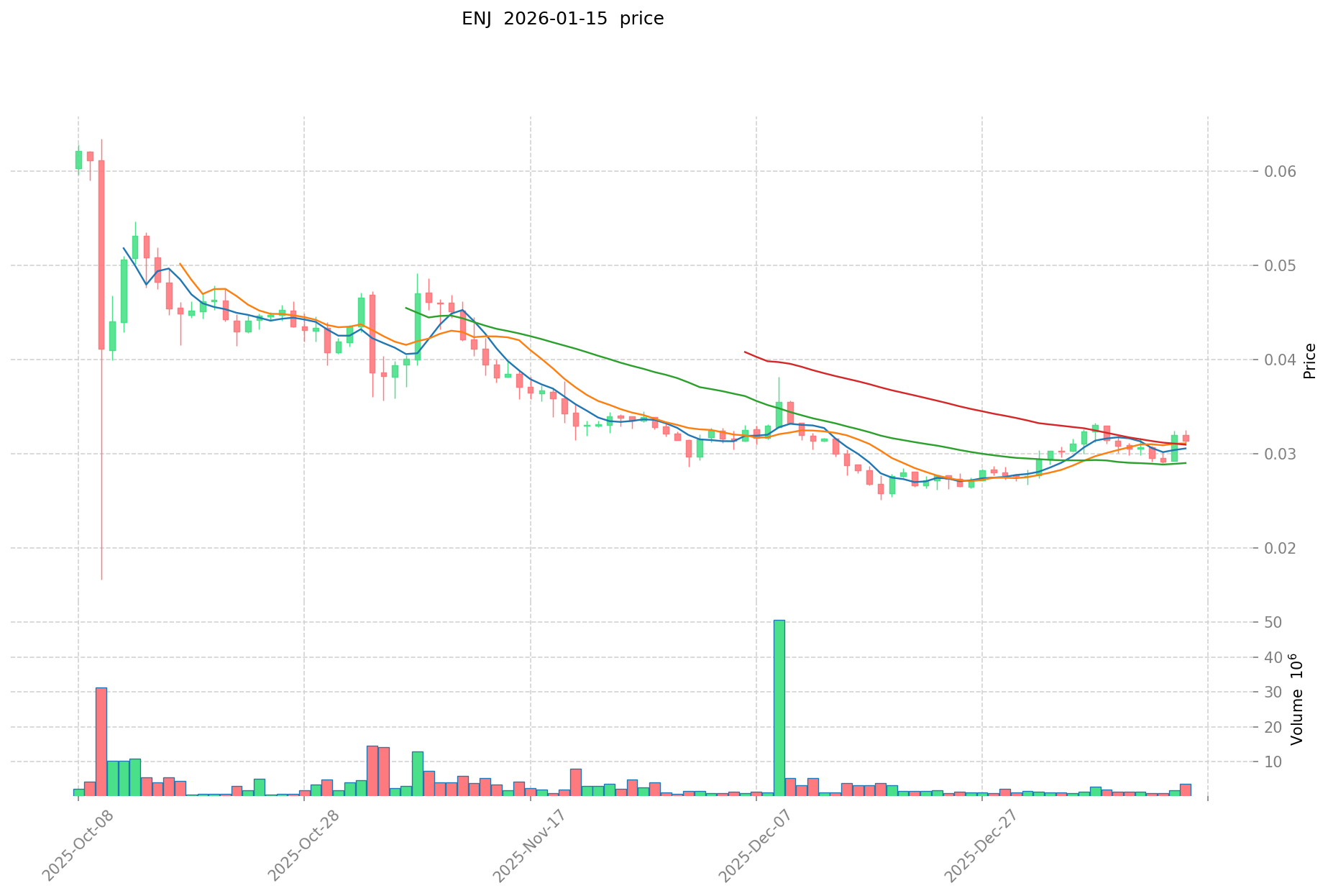
Historical Price Trends of PYTH (Coin A) and ENJ (Coin B)
- 2024: PYTH reached a peak price of $1.1552 in March following its mainnet launch momentum, but subsequently experienced significant volatility as market conditions shifted.
- 2021: ENJ saw substantial price movement, reaching a historical high of $4.82 in November during the NFT and GameFi sector expansion.
- Comparative Analysis: During recent market cycles, PYTH declined from its historical high of $1.1552 to a low of $0.04747, while ENJ dropped from $4.82 to $0.01865964, reflecting broader market corrections affecting both oracle and gaming infrastructure tokens.
Current Market Status (January 15, 2026)
- PYTH current price: $0.06935
- ENJ current price: $0.03145
- 24-hour trading volume: PYTH recorded $1,116,157.81 compared to ENJ's $114,809.52
- Market Sentiment Index (Fear & Greed Index): 48 (Neutral)
View real-time prices:
II. Core Factors Influencing PYTH vs ENJ Investment Value
Supply Mechanism Comparison (Tokenomics)
- PYTH: Fixed maximum supply of 10 billion tokens, creating a scarcity mechanism that may influence long-term price dynamics
- ENJ: Token supply structure tied to gaming and NFT ecosystem adoption, with mechanisms designed to support digital asset creation
- 📌 Historical Pattern: Supply mechanisms play a role in shaping price cycles, with fixed-supply models potentially responding differently to demand fluctuations compared to utility-driven token models
Institutional Adoption and Market Application
- Institutional Holdings: PYTH positions itself as a first-party decentralized oracle for financial markets, attracting attention from DeFi protocols requiring real-time price feeds
- Enterprise Adoption: ENJ focuses on gaming and blockchain ecosystem integration, with applications in digital asset creation and metaverse infrastructure
- PYTH Application Scope: Real-time financial market data provision for DeFi applications, cross-chain price oracle services
- ENJ Application Scope: Gaming platform integration, NFT infrastructure, metaverse gaming economy support
Technology Development and Ecosystem Building
- PYTH Technical Architecture: Cross-chain oracle infrastructure designed to deliver real-time accurate financial market data, supporting DeFi protocol requirements
- ENJ Technical Development: Gaming-focused blockchain solutions, NFT creation tools, and metaverse platform integration capabilities
- Ecosystem Comparison:
- PYTH: Concentrates on DeFi oracle services, financial data feeds, and cross-chain price discovery mechanisms
- ENJ: Emphasizes gaming adoption, NFT marketplaces, and metaverse platform collaborations
- DeFi Integration: PYTH provides essential price feed infrastructure for decentralized finance protocols
- Gaming and NFT Presence: ENJ maintains positioning within gaming and metaverse sectors
Macroeconomic Environment and Market Cycles
- Market Sentiment Impact: Both tokens respond to overall cryptocurrency market conditions and sector-specific developments
- Sector Performance: PYTH value correlates with DeFi sector growth and oracle service demand; ENJ value relates to gaming industry adoption and metaverse development trends
- Demand Drivers: PYTH benefits from increasing DeFi protocol requirements for reliable price data; ENJ benefits from expanding gaming and NFT ecosystem activities
- Revenue Mechanisms: PYTH explores data fee models and institutional service contracts; ENJ derives value from gaming platform integrations and NFT ecosystem usage
III. 2026-2031 Price Forecast: PYTH vs ENJ
Short-term Forecast (2026)
- PYTH: Conservative $0.0604-$0.0694 | Optimistic $0.0694-$0.1013
- ENJ: Conservative $0.0201-$0.0315 | Optimistic $0.0315-$0.0384
Mid-term Forecast (2028-2029)
- PYTH may enter an expansion phase, with projected prices ranging from $0.0795 to $0.1707
- ENJ may enter a consolidation phase, with projected prices ranging from $0.0269 to $0.0499
- Key drivers: institutional capital inflows, ETF developments, ecosystem expansion
Long-term Forecast (2030-2031)
- PYTH: Baseline scenario $0.0893-$0.1437 | Optimistic scenario $0.1717-$0.2421
- ENJ: Baseline scenario $0.0240-$0.0511 | Optimistic scenario $0.0511-$0.0701
View detailed price predictions for PYTH and ENJ
Disclaimer
PYTH:
| Year |
Predicted High Price |
Predicted Average Price |
Predicted Low Price |
Price Change |
| 2026 |
0.1013386 |
0.06941 |
0.0603867 |
0 |
| 2027 |
0.11098659 |
0.0853743 |
0.074275641 |
22 |
| 2028 |
0.1354890141 |
0.098180445 |
0.08345337825 |
41 |
| 2029 |
0.170578705143 |
0.11683472955 |
0.079447616094 |
67 |
| 2030 |
0.199752337111635 |
0.1437067173465 |
0.107780038009875 |
106 |
| 2031 |
0.242138633392985 |
0.171729527229067 |
0.089299354159115 |
146 |
ENJ:
| Year |
Predicted High Price |
Predicted Average Price |
Predicted Low Price |
Price Change |
| 2026 |
0.0383812 |
0.03146 |
0.0201344 |
0 |
| 2027 |
0.03841266 |
0.0349206 |
0.026888862 |
11 |
| 2028 |
0.0498666168 |
0.03666663 |
0.0307999692 |
16 |
| 2029 |
0.048891284442 |
0.0432666234 |
0.040670625996 |
37 |
| 2030 |
0.05621632378362 |
0.046078953921 |
0.02396105603892 |
46 |
| 2031 |
0.070072265227664 |
0.05114763885231 |
0.039383681916278 |
62 |
IV. Investment Strategy Comparison: PYTH vs ENJ
Long-term vs Short-term Investment Strategies
- PYTH: May appeal to investors focused on DeFi infrastructure growth and oracle service expansion, particularly those with a medium to long-term perspective on decentralized finance ecosystem development
- ENJ: May appeal to investors interested in gaming sector adoption and metaverse infrastructure development, particularly those tracking blockchain gaming industry trends
Risk Management and Asset Allocation
- Conservative Investors: PYTH 30-40% vs ENJ 60-70% allocation consideration, emphasizing lower volatility exposure and established market positioning
- Aggressive Investors: PYTH 60-70% vs ENJ 30-40% allocation consideration, focusing on growth potential within respective sectors
- Hedging Tools: stablecoin allocation for liquidity management, options strategies for downside protection, cross-asset portfolio diversification
V. Potential Risk Comparison
Market Risk
- PYTH: Price volatility influenced by DeFi sector performance, oracle service adoption rates, and competition from alternative data providers
- ENJ: Price volatility affected by gaming industry adoption cycles, NFT market sentiment, and metaverse development progress
Technical Risk
- PYTH: Scalability considerations for cross-chain oracle infrastructure, network reliability requirements for real-time data provision
- ENJ: Platform integration challenges, dependency on gaming ecosystem adoption, competition from alternative gaming blockchain solutions
Regulatory Risk
- Global regulatory developments may impact both tokens differently: PYTH faces considerations related to financial data provision and DeFi protocol regulations; ENJ encounters potential regulations affecting gaming platforms, digital assets, and NFT marketplaces
VI. Conclusion: Which Is the Better Buy?
📌 Investment Value Summary:
- PYTH Characteristics: positions within DeFi oracle infrastructure sector, fixed maximum supply of 10 billion tokens, focus on financial market data provision for decentralized applications
- ENJ Characteristics: established presence in gaming and NFT sectors since 2017, focus on digital asset creation and metaverse platform integration
✅ Investment Considerations:
- New Investors: consider starting with smaller position sizes, focusing on understanding respective sector fundamentals, and maintaining diversified exposure across multiple asset classes
- Experienced Investors: evaluate sector-specific growth trajectories, monitor adoption metrics within DeFi and gaming ecosystems, consider portfolio allocation based on risk tolerance and market outlook
- Institutional Investors: assess integration opportunities within existing infrastructure, evaluate long-term sector positioning, consider strategic allocation aligned with broader portfolio objectives
⚠️ Risk Disclaimer: Cryptocurrency markets demonstrate high volatility. This content does not constitute investment advice. Investors should conduct independent research and consult financial professionals before making investment decisions.
VII. FAQ
Q1: What are the main differences between PYTH and ENJ in terms of their blockchain ecosystem positioning?
PYTH serves as a decentralized oracle network focused on providing real-time financial market data to DeFi protocols, while ENJ operates as a gaming platform token specializing in NFT infrastructure and metaverse integration. PYTH launched in November 2023 with a fixed maximum supply of 10 billion tokens, targeting the DeFi oracle services sector with cross-chain price feed capabilities. ENJ, established in November 2017, has built its ecosystem around gaming communities and digital asset creation, with approximately 1.92 billion tokens in circulation. The fundamental distinction lies in their target markets: PYTH addresses the growing demand for reliable financial data feeds in decentralized finance, whereas ENJ focuses on blockchain gaming adoption and virtual goods infrastructure.
Q2: How do the supply mechanisms of PYTH and ENJ affect their long-term investment potential?
PYTH implements a fixed maximum supply of 10 billion tokens, creating a scarcity-based model that may respond predictably to demand fluctuations, while ENJ's supply structure ties directly to gaming and NFT ecosystem adoption patterns. The fixed-supply mechanism of PYTH potentially offers clearer supply-side dynamics for investors analyzing long-term value appreciation, as increasing demand for oracle services faces a predetermined token ceiling. ENJ's utility-driven token model means supply considerations intertwine with gaming platform integration and NFT creation activities, making its value proposition more dependent on ecosystem adoption rates. Both mechanisms serve their respective sectors appropriately, with PYTH's model aligning with infrastructure service economics and ENJ's structure supporting gaming economy requirements.
Q3: Which token shows stronger institutional adoption and market application potential?
PYTH demonstrates positioning as a first-party decentralized oracle attracting attention from DeFi protocols requiring reliable price feeds, while ENJ maintains established relationships within gaming and metaverse platform ecosystems. PYTH's institutional appeal stems from its critical infrastructure role in DeFi, where accurate real-time financial data serves as a foundational requirement for decentralized applications, derivatives protocols, and lending platforms. ENJ's market application focuses on gaming platform integration, NFT marketplace infrastructure, and metaverse gaming economy support, attracting partnerships within the blockchain gaming industry. The comparison reveals sector-specific adoption patterns: PYTH benefits from DeFi sector expansion and increasing demand for decentralized oracle services, while ENJ's growth correlates with gaming industry blockchain adoption and metaverse development trends.
Q4: What are the key price forecast differences between PYTH and ENJ for 2026-2031?
Short-term forecasts for 2026 project PYTH ranging from $0.0604-$0.1013 versus ENJ's $0.0201-$0.0384, with mid-term 2028-2029 estimates showing PYTH potentially reaching $0.0795-$0.1707 compared to ENJ's $0.0269-$0.0499. Long-term 2030-2031 projections indicate PYTH baseline scenarios between $0.0893-$0.1437 versus ENJ's $0.0240-$0.0511, with optimistic scenarios reaching $0.1717-$0.2421 for PYTH and $0.0511-$0.0701 for ENJ. These forecasts reflect fundamental differences in sector growth trajectories: PYTH's projections assume expanding DeFi infrastructure requirements and increased oracle service demand, while ENJ's estimates consider gaming industry blockchain adoption rates and metaverse ecosystem development. The wider price range for PYTH suggests higher growth potential accompanied by correspondingly higher uncertainty, whereas ENJ's narrower range indicates more modest but potentially more stable growth expectations within the gaming sector.
Q5: How should investors approach portfolio allocation between PYTH and ENJ based on risk tolerance?
Conservative investors might consider a 30-40% PYTH allocation versus 60-70% ENJ weighting, emphasizing ENJ's longer market history and established gaming sector presence, while aggressive investors could explore 60-70% PYTH versus 30-40% ENJ positions, focusing on DeFi infrastructure growth potential. Conservative strategies favor ENJ's proven track record since 2017 and existing gaming ecosystem integrations, providing exposure to blockchain gaming adoption with comparatively lower volatility relative to newer oracle infrastructure tokens. Aggressive approaches weight PYTH more heavily based on DeFi sector expansion potential and the critical infrastructure role of oracle services in decentralized finance, accepting higher volatility in exchange for potential growth as oracle service demand increases. Both strategies should incorporate risk management tools including stablecoin allocations for liquidity, options strategies for downside protection, and cross-asset diversification to balance sector-specific risks inherent in either DeFi infrastructure or gaming-focused investments.
Q6: What are the primary technical risks facing PYTH and ENJ respectively?
PYTH faces scalability considerations for maintaining cross-chain oracle infrastructure and network reliability requirements for delivering consistent real-time data provision across multiple blockchains, while ENJ encounters platform integration challenges and dependency on gaming ecosystem adoption rates. PYTH's technical architecture must ensure continuous accurate financial data delivery without interruption, as DeFi protocols rely on oracle feeds for critical functions including price discovery, liquidation mechanisms, and derivatives settlement. Any technical failures or data accuracy issues could significantly impact PYTH's reputation and adoption. ENJ's technical challenges center on seamless integration with diverse gaming platforms, competition from alternative gaming blockchain solutions, and the requirement to maintain developer-friendly tools for NFT creation and digital asset management. Both tokens face sector-specific technical considerations that directly affect their value propositions and long-term viability within respective ecosystems.
Q7: How do regulatory developments potentially impact PYTH versus ENJ differently?
PYTH faces regulatory considerations related to financial data provision and DeFi protocol regulations, particularly regarding oracle services providing price feeds for financial instruments, while ENJ encounters potential regulations affecting gaming platforms, digital assets, and NFT marketplaces. PYTH's oracle services may attract regulatory attention as financial data providers, especially when serving protocols offering derivatives, lending, or other financial services that fall under securities or commodities regulations in various jurisdictions. The classification of oracle data provision and potential liability for data accuracy represents ongoing regulatory uncertainty. ENJ's regulatory landscape involves gaming regulations, virtual goods classification, and NFT marketplace compliance requirements, which vary significantly across jurisdictions and continue evolving as governments develop frameworks for digital assets in gaming contexts. Both tokens operate in regulatory environments characterized by ongoing development and jurisdictional variations, requiring investors to monitor regulatory trends in both DeFi infrastructure and gaming sectors.
Q8: What market conditions would favor PYTH over ENJ, and vice versa?
Market conditions favoring PYTH include expanding DeFi sector growth, increasing demand for decentralized oracle services, institutional adoption of DeFi protocols, and heightened requirements for reliable financial data infrastructure, while ENJ benefits from gaming industry blockchain adoption acceleration, metaverse ecosystem development, NFT market expansion, and mainstream gaming platform integration trends. PYTH typically outperforms during periods of DeFi innovation and protocol launches requiring price feed infrastructure, whereas ENJ shows strength during gaming sector bullish cycles and heightened interest in blockchain gaming applications. Macroeconomic factors affecting each token differ substantially: PYTH correlates more closely with DeFi total value locked (TVL) metrics and derivative protocol growth, while ENJ responds to gaming industry investment trends and mainstream entertainment sector blockchain adoption. Investors should evaluate current market cycle positioning, sector-specific momentum, and broader cryptocurrency market sentiment when comparing relative performance potential between these fundamentally different blockchain infrastructure tokens.
* The information is not intended to be and does not constitute financial advice or any other recommendation of any sort offered or endorsed by Gate.