This comprehensive guide compares PYUSD and ETH as distinct cryptocurrency investment assets. PYUSD, a PayPal-issued stablecoin, maintains $1.00 parity through 100% fiat backing, designed for capital preservation and payment infrastructure. ETH, Ethereum's native token, derives value from network utility and ecosystem adoption, offering growth potential with significant volatility. The analysis examines historical price performance, supply mechanisms, institutional adoption, technical ecosystems, and macroeconomic factors. PYUSD suits conservative investors prioritizing stability, while ETH appeals to those seeking blockchain infrastructure exposure over extended horizons. Both assets process substantial economic activity—ETH handles over $50 trillion annually across DeFi and settlement layers. Risk factors differ significantly: PYUSD faces regulatory and reserve management risks; ETH encounters scalability and smart contract security challenges. Portfolio allocation recommendations range from 15-25% PYUSD/5-
Introduction: Investment Comparison Between PYUSD and ETH
In the cryptocurrency market, the comparison between PYUSD vs ETH has consistently been a topic of interest for investors. The two differ significantly in market cap ranking, application scenarios, and price performance, representing distinct positioning within the crypto asset landscape.
PYUSD (PayPal USD): Launched in 2023, it has gained market recognition with its positioning as a payment-focused stablecoin. Issued by Paxos Trust Company, PYUSD is designed to contribute to payment opportunities and is 100% backed by U.S. dollar deposits, short-term U.S. Treasuries, and similar cash equivalents, maintaining a 1:1 redemption ratio with the U.S. dollar.
ETH (Ethereum): Since its launch in 2015, it has been recognized as a foundational platform for decentralized applications and smart contracts. As one of the cryptocurrencies with significant global trading volume and market capitalization, ETH operates as the native currency of the Ethereum blockchain ecosystem.
This article will comprehensively analyze the investment value comparison between PYUSD vs ETH, focusing on historical price trends, supply mechanisms, institutional adoption, technical ecosystems, and future projections, attempting to address the question investors care about most:
"Which is the better buy right now?"
I. Historical Price Comparison and Current Market Status
PYUSD and ETH Historical Price Trends
- 2023: PYUSD reached its historical high of $1.2 on September 12, 2023, shortly after its launch, reflecting initial market enthusiasm for PayPal's entry into the stablecoin space.
- 2023: PYUSD recorded its historical low of $0.833 on August 22, 2023, during its early trading phase, reflecting market adjustment and price discovery for the newly launched stablecoin.
- 2025: ETH reached its historical high of $4,946.05 on August 25, 2025, driven by continued institutional adoption and network activity.
- 2015: ETH recorded its historical low of $0.432979 on October 20, 2015, during its early launch phase.
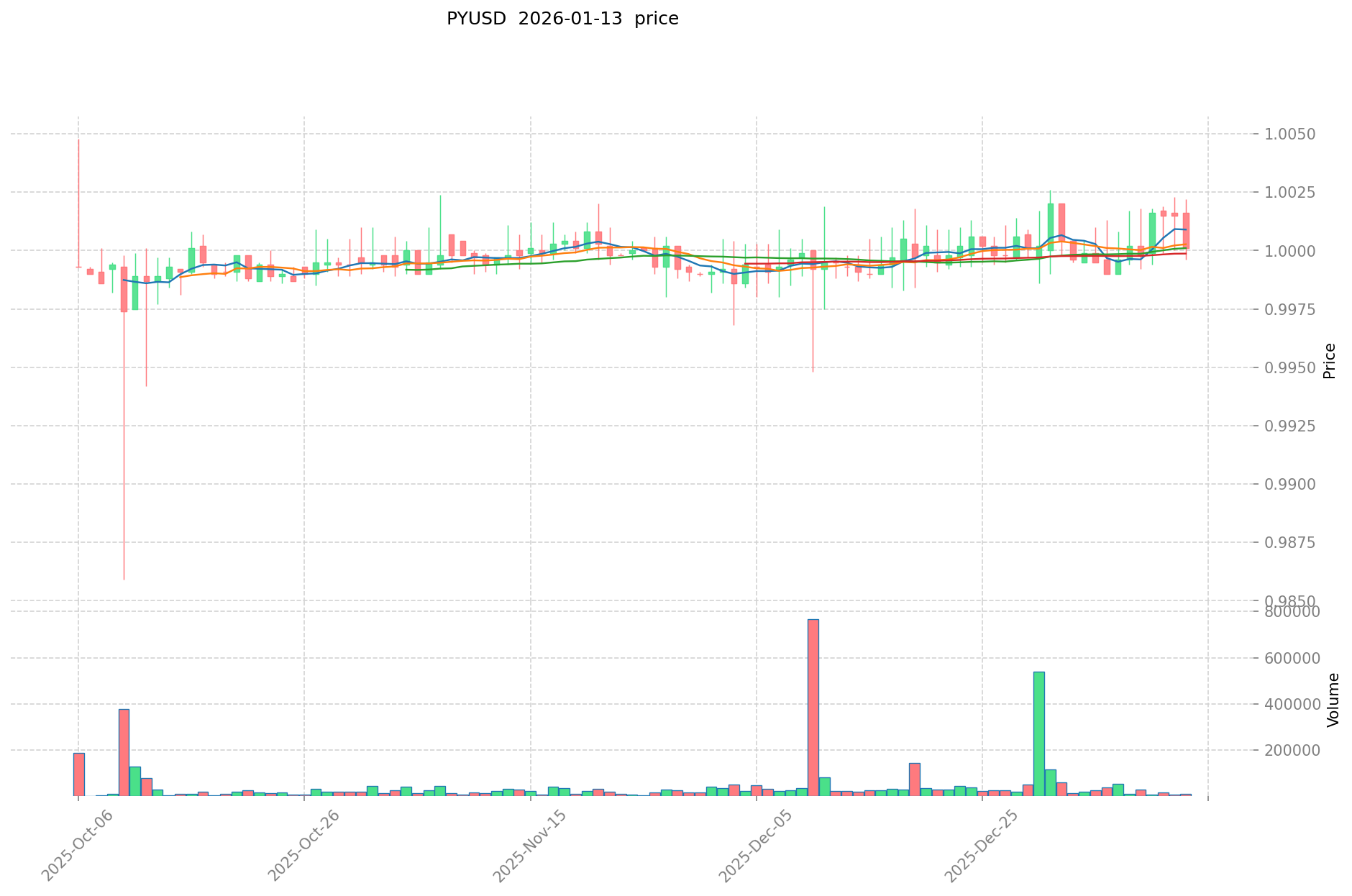
- Comparative Analysis: During the 2023-2026 market cycle, PYUSD has maintained relative stability around $1.00 as a USD-pegged stablecoin, while ETH has experienced significant volatility, trading from its low of $0.432979 to its high of $4,946.05.
Current Market Status (2026-01-13)
- PYUSD Current Price: $1.00
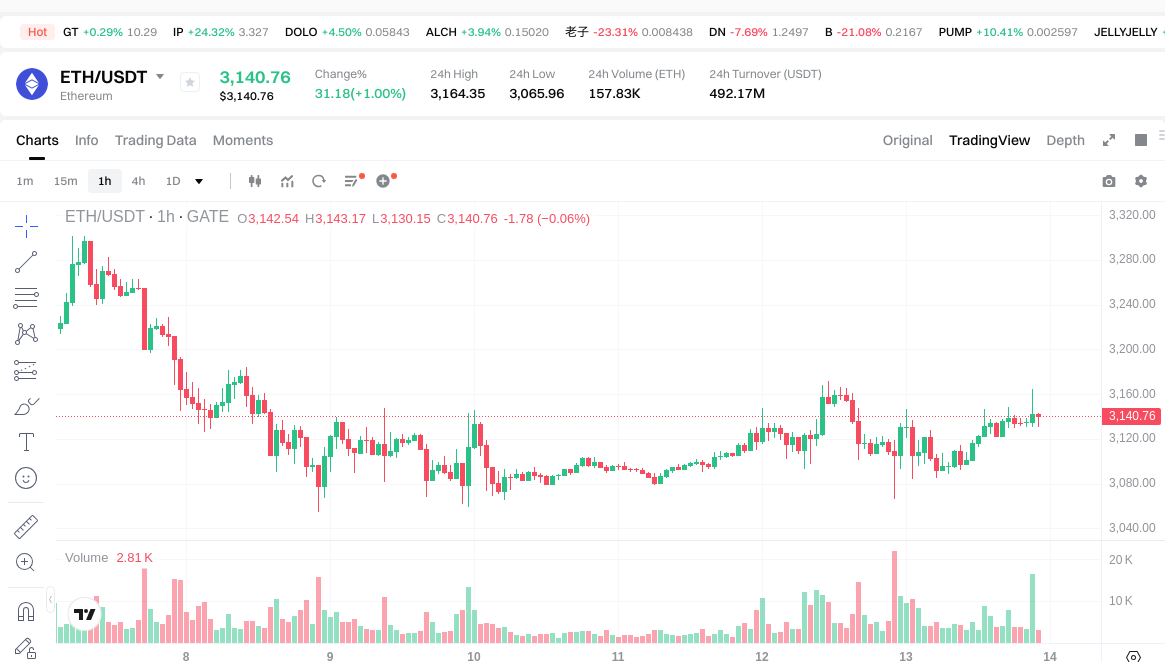
- ETH Current Price: $3,135.50
- 24-Hour Trading Volume: PYUSD $12,822.35 vs ETH $487,678,875.62
- Market Capitalization: PYUSD $3.62 billion vs ETH $378.44 billion
- Market Sentiment Index (Fear & Greed Index): 26 (Fear)
View real-time prices:
II. Core Factors Influencing Investment Value of PYUSD vs ETH
Supply Mechanism Comparison (Tokenomics)
-
PYUSD: As a stablecoin, PYUSD maintains a 1:1 peg with the US dollar through a fiat-backed framework. Its supply is not predetermined but adjusts based on demand, with issuance backed 100% by US dollar deposits, US Treasury securities, and cash equivalents. This mechanism prioritizes value stability over scarcity.
-
ETH: Ethereum operates under a dynamic supply model influenced by network activity. Following major network upgrades, ETH incorporates mechanisms that can lead to deflationary pressure during periods of high transaction volume, as base fees are burned rather than distributed to validators.
-
📌 Historical Pattern: Supply mechanisms directly shape price cycles. For stablecoins like PYUSD, scarcity is not a relevant factor; the core value proposition centers on maintaining stability. For ETH, supply dynamics interact with network demand to influence price trajectories over different market phases.
Institutional Adoption and Market Application
-
Institutional Holdings: Both assets have attracted institutional attention, though through different channels. PYUSD's growth trajectory has shown correlation with institutional interest in Ethereum-based infrastructure. For instance, PYUSD supply expanded from approximately $399 million to $775 million in 2025, tracking alongside institutional flows into Ethereum ETFs. This synchronization suggests that institutional engagement with Ethereum's ecosystem may support stablecoin adoption on the network.
-
Enterprise Adoption: PYUSD is positioned as a payment-focused instrument, issued by Paxos Trust Company and backed by PayPal's mainstream financial technology credibility. It serves as a bridge asset facilitating institutional entry into digital payment systems. While PYUSD's market share remains smaller compared to dominant stablecoins, its value proposition centers on promoting institutional acceptance of stablecoin technology within regulated frameworks. ETH's adoption spans broader use cases including decentralized finance (DeFi) protocols, compliance infrastructure, and settlement layers for diverse blockchain applications.
-
Regulatory Posture: Regulatory support significantly impacts both assets. PYUSD benefits from operating within established compliance frameworks through Paxos Trust Company's oversight and regulatory backing. The evolving regulatory environment influences how institutions assess risk and allocate capital between payment-oriented stablecoins and general-purpose programmable platforms.
Technology Development and Ecosystem Construction
-
PYUSD Technical Infrastructure: The stablecoin operates on blockchain networks with seamless on-ramp and off-ramp integration, providing reliable liquidity for users. Its technical architecture emphasizes transaction efficiency for payment scenarios and maintains price stability through its fiat-backed framework.
-
ETH Technical Evolution: Ethereum's value depends significantly on network utility and adoption metrics. The platform has been transitioning from what some characterize as a retail speculation platform toward positioning as global financial infrastructure. This evolution reflects a business model transformation whose long-term value may be recognized as the market better understands the shift. Ethereum processes substantial economic activity through stablecoin settlements, DeFi transactions, tokenized asset issuance, NFT transfers, and Layer 2 settlements. The network handles over $30 trillion annually in stablecoin settlements alone, with total economic flow across its ecosystem exceeding $50 trillion per year.
-
Ecosystem Comparison: ETH supports extensive DeFi protocols, NFT marketplaces, smart contract platforms, and Layer 2 scaling solutions. PYUSD's ecosystem focus centers on payment integration and financial technology applications within regulated environments. The two assets serve complementary rather than directly competing functions within the broader digital asset landscape.
Macroeconomic Factors and Market Cycles
-
Performance in Inflationary Environments: Stablecoins like PYUSD maintain value parity with fiat currency, offering stability rather than inflation hedging properties. ETH's relationship with inflation depends on its adoption as a store of value and the overall demand for blockchain-based financial services.
-
Macroeconomic Monetary Policy: Interest rate changes, US dollar index movements, and central bank policies affect both assets differently. For PYUSD, these factors influence the yield on backing reserves and demand for dollar-denominated settlement. For ETH, monetary policy impacts risk appetite for technology-oriented digital assets and influences institutional allocation decisions.
-
Geopolitical Factors: Cross-border transaction demand and international developments impact both assets. Regulatory frameworks in different jurisdictions, financial system accessibility, and demand for censorship-resistant settlement infrastructure influence how institutions and users assess the utility of stablecoins versus programmable blockchain platforms for various applications.
III. 2026-2031 Price Forecast: PYUSD vs ETH
Short-term Forecast (2026)
- PYUSD: Conservative scenario suggests a range of $0.53-$1.00 | Optimistic scenario indicates potential reach of $1.39
- ETH: Conservative scenario estimates a range of $2,261.83-$3,141.43 | Optimistic scenario projects potential levels around $4,052.44
Mid-term Forecast (2028-2029)
- PYUSD may experience gradual growth phase, with estimated price range of $0.93-$1.99 in 2028, potentially extending to $0.88-$2.48 by 2029
- ETH may enter expansion phase, with projected price range of $3,539.93-$5,725.07 in 2028, possibly reaching $4,795.29-$5,855.30 by 2029
- Key drivers: institutional capital flows, ETF developments, ecosystem expansion
Long-term Forecast (2030-2031)
- PYUSD: Baseline scenario estimates $1.36-$2.10 in 2030 | Optimistic scenario suggests potential range of $2.30-$2.93 by 2031
- ETH: Baseline scenario projects $3,979.58-$5,451.49 in 2030 | Optimistic scenario indicates possible levels of $5,756.77-$9,681.84 by 2031
View detailed price forecasts for PYUSD and ETH
Disclaimer
PYUSD:
| Year |
Predicted High Price |
Predicted Average Price |
Predicted Low Price |
Price Change |
| 2026 |
1.39 |
1 |
0.53 |
0 |
| 2027 |
1.70885 |
1.195 |
0.60945 |
19 |
| 2028 |
1.98913725 |
1.451925 |
0.929232 |
45 |
| 2029 |
2.47756482 |
1.720531125 |
0.87747087375 |
72 |
| 2030 |
2.791733803425 |
2.0990479725 |
1.364381182125 |
109 |
| 2031 |
2.934469065555 |
2.4453908879625 |
2.29866743468475 |
144 |
ETH:
| Year |
Predicted High Price |
Predicted Average Price |
Predicted Low Price |
Price Change |
| 2026 |
4052.4447 |
3141.43 |
2261.8296 |
0 |
| 2027 |
5143.6204105 |
3596.93735 |
2877.54988 |
14 |
| 2028 |
5725.0653331275 |
4370.27888025 |
3539.9258930025 |
39 |
| 2029 |
5855.29964375895 |
5047.67210668875 |
4795.2885013543125 |
60 |
| 2030 |
7632.08022531339 |
5451.48587522385 |
3979.5846889134105 |
73 |
| 2031 |
9681.8389143975576 |
6541.78305026862 |
5756.7690842363856 |
108 |
IV. Investment Strategy Comparison: PYUSD vs ETH
Long-term vs Short-term Investment Strategies
-
PYUSD: Suitable for investors focused on capital preservation and payment infrastructure. The asset's stability-focused design aligns with short to medium-term liquidity management strategies rather than capital appreciation objectives. Investors seeking exposure to payment technology adoption within regulated frameworks may consider allocation to PYUSD as a bridge asset.
-
ETH: Suitable for investors seeking exposure to blockchain infrastructure development and decentralized application ecosystems. The asset's utility-driven model suggests alignment with medium to long-term investment horizons, where network adoption and economic activity growth may influence value trajectories over multi-year periods.
Risk Management and Asset Allocation
-
Conservative Investors: PYUSD 15-25% vs ETH 5-10%. This allocation prioritizes capital stability through stablecoin positioning while maintaining limited exposure to blockchain infrastructure assets. The configuration reflects risk-averse positioning suitable for investors prioritizing capital preservation over growth potential.
-
Aggressive Investors: PYUSD 5-10% vs ETH 30-40%. This allocation emphasizes exposure to network utility growth potential while maintaining stablecoin holdings for liquidity management and rebalancing capabilities. The configuration reflects higher risk tolerance and longer investment horizons.
-
Hedging Tools: Stablecoin allocation for portfolio rebalancing, derivative instruments for downside protection, cross-asset diversification strategies combining payment infrastructure and programmable platform exposure.
V. Potential Risk Comparison
Market Risks
-
PYUSD: Market risks center on regulatory framework changes affecting stablecoin operations, shifts in institutional demand for payment-focused digital assets, and competitive dynamics within the stablecoin landscape. Liquidity conditions and reserve management policies influence operational stability.
-
ETH: Market risks include volatility associated with network adoption cycles, competition from alternative blockchain platforms, shifts in institutional capital allocation patterns, and correlation with broader technology asset markets. Trading volume concentration and market sentiment cycles influence price dynamics.
Technical Risks
-
PYUSD: Technical considerations include blockchain network dependencies, integration reliability with payment systems, and operational infrastructure for reserve management and redemption mechanisms.
-
ETH: Network scalability challenges, transaction processing capacity during high-demand periods, Layer 2 integration complexity, and smart contract security considerations represent ongoing technical development areas.
Regulatory Risks
- Global regulatory frameworks affect both assets through different mechanisms. Stablecoin regulations impact PYUSD's operational parameters, reserve requirements, and jurisdictional availability. Blockchain platform regulations influence ETH's utility in various applications, institutional adoption pathways, and cross-border transaction frameworks. Regulatory clarity developments in major jurisdictions may significantly impact both assets' adoption trajectories and market accessibility.
VI. Conclusion: Which Is the Better Buy?
📌 Investment Value Summary:
-
PYUSD Characteristics: Offers stability-focused positioning suitable for capital preservation objectives, provides exposure to payment technology adoption within regulated frameworks, and maintains dollar-pegged value proposition for liquidity management applications.
-
ETH Characteristics: Provides exposure to blockchain infrastructure development and decentralized application ecosystems, offers utility-driven value proposition tied to network economic activity, and maintains positioning as programmable settlement layer for diverse financial applications.
✅ Investment Considerations:
-
New Investors: May consider beginning with understanding fundamental differences between stability-focused payment instruments and utility-driven blockchain platforms. Risk assessment should account for volatility tolerance, investment horizon, and capital preservation priorities before allocation decisions.
-
Experienced Investors: May evaluate allocation strategies based on portfolio objectives, existing exposure patterns, and market cycle positioning. Consideration of both assets' complementary functions within broader digital asset portfolios may inform diversification approaches.
-
Institutional Investors: May assess both assets through distinct frameworks—PYUSD as payment infrastructure and treasury management tool, ETH as blockchain platform exposure and DeFi settlement layer. Regulatory compliance requirements, operational integration capabilities, and strategic positioning objectives influence institutional allocation decisions.
⚠️ Risk Disclosure: Cryptocurrency markets demonstrate significant volatility characteristics. This content does not constitute investment advice. Market participants should conduct independent research and consult qualified financial professionals before making investment decisions.
VII. FAQ
Q1: What is the fundamental difference between PYUSD and ETH as investment assets?
PYUSD is a fiat-backed stablecoin designed for capital preservation and payment applications, while ETH is a utility-driven blockchain platform token designed for value appreciation through network adoption. PYUSD maintains a 1:1 peg with the US dollar, backed 100% by dollar deposits, US Treasuries, and cash equivalents, making it suitable for investors prioritizing stability and liquidity management. ETH operates as the native currency of the Ethereum blockchain ecosystem, deriving value from network utility, transaction processing demand, and adoption across DeFi, NFT, and smart contract applications. The core distinction lies in their investment objectives: PYUSD serves as a bridge asset for institutional entry into digital payments with minimal price volatility, whereas ETH provides exposure to blockchain infrastructure development with significant price fluctuation potential tied to network growth and ecosystem expansion.
Q2: How do the supply mechanisms of PYUSD and ETH affect their long-term investment value?
PYUSD's supply adjusts dynamically based on demand without predetermined limits, prioritizing value stability over scarcity, while ETH operates under a dynamic supply model that can become deflationary during high network activity periods. For PYUSD, the fiat-backed framework means supply expansion or contraction does not impact its dollar-pegged value proposition—the asset is designed to maintain $1.00 regardless of circulation volume. ETH's supply mechanism incorporates base fee burning during transaction processing, creating potential deflationary pressure when network demand exceeds new issuance. This fundamental difference means PYUSD's investment value centers on adoption as a payment instrument and regulatory acceptance, whereas ETH's value trajectory correlates with network utility growth and the balance between token burns and validator rewards. Investors seeking capital appreciation should focus on ETH's utility-driven scarcity dynamics, while those prioritizing stability should consider PYUSD's abundance-compatible stability mechanism.
Q3: What role does institutional adoption play in the investment outlook for PYUSD versus ETH?
Institutional adoption impacts both assets through different channels—PYUSD benefits from regulated payment infrastructure demand, while ETH gains from broader blockchain ecosystem investment and DeFi protocol integration. PYUSD's institutional appeal stems from its positioning within established compliance frameworks through Paxos Trust Company oversight and PayPal's mainstream financial credibility, facilitating corporate treasury management and payment operations. The stablecoin's supply expansion from $399 million to $775 million in 2025 tracked alongside institutional flows into Ethereum ETFs, suggesting ecosystem correlation. ETH's institutional adoption spans diverse use cases including settlement infrastructure, tokenized asset issuance, and decentralized finance protocols, with the network processing over $50 trillion annually in economic activity. The distinction lies in adoption drivers: institutions adopt PYUSD for operational efficiency in payment workflows, whereas they adopt ETH for strategic exposure to blockchain infrastructure and programmable financial services infrastructure.
Q4: How should investors approach portfolio allocation between PYUSD and ETH based on risk tolerance?
Conservative investors should consider 15-25% PYUSD allocation with 5-10% ETH exposure, while aggressive investors may implement 5-10% PYUSD with 30-40% ETH allocation, reflecting different capital preservation versus growth objectives. Conservative allocation emphasizes capital stability through stablecoin positioning while maintaining limited blockchain infrastructure exposure for potential long-term network adoption benefits. This configuration suits investors prioritizing capital preservation over appreciation potential, using PYUSD as a core stability anchor and ETH as a satellite growth component. Aggressive allocation reverses this structure, emphasizing network utility growth exposure through substantial ETH holdings while maintaining stablecoin positions primarily for liquidity management and portfolio rebalancing capabilities. The allocation decision should account for investment horizon—shorter timeframes favor higher PYUSD weighting for capital preservation, while longer horizons enable higher ETH concentration to capture potential network adoption growth over multi-year periods.
Q5: What are the key risk factors investors should monitor when holding PYUSD versus ETH?
PYUSD investors should monitor regulatory framework changes affecting stablecoin operations and reserve management policies, while ETH investors must track network adoption metrics, competition from alternative blockchains, and smart contract security developments. For PYUSD, primary risks include regulatory shifts requiring operational modifications, changes in institutional demand for payment-focused digital assets, and competitive dynamics within the stablecoin landscape where dominant players maintain significant market share advantages. The asset's stability depends on reserve management integrity and redemption mechanism reliability. For ETH, critical risk factors include network scalability challenges during high-demand periods, Layer 2 integration complexity, transaction processing capacity limitations, and vulnerability to smart contract exploits that could undermine ecosystem confidence. Both assets face regulatory risks, though through different mechanisms—stablecoins face direct operational regulations, while blockchain platforms navigate application-specific compliance requirements across multiple jurisdictions.
Q6: How do macroeconomic conditions differently impact PYUSD and ETH investment performance?
Macroeconomic conditions affect PYUSD through reserve yield dynamics and dollar-denominated settlement demand, while impacting ETH through risk appetite shifts and institutional capital allocation patterns toward technology assets. During inflationary environments, PYUSD maintains dollar parity but does not provide inflation hedging properties—its value proposition centers on stability rather than purchasing power preservation. Interest rate changes influence the yield earned on PYUSD's backing reserves and affect institutional demand for dollar-denominated settlement instruments. For ETH, macroeconomic monetary policy impacts risk appetite for technology-oriented digital assets, with tightening conditions typically reducing institutional allocation toward growth-focused blockchain infrastructure investments. Geopolitical factors affect both assets distinctly: PYUSD benefits from cross-border payment demand during financial system stress periods, while ETH gains from demand for censorship-resistant settlement infrastructure and decentralized financial services during institutional confidence deterioration in traditional systems.
Q7: What are realistic price expectations for PYUSD and ETH through 2031, and what factors could drive divergence from forecasts?
PYUSD forecasts project relative stability with potential range of $0.53-$2.93 through 2031, while ETH projections suggest $2,261.83-$9,681.84 range, reflecting fundamental differences in asset design and value drivers. PYUSD's projected variations from its $1.00 peg reflect analytical modeling approaches rather than expected operational outcomes—as a dollar-backed stablecoin, significant sustained deviation from parity would indicate operational failure rather than normal market dynamics. The asset's value trajectory depends primarily on adoption growth as a payment instrument rather than price appreciation. ETH's wider price range reflects uncertainty around network adoption acceleration, institutional capital flows, DeFi ecosystem expansion, and competition from alternative blockchain platforms. Factors that could drive forecast divergence include regulatory clarity developments affecting institutional adoption pathways, technological breakthroughs in scalability solutions, macroeconomic shifts impacting risk asset allocation, and competitive dynamics within both stablecoin markets and blockchain platform ecosystems.
Q8: For investors new to cryptocurrency, should they start with PYUSD or ETH, and why?
New investors should begin with PYUSD for capital preservation and market familiarization before allocating to ETH for growth exposure, allowing gradual risk tolerance development and market dynamics understanding. Starting with PYUSD provides several advantages: minimal volatility exposure enables learning about blockchain technology, wallet management, and transaction mechanics without significant capital risk; the stablecoin's payment-focused design offers practical utility for understanding digital asset operations; and maintaining dollar parity reduces psychological stress associated with portfolio value fluctuations during initial market participation. After establishing operational competency with PYUSD, investors can gradually introduce ETH allocation based on developing risk tolerance and investment objectives. This staged approach allows new participants to understand fundamental differences between stability-focused payment instruments and utility-driven blockchain platforms before committing substantial capital to volatile assets. Educational foundation building through stablecoin experience creates better preparation for evaluating ETH's value proposition tied to network adoption and ecosystem development rather than fiat currency parity.
* The information is not intended to be and does not constitute financial advice or any other recommendation of any sort offered or endorsed by Gate.