This comprehensive analysis compares QORPO and GRT, two distinct blockchain projects representing different sectors. QORPO, launched in 2024, serves as a Web3 gaming ecosystem token powered by AI technology, while GRT, established in 2020, functions as a decentralized blockchain data indexing protocol. The article examines both assets across critical dimensions including historical price performance (QORPO down 99% from peak, GRT down 98%), tokenomics mechanisms, institutional adoption patterns, and technology ecosystems. Current market data shows QORPO trading at $0.004099 versus GRT at $0.03132, with GRT demonstrating higher trading volumes and longer operational stability. The analysis addresses investment suitability for different investor profiles—GRT appeals to conservative investors seeking established infrastructure utility, while QORPO attracts aggressive investors targeting emerging gaming sector exposure. Detailed price projections through 2031, risk assessments, portfolio allocation strategies, an
Introduction: QORPO vs GRT Investment Comparison
In the cryptocurrency market, the comparison between QORPO and GRT continues to be a topic of interest for investors. These two assets differ significantly in market cap ranking, application scenarios, and price performance, representing distinct positions within the crypto asset landscape.
QORPO WORLD (QORPO): Launched in 2024, QORPO positions itself as a gaming ecosystem token that aims to democratize gaming through web3 innovation. The token serves as the foundation for integrating multiple gaming products and services, powered by AI technology.
The Graph (GRT): Introduced in 2020, GRT functions as a decentralized protocol for indexing and querying blockchain data. The protocol enables simplified data access through open APIs and subgraphs, primarily serving the Ethereum ecosystem and broader blockchain infrastructure needs.
This article will analyze the investment value comparison between QORPO and GRT across several dimensions, including historical price trends, supply mechanisms, adoption metrics, technical ecosystems, and future outlook. We aim to address investors' key considerations when evaluating these two distinct crypto assets:
"Which represents a more suitable investment opportunity based on current market conditions?"
I. Historical Price Comparison and Current Market Status
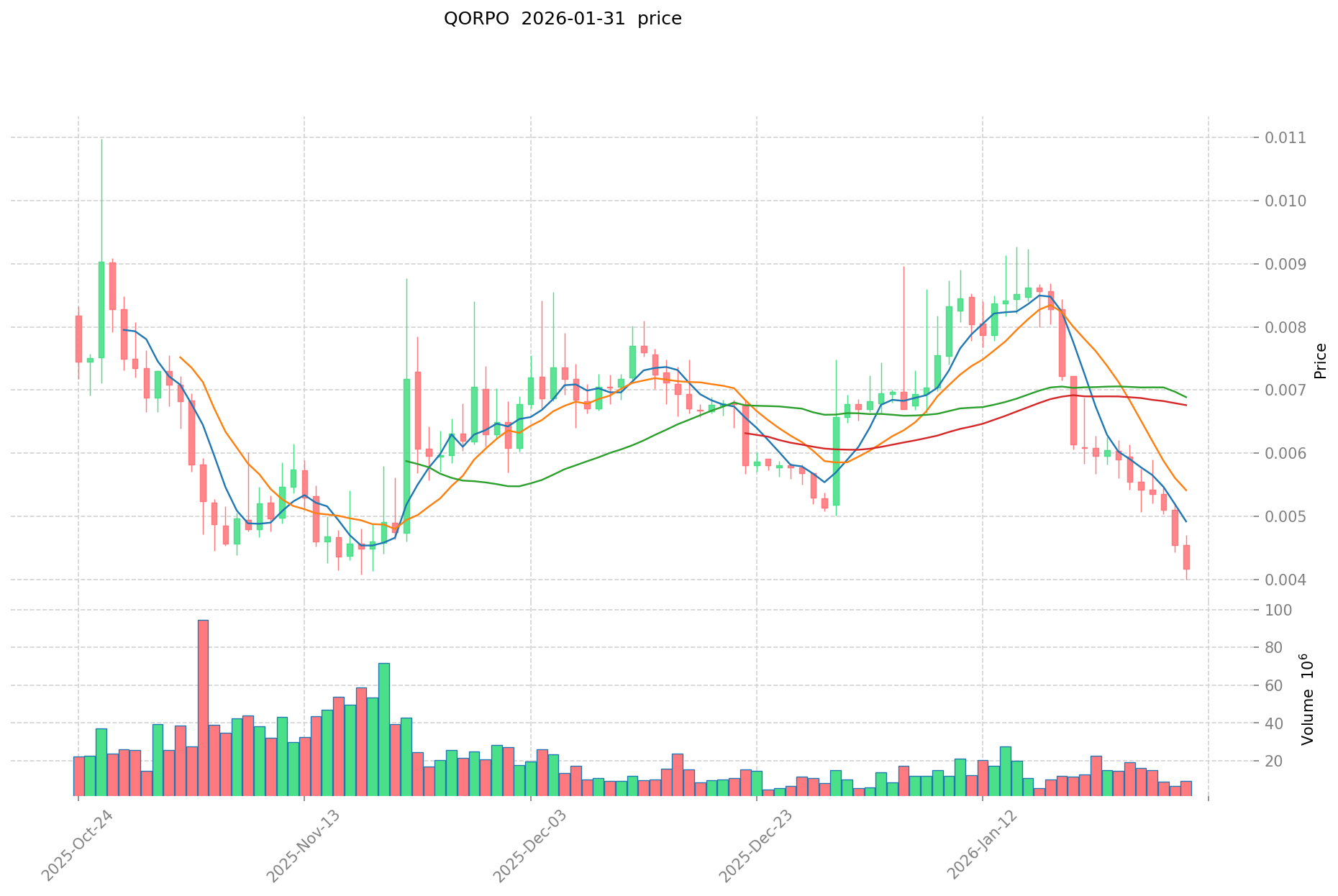
QORPO vs GRT Historical Price Trends
- 2024: QORPO experienced significant price movement following its launch in March 2024, reaching an all-time high of $0.963 in April 2024 before entering a downward trajectory.
- 2021: GRT was influenced by the broader cryptocurrency bull market, achieving its all-time high of $2.84 in February 2021 during the peak of the DeFi summer movement.
- Comparative Analysis: During the recent market cycle, QORPO declined from its peak of $0.963 to current levels around $0.004099, representing a decline of over 99%. In contrast, GRT decreased from its high of $2.84 to approximately $0.03132, showing a decline of around 98% from its peak, though GRT has maintained a longer operational history since its December 2020 launch.
Current Market Status (2026-01-31)
- QORPO current price: $0.004099
- GRT current price: $0.03132
- 24-hour trading volume: QORPO $47,533.84 vs GRT $166,859.89
- Market sentiment index (Fear & Greed Index): 20 (Extreme Fear)
View real-time prices:
- Check QORPO current price Market Price
- Check GRT current price Market Price

II. Core Factors Influencing QORPO vs GRT Investment Value
Supply Mechanism Comparison (Tokenomics)
- QORPO: The supply mechanism details are not extensively documented in available materials, though the token operates within a Web3 gaming ecosystem framework where tokenomics typically support platform utility and rewards distribution.
- GRT: Operates within a decentralized indexing protocol with token economics designed to incentivize network participants including indexers, curators, and delegators.
- 📌 Historical Pattern: Supply mechanisms influence price cycles through emission schedules, staking rewards, and demand-driven scarcity dynamics that emerge from platform adoption.
Institutional Adoption and Market Application
- Institutional Holdings: Both projects target different market segments—QORPO focuses on Web3 gaming infrastructure while GRT serves blockchain data indexing needs, attracting distinct institutional interest profiles.
- Enterprise Adoption: QORPO aims to build gaming platform utility with play-to-earn mechanisms, while GRT provides essential infrastructure for decentralized applications requiring blockchain data access.
- Regulatory Landscape: Both projects navigate evolving cryptocurrency regulations across jurisdictions, with compliance approaches varying based on their specific use cases and operational frameworks.
Technology Development and Ecosystem Building
- QORPO Technology: Focuses on Web3 gaming platform development with emphasis on game library expansion, play-to-earn mechanics, and blockchain ecosystem integration to support gaming experiences.
- GRT Technology: Develops decentralized trust network infrastructure enabling efficient blockchain data indexing and querying capabilities across multiple networks.
- Ecosystem Comparison: QORPO concentrates on gaming applications and entertainment sector integration, while GRT supports broader DeFi and dApp ecosystems through data infrastructure services.
Macroeconomic Factors and Market Cycles
- Inflation Environment Performance: The relationship between these assets and inflation dynamics depends on their adoption rates, utility demand, and broader cryptocurrency market correlations.
- Macroeconomic Monetary Policy: Interest rate changes and dollar index fluctuations impact cryptocurrency valuations through risk appetite shifts and capital flow patterns affecting both gaming and infrastructure tokens.
- Geopolitical Factors: Cross-border digital asset adoption and international regulatory developments influence market sentiment and usage patterns for blockchain-based platforms and protocols.
III. 2026-2031 Price Prediction: QORPO vs GRT
Short-term Forecast (2026)
- QORPO: Conservative $0.0032 - $0.0041 | Optimistic $0.0041 - $0.0051
- GRT: Conservative $0.018 - $0.031 | Optimistic $0.031 - $0.046
Medium-term Forecast (2028-2029)
- QORPO may enter a consolidation phase with projected price range of $0.0039 - $0.0069
- GRT may enter an expansion phase with projected price range of $0.027 - $0.065
- Key drivers: institutional capital inflows, ETF developments, ecosystem expansion
Long-term Forecast (2030-2031)
- QORPO: Baseline scenario $0.0042 - $0.0065 | Optimistic scenario $0.0065 - $0.011
- GRT: Baseline scenario $0.037 - $0.058 | Optimistic scenario $0.058 - $0.081
View detailed price predictions for QORPO and GRT
Disclaimer
QORPO:
| Year |
Predicted High Price |
Predicted Average Price |
Predicted Low Price |
Price Change |
| 2026 |
0.00507532 |
0.004093 |
0.00319254 |
0 |
| 2027 |
0.0066011904 |
0.00458416 |
0.0029338624 |
11 |
| 2028 |
0.006543429984 |
0.0055926752 |
0.003858945888 |
36 |
| 2029 |
0.00685689942896 |
0.006068052592 |
0.00400491471072 |
48 |
| 2030 |
0.008595093093938 |
0.00646247601048 |
0.004200609406812 |
57 |
| 2031 |
0.010615586218614 |
0.007528784552209 |
0.004592558576847 |
83 |
GRT:
| Year |
Predicted High Price |
Predicted Average Price |
Predicted Low Price |
Price Change |
| 2026 |
0.046339 |
0.0311 |
0.018038 |
0 |
| 2027 |
0.0542073 |
0.0387195 |
0.02090853 |
23 |
| 2028 |
0.053897544 |
0.0464634 |
0.041352426 |
48 |
| 2029 |
0.0652346136 |
0.050180472 |
0.02709745488 |
60 |
| 2030 |
0.08079055992 |
0.0577075428 |
0.041549430816 |
84 |
| 2031 |
0.0740964849552 |
0.06924905136 |
0.0373944877344 |
121 |
IV. Investment Strategy Comparison: QORPO vs GRT
Long-term vs Short-term Investment Strategies
- QORPO: Suitable for investors focused on Web3 gaming sector growth, early-stage project potential, and higher risk tolerance for emerging ecosystem developments. The token's positioning within the gaming infrastructure space may appeal to those seeking exposure to blockchain gaming adoption trends.
- GRT: Suitable for investors interested in blockchain infrastructure fundamentals, decentralized data indexing utility, and exposure to the broader DeFi and dApp ecosystem growth. The protocol's established operational history since 2020 may attract those preferring more mature project frameworks.
Risk Management and Asset Allocation
- Conservative investors: QORPO 15-20% vs GRT 25-30% (considering GRT's longer operational track record and established infrastructure utility)
- Aggressive investors: QORPO 30-40% vs GRT 35-45% (reflecting higher risk appetite for both gaming sector speculation and infrastructure protocol exposure)
- Hedging tools: stablecoin allocation for liquidity management, options strategies for downside protection, cross-asset portfolio diversification across different blockchain sectors
V. Potential Risk Comparison
Market Risks
- QORPO: Faces higher volatility associated with emerging gaming sector dynamics, limited operational history since March 2024 launch, relatively lower trading volumes ($47,533.84 as of January 31, 2026), and heightened sensitivity to Web3 gaming adoption cycles and market sentiment shifts.
- GRT: Experiences market volatility tied to broader blockchain infrastructure demand cycles, correlation with DeFi sector performance fluctuations, and price movements influenced by competing data indexing solutions and blockchain ecosystem development trends.
Technical Risks
- QORPO: Platform scalability challenges as gaming ecosystem expands, network stability requirements for supporting multiple gaming integrations, potential technical hurdles in AI technology implementation, and dependency on successful gaming product launches and user acquisition.
- GRT: Network performance considerations related to indexing efficiency across multiple blockchains, potential centralization concerns in node operation and curation activities, protocol upgrade execution risks, and ongoing competition from alternative blockchain data indexing solutions.
Regulatory Risks
- Global regulatory developments affect both assets differently based on their specific use cases. QORPO faces gaming-related regulations including play-to-earn mechanics scrutiny and digital asset gaming regulations across various jurisdictions. GRT encounters data protocol and infrastructure service regulations, potential securities classification considerations, and compliance requirements related to decentralized network operations. Both projects must navigate evolving cryptocurrency regulatory frameworks and cross-border digital asset policies that continue developing across major markets.
VI. Conclusion: Which Is the Better Buy?
📌 Investment Value Summary:
- QORPO advantages: Exposure to emerging Web3 gaming sector, potential for ecosystem expansion as blockchain gaming adoption increases, early-stage project positioning that may offer growth opportunities if the gaming platform successfully executes its roadmap and attracts user base.
- GRT advantages: Established blockchain infrastructure utility supporting DeFi and dApp ecosystems, longer operational history since December 2020 providing more performance data, essential data indexing services addressing ongoing blockchain infrastructure needs, relatively higher trading volumes indicating better liquidity conditions.
✅ Investment Recommendations:
- Beginner investors: Consider starting with smaller position sizes in GRT due to its more established operational framework and infrastructure utility, while limiting QORPO exposure given its shorter track record and higher volatility profile. Focus on understanding both projects' fundamental value propositions before increasing allocation.
- Experienced investors: Evaluate portfolio diversification opportunities by combining infrastructure exposure through GRT with gaming sector positioning via QORPO, adjusted according to individual risk tolerance and sector outlook assessments. Monitor ecosystem development progress and adoption metrics for both projects.
- Institutional investors: Assess infrastructure protocol exposure through GRT for blockchain data indexing utility within broader DeFi and dApp investment themes, while evaluating QORPO's gaming ecosystem potential as a tactical allocation within Web3 entertainment sector strategies, subject to thorough due diligence on tokenomics, governance structures, and regulatory compliance frameworks.
⚠️ Risk Warning: The cryptocurrency market exhibits significant volatility. This content does not constitute investment advice.
VII. FAQ
Q1: What are the main differences between QORPO and GRT in terms of use cases?
QORPO focuses on Web3 gaming ecosystem infrastructure while GRT provides blockchain data indexing services. QORPO serves as a gaming platform token launched in March 2024, aiming to integrate multiple gaming products with AI technology and play-to-earn mechanisms. In contrast, GRT operates as a decentralized protocol for indexing and querying blockchain data since December 2020, primarily serving DeFi applications and dApps that require efficient blockchain data access across multiple networks.
Q2: Which asset has shown better price stability historically?
GRT has demonstrated relatively better price stability compared to QORPO. While both assets have declined significantly from their all-time highs (QORPO down over 99% from $0.963, GRT down approximately 98% from $2.84), GRT benefits from a longer operational history since 2020 and higher trading volumes ($166,859.89 vs QORPO's $47,533.84 as of January 31, 2026). QORPO's limited track record since March 2024 contributes to its higher volatility profile.
Q3: What are the key risk factors investors should consider for each asset?
For QORPO, primary risks include: limited operational history, lower trading volumes creating liquidity concerns, high dependence on Web3 gaming adoption success, and platform scalability challenges. For GRT, main risks involve: competition from alternative blockchain data indexing solutions, potential centralization concerns in node operations, protocol upgrade execution risks, and correlation with broader DeFi sector performance fluctuations. Both assets face regulatory uncertainties as cryptocurrency frameworks continue evolving globally.
Q4: How do the supply mechanisms differ between QORPO and GRT?
GRT operates within a clearly defined decentralized indexing protocol with token economics designed to incentivize network participants including indexers, curators, and delegators through staking rewards and fee distributions. QORPO's supply mechanism operates within a Web3 gaming ecosystem framework, though detailed tokenomics documentation remains less extensively available. Understanding these supply dynamics is crucial as emission schedules, staking mechanisms, and demand-driven scarcity patterns significantly influence price cycles and long-term value proposition for both assets.
Q5: Which asset is more suitable for beginner cryptocurrency investors?
GRT may be more suitable for beginner investors due to several factors: longer operational history providing more performance data since December 2020, established infrastructure utility within the blockchain ecosystem, relatively higher trading volumes indicating better liquidity conditions, and clearer use case supporting DeFi and dApp development. Beginners should start with smaller position sizes and focus on understanding fundamental value propositions before increasing allocations, while limiting exposure to QORPO given its shorter track record and higher volatility profile.
Q6: What price performance can investors expect by 2031?
Based on current projections, QORPO's baseline scenario suggests prices ranging from $0.0042 to $0.0065 by 2031, with an optimistic scenario reaching $0.0065 to $0.011. GRT's baseline forecast indicates a range of $0.037 to $0.058, with optimistic projections between $0.058 and $0.081 by 2031. These predictions depend heavily on factors including institutional adoption rates, ecosystem expansion success, regulatory developments, and broader cryptocurrency market cycles. Investors should note that cryptocurrency markets exhibit significant volatility and these projections carry substantial uncertainty.
Q7: How do institutional adoption patterns differ between these two assets?
QORPO and GRT target distinctly different institutional segments. QORPO focuses on attracting gaming industry participants, Web3 entertainment platforms, and investors interested in blockchain gaming infrastructure development. GRT appeals to institutions requiring blockchain data infrastructure services, DeFi protocol developers, and investors seeking exposure to fundamental blockchain technology layers. GRT's established operational framework and essential infrastructure utility may attract more conservative institutional capital, while QORPO's gaming sector positioning appeals to institutions with higher risk tolerance and specific interest in Web3 entertainment ecosystem growth.
Q8: What portfolio allocation strategy should investors consider for these assets?
Portfolio allocation should align with individual risk tolerance levels. Conservative investors might consider QORPO allocation of 15-20% versus GRT allocation of 25-30%, reflecting GRT's longer operational track record and established utility. Aggressive investors with higher risk appetite could allocate 30-40% to QORPO and 35-45% to GRT, balancing gaming sector speculation with infrastructure protocol exposure. Both investor types should implement risk management through stablecoin reserves for liquidity, options strategies for downside protection, and cross-asset diversification across different blockchain sectors to mitigate concentration risk.
* The information is not intended to be and does not constitute financial advice or any other recommendation of any sort offered or endorsed by Gate.