This comprehensive analysis compares QUACK and ADA across multiple dimensions including historical price trends, market liquidity, tokenomics, and investment potential. QUACK, a community-driven deflationary meme token launched in 2021, currently trades at $0.0000000001672 with lower trading volume, appealing to risk-tolerant investors seeking speculative opportunities. ADA, Cardano's established third-generation blockchain platform since 2017, trades at $0.3504 with significantly higher liquidity at $2,505,033.46 daily volume. The article explores price predictions through 2031, provides risk assessments for both assets, and offers tailored investment strategies for conservative, aggressive, and institutional investors. Key findings reveal ADA's superior liquidity profile and established ecosystem advantages, while QUACK presents higher volatility characteristics, helping investors make informed decisions based on their risk tolerance and investment objectives.
Introduction: Investment Comparison Between QUACK and ADA
In the cryptocurrency market, the comparison between QUACK vs ADA remains a topic that investors cannot overlook. Both assets demonstrate notable differences in market cap ranking, application scenarios, and price performance, representing distinct positioning within the crypto asset landscape.
RichQUACK (QUACK): Launched in 2021, this deflationary token has gained market attention through its reflection mechanism and automated liquidity protocol, positioning itself as a community-driven meme token with deflationary tokenomics.
Cardano (ADA): Since its inception in 2017, Cardano has been recognized as a third-generation blockchain platform, representing one of the cryptocurrencies with substantial trading volume and market capitalization globally, focusing on smart contract capabilities and scalability.
This article will comprehensively analyze the investment value comparison between QUACK vs ADA through the dimensions of historical price trends, supply mechanisms, institutional adoption, technological ecosystems, and future predictions, attempting to address the question investors care about most:
"Which represents a more suitable investment consideration based on current market conditions?"
I. Historical Price Comparison and Current Market Status
RichQUACK (QUACK) and Cardano (ADA) Historical Price Trends
-
2021: QUACK reached its all-time high of $0.000000015463 in November 2021 during the broader cryptocurrency market rally. The token subsequently experienced significant price volatility.
-
2021: ADA achieved its historical peak at $3.09 in September 2021, driven by the anticipation and launch of smart contract functionality on the Cardano network.
-
Comparative Analysis: During the 2021-2026 market cycle, QUACK declined from its peak of $0.000000015463 to the current level of $0.0000000001672, representing a substantial decrease. Meanwhile, ADA experienced a decline from $3.09 to $0.3504, showing similar downward pressure but maintaining a different magnitude of correction relative to its initial valuation.
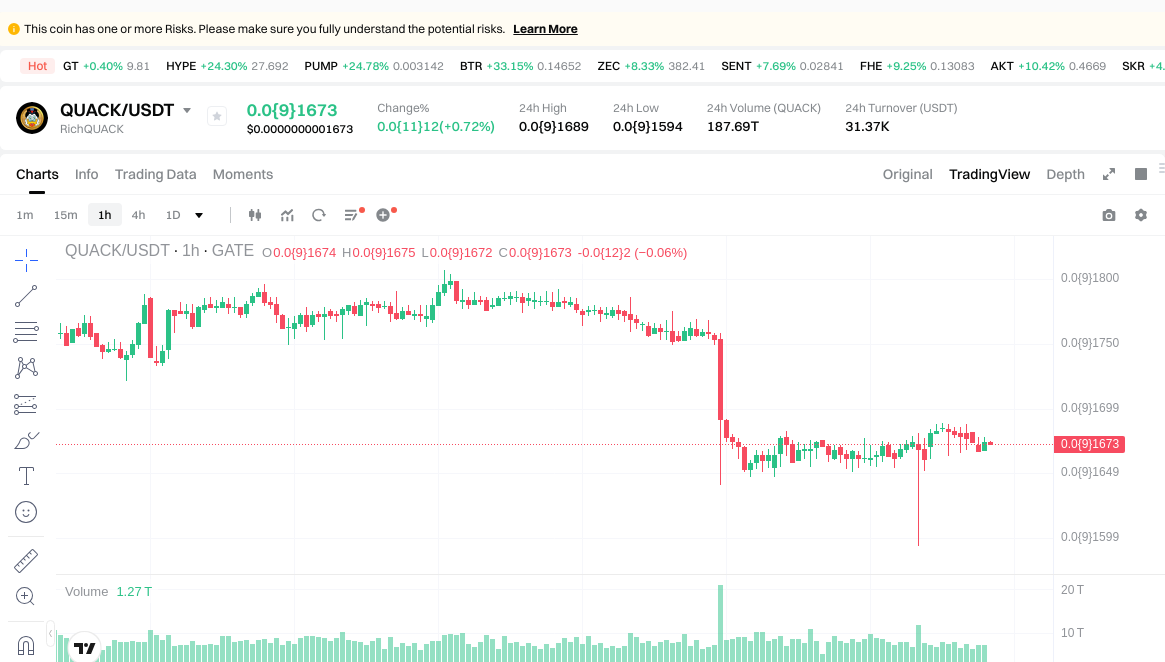
Current Market Status (2026-01-27)
- QUACK Current Price: $0.0000000001672
- ADA Current Price: $0.3504
- 24-Hour Trading Volume: QUACK recorded $31,391.16, while ADA demonstrated significantly higher liquidity with $2,505,033.46 in trading volume
- Market Sentiment Index (Fear & Greed Index): 29 (Fear)
View real-time prices:

II. Core Factors Influencing QUACK vs ADA Investment Value
Supply Mechanism Comparison (Tokenomics)
- QUACK: The supply mechanism details were not available in the provided materials.
- ADA: The supply mechanism details were not available in the provided materials.
- 📌 Historical Pattern: Supply mechanisms can influence price cycles through scarcity dynamics and inflation rates, though specific historical data for these tokens was not available in the materials.
Institutional Adoption and Market Application
- Institutional Holdings: Information regarding institutional preference between QUACK and ADA was not available in the provided materials.
- Enterprise Adoption: Comparative data on QUACK and ADA applications in cross-border payments, settlements, and investment portfolios was not available in the provided materials.
- National Policies: Specific regulatory attitudes of different countries toward QUACK and ADA were not available in the provided materials.
Technology Development and Ecosystem Building
- QUACK Technology Upgrades: Details on technology upgrades and their potential impact were not available in the provided materials.
- ADA Technology Development: Information on technology development and potential impact was not available in the provided materials.
- Ecosystem Comparison: Comparative data on DeFi, NFT, payment systems, and smart contract implementations was not available in the provided materials.
Macroeconomic Environment and Market Cycles
- Performance in Inflationary Environment: Comparative analysis of anti-inflation properties between QUACK and ADA was not available in the provided materials.
- Macroeconomic Monetary Policy: Specific impacts of interest rates and the US Dollar Index on both cryptocurrencies were not available in the provided materials.
- Geopolitical Factors: Information on cross-border transaction demand and international situation impacts was not available in the provided materials.
III. 2026-2031 Price Prediction: QUACK vs ADA
Short-term Prediction (2026)
- QUACK: Conservative 0.000000000130572 - 0.0000000001674 | Optimistic 0.000000000130572 - 0.000000000220968
- ADA: Conservative 0.294336 - 0.3504 | Optimistic 0.294336 - 0.501072
Mid-term Prediction (2028-2029)
- QUACK may enter a gradual adjustment phase, with estimated price range of 0.000000000207223 - 0.000000000320016
- ADA may enter a moderate growth phase, with estimated price range of 0.339737328 - 0.864170427672
- Key drivers: institutional capital inflows, ETF developments, ecosystem expansion
Long-term Prediction (2030-2031)
- QUACK: Baseline scenario 0.000000000151404 - 0.000000000291162 | Optimistic scenario 0.000000000177754 - 0.000000000358741
- ADA: Baseline scenario 0.590368757296953 - 0.722075290236 | Optimistic scenario 0.67153001991948 - 1.116039568588761
View detailed price predictions for QUACK and ADA
Disclaimer
QUACK:
| Year |
Predicted High Price |
Predicted Average Price |
Predicted Low Price |
Price Change |
| 2026 |
0.000000000220968 |
0.0000000001674 |
0.000000000130572 |
0 |
| 2027 |
0.000000000289334 |
0.000000000194184 |
0.000000000147579 |
16 |
| 2028 |
0.000000000282858 |
0.000000000241759 |
0.00000000021033 |
44 |
| 2029 |
0.000000000320016 |
0.000000000262308 |
0.000000000207223 |
56 |
| 2030 |
0.000000000355218 |
0.000000000291162 |
0.000000000151404 |
74 |
| 2031 |
0.000000000358741 |
0.00000000032319 |
0.000000000177754 |
93 |
ADA:
| Year |
Predicted High Price |
Predicted Average Price |
Predicted Low Price |
Price Change |
| 2026 |
0.501072 |
0.3504 |
0.294336 |
0 |
| 2027 |
0.54494208 |
0.425736 |
0.31078728 |
21 |
| 2028 |
0.6746212656 |
0.48533904 |
0.339737328 |
38 |
| 2029 |
0.864170427672 |
0.5799801528 |
0.533581740576 |
65 |
| 2030 |
0.89537335989264 |
0.722075290236 |
0.67153001991948 |
105 |
| 2031 |
1.116039568588761 |
0.80872432506432 |
0.590368757296953 |
130 |
IV. Investment Strategy Comparison: QUACK vs ADA
Long-term vs Short-term Investment Strategies
-
QUACK: May appeal to investors with higher risk tolerance seeking exposure to community-driven meme tokens with deflationary mechanisms. The token's price volatility and lower liquidity ($31,391.16 in 24-hour trading volume) suggest it may be more suitable for speculative short-term positioning rather than long-term holdings.
-
ADA: May be considered by investors interested in established blockchain platforms with smart contract capabilities and broader ecosystem development. The significantly higher trading volume ($2,505,033.46) indicates greater market liquidity, potentially making it more accessible for both short-term trading and longer-term portfolio allocation strategies.
Risk Management and Asset Allocation
-
Conservative Investors: A potential allocation framework might consider QUACK: 5-10% vs ADA: 15-25% within a diversified crypto portfolio, reflecting the different risk profiles and market maturity levels of these assets.
-
Aggressive Investors: Those with higher risk appetite might consider QUACK: 15-25% vs ADA: 25-40%, though individual circumstances and risk tolerance should guide specific allocation decisions.
-
Hedging Tools: Stablecoin allocations, options strategies, and cross-asset diversification approaches may help manage volatility exposure across different market conditions.
V. Potential Risk Comparison
Market Risk
-
QUACK: The token has experienced substantial price decline from its peak of $0.000000015463 to the current $0.0000000001672, reflecting significant volatility characteristics. Lower trading volume may also contribute to increased price sensitivity and liquidity constraints during market stress.
-
ADA: While ADA has also declined from its peak of $3.09 to $0.3504, it maintains substantially higher trading volume and market liquidity. Price movements may be influenced by broader blockchain platform adoption trends and smart contract ecosystem developments.
Technical Risk
-
QUACK: Scalability considerations and network stability factors were not detailed in available materials.
-
ADA: Network expansion capabilities and potential technical challenges related to ongoing platform development were not specified in available materials.
Regulatory Risk
- Global regulatory developments may impact both assets differently based on their respective characteristics. Community-driven tokens like QUACK and established blockchain platforms like ADA may face varying regulatory scrutiny across different jurisdictions, though specific policy impacts were not detailed in available materials.
VI. Conclusion: Which Is the Better Buy?
📌 Investment Value Summary:
-
QUACK Characteristics: Community-driven deflationary token with reflection mechanism and automated liquidity protocol. The asset has shown substantial price volatility since its 2021 launch, currently trading at $0.0000000001672 with relatively lower market liquidity.
-
ADA Characteristics: Third-generation blockchain platform with smart contract functionality, representing one of the cryptocurrencies with notable trading volume globally. Current price of $0.3504 with significantly higher 24-hour trading volume ($2,505,033.46) indicates greater market depth.
✅ Investment Considerations:
-
Novice Investors: May want to prioritize understanding fundamental differences between meme tokens and established blockchain platforms before making allocation decisions. Starting with more liquid assets and smaller position sizes could help manage learning curve and risk exposure.
-
Experienced Investors: Could evaluate these assets within a broader portfolio context, considering factors such as risk-adjusted returns, liquidity requirements, and correlation with existing holdings. Technical analysis and on-chain metrics may provide additional insights for timing considerations.
-
Institutional Investors: May focus on assets with deeper liquidity profiles, established track records, and clearer regulatory frameworks. Due diligence on custody solutions, counterparty risks, and compliance requirements would be essential considerations.
⚠️ Risk Disclosure: The cryptocurrency market exhibits substantial volatility. This content does not constitute investment advice. Current market sentiment index shows 29 (Fear), indicating cautious market conditions. Investors should conduct independent research and consider their individual financial circumstances before making investment decisions.
VII. FAQ
Q1: What are the main differences between QUACK and ADA in terms of their fundamental purpose?
QUACK is a community-driven deflationary meme token launched in 2021 with a reflection mechanism and automated liquidity protocol, while ADA is a third-generation blockchain platform established in 2017 focusing on smart contract capabilities and scalability. QUACK operates primarily as a speculative asset with tokenomics designed around community engagement and deflationary mechanics, whereas Cardano (ADA) functions as the native token of a comprehensive blockchain infrastructure aimed at supporting decentralized applications, smart contracts, and enterprise-level solutions. This fundamental distinction reflects their different value propositions: QUACK appeals to investors seeking exposure to community-driven token dynamics, while ADA targets those interested in established blockchain platform utility.
Q2: How do the trading volumes of QUACK and ADA compare, and what does this indicate?
ADA demonstrates significantly higher trading volume at $2,505,033.46 compared to QUACK's $31,391.16 in 24-hour trading volume as of January 27, 2026. This substantial difference indicates that ADA possesses considerably greater market liquidity and deeper order books, making it easier for investors to enter and exit positions without significant price impact. The higher liquidity of ADA suggests broader market participation, institutional interest, and more stable price discovery mechanisms, while QUACK's lower trading volume may result in wider bid-ask spreads and increased vulnerability to price volatility during periods of buying or selling pressure.
Q3: What has been the price performance of QUACK and ADA since their respective peaks?
QUACK has declined from its all-time high of $0.000000015463 in November 2021 to the current price of $0.0000000001672, representing a decline of approximately 98.9%. ADA has decreased from its historical peak of $3.09 in September 2021 to $0.3504, reflecting a decline of approximately 88.7%. While both assets have experienced substantial corrections from their peaks during the 2021-2026 market cycle, QUACK has shown more severe percentage-based depreciation. These price movements reflect broader cryptocurrency market cycles, with both assets subject to volatility, though the magnitude of QUACK's decline suggests higher risk characteristics compared to ADA's more moderate correction pattern.
Q4: What are the predicted price ranges for QUACK and ADA by 2031?
According to the baseline scenario, QUACK is predicted to trade between $0.000000000151404 and $0.000000000291162 by 2030-2031, while the optimistic scenario suggests a range of $0.000000000177754 to $0.000000000358741. For ADA, the baseline prediction estimates $0.590368757296953 to $0.722075290236, with the optimistic scenario projecting $0.67153001991948 to $1.116039568588761 by 2031. These predictions indicate that ADA is expected to show more substantial absolute price growth, with the optimistic scenario suggesting potential price increases of up to 130% by 2031 compared to 93% for QUACK. However, these projections should be viewed as estimates subject to significant market uncertainties and changing conditions.
Q5: How should conservative versus aggressive investors approach allocation between QUACK and ADA?
Conservative investors might consider a potential allocation framework of QUACK: 5-10% versus ADA: 15-25% within a diversified cryptocurrency portfolio, reflecting the different risk profiles and market maturity levels of these assets. Aggressive investors with higher risk tolerance might consider QUACK: 15-25% versus ADA: 25-40% allocation. These suggested ranges reflect the fact that QUACK's lower liquidity, higher volatility, and meme token characteristics present greater risk compared to ADA's more established platform status and deeper market liquidity. Individual circumstances, risk tolerance, investment timeline, and overall portfolio composition should guide specific allocation decisions, with proper risk management tools such as stablecoin reserves and diversification across multiple assets.
Q6: What is the current market sentiment, and how might it affect investment decisions?
The current market sentiment index stands at 29, indicating "Fear" conditions as of January 27, 2026. This fearful market environment typically suggests investor caution and risk aversion, which may result in reduced capital flows into more speculative assets like QUACK and potential preference for established platforms like ADA with greater liquidity profiles. During periods of market fear, investors often prioritize capital preservation and may reduce exposure to high-volatility assets, potentially leading to continued price pressure. However, contrarian investors sometimes view fearful market conditions as potential accumulation opportunities, though this approach requires careful risk assessment and should not be undertaken without thorough research and appropriate position sizing.
Q7: What are the key risks associated with investing in QUACK versus ADA?
QUACK presents several distinctive risks including its substantial historical price decline (approximately 98.9% from peak), lower trading volume indicating potential liquidity constraints, and classification as a meme token which may exhibit higher speculative volatility. ADA's risks, while different in nature, include exposure to broader blockchain platform adoption trends, smart contract ecosystem competition, and regulatory developments affecting established cryptocurrencies. Both assets face market risk from cryptocurrency sector volatility, technical risks related to their respective blockchain infrastructures, and regulatory uncertainties across different jurisdictions. QUACK's community-driven nature may subject it to different regulatory scrutiny compared to ADA's position as an established blockchain platform, though specific policy impacts remain uncertain. Investors should conduct independent research and consider these multifaceted risk factors before making investment decisions.
Q8: What factors might drive future price performance for QUACK and ADA?
For QUACK, future price performance may be influenced by community growth, adoption of its reflection mechanism and deflationary tokenomics, broader meme token market trends, and developments in its automated liquidity protocol. ADA's price trajectory could be affected by smart contract ecosystem expansion, enterprise adoption of Cardano blockchain, technological upgrades to network scalability and functionality, DeFi and NFT application growth, and institutional investment flows. Both assets may be impacted by macroeconomic factors including monetary policy changes, inflation dynamics, and overall risk appetite in financial markets. The mid-term prediction (2028-2029) suggests institutional capital inflows and ETF developments as potential key drivers, though ecosystem expansion specific to each platform's unique characteristics will likely play crucial roles in their respective price performance trajectories.
* The information is not intended to be and does not constitute financial advice or any other recommendation of any sort offered or endorsed by Gate.