This comprehensive analysis compares QUAI and ATOM, two distinct Layer-1 blockchain projects, evaluating their scalability, performance, and investment potential. QUAI, a proof-of-work blockchain launched in January 2025, merges currency with energy for decentralized commerce, while ATOM, operational since 2019, pioneered cross-chain interoperability via Tendermint consensus. The article examines historical price trends, tokenomics, institutional adoption, technical ecosystems, and risk profiles. Current market data shows QUAI at $0.1095 and ATOM at $2.398. Long-term forecasts through 2031 project different growth trajectories for each asset. Investment recommendations vary by investor profile, with conservative investors favoring ATOM's established infrastructure and experienced investors potentially balancing both assets. The analysis addresses scalability differences, technical risks, regulatory considerations, and provides actionable allocation strategies for diverse investor types seeking exposure to Lay
Introduction: Investment Comparison Between QUAI and ATOM
In the cryptocurrency market, the comparison between QUAI vs ATOM has become an increasingly relevant topic for investors. Both assets demonstrate notable differences in market capitalization ranking, application scenarios, and price performance, representing distinct positioning within the crypto asset landscape.
Quai Network (QUAI): Launched in 2025, this next-generation proof-of-work Layer 1 blockchain has gained market attention through its unique approach of merging currency with energy, positioning itself as the world's first decentralized energy dollar designed for real-world commerce.
Cosmos (ATOM): Since its launch in 2019, ATOM has been recognized as a pioneering interoperability solution, creating a parallel network of blockchains supported by Tendermint consensus, establishing itself as one of the foundational infrastructure projects in the blockchain ecosystem.
This article will provide a comprehensive analysis of the QUAI vs ATOM investment value comparison through the following dimensions: historical price trends, supply mechanisms, institutional adoption, technical ecosystems, and future projections. We aim to address the question that concerns investors most:
"Which is the better buy right now?"
By examining these factors objectively, readers will gain insights into how these two assets differ in their fundamental characteristics, market positioning, and potential risk-return profiles, enabling more informed investment decision-making within their respective risk tolerance and investment horizons.
I. Historical Price Comparison and Current Market Status
QUAI (Quai Network) and ATOM (Cosmos) Historical Price Trends
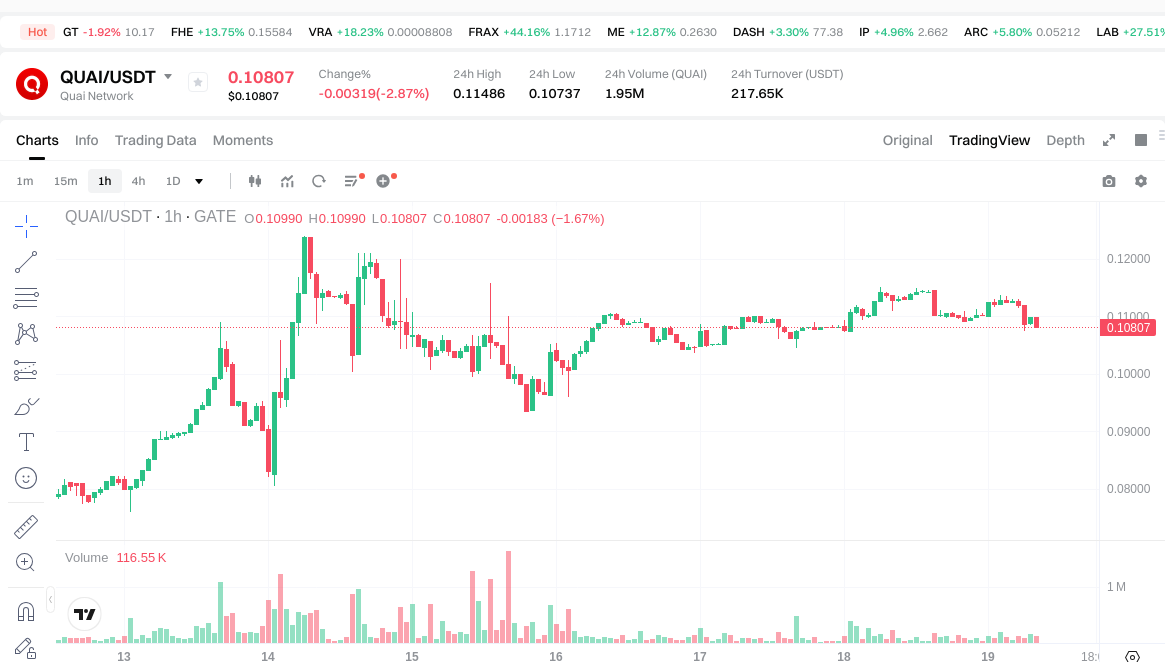
- 2025: QUAI experienced notable volatility following its initial listing in January 2025, with price movements ranging from a low of $0.01801 to a high of $0.37141 in February 2025.
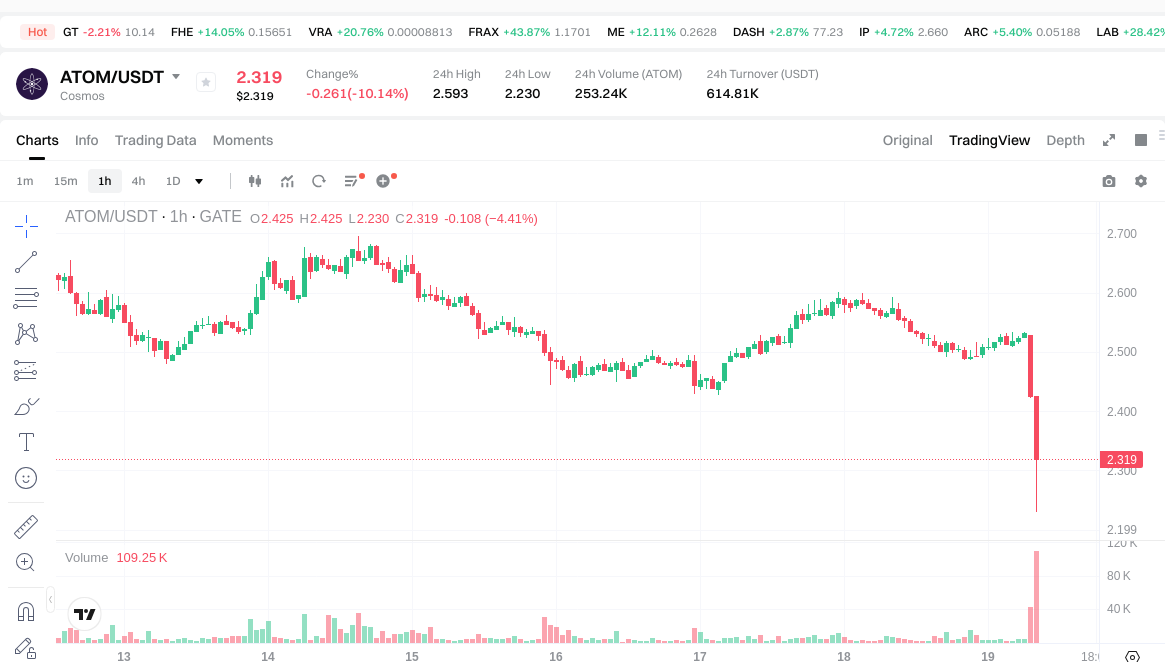
- 2022: ATOM reached a peak price of $44.45 in January 2022, driven by strong interest in cross-chain interoperability solutions, but subsequently entered a prolonged correction phase.
- Comparative Analysis: During different market cycles, QUAI showed significant price appreciation from its launch price of $0.10 to $0.37141, while ATOM declined from its peak of $44.45 to current levels around $2.40, reflecting divergent market trajectories.
Current Market Status (2026-01-19)
- QUAI Current Price: $0.1095
- ATOM Current Price: $2.398
- 24-Hour Trading Volume: QUAI $220,672.77 vs ATOM $528,528.43
- Market Sentiment Index (Fear & Greed Index): 49 (Neutral)
View Real-Time Prices:
II. Core Factors Influencing QUAI vs ATOM Investment Value
Tokenomics Comparison
- QUAI: The value of QUAI fluctuates based on market dynamics, with demand, scarcity, and utility serving as key determinants in the cryptocurrency ecosystem.
- ATOM: Investment value is closely tied to unique technological innovations and sustained research and development investments over the long term.
- 📌 Historical Pattern: Supply mechanisms and tokenomics structures play a role in shaping price cycles, though the specific impact varies based on market adoption and technological progress.
Institutional Adoption and Market Application
- Institutional Holdings: Market adoption remains a critical factor for both projects, though specific institutional preference data is not currently available in the reference materials.
- Enterprise Adoption: Both QUAI and ATOM rely on market acceptance and practical utility to drive value, with their respective applications depending on technological innovation and ecosystem development.
- Regulatory Landscape: Policy frameworks across different jurisdictions continue to influence market dynamics for both assets.
Technological Development and Ecosystem Building
- QUAI Technical Evolution: The project's value proposition centers on its unique functionality within the cryptocurrency space, with market demand and utility driving adoption.
- ATOM Technical Development: Focus on original, inimitable technologies and long-term R&D investments forms the foundation of its value proposition, marking a shift from rapid market entry strategies to sustained innovation.
- Ecosystem Comparison: Both projects depend on technological innovation and market adoption for ecosystem growth, with their respective strengths in different application areas yet to be fully determined.
Macroeconomic Environment and Market Cycles
- Inflation Response: The relative performance of both assets under inflationary conditions depends on multiple market factors including demand dynamics and utility perception.
- Monetary Policy Impact: Interest rate adjustments and currency market movements influence both assets, though the specific mechanisms vary based on market positioning and adoption levels.
- Geopolitical Considerations: Cross-border transaction demand and international developments may affect market sentiment and adoption patterns for both projects.
III. 2026-2031 Price Forecast: QUAI vs ATOM
Short-term Forecast (2026)
- QUAI: Conservative $0.0616 - $0.1081 | Optimistic $0.1081 - $0.1287
- ATOM: Conservative $1.6022 - $2.3220 | Optimistic $2.3220 - $3.2972
Mid-term Forecast (2028-2029)
- QUAI may enter a moderate growth phase, with projected prices ranging from $0.1172 to $0.1985 in 2028, potentially expanding to $0.1526 - $0.1808 by 2029
- ATOM may enter a consolidation and expansion phase, with projected prices ranging from $1.9378 to $4.2496 in 2028, potentially reaching $2.4477 - $5.3544 by 2029
- Key drivers: institutional capital inflows, ETF developments, ecosystem expansion
Long-term Forecast (2030-2031)
- QUAI: Baseline scenario $0.0953 - $0.1733 (2030) | Optimistic scenario $0.1042 - $0.2104 (2031)
- ATOM: Baseline scenario $3.9011 - $4.5895 (2030) | Optimistic scenario $2.8216 - $6.5483 (2031)
View detailed price predictions for QUAI and ATOM
Disclaimer
QUAI:
| Year |
Predicted High Price |
Predicted Average Price |
Predicted Low Price |
Price Change |
| 2026 |
0.1286866 |
0.10814 |
0.0616398 |
-1 |
| 2027 |
0.148016625 |
0.1184133 |
0.104203704 |
8 |
| 2028 |
0.198490294125 |
0.1332149625 |
0.117229167 |
21 |
| 2029 |
0.180779364860625 |
0.1658526283125 |
0.1525844180475 |
51 |
| 2030 |
0.220111315664934 |
0.173315996586562 |
0.095323798122609 |
58 |
| 2031 |
0.21048361205455 |
0.196713656125748 |
0.104258237746646 |
79 |
ATOM:
| Year |
Predicted High Price |
Predicted Average Price |
Predicted Low Price |
Price Change |
| 2026 |
3.29724 |
2.322 |
1.60218 |
-3 |
| 2027 |
3.9896604 |
2.80962 |
1.7419644 |
17 |
| 2028 |
4.24955025 |
3.3996402 |
1.937794914 |
41 |
| 2029 |
5.354433315 |
3.824595225 |
2.447740944 |
59 |
| 2030 |
6.0581588364 |
4.58951427 |
3.9010871295 |
91 |
| 2031 |
6.548318960436 |
5.3238365532 |
2.821633373196 |
122 |
IV. Investment Strategy Comparison: QUAI vs ATOM
Long-term vs Short-term Investment Strategies
- QUAI: May appeal to investors interested in emerging proof-of-work infrastructure projects with focus on energy-backed tokenomics and early-stage growth potential in decentralized commerce applications.
- ATOM: May suit investors seeking exposure to established interoperability protocols with multi-year track record, focusing on cross-chain infrastructure and ecosystem maturity.
Risk Management and Asset Allocation
- Conservative Investors: QUAI 20-30% vs ATOM 70-80% (prioritizing established projects with longer operational history)
- Aggressive Investors: QUAI 50-60% vs ATOM 40-50% (higher allocation to emerging projects with potential upside)
- Hedging Tools: stablecoin reserves for volatility management, options strategies for downside protection, diversified cross-asset portfolio construction
V. Potential Risk Comparison
Market Risks
- QUAI: Higher volatility exposure due to recent market entry (January 2025), limited historical price data, sensitivity to early-stage adoption cycles, and liquidity constraints in nascent trading markets.
- ATOM: Subject to broader interoperability sector sentiment, competitive pressures from alternative Layer 0 solutions, and sensitivity to ecosystem project performance across connected blockchains.
Technical Risks
- QUAI: Scalability verification in real-world conditions, network stability during early operational phases, proof-of-work energy efficiency concerns, and limited battle-tested infrastructure.
- ATOM: Validator centralization tendencies, security considerations across expanding ecosystem connections, technical complexity in cross-chain message passing, and dependency on Tendermint consensus robustness.
Regulatory Risks
- Evolving global regulatory frameworks may impact both assets differently: QUAI faces uncertainty regarding energy-backed token classification, while ATOM encounters scrutiny around cross-chain transaction compliance and potential securities law considerations in various jurisdictions.
VI. Conclusion: Which Is the Better Buy?
📌 Investment Value Summary:
- QUAI Strengths: Early-stage entry opportunity, innovative energy-backed value proposition, proof-of-work differentiation in predominantly proof-of-stake landscape, potential for significant appreciation from lower base price.
- ATOM Strengths: Established market presence since 2019, proven interoperability infrastructure, extensive ecosystem connections, longer operational track record providing more historical data for analysis.
✅ Investment Recommendations:
- Novice Investors: Consider starting with ATOM for its longer operational history and more established market presence, allocating smaller exploratory positions to QUAI while building understanding of both ecosystems.
- Experienced Investors: May explore balanced allocation strategies based on risk tolerance, considering ATOM for portfolio stability and QUAI for growth potential, with regular rebalancing based on market developments.
- Institutional Investors: Conduct thorough due diligence on both projects' technological roadmaps, team credentials, and ecosystem adoption metrics; consider phased entry strategies and continuous monitoring of regulatory developments affecting both assets.
⚠️ Risk Disclosure: Cryptocurrency markets exhibit extreme volatility. This content does not constitute investment advice. Investors should conduct independent research and consult qualified financial advisors before making investment decisions.
VII. FAQ
Q1: What is the main difference between QUAI and ATOM's underlying technology?
QUAI operates as a proof-of-work Layer 1 blockchain positioning itself as an energy-backed decentralized currency for real-world commerce, while ATOM functions as an interoperability protocol creating a network of connected blockchains using Tendermint consensus. The fundamental distinction lies in QUAI's focus on merging currency with energy through proof-of-work mechanics versus ATOM's specialization in cross-chain communication and blockchain interoperability infrastructure.
Q2: Which project has demonstrated more price stability historically?
ATOM has shown relatively more price stability due to its longer operational history since 2019, though it experienced significant volatility during the 2022 peak at $44.45 before declining to current levels around $2.40. QUAI, having launched in January 2025, exhibits higher volatility characteristic of newly listed assets, with price swings from $0.01801 to $0.37141 in its first month. The limited historical data for QUAI makes direct stability comparisons challenging, but ATOM's multi-year track record provides more reference points for price behavior analysis.
Q3: What are the projected price ranges for QUAI and ATOM by 2030?
Based on current forecasting models, QUAI's baseline scenario projects prices between $0.0953 and $0.1733 by 2030, while ATOM's baseline scenario suggests a range of $3.9011 to $4.5895 for the same period. These projections reflect different growth trajectories, with QUAI showing potential for percentage-based gains from a lower base price, and ATOM demonstrating steady appreciation from an established market position. However, these forecasts carry significant uncertainty and should not be interpreted as guaranteed outcomes.
Q4: How should conservative investors allocate between QUAI and ATOM?
Conservative investors may consider allocating 20-30% to QUAI and 70-80% to ATOM, prioritizing the more established project with longer operational history and proven infrastructure. This allocation strategy reflects ATOM's mature ecosystem and multi-year track record, while maintaining limited exposure to QUAI's early-stage growth potential. Risk management tools such as stablecoin reserves and regular portfolio rebalancing should complement this allocation approach.
Q5: What are the primary risk factors for investing in QUAI versus ATOM?
QUAI's primary risks include higher volatility due to recent market entry, limited historical price data, early-stage adoption uncertainties, liquidity constraints, and unproven scalability in real-world conditions. ATOM faces different risk factors including competitive pressures from alternative Layer 0 solutions, validator centralization tendencies, security considerations across expanding ecosystem connections, and sensitivity to broader interoperability sector sentiment. Both assets face evolving regulatory frameworks that may impact their classification and compliance requirements differently.
Q6: Which asset is more suitable for short-term trading strategies?
Neither asset presents an ideal profile for short-term trading without significant risk considerations. QUAI's extreme volatility since its January 2025 launch creates both opportunities and substantial downside risks for short-term traders, with 24-hour trading volume of $220,672.77 indicating moderate liquidity. ATOM's higher 24-hour trading volume of $528,528.43 and longer price history provide more technical analysis reference points, though short-term movements remain difficult to predict. Investors considering short-term strategies should employ strict risk management protocols and position sizing appropriate to their risk tolerance.
Q7: How do market cycles affect QUAI and ATOM differently?
QUAI, as a newly launched proof-of-work project, may experience amplified volatility during market cycles due to its early-stage status and lower liquidity, potentially showing sharper reactions to both bullish and bearish market sentiment. ATOM, with its established position in the interoperability sector since 2019, tends to move in correlation with broader smart contract platform trends and cross-chain infrastructure adoption cycles. The Fear & Greed Index currently stands at 49 (Neutral), suggesting neither extreme sentiment conditions that historically drive pronounced cycle-dependent behavior in both established and emerging crypto assets.
Q8: What institutional adoption factors should investors monitor for both projects?
For QUAI, investors should track enterprise adoption of its energy-backed commerce applications, partnership announcements with real-world commerce platforms, and integration progress with payment infrastructure providers. For ATOM, key monitoring points include new blockchain connections to the Cosmos Hub, validator network growth and decentralization metrics, inter-blockchain communication (IBC) transaction volumes, and adoption by major DeFi protocols utilizing Cosmos SDK. Both projects benefit from broader institutional cryptocurrency adoption trends, though specific institutional preference data between the two assets remains limited in current market intelligence.
* The information is not intended to be and does not constitute financial advice or any other recommendation of any sort offered or endorsed by Gate.