This comprehensive analysis compares QUAI and BNB, two distinct blockchain platforms serving different market segments. QUAI, launched in 2025, operates as a next-generation proof-of-work Layer 1 blockchain utilizing horizontal sharding for scalability, while BNB, since 2017, functions as Binance's ecosystem token with established utility across trading, DeFi, and NFT platforms. The article evaluates both assets through historical price trends, tokenomics, institutional adoption, technical architecture, and investment strategies. QUAI demonstrated 315.8% volatility over 30 days with lower liquidity, while BNB showed 7.77% moderate growth reflecting its mature market position. The analysis presents tailored investment recommendations for conservative, aggressive, and institutional investors, alongside comprehensive price forecasts through 2031 and detailed risk assessments.
Introduction: Investment Comparison Between QUAI and BNB
In the cryptocurrency market, the comparison between QUAI and BNB remains a recurring topic among investors. Both assets exhibit notable differences in market cap ranking, application scenarios, and price performance, representing distinct positioning within the crypto asset landscape.
QUAI (Quai Network): Launched in 2025, it positions itself as a next-generation proof-of-work Layer 1 blockchain designed to build a decentralized global monetary system by merging currency with energy, offering what is described as the world's first decentralized energy dollar for real-world commerce and DeFi solutions.
BNB (Binance Coin): Since its launch in 2017, BNB has established itself as the native token of the Binance ecosystem, serving multiple utility functions including transaction fee discounts (up to 50%), payment capabilities, and virtual gift purchases. It ranks as the 4th largest cryptocurrency by market capitalization.
This article will comprehensively analyze the investment value comparison between QUAI and BNB from perspectives including historical price trends, supply mechanisms, institutional adoption, technical ecosystems, and future projections, attempting to address investors' most pressing question:
"Which is the better buy right now?"
I. Historical Price Comparison and Current Market Status
QUAI and BNB Historical Price Trends
-
2025: QUAI experienced notable price movements following its mainnet launch, with the token initially trading around $0.10 during its early listing phase. The asset demonstrated volatility characteristic of newer Layer 1 projects, with prices fluctuating between its historical low of $0.01801 and peaks approaching higher levels.
-
2017-2025: BNB demonstrated substantial growth since its Initial Coin Offering in June 2017, when it launched at approximately $0.15. The token benefited from Binance exchange expansion, quarterly burn mechanisms, and ecosystem development. BNB achieved its all-time high of $1,369.99 in October 2025, reflecting increased adoption of BNB Chain and utility within the Binance ecosystem.
-
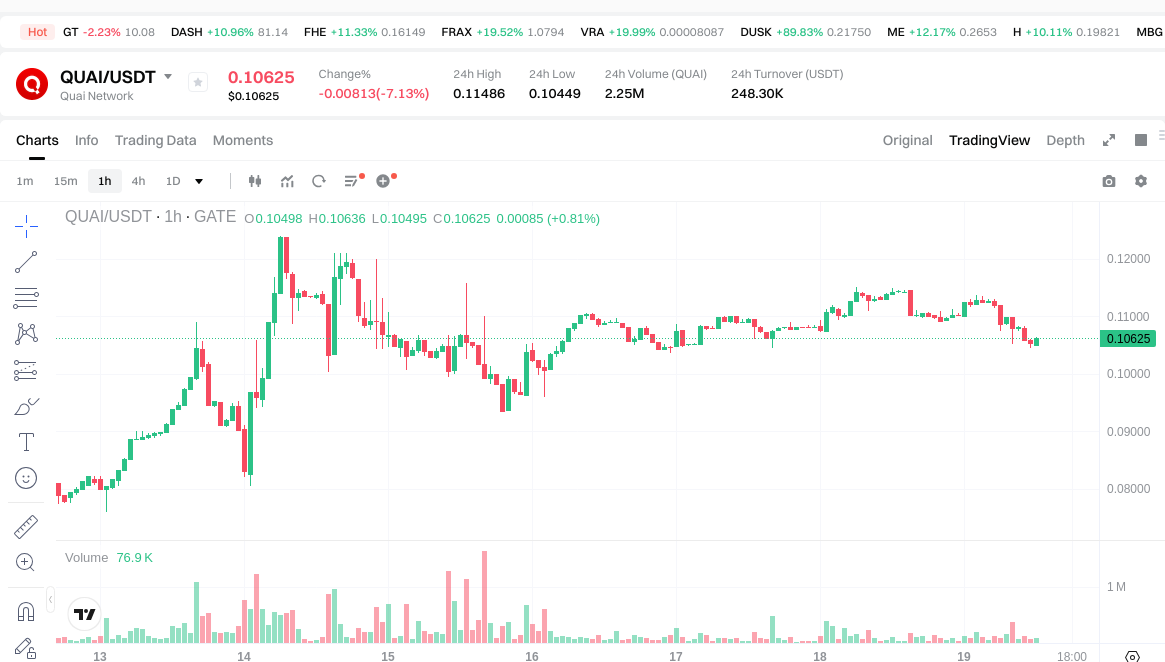
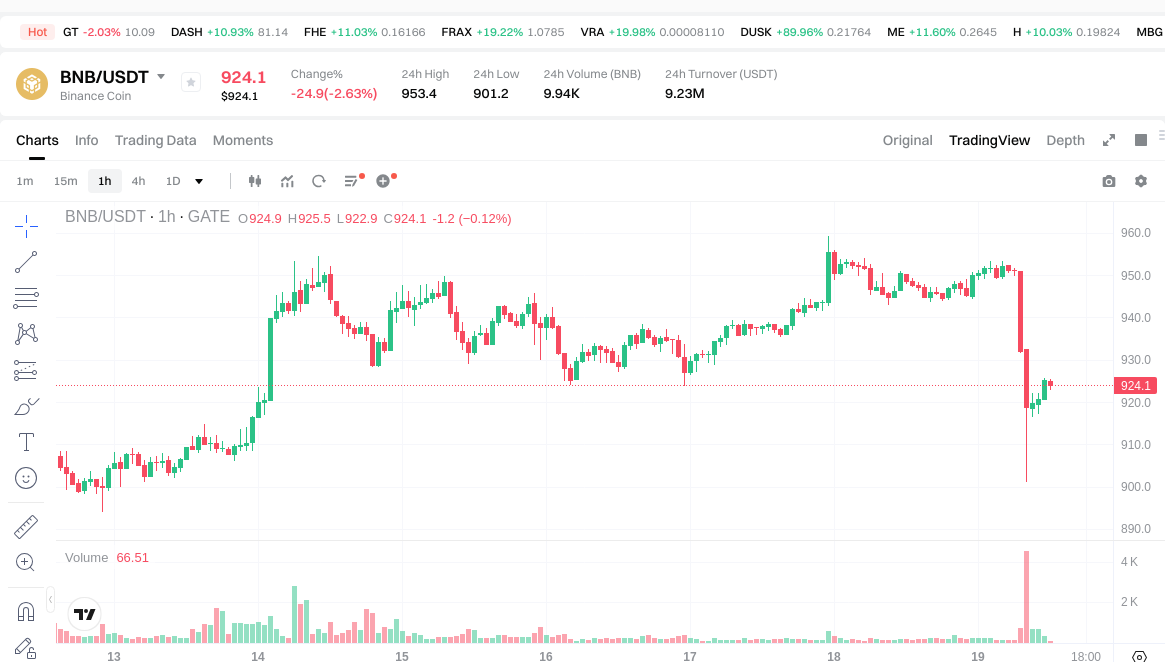
Comparative Analysis: During recent market cycles, QUAI showed significant price appreciation of approximately 315.8% over 30 days as of January 2026, moving from lower price levels to $0.106. In contrast, BNB displayed more moderate growth of 7.77% over the same 30-day period, maintaining stability around the $923.8 range, reflecting its established market position.
Current Market Status (January 19, 2026)
- QUAI Current Price: $0.106
- BNB Current Price: $923.8
- 24-Hour Trading Volume: QUAI recorded $246,595.63 compared to BNB's substantially higher $9,229,218.27
- Market Sentiment Index (Fear & Greed Index): 44 (Fear)
View real-time prices:
II. Core Factors Affecting QUAI vs BNB Investment Value
Tokenomics Comparison
- QUAI: Utilizes a Proof-of-Work consensus mechanism with merged mining functionality, designed to enhance throughput and security while maintaining decentralization principles.
- BNB: Functions within the Binance ecosystem with periodic token burn mechanisms to manage supply dynamics.
- 📌 Historical Pattern: Supply mechanisms and consensus models influence network security and scalability characteristics, which may correlate with adoption cycles.
Institutional Adoption and Market Application
- Institutional Holdings: BNB benefits from integration within the Binance exchange platform, which represents a significant trading venue in the digital asset sector.
- Enterprise Adoption: QUAI focuses on providing high-throughput infrastructure for decentralized applications, while BNB serves various functions within the Binance ecosystem including trading fee discounts and participation in token launches.
- Regulatory Landscape: Different jurisdictions maintain varying regulatory frameworks regarding exchange-based tokens and decentralized networks.
Technical Development and Ecosystem Building
- QUAI Technical Architecture: Implements horizontal sharding, proof-of-work shares, and self-organizing subnets to achieve throughput capacity while preserving decentralization. The network features dynamic and adaptive chain configurations with parallel processing capabilities.
- BNB Technical Evolution: Operates within a dual-chain architecture supporting smart contract functionality and cross-chain compatibility.
- Ecosystem Comparison: QUAI emphasizes scalable infrastructure for decentralized applications without compromising security, while BNB maintains integration across DeFi protocols, NFT marketplaces, and payment systems within its ecosystem.
Macroeconomic and Market Cycles
- Inflationary Environment Performance: Digital assets demonstrate varying correlations with traditional inflation hedges depending on market conditions and adoption trends.
- Macroeconomic Monetary Policy: Interest rate adjustments and currency index movements historically correlate with capital flows across digital asset categories.
- Geopolitical Factors: Cross-border transaction demands and international developments may influence adoption patterns across different blockchain networks.
III. 2026-2031 Price Prediction: QUAI vs BNB
Short-term Forecast (2026)
- QUAI: Conservative $0.088-$0.106 | Optimistic $0.106-$0.121
- BNB: Conservative $794-$924 | Optimistic $924-$970
Mid-term Forecast (2028-2029)
- QUAI may enter a consolidation phase with projected price range of $0.125-$0.198
- BNB may enter an expansion phase with projected price range of $698-$1,642
- Key drivers: institutional capital inflows, ETF developments, ecosystem growth
Long-term Forecast (2030-2031)
- QUAI: Base scenario $0.114-$0.175 | Optimistic scenario $0.175-$0.199
- BNB: Base scenario $1,102-$1,749 | Optimistic scenario $1,749-$2,326
View detailed price predictions for QUAI and BNB
Disclaimer
QUAI:
| Year |
Predicted High Price |
Predicted Average Price |
Predicted Low Price |
Price Change |
| 2026 |
0.121125 |
0.10625 |
0.0881875 |
0 |
| 2027 |
0.160299375 |
0.1136875 |
0.110276875 |
7 |
| 2028 |
0.165762059375 |
0.1369934375 |
0.124664028125 |
29 |
| 2029 |
0.198304850453125 |
0.1513777484375 |
0.122615976234375 |
42 |
| 2030 |
0.187080190406484 |
0.174841299445312 |
0.152111930517421 |
64 |
| 2031 |
0.199056819418488 |
0.180960744925898 |
0.114005269303315 |
70 |
BNB:
| Year |
Predicted High Price |
Predicted Average Price |
Predicted Low Price |
Price Change |
| 2026 |
969.675 |
923.5 |
794.21 |
0 |
| 2027 |
1306.29075 |
946.5875 |
530.089 |
2 |
| 2028 |
1419.3132975 |
1126.439125 |
698.3922575 |
21 |
| 2029 |
1642.0103125125 |
1272.87621125 |
891.013347875 |
37 |
| 2030 |
2040.42056663375 |
1457.44326188125 |
1165.954609505 |
57 |
| 2031 |
2326.079445962475 |
1748.9319142575 |
1101.827105982225 |
89 |
IV. Investment Strategy Comparison: QUAI vs BNB
Long-term vs Short-term Investment Strategies
-
QUAI: May appeal to investors focusing on emerging Layer 1 infrastructure with scalability features and proof-of-work consensus mechanisms. The asset demonstrated notable short-term price movements with approximately 315.8% growth over 30 days, though such volatility patterns typically characterize earlier-stage projects.
-
BNB: May appeal to investors seeking exposure to established exchange ecosystems with multiple utility functions including trading fee reductions and participation in token launch platforms. The asset showed more moderate 30-day growth of 7.77%, reflecting its positioning as a mature digital asset within the sector.
Risk Management and Asset Allocation
-
Conservative Investors: A potential allocation approach could consider 20-30% QUAI exposure versus 70-80% BNB exposure, reflecting risk tolerance considerations related to market capitalization differences and historical volatility patterns.
-
Aggressive Investors: A potential allocation approach could consider 50-60% QUAI exposure versus 40-50% BNB exposure, emphasizing growth potential characteristics while maintaining diversification across different blockchain architectures.
-
Hedging Instruments: Portfolio risk management may incorporate stablecoin positions, options strategies where available, and cross-asset diversification across different cryptocurrency categories.
V. Potential Risk Comparison
Market Risk
-
QUAI: As a newer Layer 1 project launched in 2025, the asset faces market risks associated with lower liquidity levels (24-hour trading volume of $246,595.63) and price volatility characteristic of emerging blockchain networks. Market sentiment shifts and adoption pace may significantly influence price dynamics.
-
BNB: While benefiting from integration within an established trading platform, the asset faces market risks related to competitive dynamics among exchange tokens and broader cryptocurrency market cycles. Trading volume of $9,229,218.27 indicates higher liquidity, though price movements remain correlated with overall digital asset market trends.
Technical Risk
-
QUAI: Technical considerations include network scalability performance under increasing transaction loads, proof-of-work security model effectiveness, and the implementation stability of horizontal sharding mechanisms and self-organizing subnets.
-
BNB: Technical considerations include smart contract security within the dual-chain architecture, cross-chain bridge vulnerabilities, and network congestion management during periods of high activity.
Regulatory Risk
- Different jurisdictions maintain varying regulatory frameworks regarding exchange-based tokens versus decentralized Layer 1 networks. Exchange-integrated tokens may face heightened scrutiny related to platform operations and securities classifications, while proof-of-work networks encounter different regulatory considerations related to energy consumption and mining activities. Regulatory developments in major markets could differentially impact these assets based on their distinct operational models.
VI. Conclusion: Which Is the Better Buy?
📌 Investment Value Summary:
-
QUAI Characteristics: Represents emerging Layer 1 infrastructure emphasizing scalability through horizontal sharding and proof-of-work consensus, demonstrated notable short-term price appreciation, focuses on decentralized application support with parallel processing capabilities.
-
BNB Characteristics: Represents established exchange ecosystem integration with multiple utility functions, maintains position as 4th largest cryptocurrency by market capitalization, benefits from periodic token burn mechanisms and diverse application scenarios including DeFi protocols and NFT marketplaces.
✅ Investment Considerations:
-
Beginning Investors: May consider starting with smaller position sizes in established assets with higher liquidity levels while conducting thorough research on technical fundamentals, tokenomics, and ecosystem development trajectories before allocation decisions.
-
Experienced Investors: May evaluate portfolio diversification across different blockchain architectures and consensus mechanisms, considering factors including technical differentiation, adoption metrics, and correlation patterns with broader cryptocurrency market cycles.
-
Institutional Participants: May assess regulatory clarity considerations, liquidity depth for position sizing requirements, custody solution availability, and alignment with institutional investment mandates regarding proof-of-work versus exchange-integrated digital assets.
⚠️ Risk Disclosure: Cryptocurrency markets demonstrate substantial volatility characteristics. This analysis does not constitute investment advice. Participants should conduct independent research and consult appropriate financial professionals before making allocation decisions.
VII. FAQ
Q1: What are the main differences between QUAI and BNB's technical architecture?
QUAI operates as a proof-of-work Layer 1 blockchain utilizing horizontal sharding, self-organizing subnets, and merged mining to achieve high throughput while maintaining decentralization. BNB functions within Binance's dual-chain architecture supporting smart contract functionality and cross-chain compatibility, integrated with the exchange ecosystem.
Q2: Which asset demonstrates higher short-term volatility?
QUAI exhibits significantly higher short-term volatility with approximately 315.8% growth over 30 days as of January 2026, compared to BNB's more moderate 7.77% increase during the same period. This volatility difference reflects QUAI's status as a newer Layer 1 project versus BNB's established market position as the 4th largest cryptocurrency.
Q3: How do the liquidity levels compare between QUAI and BNB?
BNB demonstrates substantially higher liquidity with 24-hour trading volume of $9,229,218.27 compared to QUAI's $246,595.63. This liquidity disparity reflects BNB's integration within a major trading platform and mature market presence versus QUAI's emerging status since its 2025 mainnet launch.
Q4: What portfolio allocation strategies are suggested for different investor types?
Conservative investors might consider 20-30% QUAI exposure versus 70-80% BNB allocation, while aggressive investors could evaluate 50-60% QUAI versus 40-50% BNB exposure. These considerations reflect risk tolerance differences related to market capitalization, historical volatility patterns, and investment time horizons.
Q5: What regulatory considerations differentiate QUAI and BNB?
BNB faces regulatory scrutiny related to exchange-integrated tokens and potential securities classifications, while QUAI encounters considerations related to proof-of-work energy consumption and decentralized network operations. Jurisdictional regulatory frameworks vary significantly in their treatment of exchange-based tokens versus Layer 1 blockchain networks.
Q6: What are the projected price ranges for 2030-2031?
QUAI projections for 2030-2031 range from $0.114-$0.175 (base scenario) to $0.175-$0.199 (optimistic scenario), while BNB forecasts range from $1,102-$1,749 (base scenario) to $1,749-$2,326 (optimistic scenario). These projections incorporate factors including institutional adoption, ecosystem development, and broader cryptocurrency market cycles.
Q7: What are the primary use cases for each token?
QUAI focuses on providing scalable infrastructure for decentralized applications through horizontal sharding and parallel processing capabilities, positioning itself as infrastructure for a decentralized monetary system. BNB serves multiple utility functions within the Binance ecosystem including trading fee discounts (up to 50%), participation in token launches, payment capabilities, and integration across DeFi protocols and NFT marketplaces.
Q8: How do the supply mechanisms differ between QUAI and BNB?
QUAI utilizes a proof-of-work consensus mechanism with merged mining functionality designed to enhance throughput and security while maintaining decentralization principles. BNB implements periodic token burn mechanisms to manage supply dynamics within the Binance ecosystem, reducing circulating supply over time to potentially support token value appreciation.
* The information is not intended to be and does not constitute financial advice or any other recommendation of any sort offered or endorsed by Gate.