This comprehensive analysis compares Rarible (RARI) and Sandbox (SAND) tokens across multiple dimensions for investors navigating the 2024 metaverse sector. RARI serves as a governance token for NFT marketplace infrastructure, while SAND functions as a utility token within gaming ecosystems. The article examines historical price performance, tokenomics, institutional adoption, and technological development before presenting detailed price predictions through 2031. It addresses market risks including NFT sector volatility and regulatory uncertainties, while offering tailored investment strategies for conservative, aggressive, and institutional participants. With real-time price data from Gate and risk analysis frameworks, this guide enables informed decision-making between these divergent metaverse investment opportunities.
Introduction: Comparative Analysis of RARI and SAND Investment Prospects
In the cryptocurrency market, the comparison between Rarible (RARI) and Sandbox (SAND) presents distinct perspectives for investors examining market capitalization rankings, application scenarios, and price performance trajectories. These tokens represent divergent positions within the crypto asset landscape.
Rarible (RARI): Launched in July 2020, RARI serves as the governance token for infrastructure supporting onchain commerce. The token powers a cross-chain rewards program on the Rarible NFT marketplace, where transaction fees are collected and distributed to users in RARI. Token holders can participate in ecosystem governance through staking mechanisms while earning yield.
Sandbox (SAND): Introduced in August 2020, SAND functions as the utility token within a virtual game world built on Ethereum. The platform enables players to create, own, and monetize digital assets and gaming experiences, establishing itself within the metaverse and gaming sectors.
This article examines historical price movements, supply mechanisms, ecosystem development, and analytical perspectives to provide a comprehensive comparison of RARI versus SAND investment considerations. The analysis addresses fundamental questions relevant to market participants:
"What factors differentiate these two tokens in the current market environment?"
I. Historical Price Comparison and Current Market Status
Historical Price Trends of RARI (Coin A) and SAND (Coin B)
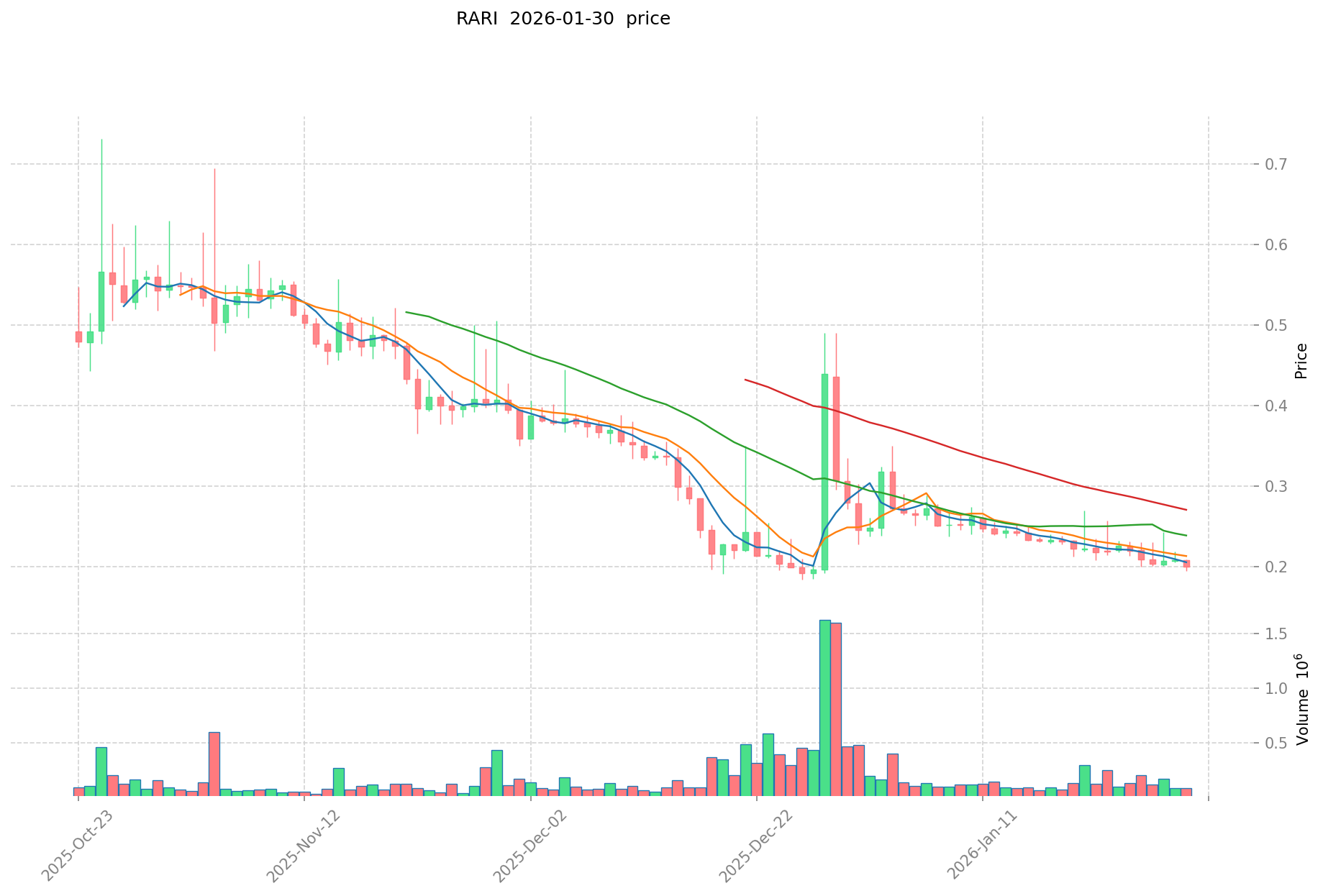
- 2021: RARI experienced significant price volatility, reaching an all-time high of $46.70 on March 30, 2021, during the broader NFT market boom.
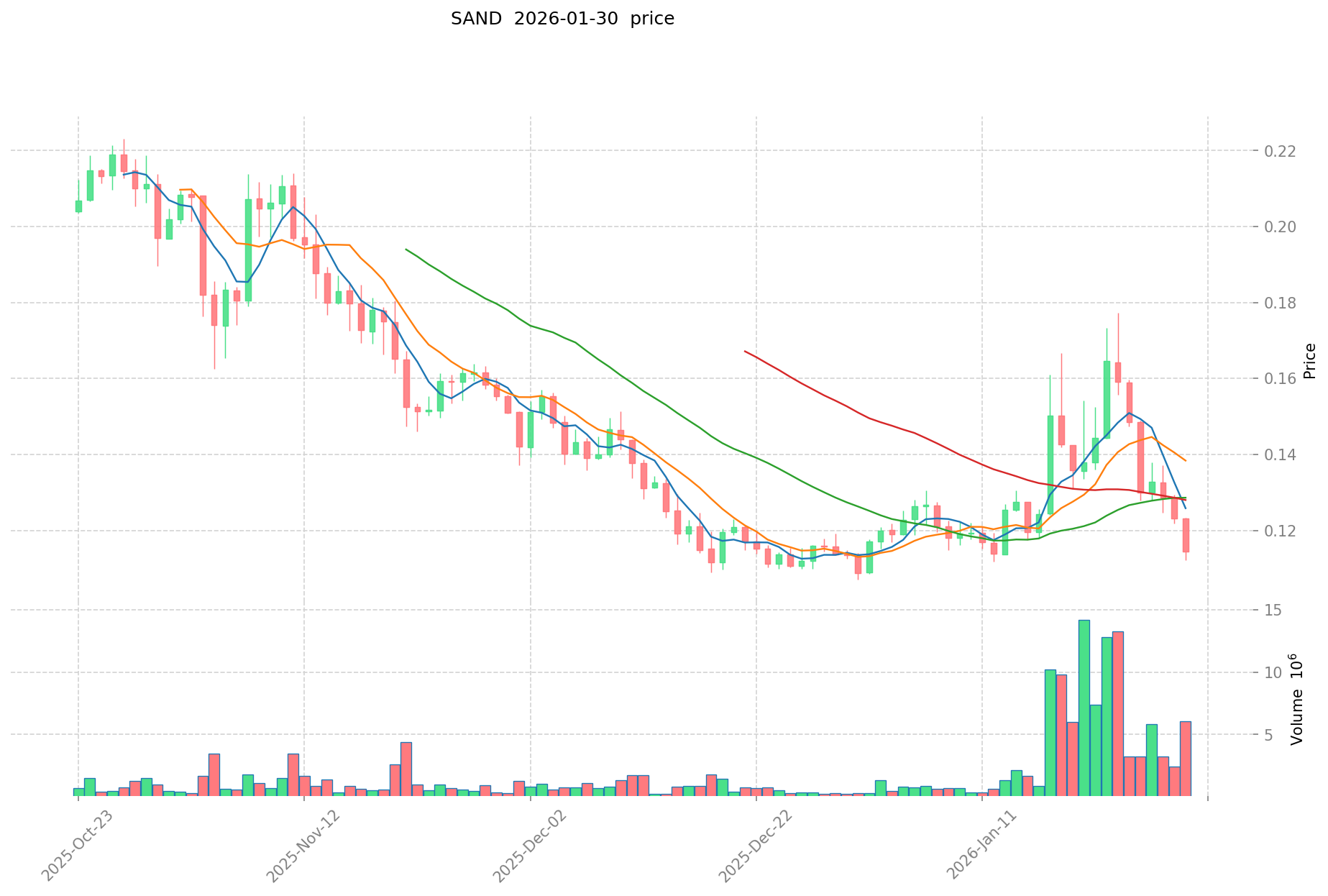
- 2021: SAND benefited from the metaverse narrative surge, achieving its all-time high of $8.40 on November 25, 2021.
- Comparative Analysis: During the 2021-2026 market cycle, RARI declined from its peak of $46.70 to a recent low of $0.183685 on January 30, 2026, representing a substantial correction. In contrast, SAND fell from $8.40 to $0.02897764 during November 2020, though its current price shows relative stabilization at higher levels compared to its historical low.
Current Market Status (2026-01-30)
- RARI Current Price: $0.1876
- SAND Current Price: $0.1132
- 24-Hour Trading Volume: RARI $19,734.85 vs SAND $703,855.96
- Market Sentiment Index (Fear & Greed Index): 16 (Extreme Fear)
Check real-time prices:
II. Core Factors Influencing RARI vs SAND Investment Value
Tokenomics Comparison
- RARI: Governance token of Rarible, an NFT digital collectibles and trading platform that launched liquidity mining. The token distribution mechanism primarily serves ecosystem governance and platform incentives.
- SAND: Native token of The Sandbox metaverse platform. Reference materials indicate SAND experienced significant growth, with one instance showing gains exceeding 2000%. The development team Animoca Brands partnered with Dapper Labs.
- 📌 Historical Pattern: Both tokens' value correlates strongly with NFT market cycles and metaverse sector development trends.
Institutional Adoption and Market Application
- Institutional Holdings: Reference materials suggest SAND attracted greater institutional attention, particularly through its development team's partnerships with established blockchain companies.
- Enterprise Adoption: Both tokens operate within NFT ecosystems. RARI focuses on NFT trading platform governance, while SAND emphasizes metaverse gaming and virtual land applications.
- Regulatory Environment: Materials note that in certain jurisdictions, NFT-related projects face regulatory considerations regarding digital collectibles versus financial speculation.
Technology Development and Ecosystem Building
- RARI Technology: Built on NFT trading infrastructure, supporting digital asset ownership verification and platform governance mechanisms.
- SAND Technology: Operates within metaverse gaming environments, integrating virtual world construction, digital asset trading, and user-generated content.
- Ecosystem Comparison: Materials indicate both tokens participate in broader metaverse and NFT categories. SAND shows stronger connections to gaming platforms, while RARI maintains closer ties to NFT trading marketplaces. Reference materials classify RARI under "metaverse trading platforms" and SAND under "metaverse games" and "metaverse collectibles."
Macroeconomic and Market Cycles
- Performance Trends: Reference materials suggest NFT and metaverse tokens experience heightened volatility during market speculation periods. Materials note that early project participation and community engagement significantly influence token value.
- Market Conditions: Both tokens face influence from broader cryptocurrency market cycles, investor sentiment toward NFT and metaverse sectors, and technological infrastructure development.
- Sector Dynamics: Materials emphasize that NFT market development depends on quality content creation, user adoption rates, and platform ecosystem maturity rather than singular macroeconomic factors.
III. 2026-2031 Price Prediction: RARI vs SAND
Short-term Prediction (2026)
- RARI: Conservative $0.155874 - $0.1878 | Optimistic $0.1878 - $0.277944
- SAND: Conservative $0.06226 - $0.1132 | Optimistic $0.1132 - $0.146028
Mid-term Prediction (2028-2029)
- RARI may enter a growth phase, with estimated price range of $0.2210421024 - $0.447136595712
- SAND may enter a consolidation phase, with estimated price range of $0.122821189488 - $0.173747048544
- Key drivers: institutional capital inflows, ETF developments, ecosystem expansion
Long-term Prediction (2030-2031)
- RARI: Baseline scenario $0.23865915796128 - $0.46974183471744 | Optimistic scenario $0.46974183471744 - $0.66233598695159
- SAND: Baseline scenario $0.10838221062624 - $0.19735268203584 | Optimistic scenario $0.19735268203584 - $0.23294087059968
View detailed price predictions for RARI and SAND
Disclaimer: Price predictions are based on historical data analysis and market trends. Cryptocurrency markets are highly volatile and subject to various risk factors. These projections should not be considered as investment advice. Past performance does not guarantee future results.
RARI:
| Year |
Predicted High Price |
Predicted Average Price |
Predicted Low Price |
Price Change |
| 2026 |
0.277944 |
0.1878 |
0.155874 |
0 |
| 2027 |
0.29341872 |
0.232872 |
0.20492736 |
24 |
| 2028 |
0.3578776896 |
0.26314536 |
0.2210421024 |
40 |
| 2029 |
0.447136595712 |
0.3105115248 |
0.301196179056 |
65 |
| 2030 |
0.56065960917888 |
0.378824060256 |
0.23865915796128 |
101 |
| 2031 |
0.66233598695159 |
0.46974183471744 |
0.446254742981568 |
150 |
SAND:
| Year |
Predicted High Price |
Predicted Average Price |
Predicted Low Price |
Price Change |
| 2026 |
0.146028 |
0.1132 |
0.06226 |
0 |
| 2027 |
0.15035224 |
0.129614 |
0.11406032 |
14 |
| 2028 |
0.1595807568 |
0.13998312 |
0.1301843016 |
23 |
| 2029 |
0.173747048544 |
0.1497819384 |
0.122821189488 |
32 |
| 2030 |
0.23294087059968 |
0.161764493472 |
0.10838221062624 |
42 |
| 2031 |
0.22103500388014 |
0.19735268203584 |
0.136173350604729 |
74 |
IV. Investment Strategy Comparison: RARI vs SAND
Long-term vs Short-term Investment Strategies
- RARI: May appeal to investors focused on NFT marketplace infrastructure and governance participation. The token's positioning within digital collectibles trading platforms suggests alignment with those monitoring NFT sector recovery and platform utility development.
- SAND: May appeal to investors interested in metaverse gaming ecosystems and virtual world monetization. The token's connection to gaming experiences and digital land ownership indicates relevance for participants tracking metaverse sector evolution.
Risk Management and Asset Allocation
- Conservative Investors: RARI 30% vs SAND 20%, with remaining allocation to stablecoins and established cryptocurrencies. This approach emphasizes capital preservation while maintaining measured exposure to NFT and metaverse sectors.
- Aggressive Investors: RARI 45% vs SAND 35%, with higher concentration in sector-specific tokens. This strategy accepts increased volatility in pursuit of potential sector growth opportunities.
- Hedging Tools: Stablecoin allocation for liquidity management, options strategies where available, cross-asset portfolio construction incorporating different cryptocurrency categories.
V. Potential Risk Comparison
Market Risks
- RARI: Subject to NFT marketplace activity fluctuations, trading volume variations on Rarible platform, and broader NFT sector sentiment shifts. Historical price movements demonstrate significant correlation with NFT market cycles.
- SAND: Faces exposure to metaverse gaming adoption rates, virtual land market dynamics, and gaming sector competitive pressures. Price performance shows sensitivity to metaverse narrative momentum and platform user engagement metrics.
Technical Risks
- RARI: Platform scalability considerations related to cross-chain infrastructure, network transaction processing capacity during high-volume periods, and smart contract security within governance mechanisms.
- SAND: Virtual world technical infrastructure requirements, platform performance optimization challenges, user-generated content moderation systems, and integration complexity with gaming ecosystems.
Regulatory Risks
- Global regulatory frameworks for NFT platforms and digital collectibles remain under development, with varying jurisdictional approaches potentially affecting both tokens differently. RARI faces considerations specific to NFT trading platforms, while SAND encounters regulatory perspectives on gaming tokens and virtual asset ownership. Policy developments regarding digital asset classification may influence both projects' operational parameters.
VI. Conclusion: Which Is the Better Buy?
📌 Investment Value Summary:
- RARI Characteristics: Governance participation in NFT marketplace infrastructure, exposure to digital collectibles trading sector, cross-chain rewards program positioning. Price projections suggest potential recovery from current levels with estimated ranges between $0.155874 - $0.66233598695159 through 2031.
- SAND Characteristics: Utility within established metaverse gaming platform, virtual land and asset monetization mechanisms, partnership network with blockchain gaming companies. Price projections indicate estimated ranges between $0.06226 - $0.23294087059968 through 2031.
✅ Investment Considerations:
- Novice Participants: Consider starting with smaller position sizes, prioritizing understanding of NFT marketplace mechanics (RARI) versus metaverse gaming platforms (SAND). Allocation decisions should reflect individual risk tolerance and sector familiarity.
- Experienced Participants: May evaluate portfolio positioning based on NFT sector recovery expectations versus metaverse gaming adoption trajectories. Analysis of ecosystem development metrics, platform user activity, and technological infrastructure progress provides relevant decision-making inputs.
- Institutional Participants: Could assess both tokens within broader digital asset portfolio construction, considering correlation patterns with cryptocurrency market cycles, sector-specific growth drivers, and liquidity characteristics for larger position management.
⚠️ Risk Disclosure: Cryptocurrency markets exhibit substantial volatility. This analysis presents information for educational purposes and does not constitute investment advice. Participants should conduct independent research and consult qualified financial advisors before making investment decisions.
VII. FAQ
Q1: What is the primary difference between RARI and SAND tokens?
RARI serves as a governance token for NFT marketplace infrastructure, while SAND functions as a utility token within a metaverse gaming platform. RARI holders participate in the governance of the Rarible NFT trading ecosystem and earn rewards through cross-chain transaction fee distributions. In contrast, SAND powers The Sandbox virtual world, enabling users to create, own, and monetize digital gaming experiences and virtual land. The fundamental distinction lies in their application focus: RARI concentrates on NFT trading platform governance, whereas SAND emphasizes metaverse gaming and virtual asset creation.
Q2: How have RARI and SAND performed historically compared to their all-time highs?
Both tokens have experienced substantial corrections from their peak values during 2021-2026. RARI reached an all-time high of $46.70 on March 30, 2021, during the NFT market boom, but declined to approximately $0.1876 as of January 30, 2026—representing a decline of over 99%. SAND achieved its peak of $8.40 on November 25, 2021, during the metaverse narrative surge, subsequently falling to around $0.1132—reflecting a similar magnitude of correction. These trajectories illustrate the significant volatility characteristic of NFT and metaverse sector tokens during market cycle transitions.
Q3: Which token shows stronger institutional adoption and partnership networks?
SAND demonstrates greater institutional attention and established partnership networks. Reference materials indicate that SAND's development team, Animoca Brands, has formed partnerships with prominent blockchain companies including Dapper Labs, suggesting stronger institutional backing within the gaming and metaverse sectors. RARI, focused on NFT marketplace governance, maintains connections primarily within digital collectibles trading infrastructure. The institutional adoption differential reflects their divergent sector positioning—SAND's gaming platform orientation versus RARI's marketplace governance focus.
Q4: What are the projected price ranges for RARI and SAND through 2031?
Price projections suggest different trajectories for each token through 2031. RARI's estimated range spans from a conservative $0.155874 in 2026 to an optimistic $0.66233598695159 by 2031, with mid-range scenarios projecting $0.46974183471744. SAND's projections indicate a range from $0.06226 in 2026 to $0.23294087059968 by 2031, with mid-range estimates around $0.19735268203584. These projections reflect historical data analysis and market trends, though cryptocurrency markets remain highly volatile and subject to numerous risk factors that may influence actual outcomes.
Q5: What trading volume differences exist between RARI and SAND?
SAND maintains significantly higher trading volume compared to RARI. As of January 30, 2026, SAND recorded 24-hour trading volume of $703,855.96, while RARI showed $19,734.85—a differential of approximately 35.7 times. This substantial volume disparity reflects SAND's broader market participation, greater liquidity depth, and wider institutional interest. Higher trading volume typically indicates stronger market activity and potentially lower execution slippage for position management, representing an important consideration for investment decisions.
Q6: Which token faces greater regulatory risks?
Both tokens face evolving regulatory considerations, though with different focal points. RARI encounters regulatory perspectives specific to NFT trading platforms and digital collectibles classification, particularly regarding distinctions between collectible assets and financial speculation instruments. SAND faces regulatory considerations related to gaming tokens, virtual asset ownership frameworks, and metaverse platform operations. Global regulatory frameworks for both NFT marketplaces and gaming tokens remain under development, with jurisdictional approaches varying significantly. Neither token demonstrates categorically greater regulatory risk; rather, they face distinct regulatory considerations aligned with their respective sector positioning.
Q7: What portfolio allocation strategies suit different investor profiles for RARI versus SAND?
Portfolio allocation strategies vary based on risk tolerance and investment objectives. Conservative investors might consider RARI allocation at 30% and SAND at 20% of their cryptocurrency portfolio, with remaining assets in stablecoins and established cryptocurrencies, emphasizing capital preservation while maintaining measured sector exposure. Aggressive investors could allocate RARI at 45% and SAND at 35%, accepting higher volatility for potential sector growth opportunities. Both strategies should incorporate hedging mechanisms including stablecoin liquidity reserves and cross-asset portfolio construction across different cryptocurrency categories to manage risk effectively.
Q8: What ecosystem development factors should investors monitor for these tokens?
For RARI, key monitoring factors include NFT marketplace transaction volumes on the Rarible platform, governance participation rates among token holders, cross-chain infrastructure development progress, and overall NFT sector sentiment indicators. For SAND, critical metrics encompass virtual land sales activity, user-generated content creation rates, active user engagement within The Sandbox platform, gaming partnership announcements, and metaverse sector adoption trajectories. Both tokens require monitoring of broader cryptocurrency market cycles, technological infrastructure advancements, and sector-specific competitive dynamics that influence ecosystem maturation and user adoption rates.
* The information is not intended to be and does not constitute financial advice or any other recommendation of any sort offered or endorsed by Gate.